Before Respan, we were doing closer to thousands of agent requests. After Respan, we crossed 4.4 million agent requests.

One Chowdhury
Co-founder and CEO of Octolane
About Octolane
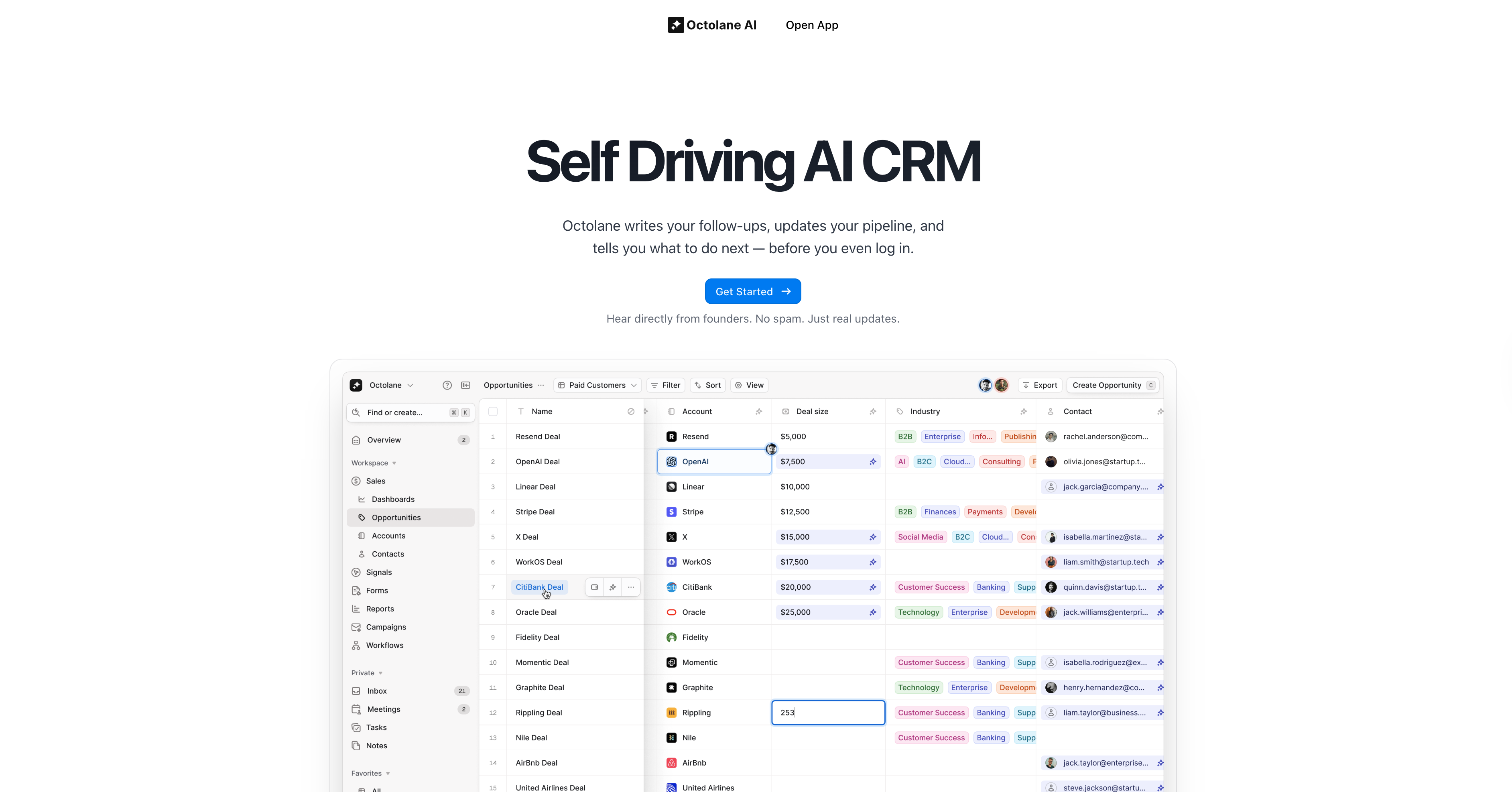
Octolane set out to eliminate sales busywork. Instead of reps manually logging notes, updating fields, or remembering follow-ups, Octolane automates it all. The CRM updates itself using email, calendar, and meeting data, and even recommends next actions.
After YC W24, Octolane grew fast. In April 2025, they raised a $2.6M oversubscribed seed round to help bring the first AI-native CRM to market (Forbes). Today, Octolane manages $700M in real pipeline for 1,200 companies.
Octolane is building superintelligence for revenue. We make sure that you never miss a follow-up and your data is always accurate, and we make sure that you can do your sales work end-to-end.
One Chowdhury
Co-founder and CEO of Octolane
The challenge: debugging blind and judging agents by vibe
Octolane runs hundreds of LLM calls per user session, from identifying patterns in sales calls to enriching contact data and generating AI field updates. But without a clear view of prompt inputs, outputs, and token costs, the engineering team lost hours debugging every week.
Debugging was only half of it. The other half was knowing whether the product was actually getting better.
When every change is judged by feel, there's no way to tell whether a new prompt or model made the agents smarter or quietly made them worse. Octolane needed observability without slowing down shipping velocity.
We were shipping fast, but any LLM error meant hours of manual backtracking. We needed to see exactly what the models were doing.

Md Abdul Halim Rafi
CTO of Octolane
Setup: LLM observability in 15 minutes
The Octolane team dropped the Respan proxy into their Next.js app through the AI gateway. In minutes:
- Every LLM call, prompt, input, response, latency, and token usage was auto-logged
- Slow calls and failures were surfaced in Slack instantly
- Prompt iterations were tracked with full history
- Costs were visible across models and endpoints
From tool calls to full traces
With Respan, Octolane replaced the vibe check with data. The team can open any agent run and see exactly what happened inside it:
- Tool calls logged alongside every model call, so each step an agent takes is on the record
- Full traces that follow a run from start to finish and show which span caused a failure
- Searchable spans with inputs, outputs, metrics, and metadata for every call
Looking across those traces, the team spots patterns in how its agents behave and turns them into improvements, instead of guessing what changed.
Thanks to Respan, now we can actually see what agents are doing, from tool calling to every single trace, how it's thinking, and giving us a lot of data. That helped us identify a lot of patterns and improve our agents.
One Chowdhury
Co-founder and CEO of Octolane
Inside the workspace: real-time debugging in action
To show what this looks like in practice, here's a live screenshot from Octolane's workspace inside Respan:
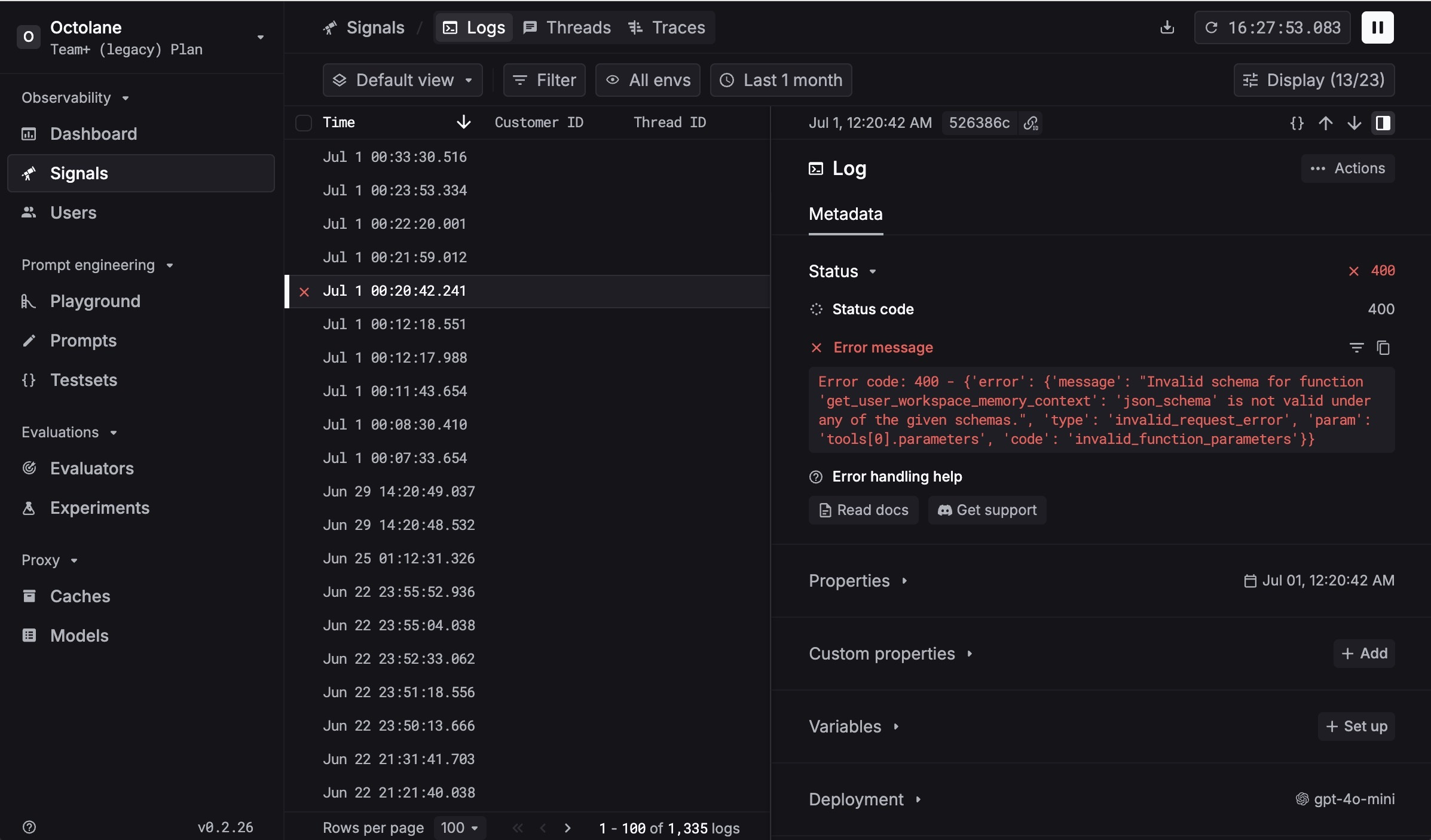
In this view, the team is inspecting a failed LLM call with full visibility: status codes, error messages, parameters, and traces, all in one place. Instead of manually backtracking issues, they can pinpoint bugs instantly and get back to shipping.
This kind of real-time observability has become part of Octolane's everyday workflow, powering a faster, more reliable AI product.
Changes: from vibe checks to full visibility
| Before Respan | After Respan |
|---|---|
| Agent quality judged by vibe check | Every tool call and trace visible |
| No clear way to tell if agents improved | Patterns across traces drive agent improvements |
| Prompt bugs hard to trace | Full input/output logging per LLM call |
| Devs re-ran sessions manually | Auto debugging with error tagging |
| No visibility into model costs | Token + cost breakdown by prompt |
| Slack pings from users when AI failed | Proactive alerts sent to engineering |
| No version history for prompts | Prompt diffs tracked over time |
| Latency issues surfaced too late | Slow calls flagged in real-time |
| Debugging blocked shipping | Teams shipped AI column + Action Mode faster |
This removed the guesswork. Instead of re-running sessions to trace bugs, the team could resolve issues in minutes and get back to building.
Results: from thousands to 4.4M agent requests
Since integrating Respan:
- Agent requests grew from the thousands to over 4.4M
- $700M in real pipeline managed for 1,200 companies
- LLM debugging time dropped 90%
- Feature velocity doubled
- AI column and Action Mode shipped with confidence
I have tremendous respect for the Respan team. There were a lot of difficulties for us, and they were always supportive. They were always there.
One Chowdhury
Co-founder and CEO of Octolane