
Overview

Every span has a log_type field that determines its input/output format. The most common type is chat, but Respan supports logging embeddings, audio, tool calls, and workflow spans. All span types use universal input and output fields and are sent to the same logging endpoint. For the complete field reference, see Span fields & parameters.

All span types

Span typeDescriptionInputOutput
chatChat completions (default)Messages arrayAssistant message
completionLegacy completion formatPrompt stringCompletion string
responseResponse API callsRequest objectResponse object
embeddingVector embeddingsText stringEmbeddings array
transcriptionSpeech-to-textAudio metadataTranscribed text
speechText-to-speechText stringAudio metadata

Chat

The default span type. Input is an array of messages, output is the assistant’s response.
{
  "model": "gpt-4o",
  "input": [
    {"role": "system", "content": "You are a helpful assistant."},
    {"role": "user", "content": "What is machine learning?"}
  ],
  "output": {
    "role": "assistant",
    "content": "Machine learning is a subset of artificial intelligence..."
  }
}

Images

Include images in your messages using the image_url content type. This follows the same format as the OpenAI vision API.
{
  "model": "gpt-4-vision-preview",
  "input": [
    {
      "role": "user",
      "content": [
        {
          "type": "text",
          "text": "What do you see in this image?"
        },
        {
          "type": "image_url",
          "image_url": {
            "url": "https://example.com/image.png",
            "detail": "auto"
          }
        }
      ]
    }
  ],
  "output": {
    "role": "assistant",
    "content": "This image shows..."
  }
}
The detail parameter can be auto, low, or high.

Thinking blocks

When using models with thinking capabilities (e.g. Claude with extended thinking), the response includes additional reasoning fields that are automatically captured. Request:
{
  "model": "claude-sonnet-4-20250514",
  "max_tokens": 16000,
  "thinking": {
    "type": "enabled",
    "budget_tokens": 10000
  },
  "messages": [
    {"role": "user", "content": "Prove there are infinitely many primes p where p mod 4 = 3."}
  ]
}
Response fields:
{
  "role": "assistant",
  "content": "Yes, there are infinitely many such primes...",
  "reasoning_content": "This is asking about primes congruent to 3 modulo 4...",
  "thinking_blocks": [
    {
      "type": "thinking",
      "thinking": "This is asking about primes congruent to 3 modulo 4...",
      "signature": "EswgCkYIBhgCKkDCG..."
    }
  ]
}
For more on enabling thinking mode via the gateway, see Enable Thinking.

Prompt variables

Pass prompt variables so they appear in the side panel for easy inspection and can be added to testsets with one click.
Wrap variables in {{}} in your input and pass a variables object:
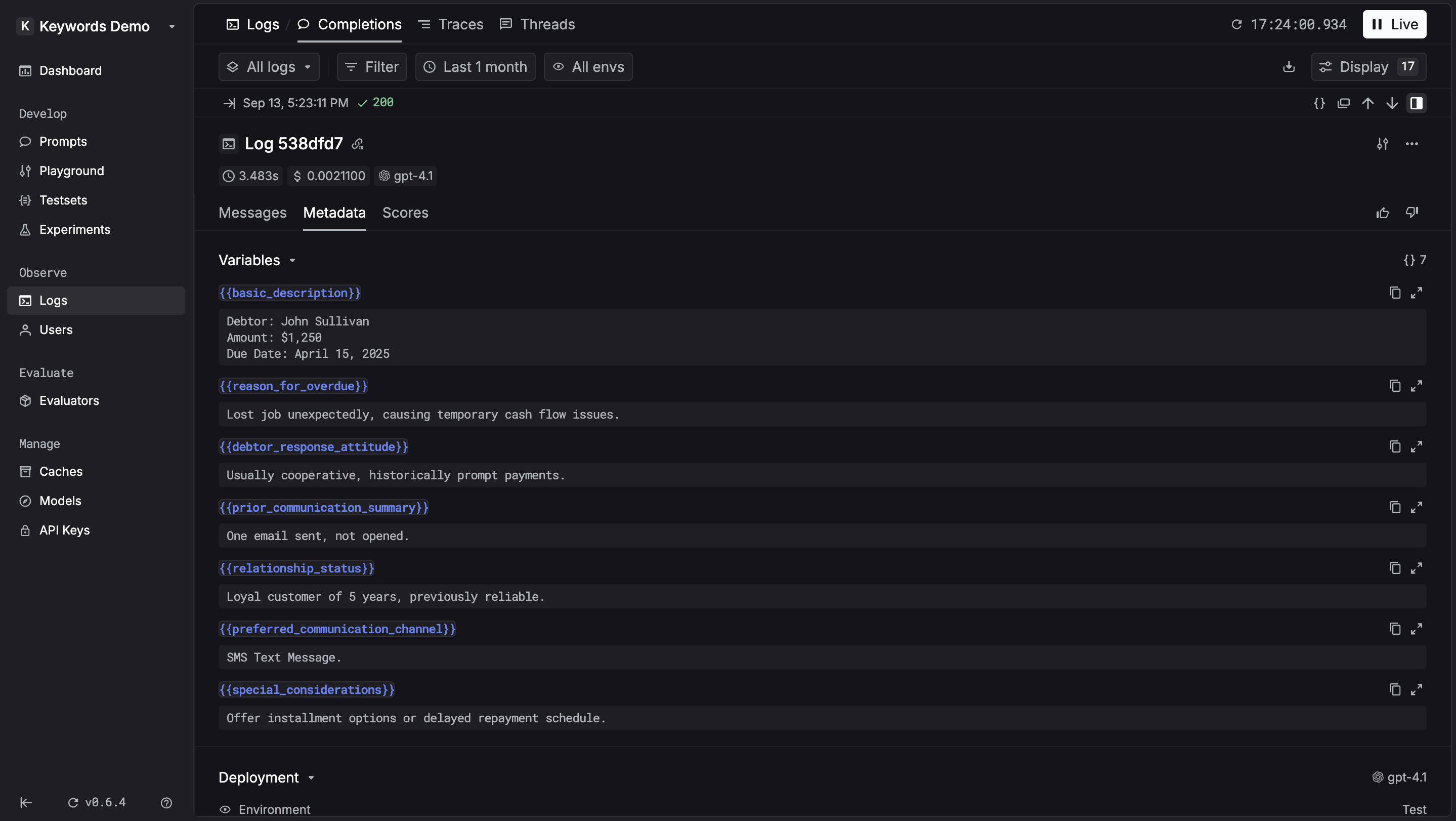
"input": [
    {
      "content": "Please develop an optimized Python function to {{task_description}}, utilizing {{specific_library}}.",
      "role": "user"
    }
],
"variables": {
    "task_description": "Square a number",
    "specific_library": "math"
}
Prompt variables in spans
If you are using prompts via the LLM Gateway, variables are logged automatically — no need to pass them manually.

Tool calls

Record tool calls and function calling interactions as part of chat messages:
import requests

url = "https://api.respan.ai/api/request-logs/"
headers = {
    "Authorization": "Bearer YOUR_RESPAN_API_KEY",
    "Content-Type": "application/json"
}

payload = {
    "model": "gpt-4",
    "input": [
        {"role": "user", "content": "What's the weather in Boston?"},
        {
            "role": "assistant",
            "content": None,
            "tool_calls": [
                {
                    "id": "call_abc123",
                    "type": "function",
                    "function": {
                        "name": "get_current_weather",
                        "arguments": '{"location": "Boston, MA"}'
                    }
                }
            ]
        }
    ],
    "output": {
        "role": "assistant",
        "content": "The current weather in Boston is 72°F and sunny."
    },
    "tools": [
        {
            "type": "function",
            "function": {
                "name": "get_current_weather",
                "description": "Get the current weather in a given location",
                "parameters": {
                    "type": "object",
                    "properties": {
                        "location": {"type": "string", "description": "City and state, e.g. San Francisco, CA"},
                        "unit": {"type": "string", "enum": ["celsius", "fahrenheit"]}
                    },
                    "required": ["location"]
                }
            }
        }
    ]
}

response = requests.post(url, headers=headers, json=payload)
Key fields:
  • tool_calls in the assistant message — array of function calls made
  • tools at the top level — array of available function definitions
  • tool_choice (optional) — specify which tool the model should use

Embedding

Set log_type to "embedding". Input is text, output is the vector array.
import requests

url = "https://api.respan.ai/api/request-logs/"
headers = {
    "Authorization": "Bearer YOUR_RESPAN_API_KEY",
    "Content-Type": "application/json"
}
payload = {
    "log_type": "embedding",
    "model": "text-embedding-3-small",
    "input": "something to embed",
    "output": [
        -0.006929283495992422,
        -0.005336422007530928,
        -4.547132266452536e-05,
        -0.024047505110502243
    ],
    "latency": 0.323887338
}
response = requests.post(url, headers=headers, json=payload)

Speech & transcription

Transcription (speech-to-text)

Set log_type to "transcription". Input is audio metadata, output is transcribed text.
{
  "log_type": "transcription",
  "model": "whisper-1",
  "input": {"audio_url": "https://example.com/audio.mp3", "filename": "recording.mp3"},
  "output": "Hello, how can I help you today?"
}

Speech (text-to-speech)

Set log_type to "speech". Input is text, output is audio metadata.
{
  "log_type": "speech",
  "model": "tts-1",
  "input": "Hello, how can I help you today?",
  "output": {"audio_url": "https://example.com/output.mp3", "filename": "response.mp3"}
}

Workflow & agent types

These span types are used by tracing to represent spans in a trace hierarchy:
  • workflow — Root-level workflow orchestration
  • task — Individual task within a workflow
  • tool — Tool or function execution
  • agent — AI agent operation
  • handoff — Agent-to-agent transfer
  • guardrail — Safety and validation check
For details on how to create and orchestrate these span types, see Orchestration.