AI Observability for
Production LLM Apps
On the same platform as tracing, evals, and the gateway, metrics, saved views on logs and traces, and threshold monitors.
Know the moment things change.
Track requests, errors, cost, latency, and tokens on one dashboard, and get alerted the moment any of them crosses a threshold you set.
An alert the instant a metric crosses its limit
Watch cost, errors, latency, or tokens over any window, and the alert reaches Slack, email, or a webhook the moment it breaches.
Every metric on one dashboard
Requests, errors, cost, latency, and tokens across all your traffic, sliced by model, key, or user, so a spike is easy to spot.
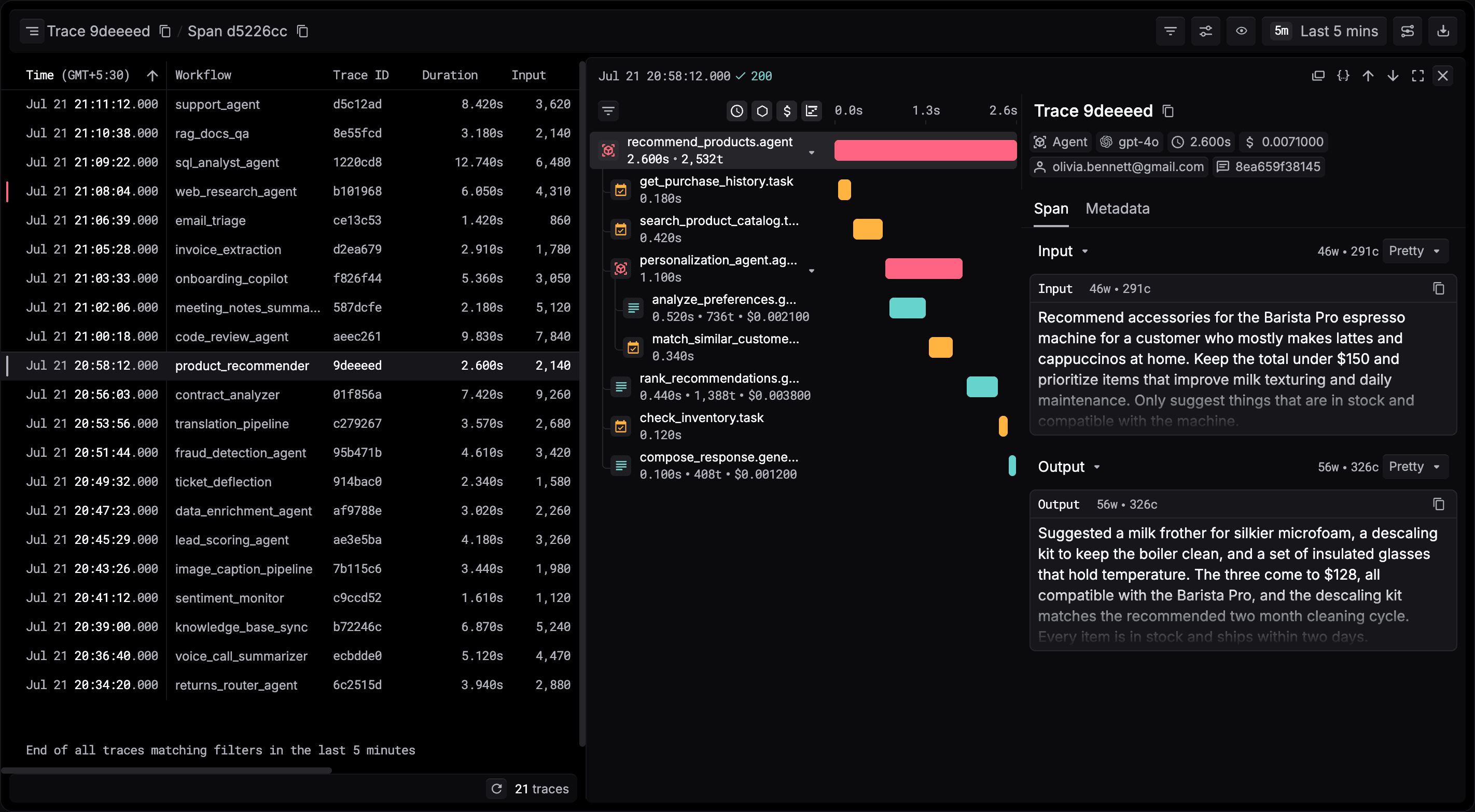
See exactly what your agents did.
Every LLM call, tool run, retrieval, and agent turn becomes a span in one trace, with its input, output, latency, and cost captured.
Every step of a request, in one trace
LLM calls, tool runs, retrievals, and agent turns each become a span in one trace, showing exactly where a run's time and cost go.
{
  "model": "claude-opus-4-8",
  "temperature": 0.2,
  "max_tokens": 1024,
  "messages": [
    { "role": "system", "content": "You are a support agent. Answer only from the retrieved context." },
    { "role": "user", "content": "Why was I charged twice this month?" },
    { "role": "assistant", "content": "Let me check your recent invoices and payment retries." }
  ]
}
Any span, down to the last field
Model, latency, cost, tokens, and the exact input and output sit on every span, showing precisely what each step ran and returned.
You monitor apps, not models.
Standard monitoring counts requests and errors, so a slower or costlier model never trips an alert, and a flat log cannot replay the run behind it.
One total, and nothing under it
The bill arrives as a single number each month, with no way to see which model, feature, or customer is the one that actually moved it.
Only the crashes raise an alarm
A model can answer every request successfully while cost doubles and replies slow to a crawl, and nothing built around errors will notice.
A chart you cannot open
The line moves and that is where it ends, because nothing connects the number to the individual requests that made it move.
Every call is its own record
Each model and tool call lands separately, so a ten step run arrives as ten unrelated entries with nothing to say which came from which.
The tool runs never show up
Only the model calls get recorded, so retrievals and function steps are missing, and the slow step is never the one you can actually see.
Sampled away before anyone looked
Traffic gets thinned at the door to hold down storage, and the rare broken run nobody has seen yet is exactly the one that gets dropped.
Instrument once, see everything.
One Respan() call captures the SDKs you already use, so every request lands on the dashboard, opens as a trace, and can be monitored.
from openai import OpenAIfrom respan import Respanfrom respan.decorators import workflowfrom respan.contexts.span import respan_span_attributes Respan()client = OpenAI() @workflow(name="support_agent")def support_agent(question): with respan_span_attributes( respan_params={"customer_identifier": "user_123"} ): return client.chat.completions.create( model="claude-opus-4-8", messages=[{"role": "user", "content": question}], )from openai import OpenAIfrom respan import Respanfrom respan.decorators import workflowfrom respan.contexts.span import respan_span_attributes Respan()client = OpenAI() @workflow(name="support_agent")def support_agent(question): with respan_span_attributes( respan_params={"customer_identifier": "user_123"} ): return client.chat.completions.create( model="claude-opus-4-8", messages=[{"role": "user", "content": question}], )The AI observability platform behind 80 trillion+ tokens.
Loved by world-class founders, engineers, and product teams.
“Imagine jumping to a log immediately after every LLM call. This is the dream for debugging.”
Daniel Wolf
Product Lead, AlphaSense
“We scaled from 5M to 500M+ monthly API calls quickly. Respan gave us the debugging layer to resolve production issues 10x faster.”
Read how Retell builds next-gen voice agents that scale->Zexia Zhang
CTO, Retell AI
“Respan legit has some of the best UX/DX I’ve ever seen in my life. I truly don’t think I’ve ever integrated a product that was as easy.”
Rahul Behal
Co-founder, Gumloop
“This one felt pretty nice.”
Fabian Hedin
CTO, Lovable
“Such a no brainer choice over LangSmith or anything else and super easy to set up.”
Andy Wang
CEO, Finta
“Respan has been key in helping us scale to trillions of tokens reliably with real-time observability.”
Read how Mem0 builds reliable self-improving AI memory layer->Deshraj Yadav
CTO, Mem0
“Great product - really love the metrics dashboard.”
Esha Dinne
CTO, Giga
Certified where it counts.
Built to meet the security and privacy standards that enterprise and healthcare teams require.
ISO 27001
The internationally recognized standard for information security management.
SOC 2
Secure, compliant management of your data across all of our systems.
GDPR
Operated under GDPR, the world's strictest standard for data privacy.
HIPAA
HIPAA compliant, with a BAA available for healthcare teams.
Works with your entire stack
Use Respan with your favorite frameworks and tools.

