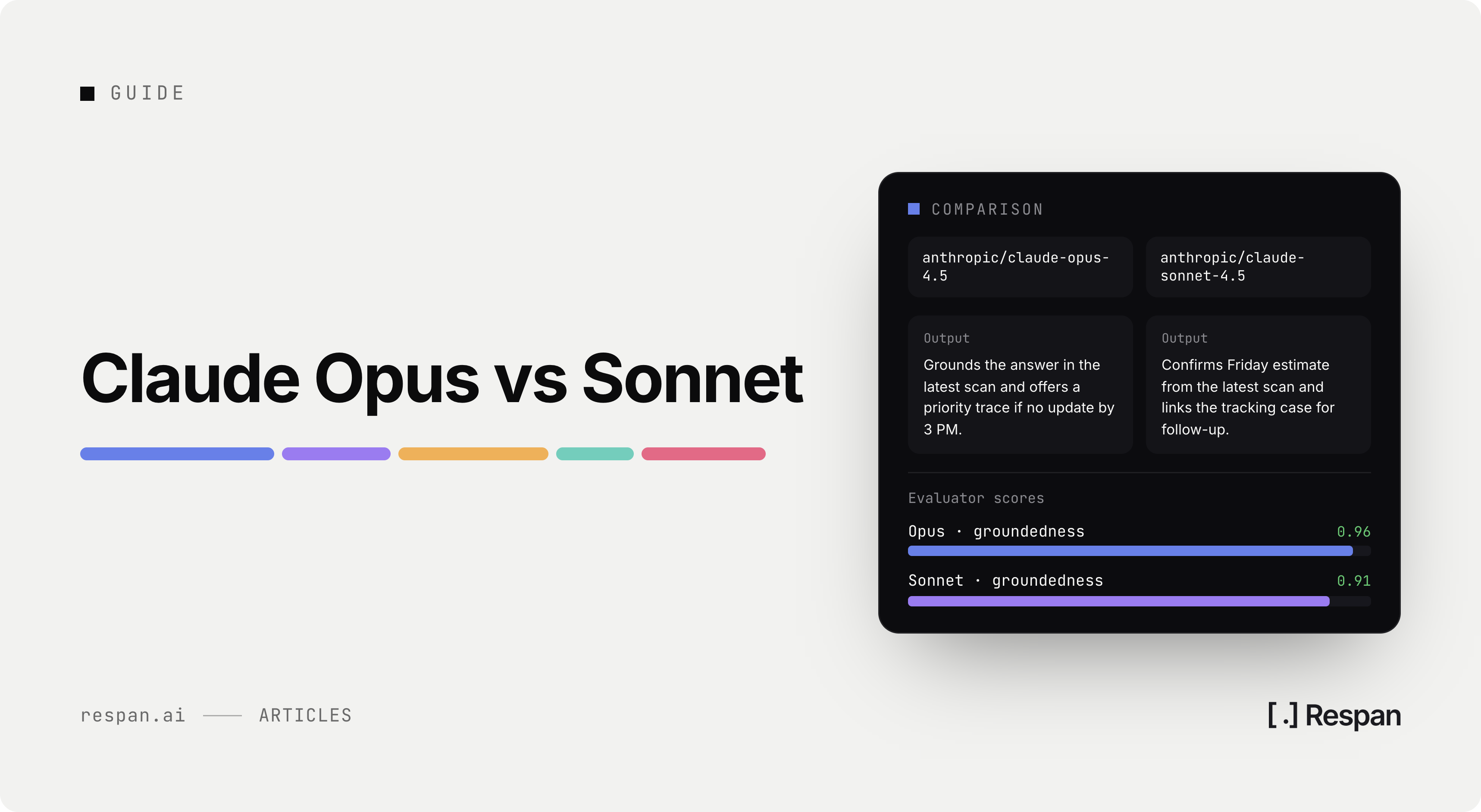

Claude Opus 5 runs $5 per million input tokens and $25 per million output. Claude Sonnet 5 runs $2 and $10. That works out to 2.5x on both sides of the meter, which is a cleaner ratio than these tiers have had before, and it makes the arithmetic easy: every token you route to Opus instead of Sonnet costs two and a half times as much, whatever the prompt length.
The ratio is the only part of this comparison that is genuinely settled. Anthropic's own documentation now tells you to start with Opus 5 for most workloads and to reach for Fable 5.1 when your evals on Opus at high effort still fall short. That is close to the opposite of the advice most comparison pages give, which is to default to Sonnet and escalate.
Both defaults are defensible and neither one is a fact about your application. What the docs publish are prices, context limits, and output ceilings. What they do not publish is a task-by-task quality delta between the tiers, because that number depends on the shape of your requests.
Below is Claude Opus vs Sonnet compared on pricing, context and output limits, the task shapes that actually separate the two tiers, how Haiku fits underneath them, and every version pair still worth putting side by side.
TL;DR: When to Pick Opus vs Sonnet
| Pick Opus 5 if... | Pick Sonnet 5 if... |
|---|---|
| A wrong step has consequences that are expensive or slow to reverse | Output is checked by a test, a schema, or a human before it does anything |
| The task is open-ended and the model has to decide what the right problem is | The task has a clear specification and a clear expected output |
| You are running few, high-value requests where the token bill is not the constraint | You are running high request volume and per-call cost tracks directly to margin |
| The work runs asynchronously and latency is not part of the product | Someone is waiting on the response and time to first token is part of the experience |
Anthropic's guidance points at Opus as the starting point rather than the escalation target, so if you have never measured the difference on your own traffic, starting on Opus and moving work down is at least as reasonable as starting on Sonnet and moving work up.
Claude Opus vs Sonnet: Pricing and Specs
Anthropic's current lineup runs four tiers, and Opus is no longer the top of it. Rates and specs below are from the Claude pricing page and the models overview.
| Model | Input / output per MTok | Context | Max output | Thinking |
|---|---|---|---|---|
| Claude Fable 5.1 | $10 / $50 | 1M | 128K | Adaptive, always on |
| Claude Opus 5 | $5 / $25 | 1M | 128K | Adaptive |
| Claude Sonnet 5 | $2 / $10 | 1M | 128K | Adaptive |
| Claude Haiku 4.5 | $1 / $5 | 200K | 64K | Extended |
Opus 5 and Sonnet 5 are the same shape. Both carry a 1M-token context window at standard pricing with no beta header, both cap output at 128K tokens in a single request, and both use adaptive thinking with a default effort of high. Nothing about the request changes when you switch between them, which is why the decision reduces so cleanly to price against reasoning quality.
Sonnet 5's $2/$10 is worth a note because it moved. The rate launched as introductory pricing scheduled to expire August 31, 2026, and Anthropic has since confirmed it as the standard price, cancelling the planned increase to $3/$15. If you sized a budget against that increase, the money is still there.
Legacy rates and what is actually still callable
The older versions are a mixed bag, and most write-ups get their status wrong. Every Opus from 4.5 up and both recent Sonnets are still Active on Anthropic's deprecations page, not legacy, with retirement dates that mostly sit in 2027.
| Model | Input / output per MTok | State | Retirement |
|---|---|---|---|
| Claude Opus 4.8 | $5 / $25 | Active | Not sooner than May 28, 2027 |
| Claude Opus 4.7 | $5 / $25 | Active | Not sooner than April 16, 2027 |
| Claude Opus 4.6 | $5 / $25 | Active | Not sooner than February 5, 2027 |
| Claude Opus 4.5 | $5 / $25 | Active | Not sooner than November 24, 2026 |
| Claude Opus 4.1 | $15 / $75 | Retired | August 5, 2026 |
| Claude Sonnet 4.6 | $3 / $15 | Active | Not sooner than February 17, 2027 |
| Claude Sonnet 4.5 | $3 / $15 | Active | Not sooner than September 29, 2026 |
Two rows carry near-term pressure. Opus 4.1 is already gone from the Claude API, and Sonnet 4.5's retirement window opens at the end of September 2026. Anthropic commits to at least 60 days' notice before retiring a publicly released model, so nothing disappears without warning, but a "not sooner than" date is a floor rather than a promise.
The pricing detail that matters most in this table is that every 5-series model is cheaper or equal to its predecessor. Sonnet 5 at $2/$10 undercuts Sonnet 4.6 and Sonnet 4.5 at $3/$15, and Opus 5 matches every Opus back to 4.5 at $5/$25. Staying on an older version to save money does not work in either tier.
The tokenizer changes the ratio on cross-generation comparisons
Anthropic puts the boundary at Sonnet 4.6. Models from Claude 4.7 onward use a newer tokenizer that produces roughly 30% more tokens for the same text, and Sonnet 4.6 and earlier use the previous one. The exact increase depends on the content.
This does not touch the headline comparison, because Opus 5 and Sonnet 5 both sit on the newer tokenizer and the 2.5x holds. However, it matters a great deal if you are budgeting a move from Sonnet 4.6 up to any 5-series model, since the list price understates what the same corpus of text will cost you once it is tokenized differently. Measure the token count on the model you plan to deploy rather than the one you are leaving.
Batch and caching apply the same discount to both tiers
The Batch API takes 50% off input and output on every model, and cache reads cost 0.1x the base input price, which works out to $0.50 per MTok on Opus 5 against $0.20 on Sonnet 5. Cache writes run 1.25x base input for the five-minute TTL and 2x for the one-hour TTL. Fable 5.1 and Mythos 5.1 are the exception on reads, at 0.025x.
Because the multipliers are identical across tiers, neither one narrows the gap between Opus and Sonnet. They lower both bills by the same proportion and leave the 2.5x intact. The cache pricing math and TTL breakpoints get more involved once you are choosing between the two durations, and the Message Batches API guide covers the 24-hour completion window that comes with the batch discount.
One asymmetry does exist. Fast mode, in research preview, delivers significantly faster output for Opus 5 and Opus 4.8 at $10/$50, and it has no Sonnet equivalent. Opus 4.7 returns an error on speed: "fast", and Opus 4.6 accepts the parameter but runs at standard speed and standard rates, which is the kind of silent no-op worth catching before it ends up in a benchmark.
When to use Opus vs Sonnet
The docs are direct about the starting point: if you are unsure which model to use, start with Opus 5 for most workloads. Fable 5.1 is positioned for demanding reasoning and long-horizon agentic work, or for when evals on Opus 5 at higher effort still fall short.
Most comparison content recommends the reverse, defaulting to Sonnet and escalating to Opus only when Sonnet visibly fails. That advice is not wrong, and it comes from a real place, since the cheaper tier clears the bar on a large share of production work and the savings compound at volume. The two defaults conflict because they optimize different things. Anthropic's guidance minimizes the chance you ship something worse than you could have, while the escalate-from-Sonnet guidance minimizes spend.
Four things decide which of those you should be optimizing for:
- Task shape - Well-specified work is where the tiers converge. When the input is clear, the expected output is clear, and correctness is checkable, you are asking the model to generate rather than to decide, and the extra reasoning headroom has less to work with. Open-ended work is where they separate, because the model has to infer what the right problem is before solving it. The signal to watch for is iteration count: if you keep re-prompting the same request because the output misses something that required judgment rather than execution, that is the ceiling talking rather than the prompt.
- Error cost - The 2.5x price gap is fixed and small in absolute terms on any single request. The cost of a wrong answer is neither. A wrong answer that a test catches or a reviewer sends back costs you a retry. A wrong answer that reaches a customer, mutates a record, or ships into a release costs something else entirely, and the gap between $0.02 and $0.05 on the call that produced it stops being the interesting number. Because of that, the tier decision tends to follow the blast radius of the step rather than its difficulty.
- Latency budget - Anthropic rates Opus 5 at moderate comparative latency and Sonnet 5 as fast, with Haiku 4.5 fastest and Fable 5.1 slower than all of them. For anything running asynchronously that ordering rarely changes a decision. It changes decisions for interactive work, where time to first token is what people actually perceive as speed in a streaming interface. High-concurrency pipelines feel it differently, since a slower per-call model stretches the tail latency of the whole batch.
- Recency - Opus 5's reliable knowledge cutoff is May 2026 against Sonnet 5's January 2026. That gap only matters if your prompts assume the model knows about something recent without being told, but when it matters it is not a quality difference you can prompt around.
The error-cost point is also the argument for splitting a pipeline rather than picking one model for it. Planning steps and irreversible actions can sit on Opus while the bounded, checkable steps around them sit on Sonnet or Haiku, so the bill tracks the shape of the work instead of the ceiling of it.
What none of this gives you is a number. Anthropic publishes prices, context limits, output ceilings, and latency ordering, but not a task-by-task quality delta between Opus 5 and Sonnet 5, and any article claiming one is describing its own workload rather than yours. The price ratio is known to two decimal places and the quality ratio is unknown until someone measures it on real requests, which means the honest answer to "which tier do I need" is a number you produce rather than one you look up.
Claude Sonnet vs Opus vs Haiku
Moving between Opus 5 and Sonnet 5 changes one thing, which is how much reasoning you are paying for. The request shape is identical, so a workload that runs on one runs on the other without modification.
Haiku 4.5 is not that kind of step down. Its context window is 200K rather than 1M, its output ceiling is 64K rather than 128K, it uses extended thinking rather than adaptive, and it does not support the effort parameter at all. Its reliable knowledge cutoff also sits well behind the other two, at February 2025 against May 2026 for Opus 5.
| Model | Input / output per MTok | Context | Max output | Thinking |
|---|---|---|---|---|
| Claude Opus 5 | $5 / $25 | 1M | 128K | Adaptive |
| Claude Sonnet 5 | $2 / $10 | 1M | 128K | Adaptive |
| Claude Haiku 4.5 | $1 / $5 | 200K | 64K | Extended |
The practical consequence is that a workload has to fit Haiku before it can be priced against Haiku. A request that comfortably uses 300K tokens of context on Sonnet does not become cheaper on Haiku, it fails. The same applies to any generation that needs to exceed 64K output tokens, and to request payloads carrying more than 100 images or PDF pages, which is the per-request limit on 200K-context models against 600 on the 1M ones.
Where the fit is real, the savings are substantial. Haiku 4.5 is half of Sonnet 5 on both input and output, and a fifth of Opus 5, which makes it the right home for high-volume bounded work as long as the context math holds.
Claude Model Version Comparisons
Claude Opus 5 vs Sonnet 5
This is the live pairing, and the specs are identical apart from price. Both run 1M context, 128K max output, adaptive thinking, and a default effort of high. The API IDs are claude-opus-5 and claude-sonnet-5.
Opus 5 costs $5/$25 against Sonnet 5's $2/$10, exactly 2.5x on both meters. Opus 5 also supports Fast mode at $10/$50, in research preview, where Sonnet 5 has no equivalent.
Note that Anthropic recently released 5.5. Check out our Opus 5.5 comparison to see how it compares to other popular models.
Claude Opus 5 vs Fable 5
Fable 5.1 is Anthropic's frontier tier, and it sits above Opus at $10 input and $50 output per MTok, double Opus 5 on both. Fable 5 remains available at the same rates, so the version choice inside the tier is about the cache read price rather than the base rate: cache hits cost 0.025x base input on Fable 5.1 against the standard 0.1x on Fable 5, which is $0.25 per MTok versus $1.
The specs otherwise track Opus 5 closely, with 1M context and 128K max output on both. The differences are that Fable 5.1 runs adaptive thinking always on rather than optionally, Anthropic rates its comparative latency as slower than Opus, and its reliable knowledge cutoff is June 2026 against Opus 5's May 2026.
Anthropic frames the escalation condition narrowly, which is useful. Fable is positioned for demanding reasoning and long-horizon agentic work, or for when your evals on Opus 5 at higher effort still come up short. That second clause is doing real work: raising effort on Opus is the cheaper move and it should be exhausted before doubling the rate. Mythos 5.1 is the same rate and limited availability, so it is not a routing option for most teams.
Claude Sonnet 5 vs Opus 4.8
This pairing comes up because Opus 4.8 was the flagship immediately before Opus 5, and plenty of production systems are still pointed at it. Both models sit on the newer tokenizer, so a token-count comparison between them is apples to apples.
Opus 4.8 costs $5/$25 against Sonnet 5's $2/$10, the same 2.5x ratio that Opus 5 carries, and it supports Fast mode at $10/$50. It remains Active with a retirement date not sooner than May 28, 2027, so there is no urgency to move.
The reason to move anyway is that Opus 5 costs exactly what Opus 4.8 costs. If you are already paying flagship rates, staying on 4.8 buys nothing, and Anthropic publishes a migration guide for the jump. The live question is usually whether the workload needs a flagship at all, in which case Sonnet 5 at 40% of the rate is the comparison that matters.
Claude Sonnet 4.6 vs Opus 4.6
Both are still Active, with retirements not sooner than February 2027, and both sit on the older tokenizer, which makes this the one pairing in this section where cross-generation token inflation is not a factor.
Opus 4.6 runs $5/$25 against Sonnet 4.6's $3/$15, a ratio of roughly 1.67x rather than the 2.5x that the 5-series carries. Both include the full 1M context window at standard pricing. Fast mode is not available on either, and Opus 4.6 will accept speed: "fast" without applying it or charging the premium.
Anyone weighing this pair should weigh Sonnet 5 alongside it, since Sonnet 5 costs less than Sonnet 4.6 at $2/$10. Be aware that the tokenizer change means a straight rate comparison flatters the newer model, so measure your own token counts before assuming the saving is the full third that the list prices suggest.
Claude Opus 4.1 vs Sonnet 4.5
Opus 4.1 no longer runs on the Claude API. Anthropic deprecated it on June 5, 2026 and retired it on August 5, 2026, and requests to it now fail. It survives on Amazon Bedrock and Google Cloud, which set their own retirement schedules, so a workload calling it through Bedrock rather than the first-party API may still be running.
Sonnet 4.5 is still Active, but it comes with two constraints worth knowing. Its context window is 200K, not 1M: the context-1m-2025-08-07 beta was retired for Sonnet 4.5 and Sonnet 4 on April 30, 2026, and requests above 200K now return an error. Its own retirement window also opens September 29, 2026.
For anyone on either model, Anthropic's recommended replacement for Opus 4.1 is Opus 4.8, though Opus 5 costs the same and is the better target. Sonnet 4.5 should move to Sonnet 5, which is cheaper at $2/$10 and carries the 1M window that Sonnet 4.5 lost. One migration detail catches people: temperature, top_p, and top_k return a 400 error on Claude 4.7 and later when set to a non-default value, and the Python SDK from v1.0 removes them outright, so passing them raises a TypeError. Prompt for the behavior instead.
How to Route, Observe, and Evaluate Every Claude Call
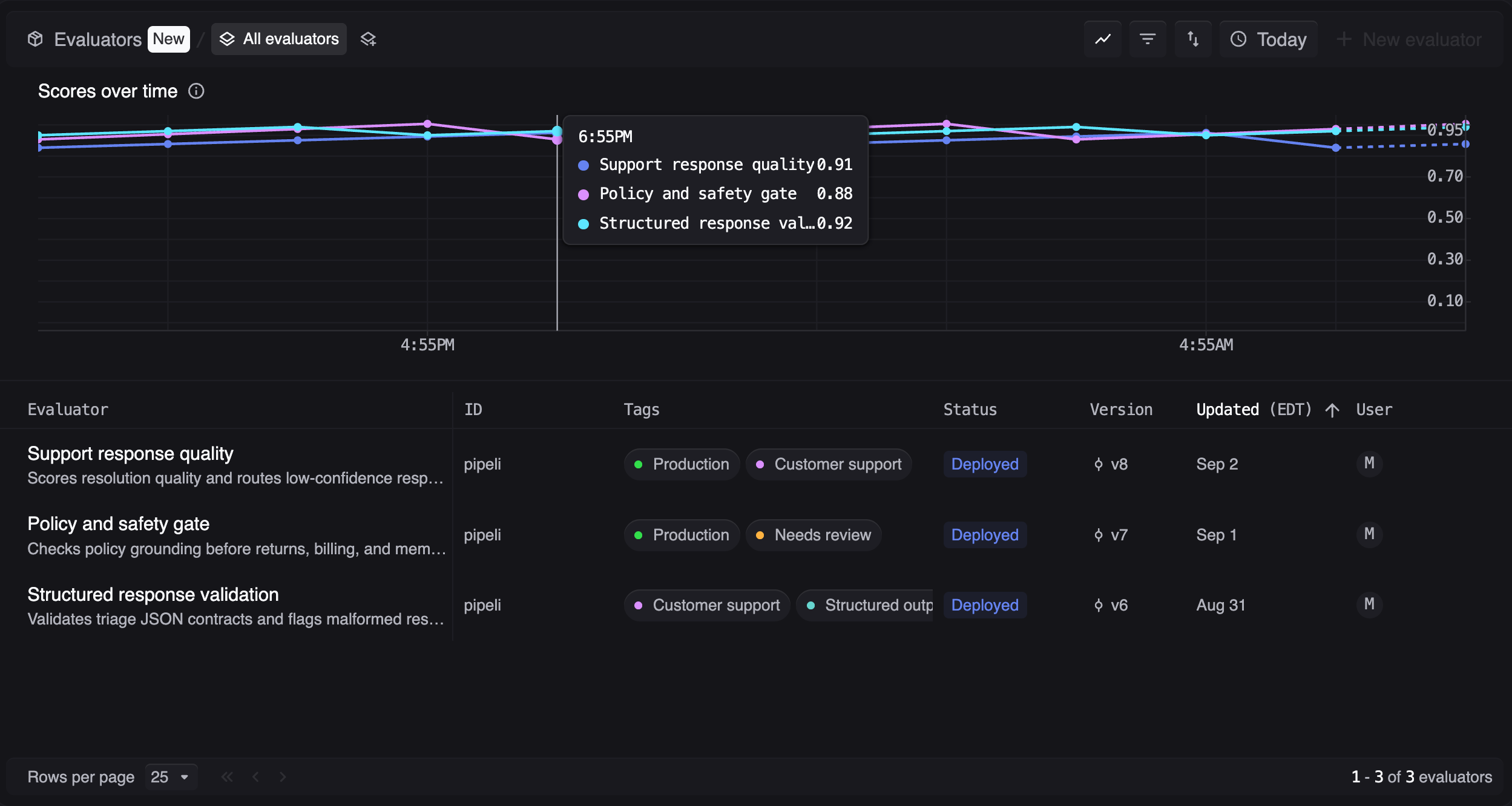
Anthropic publishes the price ratio and leaves the quality ratio to you. Respan is where you produce that second number, on your own traffic, next to what each tier costs to run.
- Measure quality with scores, not vibes - An LLM judge, a deterministic code check, or a human reviewer compose into one evaluator that turns any output into a single score, so "Opus felt better" becomes a number you can defend in a budget conversation.
- Run both models against the same dataset - Build a test set from real production requests by filter and sampling rate, then run Opus and Sonnet through your evaluators at scale. Experiments return per-row and average scores with side-by-side distributions, and any row clicks straight into the full trace behind it.
- Keep scoring after you decide - Deploy the same evaluator on live production spans, filtered by status, customer, or thread and sampled to control cost, so a tier that quietly stops clearing the bar after a model update surfaces as a score change instead of a support ticket.
- Put cost next to quality - Every request is logged as a span automatically with latency and cost attached, broken down by model, by request, and by end customer. The quality delta and the 2.5x price delta sit in the same platform rather than in two different tabs, and soft and hard spend caps stop a runaway Opus experiment at a ceiling you set.
- Switch models by changing a single word - One endpoint reaches 1,000+ models across every major provider, so moving a workload from
claude-sonnet-5toclaude-opus-5is a config change rather than a deploy. Setup is OpenAI-compatible and the gateway adds roughly 10ms at P95. - Stay up when a provider does not - Set a fallback chain once, at org level or per request, and traffic reroutes automatically when a model errors or rate-limits. Failed requests retry on your rules, and load balancing distributes across providers, which keeps a two-tier setup from becoming a single point of failure.
Stop guessing which Claude tier you need
Run Opus and Sonnet against the same production dataset, score both, and see the cost difference next to the quality difference before you commit. Free to start.
Frequently Asked Questions
Should I use Opus or Sonnet for coding?
It depends on what the coding task asks the model to decide. Sonnet 5 handles work with a clear specification and a checkable result well, and it costs 40% of Opus 5, which matters when a coding agent fires many calls per task. Opus 5 earns the difference on architecture decisions, comprehension across a large codebase, and anything where a wrong change is expensive to unwind.
Anthropic positions Opus 5 for complex agentic coding and enterprise work, and its guidance is to start there rather than escalate to it. The reliable way to settle it is to run both tiers against a dataset of your own coding requests, score the output, and compare the score gap to the 2.5x price gap. Respan runs both sides of that comparison in one place.
How much more does Opus cost than Sonnet?
Exactly 2.5x on both input and output. Opus 5 is $5 per million input tokens and $25 per million output; Sonnet 5 is $2 and $10. The ratio is different on older versions, where Opus 4.6 at $5/$25 against Sonnet 4.6 at $3/$15 works out closer to 1.67x. Batch processing takes 50% off both tiers and cache reads cost 0.1x base input on both, so neither discount narrows the gap between them.
Does Opus have a longer context window than Sonnet?
No. Claude Opus 5, Sonnet 5, and Fable 5.1 all carry a 1M-token context window at standard pricing with no beta header, and all three cap a single response at 128K output tokens. Haiku 4.5 is the one current model with a smaller window, at 200K context and 64K output. Among older versions, Sonnet 4.5 is limited to 200K after Anthropic retired its 1M beta in April 2026.
Is there a model above Opus?
Yes. Claude Fable 5.1 sits above Opus 5 at $10 input and $50 output per MTok, double Opus on both meters, and Anthropic positions it for demanding reasoning and long-horizon agentic work. Its documented escalation condition is that your evals on Opus 5 at higher effort still fall short, so raising effort on Opus is the cheaper step to try first. Claude Mythos 5.1 shares the same rates with limited availability.
Should I use Opus or Sonnet for agents?
Agent workloads are where a single-tier answer serves you worst, because one run mixes steps with very different requirements. Planning, ambiguous decisions, and actions that cannot be undone are the steps that justify Opus 5. Tool result summarization, formatting, and bounded lookups usually clear on Sonnet 5 or Haiku 4.5.
The number to watch is cost per completed task rather than cost per call, since a cheaper model that needs extra turns can erase its own advantage. Tracing every call in an agent run as a span with cost attached is how that number becomes visible, which is what Respan's agent observability is built to do.
Can I use Opus and Sonnet in the same application?
Yes, and mixed-tier routing is the common pattern in production. Anthropic exposes both through the same API with the same request shape, so the only difference is the model string. Running them behind one gateway endpoint makes the switch a configuration change, keeps cost and latency for both in the same set of traces, and gives you fallback chains if one provider errors or rate-limits. Respan handles the routing, the logging, and the evaluation in a single platform, and it is free to start.