agentgateway has gone from a Solo.io project to shared infrastructure in about a year. The Rust gateway joined the Linux Foundation in September 2025, and in June 2026 it became the fourth project hosted by the Agentic AI Foundation, with one data plane for LLM, MCP, and agent-to-agent (A2A) traffic alongside ordinary HTTP and gRPC services.
Covering all of that in one place is a real advantage for platform teams that want a single point to apply policy. What comes with it is the operating model. agentgateway is self-hosted only, it calls model providers on your own keys at list price, and the enterprise edition that adds hardened builds and 24x7 support is priced by quote.
If you're weighing a move, it likely comes down to one of two things: running less infrastructure, or paying less for the tokens that pass through the gateway. Those two lines separate the options below more clearly than any feature grid does.
Below are the best agentgateway alternatives in 2026, self-hosted or managed, compared on what each one takes to run and what you pay per token.
agentgateway alternatives at a glance
| Tool | Runs on | Token cost | Starting price |
|---|---|---|---|
| Respan | Managed or single binary | Up to 55% off on credits, 0% fee | Free; Team $199/mo billed yearly |
| Agent Router | Local, Kubernetes, or Tetrate-hosted | Your keys; Tetrate +5% | Free OSS |
| Kong AI Gateway | Konnect, or Enterprise self-hosted | List price, your keys | Plus $25/mo + usage |
| Apache APISIX | Self-hosted, etcd or YAML | List price, your keys | Free OSS |
| TrueFoundry | SaaS, VPC, on-prem, air-gapped | List price, your keys | Free; Pro $25/user/mo |
| Bifrost | npx or Kubernetes | List price, your keys | Free OSS; Enterprise custom |
| LiteLLM | Self-hosted, Postgres + Redis | List price, your keys | Free OSS; Enterprise custom |
The token cost column is where the field splits. Every self-hosted option here other than Respan, agentgateway included, pays providers list price on your own keys, so caching and budgets can cut how many tokens you buy but not what each one costs. Respan passes its bulk rates on for calls on Respan credits, with a 0% fee.
If you already know how you want to run it, the shortlist gets short quickly. Kong and APISIX keep API and AI traffic in one gateway the way agentgateway does, Agent Router stays closest to its Kubernetes and foundation roots, and Respan managed or TrueFoundry's SaaS leave you nothing to operate.
What is agentgateway?
agentgateway is an open-source gateway that routes LLM, MCP, and A2A traffic through one data plane, along with HTTP, gRPC, and TCP services, under an Apache 2.0 license.
agentgateway was originally created by Solo.io and now sits under the Agentic AI Foundation, part of the Linux Foundation. On the LLM gateway side, it puts an OpenAI-compatible API in front of providers like OpenAI, Anthropic, Gemini, and Bedrock, with failover, token budgets and spend limits per key or team, semantic caching, and prompt redaction. Each request also gets a cost in USD from a per-model pricing catalog, which shows up in logs, metrics, and traces.
The MCP and A2A layers cover ground that LLM-only gateways don't. It scopes MCP tools per caller identity, keeps an audit trail of tool calls, and routes agent-to-agent calls between runtimes like LangChain, CrewAI, and Google ADK, with identity and tracing on each hop.
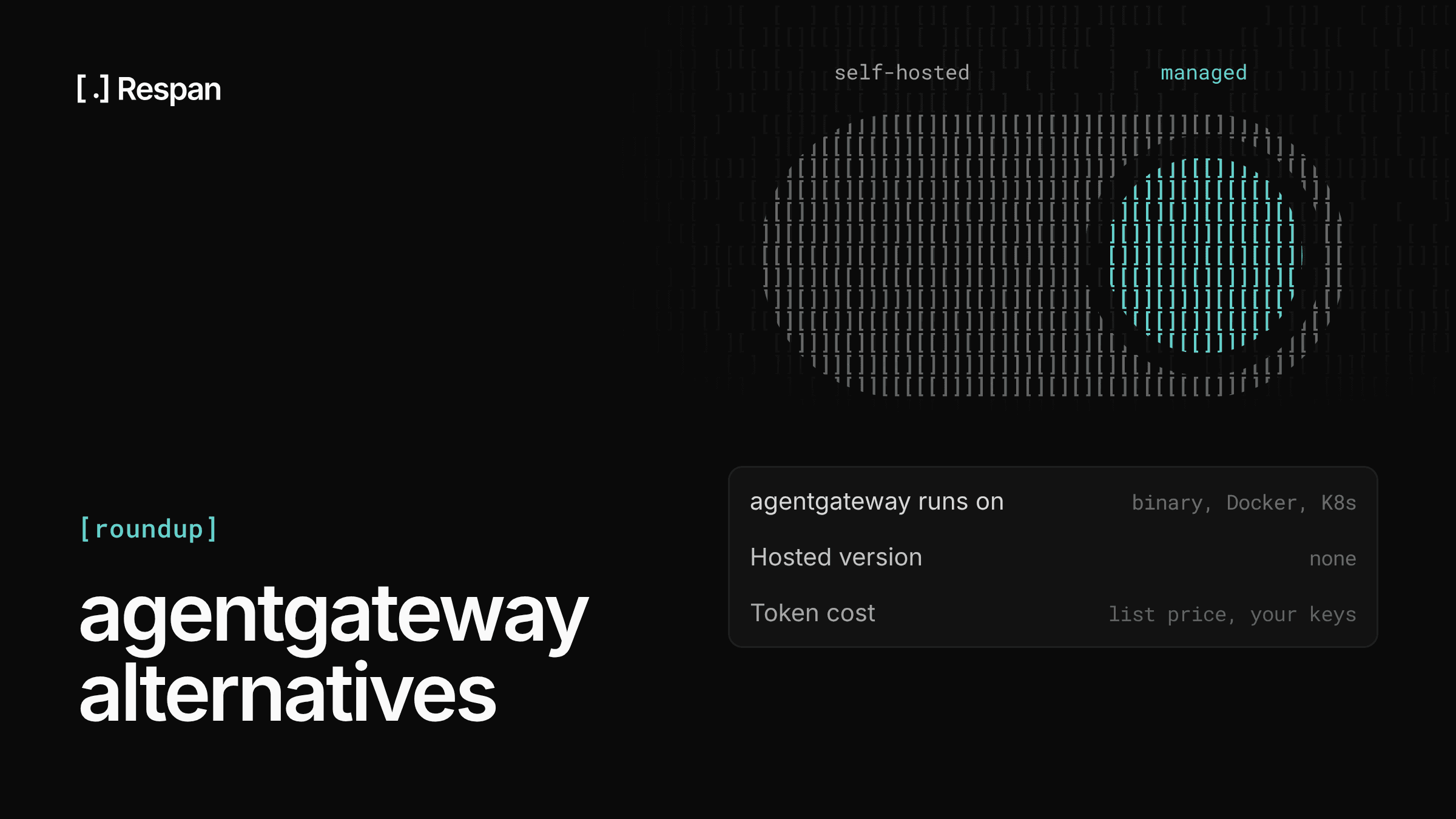
You run it yourself, either as a standalone binary installed with one command, in Docker, or on Kubernetes with Gateway API support. There's no hosted version. Solo Enterprise for agentgateway adds a hardened distribution, MCP security and governance features, and 24x7 support, and Solo doesn't publish its pricing.
7 best agentgateway alternatives compared
Respan comes first because it lowers the token bill rather than passing it through, and it runs managed or as a single binary. After that, the list moves from the option closest to agentgateway toward the ones furthest from it: Agent Router shares its foundation, Kong and APISIX are API gateways with AI plugins, TrueFoundry bundles LLM, MCP, and agent gateways in one platform, and Bifrost and LiteLLM are self-hosted LLM proxies.
1. Respan
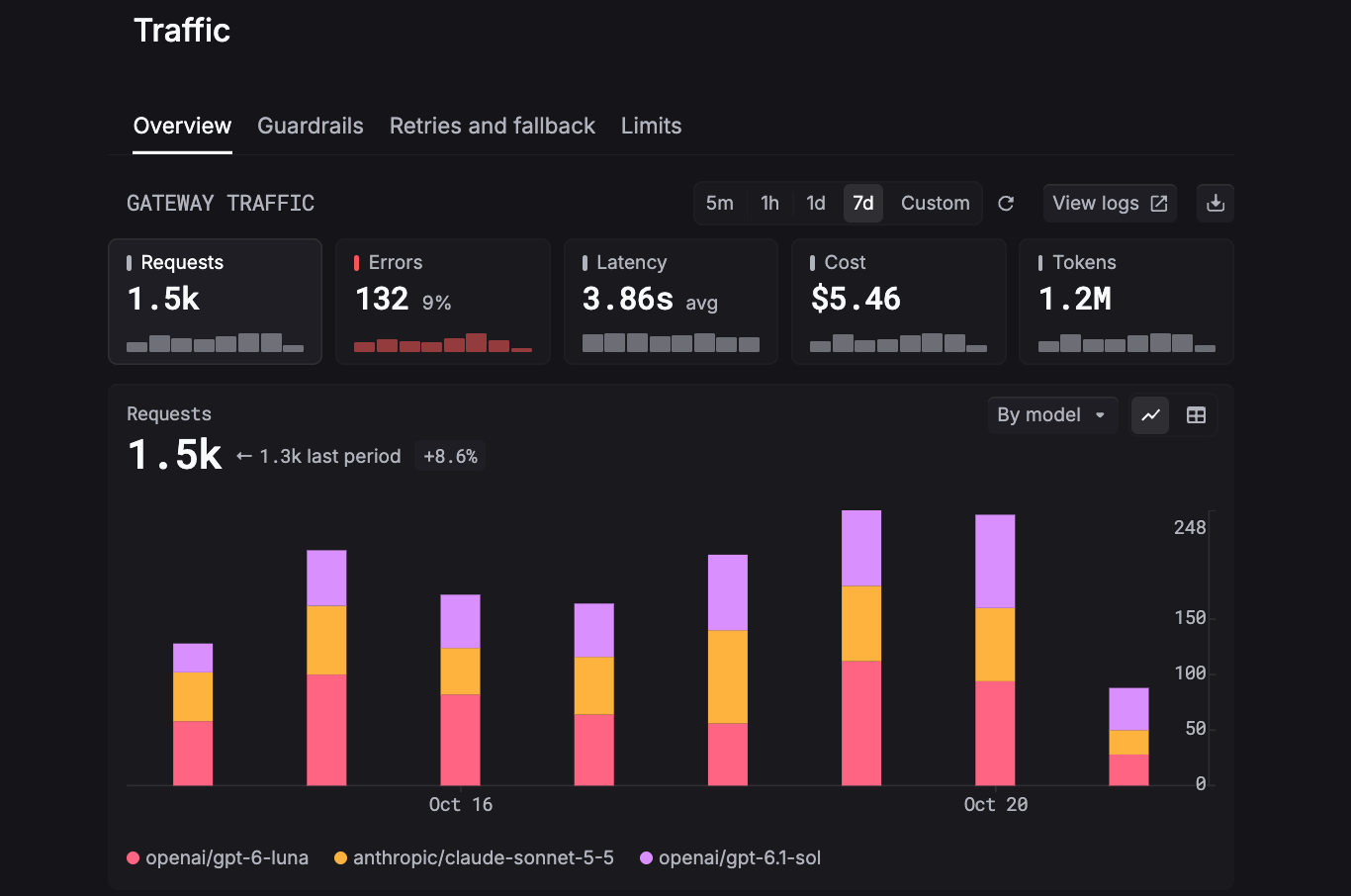
Respan is an open-source AI gateway that gives you one API key to 1,000+ models at up to 55% off per token, with a 0% fee. Because Respan passes its bulk rates on, routing through it brings the model bill down instead of adding to it. On speed, its open-source gateway handles 56,734 requests per second with 0.07 ms median added latency and 31 MB of memory in Respan-run benchmarks against LiteLLM, Portkey, and Bifrost.
Like agentgateway, you can run it yourself. Respan's open-source gateway is a single binary under MIT or Apache-2.0, and you turn on routing, fallbacks, and MCP in one config file. Unlike agentgateway, there's also a managed option, where switching means changing a base URL and an API key, and you can move between the two: start with the open-source gateway on your own infrastructure, then add your Respan API key under [plugins.respan] in gateway.toml when you want every request traced, priced, and scored in the hosted platform. The Free plan covers getting started, and Team is $199 a month billed yearly.
- Pay less per token - Bulk rates are passed on, and discounts vary by model, so the savings show up on the models you already use.
- Stay up when a provider fails - List the models to fall back to once, and traffic moves to the next the moment one errors or rate-limits. Retries and load balancing run at the gateway.
- Cap spend per customer - Soft and hard limits per key, per customer, or org-wide, with costs broken down by model, request, and end customer.
- Keep personal data out of prompts - PII redaction masks names, card numbers, and emails before the model sees them.
- MCP behind one key - MCP servers listed in
gateway.tomlare served at/mcp/{name}, and tools can run inside a chat request so any model can use them. - Any SDK, any model - The Anthropic SDK can call GPT and the Gemini SDK can call Claude, with tools, images, and streaming translated on the way.
- See every call - Each request becomes a trace with latency and cost attached, and monitors on cost, errors, latency, or tokens alert Slack, email, or a webhook when a threshold breaches.
Runs on: Managed on Respan, or a single open-source binary on your own infrastructure.
Token cost: Up to 55% off list price on Respan credits, with a 0% fee.
2. Agent Router (formerly Envoy AI Gateway)
Agent Router is an open-source control plane powered by Envoy that puts one OpenAI-compatible API in front of 22 providers and one router in front of your MCP tools. It covers provider fallback, token limits per team, app, or model, an MCP tool catalog filtered by caller, and Kubernetes InferencePool support for self-managed models, with telemetry on OpenTelemetry's GenAI conventions.
It's the closest neighbor to agentgateway here, since both are Agentic AI Foundation projects; Agent Router joined in September 2026 when it was renamed from Envoy AI Gateway. The difference shows up at the edges. Its site doesn't mention A2A, and cost attribution, runtime guardrails, and enterprise SSO sit in Tetrate's paid Agent Router Enterprise rather than the open-source project, which is a common reason teams also look at tools like Envoy AI Gateway.
You can start it on a laptop with aigw run and ship the same configuration to a Kubernetes cluster or a dedicated gateway. Tetrate also hosts it as a service, billed pay as you go at the provider's cost plus a 5% fee.
Runs on: Locally, on Kubernetes or a dedicated gateway, or hosted by Tetrate.
Token cost: Provider list price on your own keys, or list price plus 5% on Tetrate's hosted service.
3. Kong AI Gateway
Kong AI Gateway brings LLM traffic into Kong's API platform, so a team already running Kong for its APIs can apply the same layer and policies to models. The AI features come as plugins, and on the Plus plan several of them are paid add-ons, including semantic caching, advanced AI rate limiting, prompt guards, PII sanitization, and AWS Guardrails. Enterprise includes all of them.
Pricing stacks along more than one axis. Plus starts at $25 a month and includes 1 million requests and up to five LLMs, with each extra model at $100 a month and each extra million requests at $200, and the gateway itself bills per control plane on top of that, from $25 a month serverless to $500 a month for a dedicated cloud gateway. Running both the control plane and data plane on your own infrastructure falls under Kong's separate Gateway Enterprise offering at custom pricing, which is the usual trigger for comparing Kong AI Gateway alternatives.
Runs on: Kong Konnect, or fully self-hosted under Gateway Enterprise.
Token cost: Provider list price on your own keys, with Kong billing platform usage separately.
4. Apache APISIX
Apache APISIX is an Apache 2.0 gateway that extends to LLM traffic through plugins, so you can run API and AI traffic through one open-source API gateway the way agentgateway combines service and model traffic. ai-proxy connects to providers and OpenAI-compatible endpoints, ai-proxy-multi balances load across model instances with configurable retries and fallback, ai-rate-limiting cuts off requests once a token quota is spent, and ai-cache serves repeat responses from Redis.
What you take on is the gateway itself. In its traditional mode, APISIX keeps configuration in etcd, which you run and maintain alongside it, though a standalone mode reads YAML or JSON from local files instead. Its AI logging records model, latency, and token usage but not dollar cost, and MCP support is limited to an mcp-bridge plugin that turns stdio MCP servers into HTTP services, which covers far less ground than agentgateway's tool scoping and A2A routing.
Runs on: Self-hosted via Docker, Helm, or packages, with etcd or in standalone YAML mode.
Token cost: Provider list price on your own keys.
5. TrueFoundry
TrueFoundry sells an AI gateway alongside separate MCP and agent gateways, so it covers the same three traffic types as agentgateway, with A2A support on the agent side. Budgets and rate limits apply per team, user, model, application, or environment, and crossing one can throttle a request, downgrade it to a cheaper model, or block it. Input and output guardrails cover PII, prompt injection, and toxicity, with integrations for OpenAI Moderation and AWS and Azure safety services.
Deployment is broad, from SaaS to VPC, on-prem, hybrid, and air-gapped. Pricing starts with a free Developer plan for up to three users and 30,000 requests a month, then Pro at $25 per user per month, so the bill tracks team size rather than traffic until you reach Enterprise, which carries custom annual pricing and is where SSO and audit logging sit. If that seat-based model doesn't fit, there's a separate field of platforms similar to TrueFoundry to weigh.
Runs on: SaaS, VPC, on-prem, hybrid, or air-gapped.
Token cost: Provider list price on your own keys.
6. Bifrost
Maxim's Bifrost is an Apache 2.0 gateway with automatic provider failover, semantic caching, and an MCP gateway that centralizes tool connections and auth. Virtual keys carry their own budgets and access controls, and Maxim reports about 11 microseconds of added overhead at a sustained 5,000 requests per second on a t3.xlarge, measured on its own setup, so it isn't comparable with other vendors' figures.
It starts with a single npx command and has a Kubernetes deployment guide, so a team leaving agentgateway can run it with or without a cluster. Guardrails, adaptive load balancing, SSO, and audit logs link to enterprise documentation, which means the parts a larger org needs come at a sales-quoted price. Teams that would rather not operate a gateway at all may find a better fit among the managed Bifrost alternatives.
Runs on: npx or Kubernetes, self-managed, or in-VPC on Enterprise.
Token cost: Provider list price on your own keys.
7. LiteLLM
Under an MIT license, LiteLLM puts 140+ providers behind one OpenAI-compatible endpoint as a self-hosted proxy. Virtual keys carry hard budgets per key, team, org, and model, TPM and RPM limits apply per key and team, and spend is tracked down to the tool, agent, and MCP server. Fallbacks, load balancing, and caching handle provider trouble, and guardrails like PII masking and prompt-injection detection are part of the free build.
Compared with agentgateway, it stays focused on LLM traffic, and the operating footprint is yours to carry, since it runs on your own Postgres and Redis, deploys through Docker, Helm, or Terraform, and needs upgrades you schedule. SSO, RBAC, JWT auth, audit logs, and SCIM require an Enterprise license with pricing on request, which is part of why teams also compare LiteLLM alternatives.
Runs on: Self-hosted proxy with Postgres and Redis.
Token cost: Provider list price on your own keys.
FAQ
What is the best agentgateway alternative?
For lower token costs and the choice of managed or self-hosted, start with Respan: one API key to 1,000+ models at up to 55% off per token with a 0% fee. Agent Router stays closest to agentgateway's model, Kong and APISIX fit teams that want API and AI traffic in one gateway, and among the other LLM gateways, TrueFoundry covers MCP and A2A in a managed platform while LiteLLM and Bifrost fit self-hosting.
Is agentgateway open source?
Yes. agentgateway is licensed under Apache 2.0. It joined the Linux Foundation in September 2025 and became an Agentic AI Foundation project in June 2026. Solo.io, which created the project, sells a separate commercial distribution called Solo Enterprise for agentgateway.
Do you need Kubernetes to run agentgateway?
No. agentgateway runs as a standalone binary or in Docker, and on Kubernetes when you want it managed through Gateway API resources. Solo Enterprise for agentgateway also added a standalone mode in September 2026, so a cluster isn't required on either edition.
How much does agentgateway cost?
The open-source project is free, so what you pay is the infrastructure and engineering time to run it, plus provider tokens at list price on your own keys. Solo Enterprise for agentgateway is priced by quote with no public price list. At production volume, token spend tends to be the larger line item, so routing through a gateway that passes bulk rates on is one of the more direct ways to reduce LLM API costs.
agentgateway vs LiteLLM: which should you use?
agentgateway fits platform teams that want one Rust gateway for LLM, MCP, and A2A traffic, plus ordinary service traffic, running as a binary or on Kubernetes. LiteLLM fits teams focused on LLM traffic who want budgets, rate limits, and spend tracking in a self-hosted proxy, at the cost of running its Postgres and Redis. Both send tokens to providers at list price on your own keys.