Envoy AI Gateway has a new name. In September 2026 the project left the Envoy family, joined the Agentic AI Foundation, and became Agent Router, keeping the same code, maintainers, and Kubernetes resources it had before.
The rename doesn't change how the gateway runs. Agent Router is still a control plane that manages Envoy for AI traffic, so running it in production means a Kubernetes cluster, Envoy Gateway, and the custom resources that configure both. For platform teams already living in that stack, that's a reasonable trade. Teams that don't want to operate Kubernetes and Envoy Gateway for an LLM gateway, or that need cost attribution the open-source project leaves to Tetrate's paid edition, have good reasons to look at what else does the job.
The options that come up split along two lines that matter more than feature lists: what each one takes to run, and what you pay per token once traffic flows through it.
Below are the 7 best Envoy AI Gateway alternatives in 2026, compared on both.
Envoy AI Gateway alternatives at a glance
Agent Router is included at the bottom for comparison.
| Tool | Runs on | Token cost | Starting price |
|---|---|---|---|
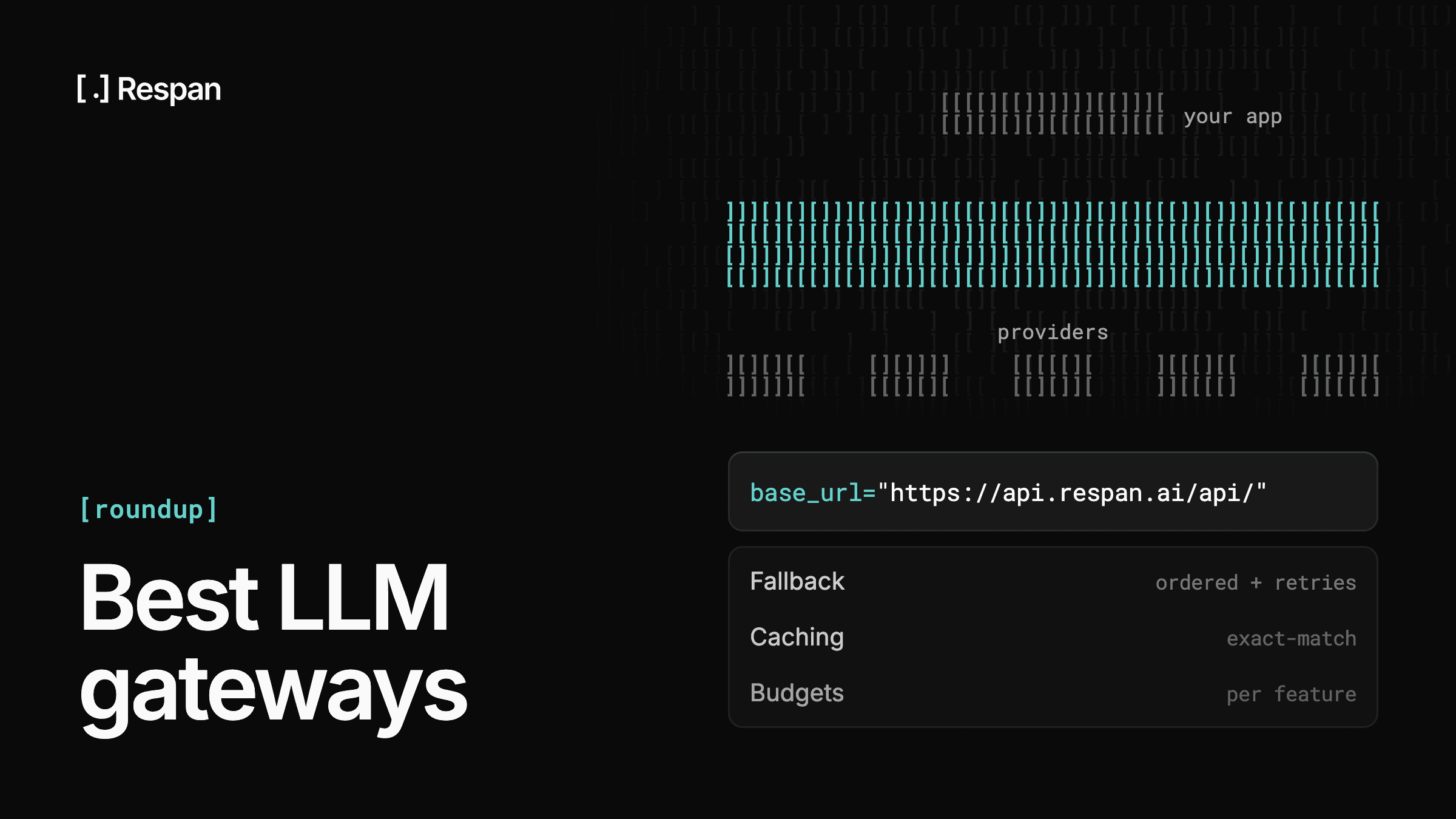
| Respan | Managed or single binary | Up to 55% off, 0% fee | Free; Team $199/mo billed yearly |
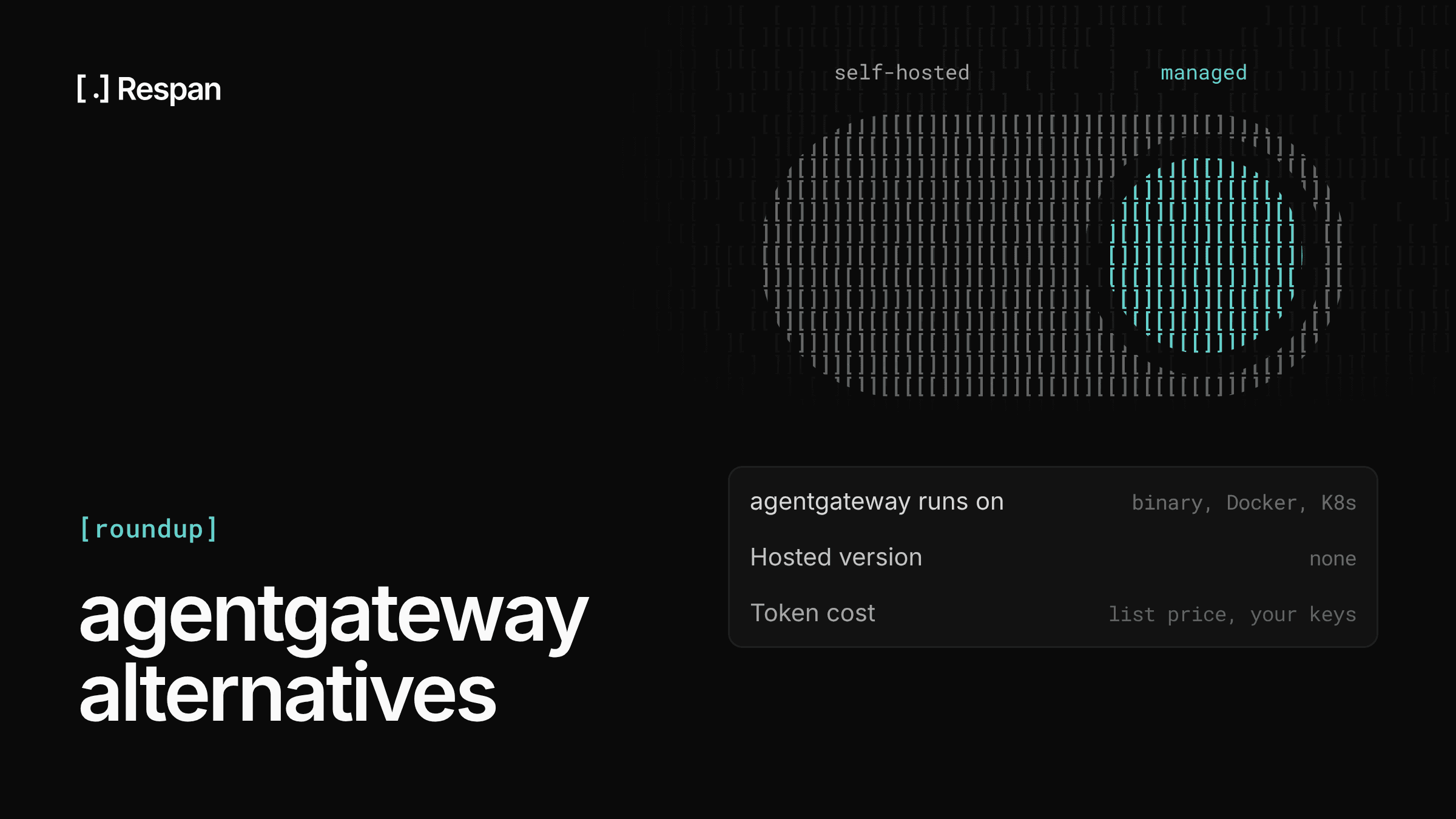
| agentgateway | Binary or Kubernetes | List price, your keys | Free OSS; Enterprise unlisted |
| Kong AI Gateway | Konnect, or Enterprise self-hosted | List price, your keys | Plus $25/mo + usage |
| LiteLLM | Self-hosted proxy + Postgres | List price, your keys | Free OSS; Enterprise custom |
| Bifrost | npx, Docker, or Kubernetes | List price, your keys | Free OSS; Enterprise custom |
| Portkey | Managed or self-hosted | List price, your keys | Free; Production $49/mo |
| OpenRouter | Managed only | List price + 5.5% fee | Pay as you go |
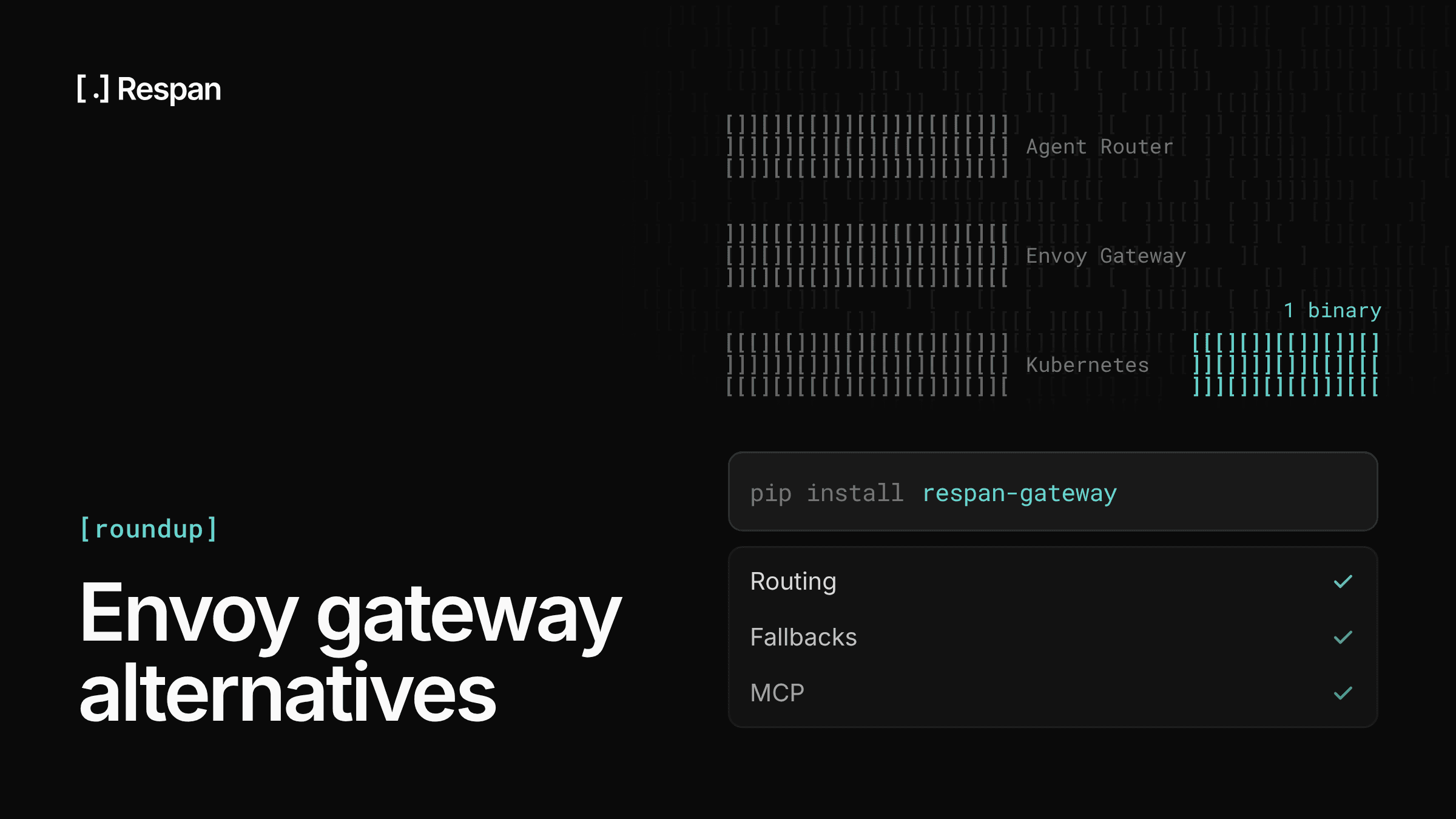
| Agent Router | Kubernetes 1.32+ | Your keys; Tetrate +5% | Free OSS |
To put the token cost column in numbers, a $5K monthly gpt-6.1-sol bill at list price costs about $3K on Respan, against about $5.3K through OpenRouter with its 5.5% fee. On the options that use your own provider keys, the same bill stays at $5K in tokens, plus whatever the gateway costs to run.
If you already know how you want to run the gateway, the shortlist narrows quickly: staying on Kubernetes points to agentgateway or Kong, a single binary to Respan's open-source gateway, agentgateway, or Bifrost, and nothing to run to Respan managed, Portkey, or OpenRouter.
What is Envoy AI Gateway (now Agent Router)?
Envoy AI Gateway and Agent Router are the same project, renamed in September 2026 when it joined the Agentic AI Foundation.
Agent Router is an LLM gateway built on Envoy, the proxy many teams already run as their API gateway. It gives you one OpenAI-compatible endpoint across 20+ providers, with fallback, token limits per team, app, or model, an MCP gateway, and OpenTelemetry metrics.
Running it is where the weight sits. Routes, backends, and policies are Kubernetes custom resources, and version 1.2 needs Kubernetes 1.32 or later plus Envoy Gateway 1.9.2 or later.
The open-source project also stops at telemetry. Cost attribution, guardrails, and SSO are part of Tetrate's paid Agent Router Enterprise, so LLM cost tracking by team or customer means a Tetrate contract or building it yourself from the token metrics.
7 best Envoy AI Gateway alternatives
Respan comes first because it lowers the token bill rather than adding to it, and it runs without Kubernetes. After that, the list moves from the option closest to Agent Router toward the ones furthest from it: agentgateway shares its foundation and Gateway API model, Kong brings an API platform, LiteLLM and Bifrost are self-hosted proxies, and Portkey and OpenRouter run as managed services.
1. Respan
Respan is an open-source AI gateway that gives you one API key to 1,000+ models at up to 55% off per token, with a 0% fee. Respan passes its bulk rates on, so routing through it lowers the model bill, and in Respan-run benchmarks against LiteLLM, Portkey, and Bifrost, its open-source gateway handles 56,734 requests per second with 0.07 ms median added latency and 31 MB of memory.
Leaving Agent Router doesn't have to mean taking on another cluster. You can use Respan managed, where switching means changing a base URL and an API key, or run Respan's open-source gateway yourself as a single binary under MIT or Apache-2.0, with routing, fallbacks, and MCP turned on in one config file. Start with the open-source gateway on your own infrastructure. When you want every request traced, priced, and scored, turn on the Respan plugin to send them to the hosted platform. The Free plan covers getting started, and Team is $199 a month billed yearly.
- Pay less per token - Up to 55% off on Respan credits, with a 0% fee, across 1,000+ models.
- Stay up when a provider fails - Set a fallback chain once, and traffic moves to the next model the moment one errors or rate-limits. Retries and load balancing run at the gateway.
- Cap spend where it starts - Soft and hard limits per key, per customer, or org-wide, with costs broken down by model, request, and end customer.
- Keep personal data out of prompts - PII redaction masks names, card numbers, and emails before the model sees them.
- Tools for every model - MCP servers sit behind one key, so any model can use their tools.
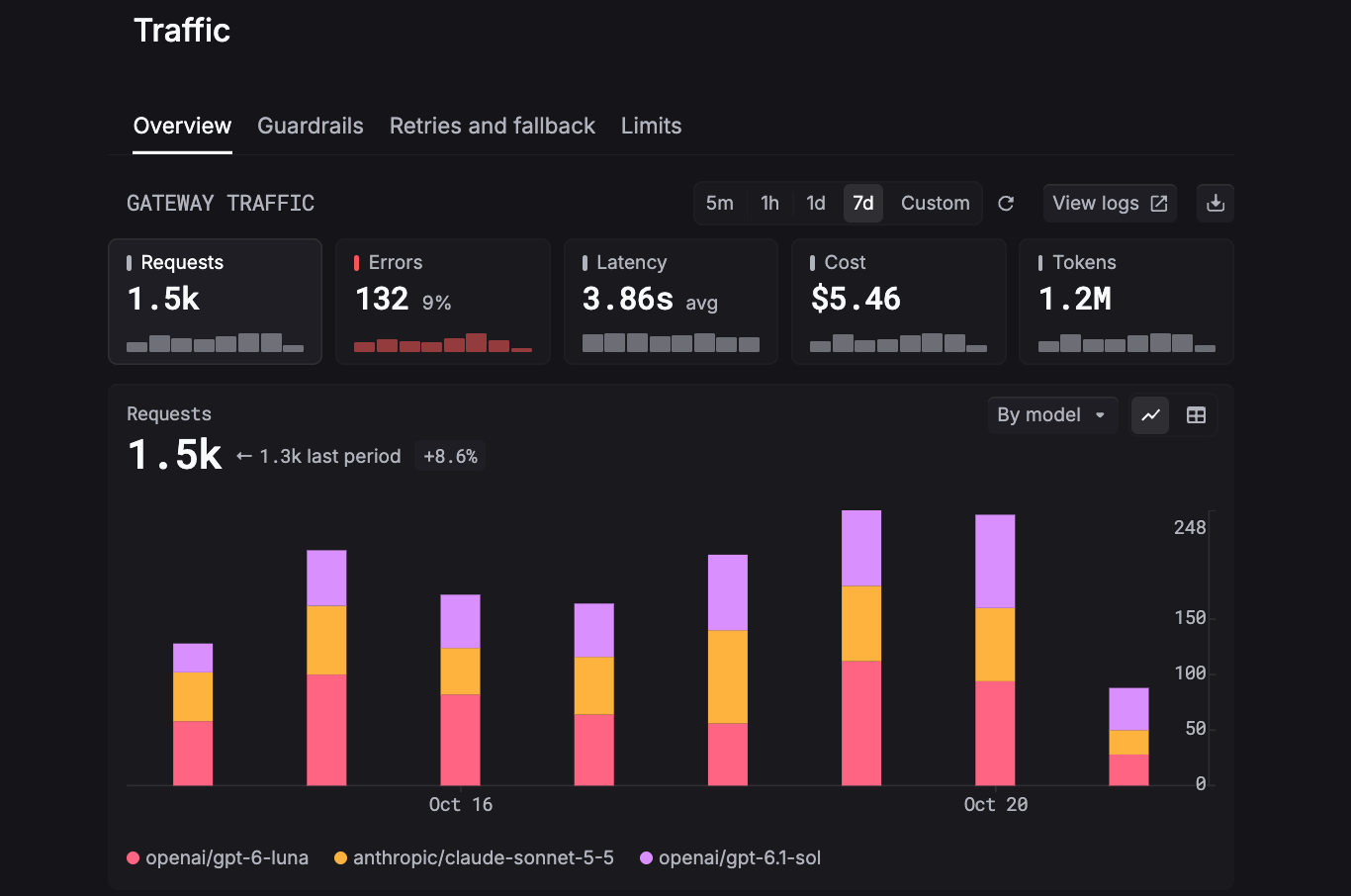
- See every call - Each request becomes a trace with latency and cost attached, and monitors on cost, errors, latency, or tokens alert Slack, email, or a webhook the moment a threshold breaches.
Runs on: Managed on Respan, or a single open-source binary on your own infrastructure.
Token cost: Up to 55% off list price on Respan credits, with a 0% fee.
2. agentgateway
agentgateway handles LLM, MCP, and agent-to-agent (A2A) traffic in one data plane. It's a Linux Foundation project under Apache 2.0 that has also joined the Agentic AI Foundation, and Solo.io sells an enterprise edition on top of it.
Where it differs from Agent Router is how it runs. You can start it as a standalone binary driven by a YAML file, or deploy it into Kubernetes with its own controller and Gateway API support, so a team can try it without a cluster and move into one later. On the LLM side it covers provider failover, token budgets, semantic caching, and prompt redaction, and its request logs carry token counts and cost in USD alongside OpenTelemetry and Prometheus output.
What you take on is operating it, rate limiting included, since limits shared across instances run through an Envoy rate limit service you deploy next to the gateway. Solo Enterprise for agentgateway doesn't have published prices, so if you want a number before talking to sales, the agentgateway alternatives are worth a look.
Runs on: Standalone binary or Kubernetes, self-managed.
Token cost: Provider list price on your own keys.
3. Kong AI Gateway
Kong AI Gateway adds LLM traffic to Kong Gateway, so teams already running Kong for their APIs can route models through the same layer and the same policies. It puts multiple providers behind one API with load balancing and provider switching, and adds prompt guards, PII sanitization, and token quotas by user, model, and time window. On the MCP side, it can generate MCP tools from APIs Kong already manages, and on the Plus plan, semantic caching and advanced AI rate limiting are paid add-ons.
The fit runs the other way for a team with no Kong footprint, since getting the LLM gateway means adopting an API management platform around it, which is the usual starting point for Kong AI Gateway alternatives. Plus starts at $25 a month and includes up to five LLMs and 1 million requests a month, with each additional model at $100 a month and each additional million requests at $200, so the bill grows with both your model mix and your traffic. Enterprise is custom-priced, fully self-hosting Kong sits under that separate Enterprise offering, and token spend still goes to providers at list price.
Runs on: Kong Konnect, or fully self-hosted on Kong's Enterprise plan.
Token cost: Provider list price on your own keys, with Kong billing platform usage separately.
4. LiteLLM
Under an MIT license, LiteLLM puts 100+ providers behind one OpenAI-compatible endpoint as a self-hosted proxy. Virtual keys carry models, budgets, and rate limits per user, team, or project, spend is tracked per key, team, user, and tag, and load balancing, fallbacks, and retries move traffic when a provider has problems. Logs go out to tools like Langfuse, Datadog, OpenTelemetry, and Prometheus.
Compared with Agent Router, the operating footprint is smaller, but it's still yours. You deploy it with Docker, Helm, or Terraform, connect a Postgres database, plan for Redis at production scale, and own upgrades and uptime for all of it. Features such as SSO and audit logs sit behind an Enterprise license, so the free version covers the gateway while the access controls a larger org needs come at a contract price, which is part of why teams also compare LiteLLM alternatives.
Runs on: Self-hosted proxy with a Postgres database.
Token cost: Provider list price on your own keys.
5. Bifrost
Maxim's Bifrost puts 23+ providers behind one OpenAI-compatible API from a gateway written in Go and licensed under Apache 2.0. It handles fallbacks and load balancing across keys and providers, semantic caching, and MCP tool calling, with governance through virtual keys that carry budgets and rate limits. Maxim reports about 11 microseconds of added overhead per request at a sustained 5,000 requests per second on a t3.xlarge instance.
It starts with npx or Docker and ships Helm charts for Kubernetes, so a team leaving Agent Router can run it with or without a cluster. What you give up on the free build is the enterprise layer, since adaptive load balancing, clustering, guardrails, the full MCP gateway, and private deployments are Enterprise features with custom pricing. Teams that would rather not operate a gateway at all will get less from it than from the managed Bifrost alternatives.
Runs on: npx, Docker, or Kubernetes, self-managed.
Token cost: Provider list price on your own keys.
6. Portkey (Prisma AIRS AI Gateway)
Portkey runs as a managed gateway with fallbacks across providers and models, automatic retries, load balancing across API keys, conditional routing, and both simple and semantic caching. Budget limits cap spend or tokens, rate limits set per-minute, hourly, or daily caps, and it connects to remote MCP servers. An open-source version of the gateway can also be self-hosted.
Palo Alto Networks acquired Portkey in May 2026, and the product now carries the Prisma AIRS AI Gateway name, though the free plan is still open to sign up. Pricing follows logs rather than tokens: Developer is free with 10K recorded logs a month and three days of retention, and Production is $49 a month for 100K logs with 30 days of retention, plus $9 per additional 100K. If moving onto a security vendor's platform isn't what you had in mind, there's a separate field of Portkey alternatives to weigh.
Runs on: Managed, or the self-hosted open-source gateway.
Token cost: Provider list price on your own keys.
7. OpenRouter
OpenRouter is a managed API with 600+ models from 80+ providers behind one account and one balance. By default it routes each request on providers' measured price, throughput, latency, and reliability, and a failed request retries on another provider. You can sort by price, throughput, or latency instead, and restrict routing to zero-data-retention endpoints.
There's nothing to deploy, which puts it at the opposite end from operating Agent Router, and nothing to self-host either. Usage is pay as you go, and the cost sits on top of the tokens: the Standard plan carries a 5.5% platform fee and Business 8%, while bring-your-own-key traffic is free up to $25,000 of list-price inference a month and 5% after that. At production volume, that fee is the number to model first, and it's a common reason teams start comparing OpenRouter alternatives.
Runs on: Managed only.
Token cost: List price plus a 5.5% fee, or 8% on Business.
How to migrate off Agent Router
Moving off Agent Router mostly means translating its custom resources into the new gateway's configuration, then moving clients over in stages. Because the rename kept the resource names, the inventory looks the same whether your cluster still says Envoy AI Gateway or Agent Router.
- Inventory the custom resources - List every
AIGatewayRoute,AIServiceBackend,BackendSecurityPolicy, andQuotaPolicy, since together they hold your routes, provider backends, credentials, and token budgets. - Carry over credentials - The provider keys referenced by each
BackendSecurityPolicymove into the new gateway as provider keys. On Respan, you can keep them or route on Respan credits instead, which is where the per-token discount applies. - Recreate limits before moving traffic - Token limits in Agent Router run on Envoy Gateway's global rate limiting, with a Redis instance storing the counters. Map each one to the new gateway's per-key or per-customer caps first, so no budget disappears at cutover.
- Recreate MCP routes - If you use Agent Router's MCP gateway, list each
MCPRoutewith the servers and tools it exposes, then register the same servers in the new gateway. In Respan's open-source gateway, servers listed ingateway.tomlare served at/mcp/{name}. - Point clients at the new endpoint - Agent Router and most of the alternatives above expose an OpenAI-compatible API, so moving a client is usually a base URL and key change. With Respan, that looks like this:
import os
from openai import OpenAI

client = OpenAI(
    base_url="https://gateway.respan.ai/v1/",
    api_key=os.environ["RESPAN_API_KEY"],
)- Run both gateways in parallel - Send a slice of traffic through the new gateway, compare error rates, latency, and cost on both paths, then raise the share as the numbers hold.
- Decommission last - Remove the custom resources, the rate limit service, and Redis only after traffic has fully moved.
Kept in parallel, the switch stays reversible until the new gateway has carried your real traffic long enough to trust it.
FAQ
What is the best Envoy AI Gateway alternative?
For teams that want lower token costs without running Kubernetes, the alternative to look at first is Respan: one API key to 1,000+ models at up to 55% off per token with a 0% fee, managed or self-hosted as a single binary. Teams that want to stay close to Agent Router's model can look at agentgateway, and among the other LLM gateways, LiteLLM and Bifrost fit self-hosting, while OpenRouter fits teams that want nothing to deploy.
Is Envoy AI Gateway now called Agent Router?
Yes. Envoy AI Gateway was renamed Agent Router on September 10, 2026, when it left the Envoy project and joined the Agentic AI Foundation. The code, maintainers, Apache 2.0 license, CLI, and custom resource names stayed the same, and version 1.2 was the first release under the new name.
Is there an Envoy AI Gateway alternative that doesn't need Kubernetes?
Yes, several. Respan runs managed with nothing to deploy, or as a single open-source binary configured from one file. agentgateway also runs as a standalone binary, LiteLLM and Bifrost run in Docker, and Portkey and OpenRouter are managed services. Agent Router's own aigw run mode works without Kubernetes, though its docs position it for testing configuration locally.
How much does Envoy AI Gateway cost?
The open-source project is free under Apache 2.0, so the cost is the infrastructure and engineering time to run it, plus provider tokens at list price on your own keys. The hosted Tetrate Agent Router Service is pay as you go at the model provider's cost plus a 5% fee, and Agent Router Enterprise is priced by quote. Either way, tokens bill at list price or above, which is the first number to look at if the goal is to reduce LLM API costs.
Envoy AI Gateway vs LiteLLM: which should you use?
Envoy AI Gateway, now Agent Router, fits platform teams that already run Kubernetes and Envoy and want AI traffic managed through the same custom resources. LiteLLM fits teams that want a self-hosted proxy without a cluster, with virtual keys, budgets, and spend tracking in the free version, at the cost of running the proxy and its Postgres database.