11 Best Bifrost LLM Gateway Alternatives to try in 2026
The top alternatives to Bifrost in the LLM Gateways space, compared on features, pricing, and what they're best at.
Updated November 25, 2026
Respan Gateway: up to 40% off tokens on Gemini, GPT, Claude and 1,000+ more models. One API key, 0% fee.
Bifrost alternatives compared
Disclosure: Respan, which publishes this guide, makes one of the products below. We tried to place it only where it is a strong fit, and we list its limitations the same way we list everyone else's.
After Respan, the order runs from gateways you host yourself to gateways someone else runs for you. Each entry says who it's best for, how it runs, and what it costs.
| Tool | Best for | How it runs | Pricing | Token price | Paid tiers add | MCP |
|---|---|---|---|---|---|---|
| Respan | Cheaper tokens, every call traced | Self-hosted or managed | 0% fee; plans from $0 | Up to 55% off list | SAML SSO, self-hosted platform | Built into the gateway |
| LiteLLM | Python teams, 100+ providers | Self-hosted | Free OSS; Enterprise quoted | Your provider rates | SSO, RBAC, audit logs | Built into the proxy |
| Portkey | Prisma AIRS customers | OSS gateway or hosted | Free; Pro $49/mo | Your provider rates | VPC, SSO, audit logs | Hosted MCP gateway |
| Kong AI Gateway | Teams already on Kong | Hybrid or managed | $25/mo plus usage | Your provider rates | SSO, audit logs, unlimited LLMs | Governs and generates MCP servers |
| TrueFoundry | VPC or air-gapped deployment | SaaS; VPC on Enterprise | Free; Pro $25/user/mo | Your provider rates | VPC, air-gap, data residency | Included; 5 servers free |
| Envoy AI Gateway | Envoy and Kubernetes teams | Self-hosted, laptop to Kubernetes | Free OSS; partners sell hosted | Your provider rates | Hosted and enterprise via partners | One catalog across servers |
| agentgateway | MCP and A2A traffic | Self-hosted, binary or Kubernetes | Free; Solo.io sells enterprise | Your provider rates | Enterprise distribution via Solo.io | Federation, plus A2A |
| OpenRouter | Large hosted model catalog | Managed | 5.5% fee (8% Business) | Provider list price | Fee discounts on Enterprise | No MCP gateway |
| Cloudflare AI Gateway | Teams already on Cloudflare | Managed | Core free; 5% on credits | Provider list price | Logs and guardrails billed separately | None documented |
| Vercel AI Gateway | Hosted, no token markup | Managed | No platform fee; paid add-ons | Provider list price | ZDR, allowlists, regional hosting | None documented |
| Mintive | Governing agents' MCP tools | Not published | Per user, quote only | Not published | Quote covers all features | Core product, role-based bundles |
How we picked
The 11 tools here route LLM traffic across more than one model provider, are actively sold or maintained, and come up when teams look for a Bifrost replacement. Each one is compared on:
- How it runs - Self-hosted, managed, or both, and what you take on when you run it yourself.
- Pricing - Platform fees, plans, per-seat or per-request charges, and what is quote-only.
- Token price - Whether you pay provider list price, your own provider rates, or a discount.
- What paid tiers add - Controls such as SSO, RBAC, audit logs, and private deployment that sit behind an enterprise plan.
- MCP support - Whether the gateway can sit in front of MCP servers as well as model providers.
Prices and plan limits were checked on each vendor's own pricing page or docs on November 25, 2026, and each entry links its source.
Low overhead is the main reason teams pick Bifrost, but vendors benchmark speed their own way. The one side-by-side run that includes Bifrost comes from the respan-gateway README:
| Respan Gateway (open source) | Bifrost | Portkey | LiteLLM (1 worker) | |
|---|---|---|---|---|
| Added latency (p50) | 0.07 ms | 0.16 ms | 0.17 ms | 4.34 ms |
| Throughput | 56,734/s | 18,182/s | 4,187/s | 268/s |
| Memory | 31 MB | 488 MB | 350 MB | 418 MB |
| 1k streams, success | 100% | 92-100% | Not reported | 79% |
| p99 with 5% slow calls | 105 ms | 2,002 ms | 2,003 ms | 2,024 ms |
These are Respan-run benchmarks, and Maxim's own test reports 11 µs of added overhead for Bifrost at 5,000 requests per second on a t3.xlarge, so expect the numbers to differ by setup. Production LiteLLM deployments also usually run more than one worker, so test your shortlist on your own traffic before deciding on speed.
The best Bifrost LLM gateway alternatives
Respan
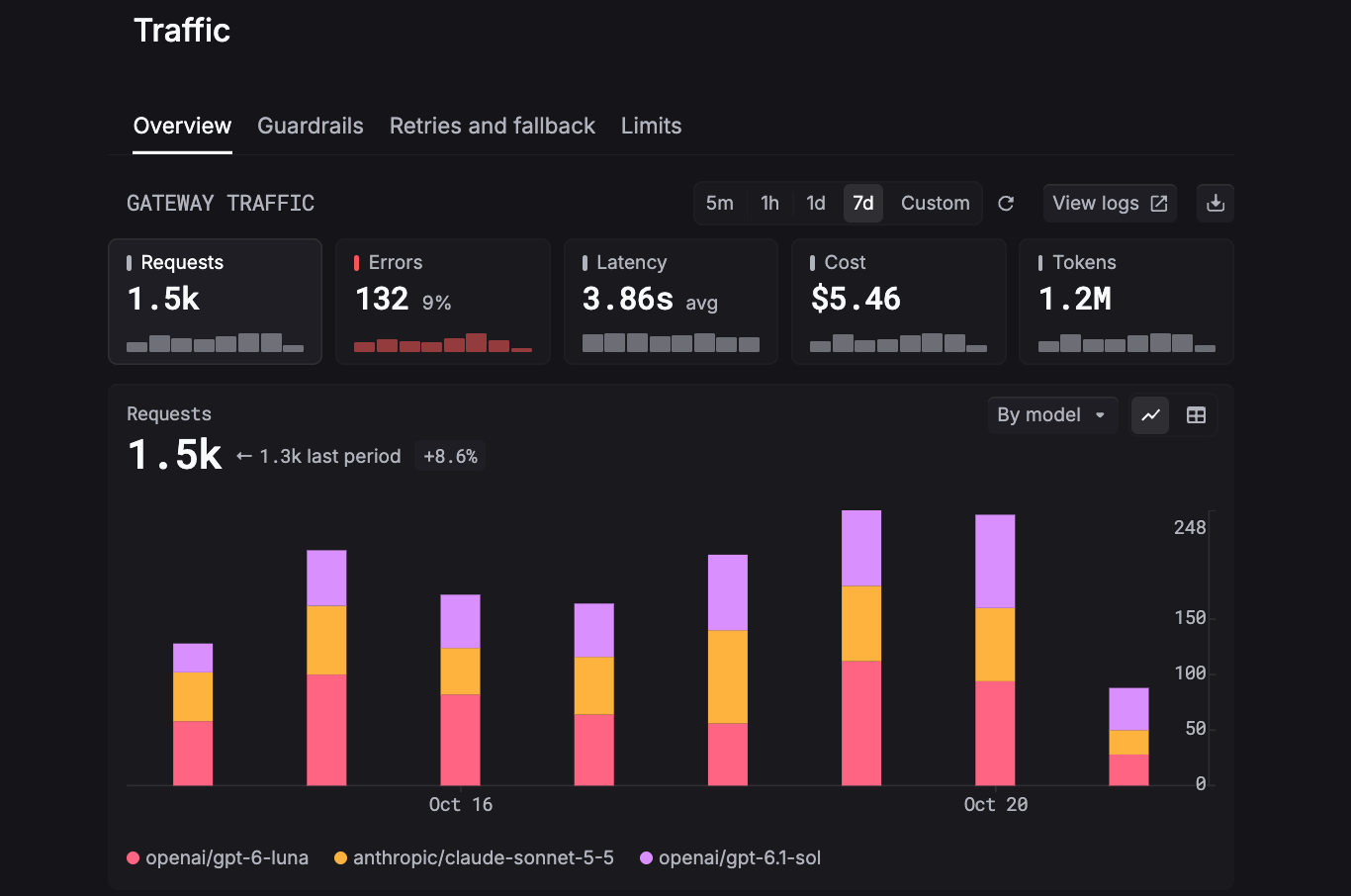
Best for: Teams that want to pay less per token, with a gateway faster than Bifrost and every call traced.
The take: Respan (formerly Keywords AI) is an open-source AI gateway: one API for 1,000+ models, with every call traced in Respan. Respan charges a 0% fee and passes bulk rates on, so tokens bought with Respan credits cost up to 55% less than list price, depending on the model.
On speed, the open-source gateway adds 0.07 ms of median latency against 0.16 ms for Bifrost in Respan-run benchmarks, and the managed gateway adds 0.07 ms of median server-side overhead.
- Up to 55% off tokens - On Respan credits, bulk rates are passed on with a 0% fee, so the managed gateway can cost less than paying provider rates through a gateway you run yourself.
- More throughput on less memory - 56,734 requests per second on 31 MB, against 18,182 requests per second on 488 MB for Bifrost, in the same Respan-run tests.
- Stays up when a provider stalls - Fallbacks, retries, and hedged races between providers, and with 5% of provider calls slowed, p99 held at 105 ms against 2,002 ms for Bifrost.
- MCP and any SDK - MCP servers sit behind one key, and the OpenAI, Anthropic, and Gemini SDKs can each call any model, with tools and streaming translated both ways.
- Every call traced - The Respan plugin turns each request into a trace in Respan, with its cost and latency attached.
Self-host it: Install the open-source gateway as a single binary, a Python package, or a Docker image, and turn on the Respan plugin when you want each request traced, priced, and scored in the hosted platform.
Respan is not ideal if:
- You want the whole Respan platform (dashboards, evals, prompts) on your own servers. That's Enterprise only, while the open-source gateway is free to self-host on any plan.
- You'll push more than 8,400 gateway requests a minute on a self-serve plan, since higher throughput is on Enterprise.
- You only route on your own provider keys, since Respan's token discounts apply to Respan credits, not bring-your-own-key traffic.
Pricing: The open-source gateway is free. On the managed platform, Free is $0 with 100k logs and 4,200 gateway requests a minute, and Team is $199/month billed yearly ($249 monthly), adding bring-your-own-key support, 8,400 requests a minute, and a 99.99% uptime SLA, per Respan's pricing page. Enterprise is custom and adds SAML SSO and self-hosting of the full platform. Each model's current discount is listed in Respan's model catalog, and discounts grow with annual commitment, with spend across every provider counting toward one commitment.
LiteLLM
Best for: Python teams that want 100+ providers behind a proxy they host themselves.
The take: LiteLLM is an open-source Python SDK and proxy that puts 100+ LLM providers behind one OpenAI-compatible API, with virtual keys, budgets, spend tracking, and an MCP gateway in the free version. Moving from Bifrost means trading Go for Python, and one LiteLLM worker handled 268 requests per second in the Respan-run benchmark above, so you may need more instances at the same traffic, a tradeoff the Bifrost vs LiteLLM comparison covers in detail.
LiteLLM is not ideal if:
- You need SSO, SCIM, RBAC, audit logs, or secret-manager integration without an Enterprise contract.
- You'd rather not run a database beside the gateway, since virtual keys and spend tracking need one.
Pricing: The open-source proxy is free, so the bill is provider rates plus the infrastructure you run it on. Enterprise is an annual plan quoted by sales and sized to gateway request capacity, deployment, and support rather than tokens, per LiteLLM's pricing, with a 30-day trial key.
Portkey
Best for: Teams standardizing on Palo Alto Networks' Prisma AIRS platform.
The take: Portkey is an AI gateway with an open-source build you can self-host and a hosted product that adds an MCP gateway. Since Palo Alto Networks acquired it, Portkey has been sold as the Prisma AIRS AI Gateway, and teams reassessing after that change can compare Portkey alternatives. In the Respan-run benchmark above, its gateway came close to Bifrost on median latency, 0.17 ms against 0.16 ms, at 4,187 requests per second.
Portkey is not ideal if:
- You need longer log retention on a lower tier, since Dev keeps 3 days and Pro keeps 30.
- You need VPC hosting, SSO, or audit logs without an Enterprise contract, or an air-gapped deployment, which Portkey no longer offers to new customers.
Pricing: Dev is free with 10K requests a month, and Pro is $49/month with 100K requests and $9 per additional 100K, up to 3M, per Portkey's plan comparison. Enterprise is custom, and the open-source gateway is free to self-host, with tokens at your own provider rates on every option.
Kong AI Gateway
Best for: Teams already running Kong for API management who want AI traffic under the same control plane.
The take: If Kong already handles your APIs, Kong AI Gateway adds LLM, MCP, and agent-to-agent traffic to the same platform through AI plugins, and it can generate MCP servers on top of APIs Kong already manages. You can run it hybrid, with gateways on your own infrastructure, or on Kong's serverless and dedicated cloud gateways, and teams weighing other options can compare Kong AI Gateway alternatives.
Kong AI Gateway is not ideal if:
- You proxy many models on a small plan, since Plus charges $100 a month for each LLM past the ones included and caps you at 5.
- You need SSO or audit logging, which are Enterprise only.
Pricing: Konnect Plus starts at $25/month plus usage, with 1 million AI gateway requests included and $200 for each additional million, up to 10 million, per Kong's pricing. Hybrid control planes cost $200/month each, semantic caching is a paid add-on, and Enterprise is custom, billed annually.
TrueFoundry
Best for: Enterprises that need the gateway in their own VPC, on-prem, or air-gapped.
The take: TrueFoundry runs its gateway as SaaS on every plan and moves it into your VPC, on-prem, or an air-gapped environment on Enterprise. An MCP gateway is included, with 5 MCP servers on the free Developer plan and full access on Pro, and MCP tool calls draw from the same request allowance as LLM calls, which adds up quickly if your agents lean on tools.
TrueFoundry is not ideal if:
- You need VPC, on-prem, air-gapped deployment, or data residency without an Enterprise contract.
- Your team is large, since Pro is priced per user.
Pricing: Developer is free for up to 3 users with 10K requests per user a month. Pro is $25 per user a month with 20K requests per user and $20 per additional 100K, per TrueFoundry's pricing, and Enterprise is custom with an annual commitment.
Envoy AI Gateway
Best for: Platform teams already running Envoy or Kubernetes.
The take: The project now goes by Agent Router, since Envoy AI Gateway was renamed with the same code and maintainers and sits in the Agentic AI Foundation under an Apache 2.0 license. It puts 22 providers behind one API and builds one tool catalog from many MCP servers, filtered by who is asking. You can try it on a laptop with aigw run and deploy the same configuration to Kubernetes, and teams moving off it can compare Envoy AI Gateway alternatives.
Envoy AI Gateway is not ideal if:
- You want cost attribution, guardrails, or enterprise SSO from the project itself, since those come from partner editions such as Tetrate's.
- You don't run Kubernetes or Envoy in production and don't plan to.
Pricing: The open-source project is free. Tetrate sells a hosted service and a self-managed enterprise edition, Nutanix and Paper Compute Co. offer their own versions, and none of them list pricing on the Agent Router site.
agentgateway
Best for: Teams routing MCP and agent-to-agent traffic alongside their LLM calls.
The take: Built for agent traffic first, agentgateway is an Apache-2.0 Linux Foundation project, originally created by Solo.io, that federates MCP tools across stdio, HTTP, SSE, and Streamable HTTP servers, turns OpenAPI specs into tools, and routes A2A calls between agents. It runs as a standalone binary, in Docker, or on Kubernetes, and if it isn't the right fit, the agentgateway alternatives cover self-hosted and managed options.
agentgateway is not ideal if:
- You want enterprise features and vendor support from the project itself, since those come through Solo.io's enterprise distribution.
Pricing: The project is free to self-host. Solo.io sells an enterprise distribution and 24x7 production support, with no public pricing.
OpenRouter
Best for: Teams that want a large hosted model catalog behind one key, paid with credits.
The take: OpenRouter is a hosted gateway with 600+ models from 80+ providers behind one API, so there's nothing to run. Coming from Bifrost, the change is where the cost sits: tokens are billed at provider list price, and a platform fee on credits grows with your spend, which the OpenRouter alternatives comparison weighs against fee-free options.
OpenRouter is not ideal if:
- Your token bill is large and growing, since the 5.5% fee (8% on Business) scales with every dollar.
- You need the gateway inside your own network, or an MCP gateway for your agents' tools.
Pricing: Standard carries a 5.5% platform fee and Business 8%, per OpenRouter's pricing. Bring-your-own-key traffic is free up to $25,000 of list-price inference a month, then 5%, and Enterprise offers fee discounts.
Cloudflare AI Gateway
Best for: Teams already on Cloudflare that want caching, rate limiting, and analytics in front of their model calls.
The take: For teams on Cloudflare, Cloudflare AI Gateway is available on every plan, with dashboard analytics, caching, rate limiting, and DLP scanning free and provider inference passed through with no markup. Its AI Gateway docs don't cover MCP, so tool traffic would need its own path.
Cloudflare AI Gateway is not ideal if:
- You buy inference through Unified Billing at volume, since the 5% fee on credits grows with spend.
- You need to run the gateway on your own infrastructure.
Pricing: Core features are free. Unified Billing adds 5% to every credit purchase, guardrails bill as Workers AI inference, and gateways created on or after September 24, 2026 store logs in Workers Logs at that product's rates, per Cloudflare's pricing docs.
Vercel AI Gateway
Best for: Teams that want a hosted gateway at provider list price, with no token markup.
The take: Pricing is the draw with Vercel AI Gateway, which charges no markup or platform fee on tokens, including when you bring your own keys, and your app doesn't need to run on Vercel to use it. Budgets, provider failover, and prompt caching are included, so the costs to watch are the add-ons you turn on, and the Vercel AI Gateway alternatives comparison covers other managed options.
Vercel AI Gateway is not ideal if:
- You need to self-host the gateway.
- You want team-wide data controls without surcharges, since team-wide ZDR and provider allowlists each cost $0.10 per 1,000 requests.
Pricing: Provider list price through AI Gateway credits, with custom discounts on volume spend, per Vercel's pricing docs. Regional hosting adds 5% of inference cost, and turning off fallback to Vercel's keys adds $0.20 per 1,000 BYOK requests.
Mintive
Best for: Security and platform teams governing which MCP tools and models their agents can use.
The take: Formerly MintMCP, Mintive is a governance platform for AI agents with both an MCP gateway and an LLM gateway. On the MCP side, you approve servers, group them into role-based bundles with one endpoint per role, and switch off individual tools, while on the LLM side you set allowed models and budgets per team and trace each call to a person, agent, server, and model. It's SOC 2 Type II audited, with EU and US data residency.
Mintive is not ideal if:
- You want published pricing to compare against, since every plan is quoted.
- You need to confirm up front that it runs on your own infrastructure, since its site doesn't describe deployment options.
Pricing: Per user, based on active AI agent users, plus platform fees that scale with usage and team size, per Mintive's pricing. There's a 14-day free trial.
Recent changes
- Portkey joined Palo Alto Networks - The acquisition closed May 29, 2026, and Portkey is now sold as the Prisma AIRS AI Gateway.
- Envoy AI Gateway became Agent Router - The project kept the same code, maintainers, and Apache 2.0 license, and now sits in the Agentic AI Foundation.
- MintMCP became Mintive - The company renamed and now sells an LLM gateway alongside its MCP gateway.
- Cloudflare moved AI Gateway logs - Gateways created on or after September 24, 2026 store logs in Workers Logs, which is priced separately.
- Respan open-sourced its gateway - respan-gateway launched in October 2026 under an MIT or Apache-2.0 license.
Gateways are changing owners, names, and pricing often enough that keeping your code on an OpenAI-compatible API is a reasonable hedge, since switching later stays a base-URL change.
How to choose a Bifrost alternative
Which alternative fits depends on what you rely on in Bifrost today and why you're moving off it:
- If the upkeep is the problem - A managed gateway takes deploying, scaling, and patching off your team, and OpenRouter, Cloudflare AI Gateway, Vercel AI Gateway, and Respan's managed gateway all run that way. The best LLM gateways comparison covers managed options on price and fees.
- If Enterprise pricing is the problem - Check where each alternative gates the same controls, since LiteLLM, Portkey, and Kong AI Gateway also keep SSO and audit logs on their enterprise plans.
- If you rely on its MCP gateway - LiteLLM, TrueFoundry, Envoy AI Gateway, agentgateway, and Respan route MCP traffic too, while OpenRouter has no MCP gateway and Cloudflare and Vercel don't document one.
- If speed is why you picked Bifrost - One LiteLLM worker handled 268 requests per second in the Respan-run benchmark against 18,182 for Bifrost, so plan for more instances on a Python proxy, or compare the self-hosted options in the open source AI gateways roundup.
- If you're moving from your own keys to credits - Bifrost adds nothing on top of your provider rates, so check how a managed gateway charges: OpenRouter adds a 5.5% fee, Cloudflare adds 5% on credits, Vercel adds no markup, and Respan discounts tokens bought with its credits.
Whichever you pick, the keys, budgets, and fallback rules you set up in Bifrost likely won't carry over as-is, so run the new gateway beside the old one on a share of traffic before you cut over.
Move off Bifrost without running another gateway
Switch with a base-URL change and route to 1,000+ models at up to 55% off tokens, with a 0% fee and every call traced. Book a demo to see how it works on your stack.
Bifrost alternatives FAQ
The open-source build of Bifrost is free, so you pay your provider rates plus the infrastructure you run it on. Bifrost Enterprise is custom-priced with a 14-day trial, and it adds guardrails, cluster mode, adaptive load balancing, SSO, RBAC, audit logs, and VPC, on-prem, or air-gapped deployment. If you'd rather not run a gateway at all, Respan's managed gateway charges a 0% fee, with up to 55% off tokens on Respan credits.
Yes. Bifrost is written in Go and licensed Apache 2.0, and the open-source build includes fallbacks, load balancing, caching, and an MCP gateway, while controls like SSO, RBAC, and audit logs are Enterprise only. Respan's gateway is also open source, dual-licensed MIT or Apache-2.0, and free to self-host.
It depends on whether you want MCP in the same gateway as your model calls. Respan's open-source gateway puts MCP servers behind one key and runs their tools inside a chat request, so any model can use them. Among the others, agentgateway federates MCP servers and routes A2A traffic, Mintive focuses on governing which tools each role can use, and LiteLLM and TrueFoundry include an MCP gateway as well.
In Respan-run benchmarks, Respan's open-source gateway added 0.07 ms of median latency against 0.16 ms for Bifrost, handled 56,734 requests per second against 18,182, and used 31 MB of memory against 488 MB. Maxim's own test reports 11 µs of added overhead for Bifrost at 5,000 requests per second on a t3.xlarge, so run your own traffic through a shortlist before deciding on speed.
Several do, through compliance programs or private deployment. Respan covers SOC 2, HIPAA with a BAA, GDPR, and ISO 27001, with PII masking and the option to omit logs, and teams that need routing inside their own network can run the open-source gateway. TrueFoundry offers VPC, air-gapped deployment, and data residency on Enterprise, and Mintive is SOC 2 Type II audited with EU and US data residency.