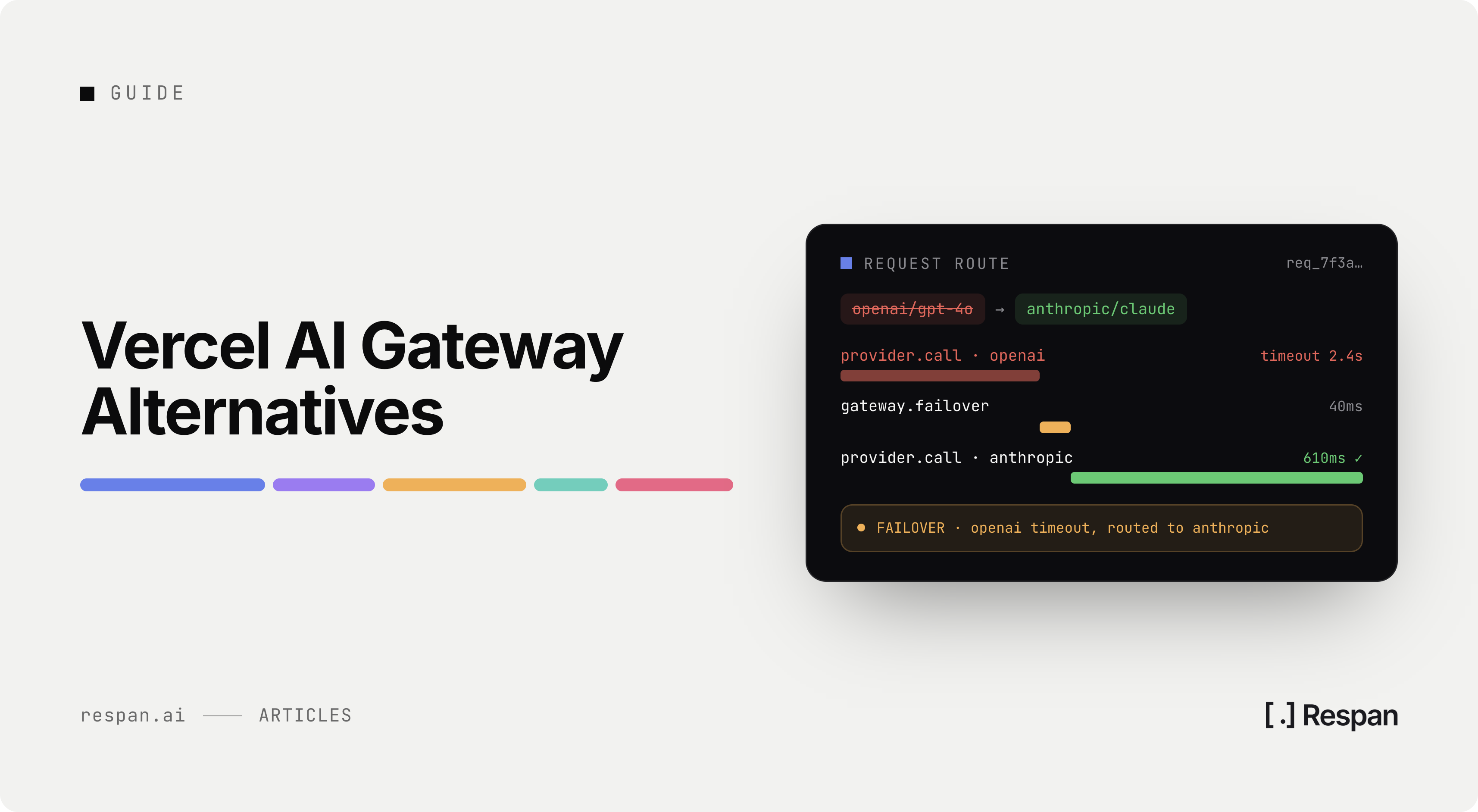

For a lot of teams, Vercel AI Gateway is the path of least resistance when your app already deploys to Vercel. One base URL, zero markup on tokens including bring-your-own-key, failover across providers, and spend visible in the dashboard you already use. For a Next.js team adding an AI feature, that combination is hard to argue with.
The argument starts when the app stops being only a Next.js app. Backend services move to AWS. A compliance review asks where prompts are stored and who can read them. An agent workload starts making twelve model calls per user action, and the question changes from what the request cost to which step failed.
Teams evaluating Vercel AI Gateway alternatives are usually solving one of three problems: the gateway needs to run somewhere Vercel does not, traffic and logs need to stay inside their own network, or routing alone stopped being enough. Model catalog size is rarely the reason anyone moves.
This list covers ten Vercel AI Gateway alternatives, what each one costs, where each one runs, and what each one hands back after a request resolves.
Why Teams Leave Vercel AI Gateway
The gateway itself works. What pushes teams off it is the set of assumptions baked into a first-party product on a hosting platform.
-
Deployment coupling - Vercel AI Gateway is a managed service operated by Vercel. There is no self-hosted build, no VPC deployment, and no air-gapped option. Once part of your stack runs on AWS, GCP, or your own hardware, the gateway is the one component that cannot follow it.
-
Data residency and key control - Prompts and completions transit Vercel's infrastructure. BYOK removes the token markup but not the transit, and BYOK requires moving to the paid tier by purchasing credits first. Regulated workloads that need model traffic to stay inside a controlled network do not have a configuration that gets them there.
-
What comes back per request - The gateway returns cost, token counts, and spend monitoring. For a single completion that is enough. For an agent that chains retrieval, three tool calls, and a summarization step, spend per request does not tell you which span was slow, which tool returned garbage, or whether the output was worse than last week's.
The free tier also narrows faster than most teams expect. It covers a subset of the catalog rather than the full model list, applies lower per-model rate limits, and returns a 429 when you exceed them. Buying credits moves you to the paid tier and the monthly free credit stops applying.
10 Vercel AI Gateway Alternatives
Ranking a gateway on model count is the easiest comparison to make and the least useful one. Nearly every option below routes to hundreds of models through an OpenAI-compatible endpoint, so catalog size stops being a differentiator somewhere around the second entry.
The criteria that actually separate these tools:
- Where it runs - Managed only, self-hostable, or deployable inside your own VPC.
- Migration cost - Whether adoption is a base URL change or an application rewrite.
- Reliability primitives - Ordered fallback, load balancing across keys, retries with backoff.
- Cost controls - Per-key budgets, hard caps, alerting before the invoice.
- What you get per request - Logs only, or a trace tree with the model attempted, the fallback that fired, the cache result, and eval scores attached.
- Governance - Per-team budgets, RBAC, SSO, audit trails.
| Gateway | Best for | Self-host | Pricing |
|---|---|---|---|
| Respan | Gateway, observability, evals, and prompts on one platform | Enterprise | Free, $199/mo Team |
| LiteLLM | Open-source proxy you operate yourself | Yes (OSS) | Free OSS, Enterprise custom |
| Bifrost | Low-overhead Go gateway, fully self-hosted | Yes (OSS) | Free OSS, Enterprise custom |
| Portkey | Managed gateway with governance controls | OSS and Enterprise | Free, $49/mo Production |
| Cloudflare AI Gateway | Teams already on Cloudflare | No | Free with a Cloudflare plan |
| OpenRouter | Widest catalog with the least setup | No | Free, 5.5% platform fee |
| Kong AI Gateway | Organizations standardized on Kong | Yes | $500/mo per control plane |
| TrueFoundry | Gateway bundled with model deployment | Yes | Free, $499/mo Pro |
| Apigee AI Gateway | API programs already run through Google Cloud | Hybrid | $365 to $3,431/mo per environment |
| Helicone | Existing installs only | Yes (OSS) | Free OSS, paid tiers above |
1. Respan
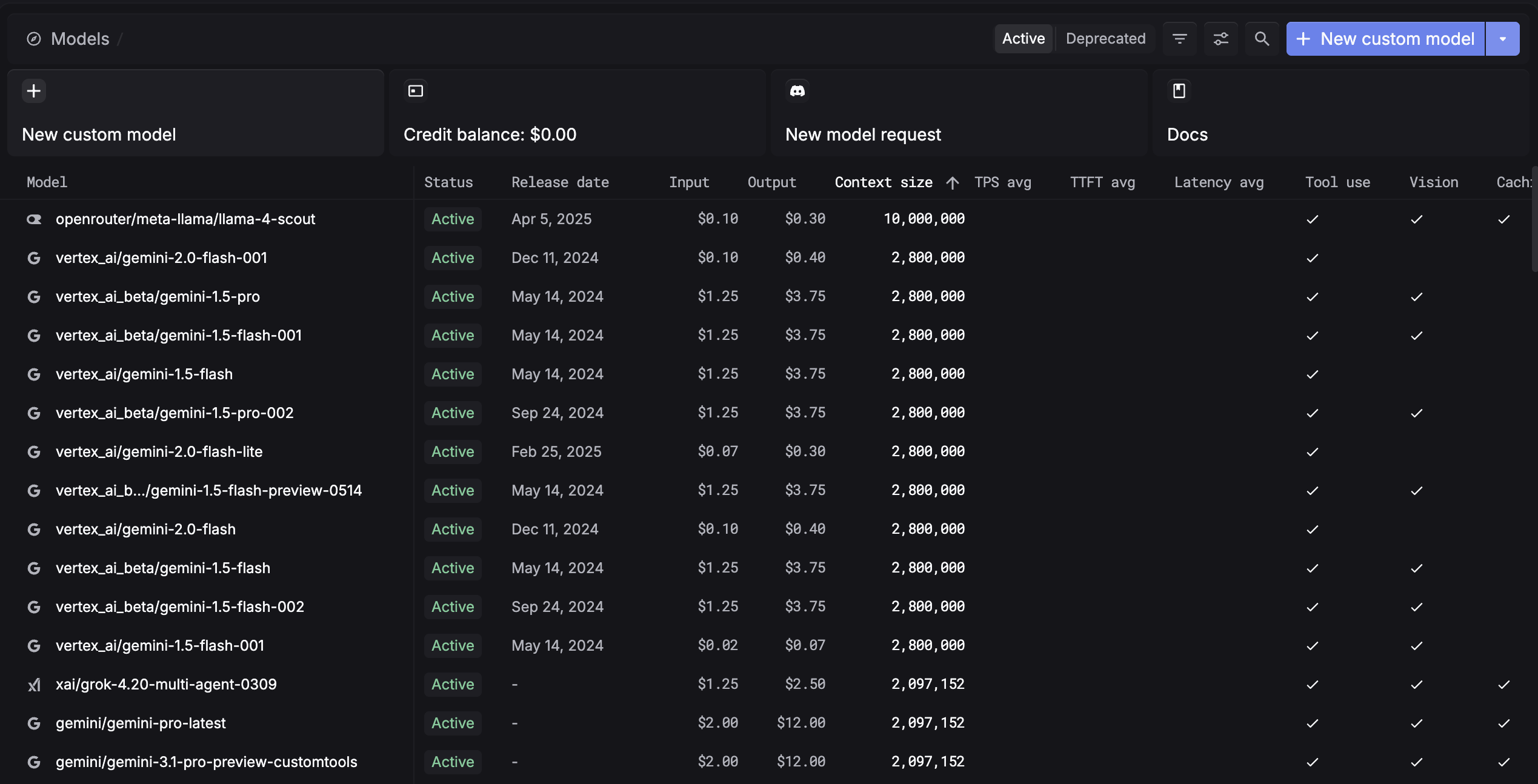
- Deployment: Cloud on Free and Team, self-hosted on Enterprise
- Models: 1,000+ through one OpenAI-compatible endpoint
- Pricing: Free tier, Team at $199/month, Enterprise custom
Leaving a platform-coupled gateway usually means assembling what it bundled: a router, a logging tool, an eval harness, and somewhere to keep prompts. Respan is one platform that owns all four, so a metric always ties back to the run behind it. Route, observe, and evaluate every LLM call.
Point your client at a single endpoint and ship. Every request is logged automatically, whether it goes through the router or a provider's native passthrough URL.
Here's what sets Respan apart from other Vercel AI Gateway alternatives:
- Stay up when a provider fails - Ordered model fallback turns an upstream error into the next model in your list instead of user-facing downtime, with load balancing across keys and automatic retries with backoff.
- See what your agent actually did - Each call becomes a trace tree with latency on every span, showing the model attempted, whether a fallback fired, cache hit or miss, tokens, and cost.
- Debug by tenant, feature, or thread - Tag requests with a customer identifier and metadata, then break down latency, errors, and eval scores by any of them.
- Know whether a change helped - Online and offline eval pipelines run against production traffic, so a prompt edit is measured rather than argued about.
- Ship prompts without a deploy - Versioned prompts referenced by ID, with a collaborative IDE, one-click deployment, and release management.
- Catch spend before the invoice - Soft warnings or hard caps per key, with Slack and email alerts when a threshold crosses.
- Pass the compliance review - SOC 2, HIPAA with a BAA, and GDPR, with self-hosted deployment on Enterprise.
- Test what your agent blocks - Red teaming against deployed agents, run on your terms.
Free covers the full platform with 100k logs, 412 requests per minute through the gateway, and 7-day retention. Team is $199 per month billed yearly, raising throughput to 8,400 requests per minute, extending retention to 30 days, and making datasets, evaluators, and prompts unlimited, with overages at $8 per 100k logs. Enterprise adds self-hosted deployment, SAML SSO, custom retention, and a HIPAA BAA.
Best fit: Teams whose reason for leaving Vercel AI Gateway is that routing alone stopped answering their questions.
One gateway that tells you why the request failed
Route to 1,000+ models through one endpoint with ordered fallback and per-key spend caps. Every call comes back as a trace tree with the model attempted, the fallback that fired, cost, and eval scores attached, so a bad output leads to the exact step that caused it.
2. LiteLLM
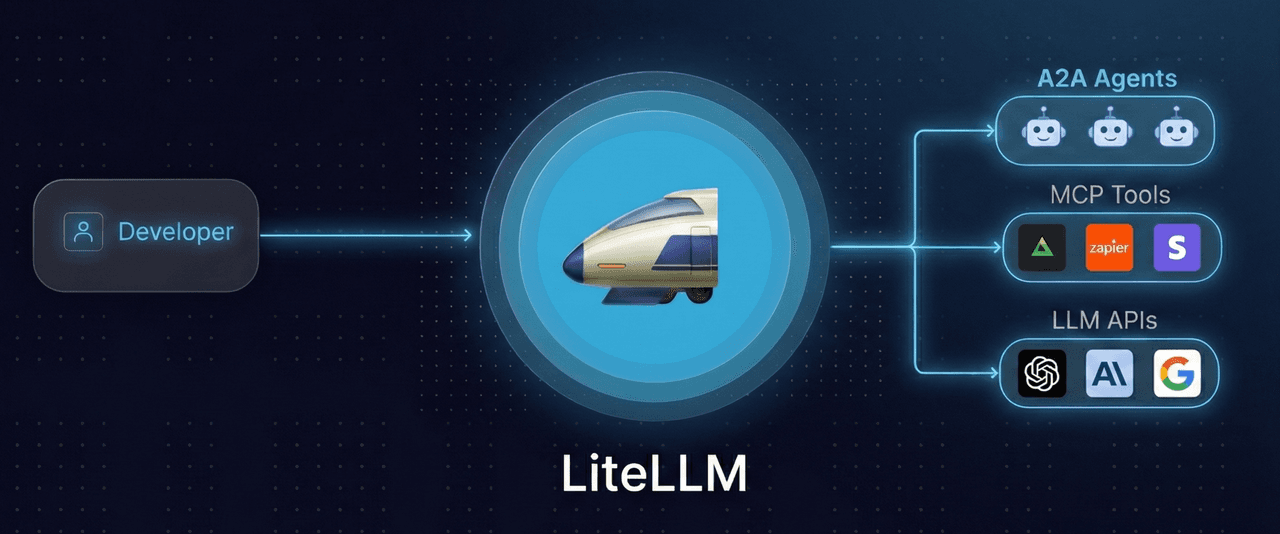
- Deployment: Self-hosted
- Models: 100+ providers through an OpenAI-compatible proxy
- Pricing: Open source free, Enterprise custom
LiteLLM is an open-source proxy that normalizes calls to more than 100 providers into OpenAI format. You run it, so keys and traffic never leave your infrastructure, which is the direct answer to the data control problem that pushes teams off a managed gateway. Routing, load balancing, per-key budgets, and spend tracking are in the open-source build.
Running a tool like LiteLLM is real operational work. The proxy needs a database, a cache layer, monitoring, and someone on call when it sits on the critical path of production traffic. Observability beyond request logging is not included, so most teams pair it with a separate tool. Governance features including SSO, audit logs, and JWT authorization are in the Enterprise tier.
The open-source gateway carries no license fee, so the bill is your infrastructure plus provider costs. Enterprise is quoted by annual request capacity, deployment architecture, and support needs rather than per token, which means the number comes out of a sales conversation instead of a published table. A 30-day trial key is available without a credit card.
Best fit: Teams with platform engineers who want to own the gateway layer outright and already have somewhere to send the telemetry.
3. Bifrost
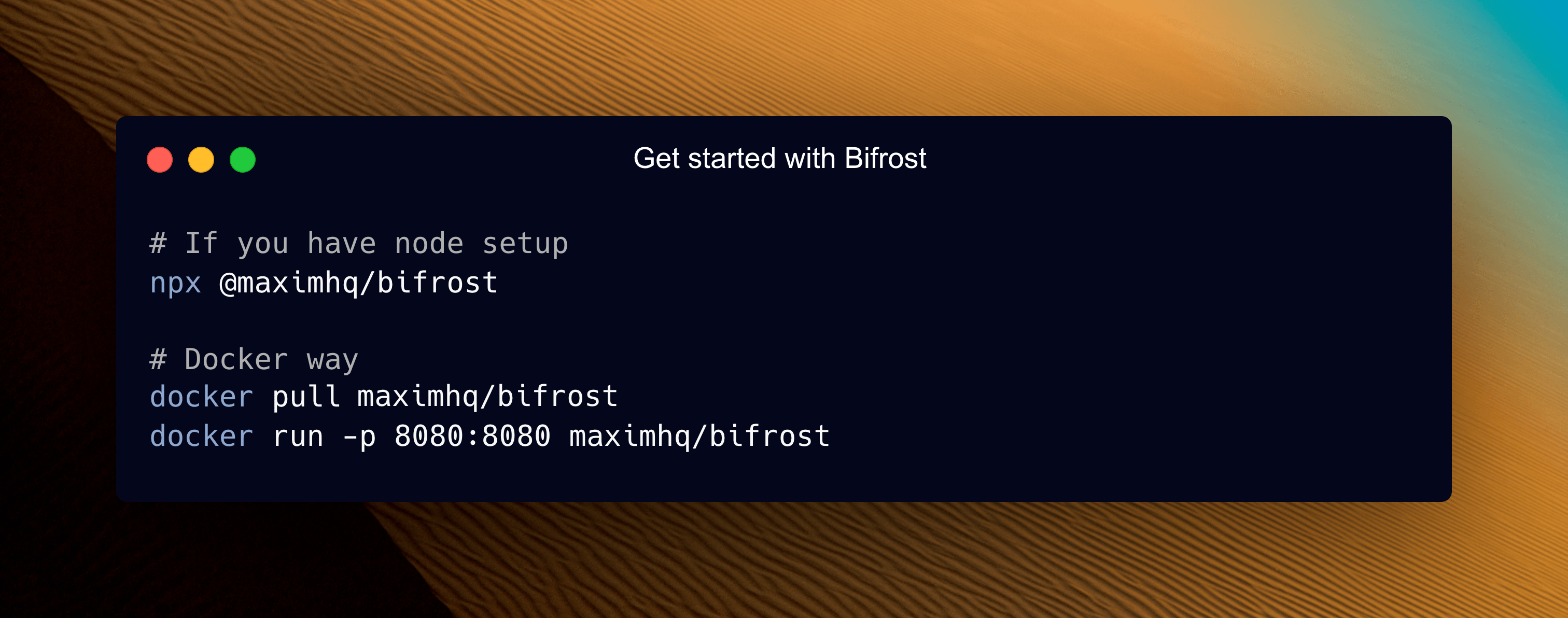
- Deployment: Self-hosted, in-VPC, on-prem, air-gapped
- Models: 1,000+ across 20+ providers
- Pricing: Open source free, Enterprise custom
Bifrost is a gateway written in Go by Maxim AI, published under Apache 2.0, and designed to run on infrastructure you control. Adoption is a base URL change against an existing OpenAI, Anthropic, or Google GenAI client. The open-source build covers routing, automatic fallback across providers and models, weighted load balancing across keys, semantic caching, governance through virtual keys with per-consumer budgets and rate limits, MCP support, and native Prometheus and OpenTelemetry export.
Observability is exported rather than resident, so traces and metrics land in whatever stack you already run and the gateway does not answer quality questions on its own. Evaluation lives in Maxim's separate platform. It is a newer project with a smaller community than LiteLLM, and self-hosting carries the same infrastructure and on-call cost as any gateway you operate.
Nothing in the open-source build is gated behind a paid tier, governance included. Enterprise is custom priced and buys private networking, SAML SSO, adaptive load balancing, clustering, and direct access to Bifrost engineers under an SLA. In-VPC, on-prem, and air-gapped deployments are Enterprise, with a 14-day trial available.
Best fit: Teams that want the gateway inside their own perimeter with minimal overhead and already have a metrics stack to send telemetry to.
4. Portkey
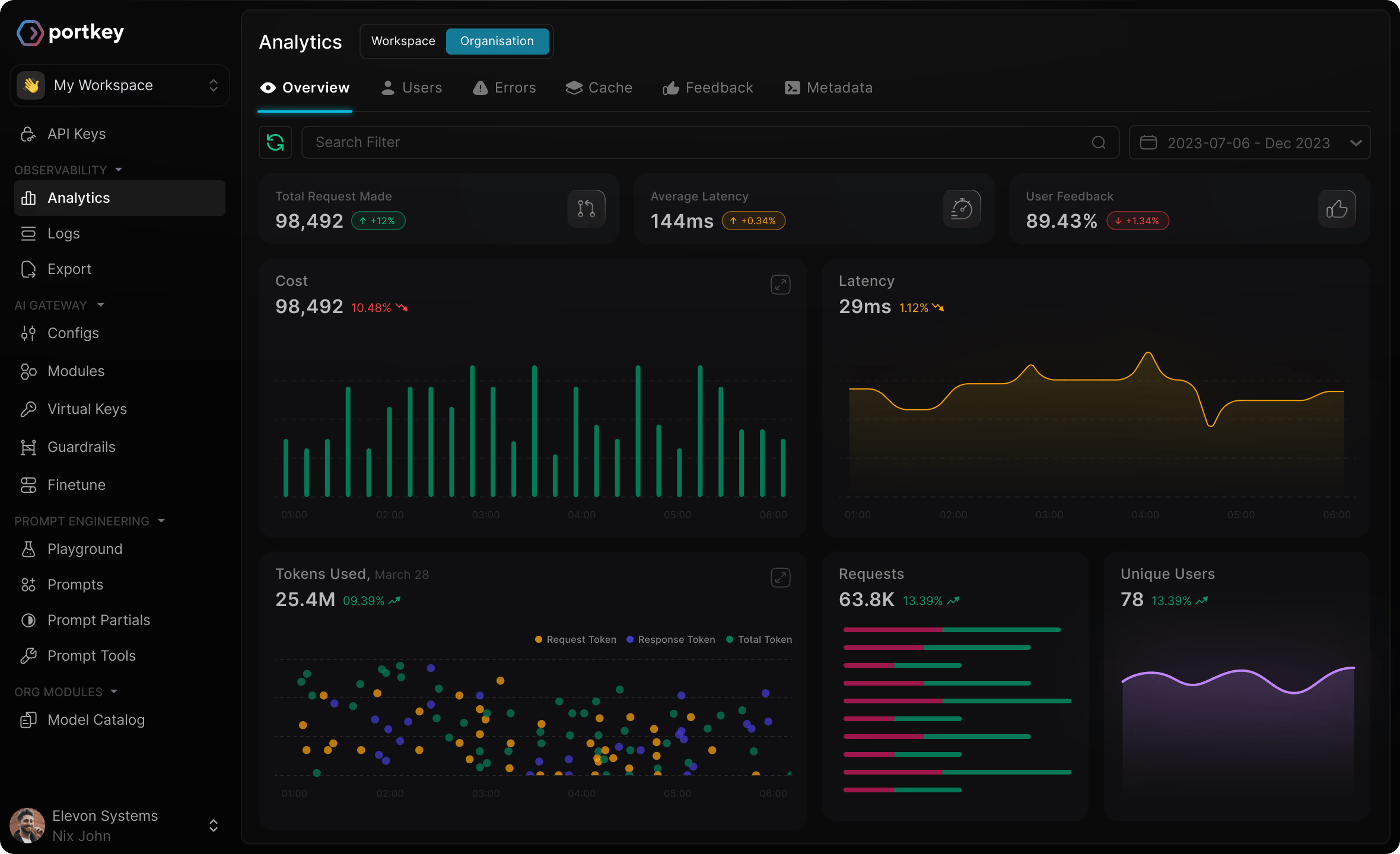
- Deployment: Open-source self-host, managed cloud, VPC on Enterprise
- Models: 250+ through a unified API
- Pricing: Open source and Developer free, Production at $49/month, Enterprise custom
Portkey is a managed gateway with a control-plane layer on top: universal API, automatic fallbacks, load balancing, retries, request timeouts, virtual keys with budgeting, and both simple and semantic caching. Observability covers logs, traces, feedback, custom metadata, filters, and alerts. Prompt management, guardrails, and an MCP gateway sit alongside the routing layer. For many tools like Portkey, the core gateway feature is open source and can be self-hosted with no request limit.
Also note that Palo Alto Networks completed its acquisition of Portkey, folding the product into Prisma AIRS, which is worth factoring into a multi-year roadmap decision. Metering is on recorded logs rather than requests, so exceeding your log allowance does not break routing but does stop recording observability data during your highest-traffic periods.
Developer is free with 10k recorded logs per month, and Portkey states outright that it is not suitable for production. Production at $49 per month raises that to 100k logs with overages at $9 per additional 100k requests, plus RBAC, semantic caching, and 30-day retention. Enterprise is custom priced for 10M or more logs and adds VPC hosting, SSO, and SOC 2 Type 2, GDPR, and HIPAA coverage.
Best fit: Teams that want a managed gateway with governance controls and are comfortable with the ownership change.
5. Cloudflare AI Gateway
- Deployment: Managed only
- Models: 20+ providers behind one endpoint
- Pricing: Core features free on all Cloudflare plans
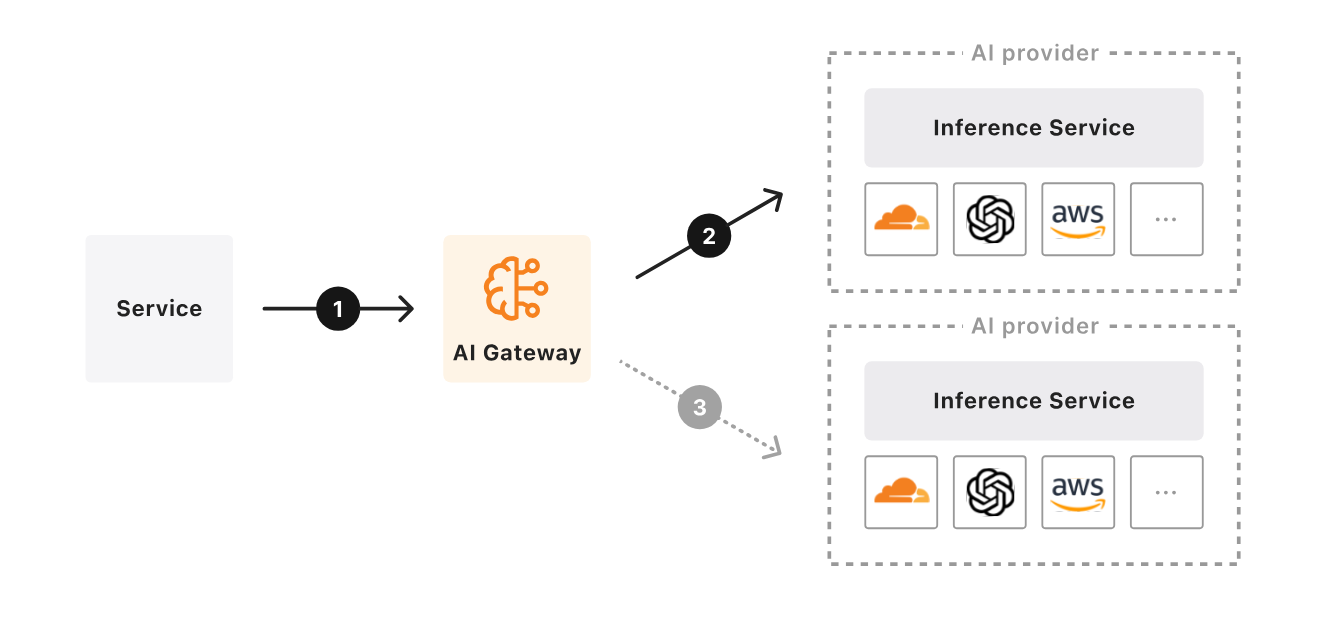
Cloudflare AI Gateway is a proxy that runs on Cloudflare's edge network, so the control plane sits close to your users rather than in one region. Integration is a base URL change, and a default gateway is created on your first request. Since the REST API release it exposes a universal endpoint plus OpenAI-compatible, OpenAI Responses-compatible, and Anthropic-compatible paths, so existing SDKs keep working.
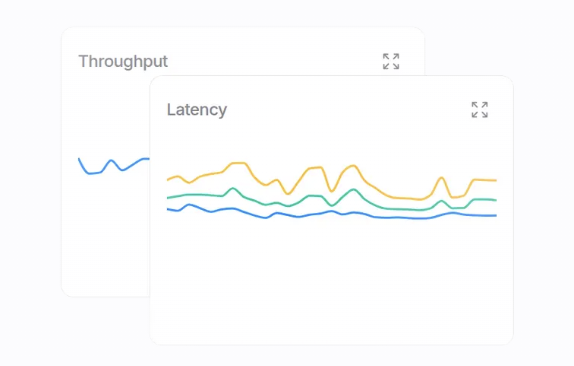
Trading one platform-coupled gateway for another does not solve deployment independence. There is no self-hosted build and no VPC option, and the gateway is most useful inside the Cloudflare ecosystem. Persistent log storage is capped by plan, and when the limit is reached new logs stop being saved until old ones are deleted. Observability is request-level rather than trace-level.
The gateway carries no per-call fee beyond your existing Cloudflare plan, so analytics, caching, and rate limiting cost nothing on any tier. Storage is what you pay for: persistent log limits scale from Workers Free up to Workers Paid at $5 per month, and new logs stop being written once you hit the ceiling. Logpush and Unified Billing both bill separately.
Best fit: Teams already on Cloudflare who want edge routing and caching and do not need the gateway to run anywhere else.
6. OpenRouter
- Deployment: Managed only
- Models: 400+ across 70+ providers
- Pricing: Free tier, 5.5% platform fee on pay-as-you-go, Enterprise custom
OpenRouter is a hosted aggregator that exposes 400 or more models from 70 or more providers behind one OpenAI-compatible API. Adoption is a base URL change and a single key, which makes it the shortest migration on this list. Auto-routing and preferred vendor selection, budgets and spend controls, prompt caching, and activity logs with export are available across paid tiers. Data policy-based routing lets you constrain which providers can see a request based on their logging terms.
Requests transit OpenRouter's infrastructure. There is no self-hosted build and no VPC deployment, so teams that moved off Vercel AI Gateway specifically to keep model traffic inside their own network do not solve that problem here. With tools like OpenRouter, observability stops at request logs, with no trace tree, eval scores, or prompt versioning.
The 5.5% platform fee on credit purchases is the number that decides this one, since tokens pass through at provider list price with no markup or minimum spend. BYOK is free up to $25,000 of list-price inference per month, then 5% of what the same call would have cost. Enterprise raises that allowance to $200,000 and adds SSO, contractual SLAs, and negotiated fee discounts.
Best fit: Teams that want the broadest catalog and the fastest cutover, and for whom hosted routing is acceptable.
7. Kong AI Gateway
- Deployment: Self-hosted, hybrid, or dedicated cloud
- Models: Provider-agnostic through AI Proxy plugins
- Pricing: $500/month per control plane
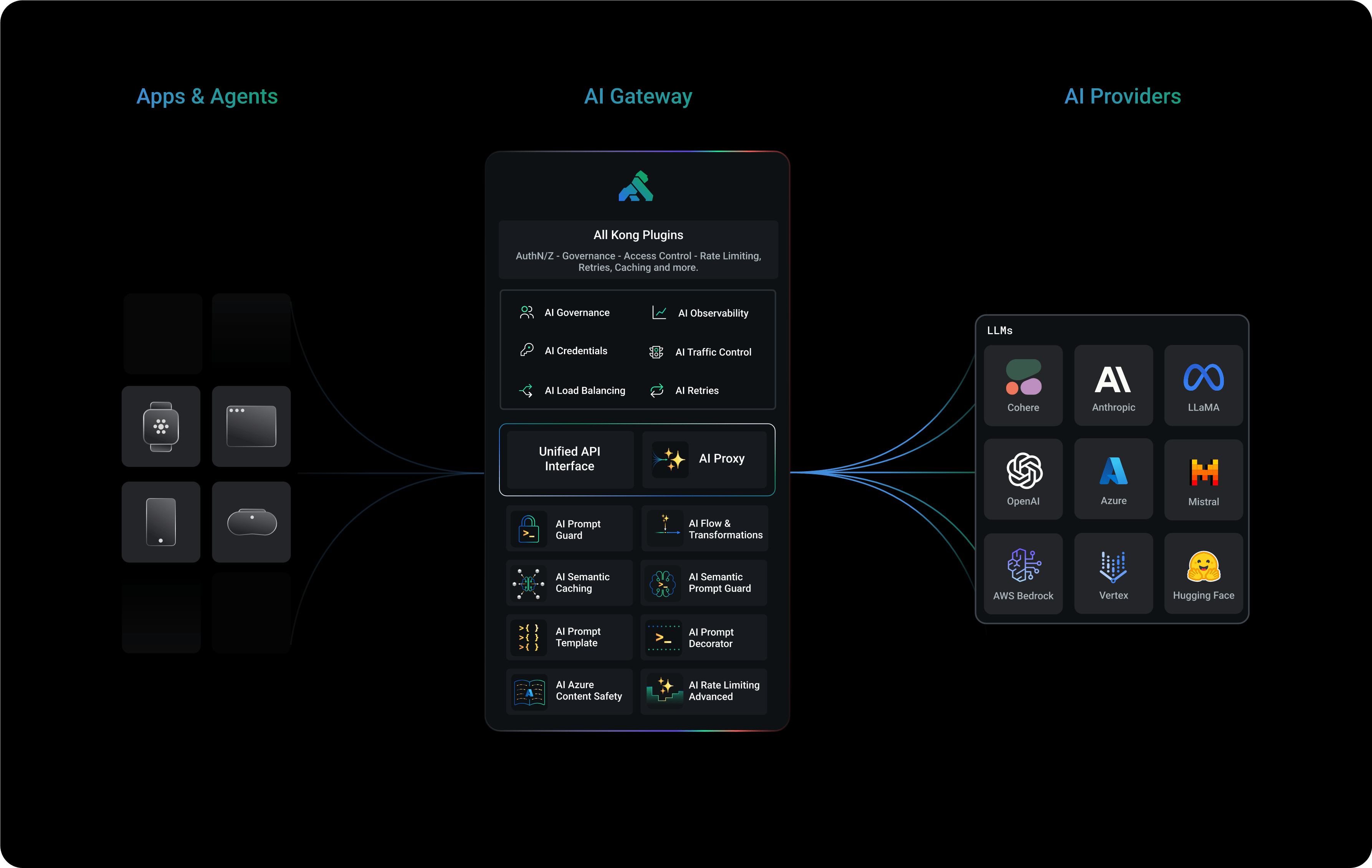
Kong added AI routing to its existing API gateway rather than building a separate product, so AI traffic is governed by the same plugin architecture, policies, and control plane as the rest of your APIs. The AI Proxy plugins normalize provider APIs, and the surrounding platform brings authentication, rate limiting, and audit that predate anyone's LLM workload.
The AI capabilities sit on top of a general-purpose HTTP proxy, which means the primitives are request-shaped rather than token-shaped. Semantic caching, per-model cost attribution, and trace-level LLM observability are not what the platform was built for.
$500 per month per control plane is the entire structure, and it rewards consolidation: one control plane covering your APIs and your model traffic costs what one covering APIs alone costs. Teams needing separate control planes per environment or region pay for each. AI Gateway capabilities meter separately per unique model routed, so a multi-model strategy adds line items a single-provider setup never generates.
Best fit: Organizations already standardized on Kong that want model traffic under the same governance as everything else.
8. TrueFoundry
- Deployment: SaaS, customer cloud, or on-prem
- Models: 250+ through one OpenAI-compatible API
- Pricing: Free Developer tier, Pro at $499/month, Enterprise custom
TrueFoundry pairs an LLM gateway with a model deployment platform, so the same product routes to hosted provider APIs and to models you run yourself on your own GPUs. Routing covers failover, retries, and load balancing, with virtual keys, budgets, and cost caps for governance, plus SSO, RBAC, and audit logs. An MCP gateway handles agent and tool workloads. Deployment runs as SaaS, into your cloud account, or on-prem.
The platform is considerably broader than a gateway. Teams that want routing and nothing else are buying a model registry, fine-tuning orchestration, and GPU scheduling they will not use. Onboarding and pricing lean toward sales rather than self-serve at the tiers where governance lives, and the gateway-specific community is small next to LiteLLM or OpenRouter.
The free Developer tier covers roughly 50,000 requests per month, enough to evaluate and not enough to run. Governance lives at Pro, $499 per month for up to 1M requests, unlocking RBAC on models, per-team budget controls, and rate limiting. Raw compute for self-hosted models bills through your cloud provider, so the platform fee is never the whole number.
Best fit: Teams that need one vendor for both API routing and self-hosted model inference inside their own VPC.
9. Apigee AI Gateway
- Deployment: Google Cloud managed, with hybrid entitlements on subscription
- Models: Provider-agnostic through API proxies
- Pricing: From $365/month per environment per region, plus per-call charges
Apigee is Google Cloud's API management platform, and model traffic runs through it as another set of API proxies. The value is consolidation for organizations whose API program already lives there: the same policy engine, security posture, analytics, and procurement contract cover model calls. Advanced API Security and API Analytics are available as add-ons, and hybrid entitlements let proxies run outside Google Cloud on subscription plans.
Nothing here is built for LLM traffic specifically. There is no token-level cost attribution, no semantic caching, no prompt management, and no eval layer. Cost is driven by environments and API call volume, which maps badly onto an agent that fires twenty calls per user action. The billing model has enough dimensions that forecasting requires a spreadsheet before it requires an architecture decision.
Three meters run at once on pay-as-you-go. Environments cost $365 per month per region for Base, $1,460 for Intermediate, and $3,431 for Comprehensive, API calls bill on top at $20 per 1M for Standard proxies and $100 per 1M for Extensible, and add-ons meter per call again at $20 per 1M for Analytics and $350 per 1M for Advanced API Security. Subscription tiers run through sales, and a 60-day evaluation sandbox is free.
Best fit: Enterprises whose API governance already runs on Apigee and who need model traffic under the same contract.
10. Helicone
- Deployment: Self-hosted open source, or existing cloud installs
- Models: Provider-agnostic through a proxy
- Pricing: Open source free, Hobby free, paid tiers above
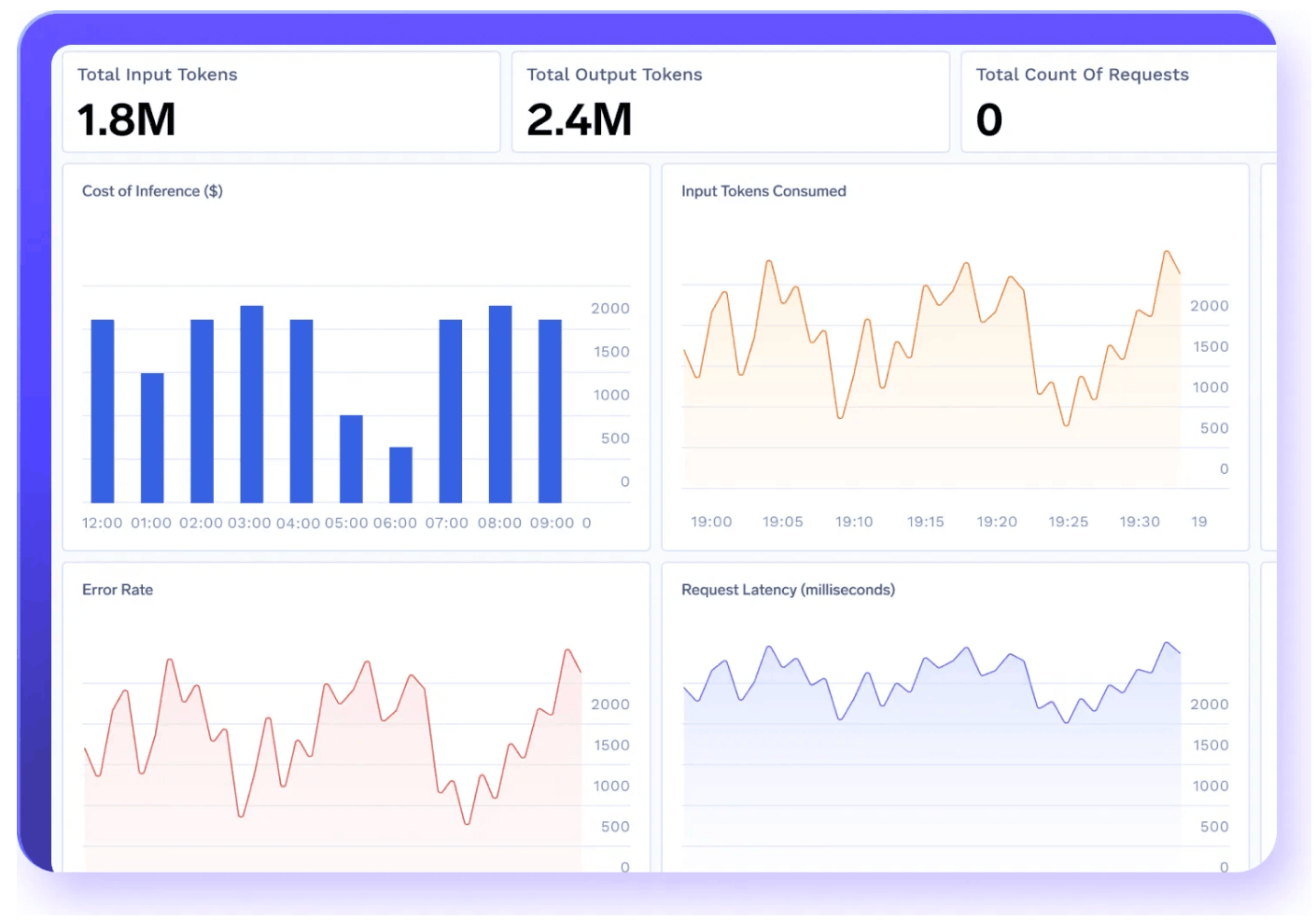
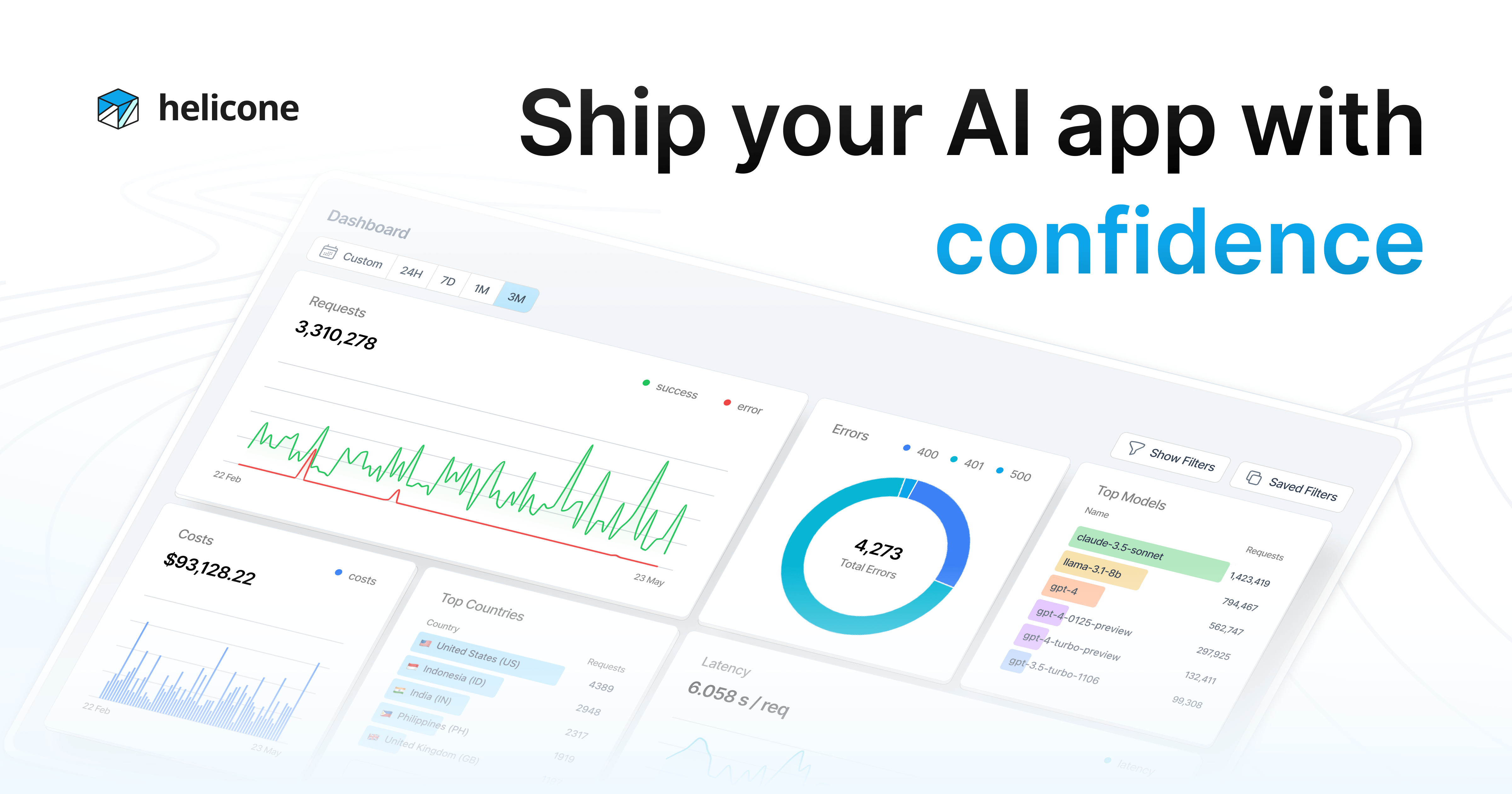
Helicone is an open-source observability proxy and gateway. Integration is a base URL change, after which request logs, token counts, cost tracking, and latency metrics appear on a dashboard. The proxy design makes platforms like Helicone some of the fastest ways to get visibility into LLM spend.
Note that Helicone was acquired by Mintlify in March 2026. The team confirmed that services remain live in maintenance mode with security patches, bug fixes, and new model support continuing, while active feature development has ended. Choosing it fresh in 2026 means adopting a product whose roadmap has stopped, which is a difficult argument to make for infrastructure sitting on the critical path.
A free Hobby tier still covers prototyping, with paid cloud tiers above it billed on request volume and a custom Enterprise tier above those. The open-source build stays free to self-host, and for teams already running it that path has the longest useful life, since a frozen roadmap matters less when you control the deployment.
Best fit: Existing installs. Teams choosing a gateway today should evaluate the options above.
Migrating Off Vercel AI Gateway
The migration is smaller than it looks, because almost every gateway here speaks OpenAI format. That was the point of the format winning.
- Change the base URL and the key. Point your client at the new endpoint and swap the credential. Application code, request shape, and response parsing stay as they are.
- Add your provider keys. Vercel's zero-markup BYOK means you likely already hold keys with each provider. Move them into the new gateway's key store rather than reissuing.
- Rebuild your fallback chain. Fallback configuration does not port between vendors. Write the ordered model list explicitly and test it by pointing the primary at a model name that does not exist.
- Reset budgets and rate limits. Per-key caps and alert thresholds are vendor-specific. Set them before you move traffic, not after the first runaway agent.
- Run both in parallel for a day. Send real traffic through the new path and reconcile token counts and cost against your provider invoices before you tear anything out. This is the step teams skip and regret.
- Check what you kept. If the reason for moving was visibility, confirm you can now answer which model served a request, whether a fallback fired, and whether output quality changed. If you cannot, the migration solved the deployment problem and left the harder one in place.
Two things are worth checking on whatever you pick, given how much of this market changed ownership in a single year. Can you export raw trace data without filing a support ticket, and can you self-host the whole thing, so a change of ownership is a decision you make rather than an event that happens to you.
FAQ
What is Vercel AI Gateway?
Vercel AI Gateway is a managed routing layer that gives Vercel team accounts a single endpoint for hundreds of models across providers including OpenAI, Anthropic, Google, Mistral, and xAI. It handles automatic retries, managed fallback, load balancing, spend monitoring, and bring-your-own-key, and it bills pay-as-you-go with no markup on provider list rates. It is tightly integrated with the Vercel AI SDK and the wider Vercel platform.
Teams look for alternatives when they need the gateway to run outside Vercel, need model traffic and logs inside their own network, or need trace-level detail on multi-step agents rather than cost per request.
Is Vercel AI Gateway good enough for production?
For applications that deploy to Vercel and make single completion calls, yes. It handles failover, tracks spend, and passes tokens through at provider list price. The constraints show up in three places: it cannot be self-hosted or deployed into a VPC, prompts and completions transit Vercel's infrastructure, and observability is request-level rather than trace-level, which is thin for multi-step agents.
Can I keep the Vercel AI SDK and switch gateways?
Yes. The Vercel AI SDK and Vercel AI Gateway are separate products. The SDK is an open-source TypeScript toolkit that works against any OpenAI-compatible endpoint, so you can keep your streaming UI and tool-calling code and point the provider configuration at a different gateway.
Do I have to rewrite application code to migrate?
Usually not. Every gateway on this list except Kong and Apigee exposes an OpenAI-compatible endpoint, so migration is a base URL change plus a key swap. What does not port is configuration: fallback chains, budget rules, rate limits, and caching policy all need to be rebuilt in the new tool.
Which Vercel AI Gateway alternatives can be self-hosted?
LiteLLM, Bifrost, Portkey, Helicone, and Kong all publish self-hostable builds. TrueFoundry deploys into your cloud account or on-prem. Respan offers self-hosted deployment on Enterprise. OpenRouter and Cloudflare AI Gateway are managed only, so neither solves the deployment independence problem that drives most migrations off Vercel.
What does Vercel AI Gateway cost compared to the alternatives?
Vercel charges no markup on tokens, including BYOK, so the gateway itself is close to free and you pay providers at list price plus payment processing on credit purchases. Optional surcharges apply for Custom Reporting at $0.075 per 1,000 writes and $5 per 1,000 reporting queries, and for team-wide provider allowlisting or zero data retention at $0.10 per 1,000 requests each. OpenRouter charges a 5.5% platform fee on credits. Portkey starts at $49 per month and Respan at $199 per month for Team, both metered on logs and scores rather than tokens. LiteLLM and Bifrost are free to self-host and cost infrastructure and engineering time instead.
Which alternative includes observability and evals?
Respan is the only option here that ships the gateway, tracing, evaluations, prompt management, and cost controls on one data plane, so eval scores and traces attach to the same request the router handled. Portkey and TrueFoundry include observability alongside routing but keep evaluation separate or limited. LiteLLM, Bifrost, OpenRouter, and Cloudflare export logs or metrics and expect you to bring your own analysis layer.
The gateway question and the observability question tend to arrive together, and answering them with two products means correlating two sets of IDs every time something breaks.
Reach every model, and know what happened
Respan runs the gateway, tracing, evals, prompt management, and spend limits on one data plane, so eval scores and traces attach to the same request the router handled. One integration instead of four.