October brought three new sets of open weights in three days. Meta released Muse Spark Open and StepFun released Step 5 Preview on October 15, and DeepSeek followed with its V4.1 Flash 1017 update on October 17. Two of the three now rank in the top three of this list.
Benchmark position is only part of the decision, though. What the license lets you do, what hardware you have, and what the model needs to be good at usually decide which open source LLM fits, and a 27B model you can serve from one machine may suit you better than a 2.8T model that needs a multi-GPU node.
Below are the 10 best open source LLMs of 2026, ranked by benchmark and compared by license, size, context window, and price, followed by notes on choosing and running them.
Open source LLMs at a glance
| Model | Maker | License | Total / active params | Context | Best for |
|---|---|---|---|---|---|
| DeepSeek V4.1 Flash 1017 | DeepSeek | MIT | 763B total | 1M | Long-context agents at low cost per call |
| MiMo-V2.6-Pro | Xiaomi | MIT | 1.02T / 42B | 1M | Agents working across text, image, video, and audio |
| Step 5 Preview | StepFun | StepFun Model License 1.0 | 600B / 27B | 1M (input and output combined) | Coding agents self-hosted on one GPU node |
| Kimi K3 | Moonshot AI | Kimi K3 License | 2.8T / 104B | 1M | Long engineering and research tasks with images |
| Qwen3.8 (2.4T-A95B) | Qwen (Alibaba) | Qwen3.8-Max License | 2.4T / 95B | 262K native, up to ~1M | General-purpose agents |
| GLM-5.3 | Z.ai | GLM-5.3 License | 744B / 40B | 1M | Coding and terminal agents |
| Muse Spark Open | Meta | Muse Model License | 816B / 42B | 1M | Multimodal input including audio |
| Qwen3.8-27B | Qwen (Alibaba) | Apache 2.0 | 27B dense | 262K native, up to 1M | Self-hosted agents and fine-tuning |
| Gemma 4 | Apache 2.0 | 31B dense (largest size) | 256K | On-device and workstation deployments | |
| gpt-oss-120b | OpenAI | Apache 2.0 | 117B / 5.1B | 128K | Single-GPU serving with a permissive license |
Parameter counts and context windows come from each model's official model card or launch post. DeepSeek's card for V4.1 Flash 1017 lists 763B total parameters without an active count. GLM-5.3's card doesn't restate its size, but its configuration matches GLM-5, which Z.ai lists at 744B total and 40B active parameters.
Latest open source LLM releases
Open weights have arrived quickly this fall, and three of the ten models here shipped in October:
- DeepSeek V4.1 Flash 1017 (October 17) - An update to V4.1 Flash with gains in coding and agent tasks and shorter outputs. DeepSeek's Flash API now serves it at the same price as the version it replaced.
- Step 5 Preview (October 15) - StepFun's 600B-parameter preview, with text and image input and a 1M-token context.
- Muse Spark Open (October 15) - Meta's first Muse model with downloadable weights, taking text, image, video, and audio input.
- MiMo-V2.6-Pro (September 21) - Xiaomi's 1T-parameter model, which handles text, image, video, and audio in a single model.
DeepSeek's update and Step 5 Preview both reached the top three of the Respan Index within weeks of release, and both are available as downloadable weights and through hosted APIs.
How we picked and ranked them
Every model on the list has downloadable weights in its maker's official Hugging Face organization, with a license file. API-only models and announced-but-unreleased weights were left out.
Strictly speaking, nearly every model here is open-weight rather than open source. You can download, run, and fine-tune the weights, but the training data and full training pipeline usually stay private. NVIDIA's Nemotron family, listed under other models, is one of the few that also publishes its training data and recipes.
Each model family gets one entry, led by its flagship, and variants such as DeepSeek V4 Pro or GLM-5.3-Flash are covered inside that entry. The list separates frontier-scale models that need a multi-GPU node from smaller models you can serve on one machine, and within each group the order follows the Respan Index.
The Respan Index is a 0 to 100 score on Respan's LLM benchmarks page that combines public benchmark results and lab-reported scores across coding, agents, reasoning, knowledge, and human preference. Scores are as of November 4, 2026. Respan didn't run separate evaluations for this guide, so every other number links back to where it was published.
Frontier-scale open source LLMs
All seven models in this group have 600B or more total parameters. Self-hosting any of them takes a multi-GPU node, so a hosted API is usually the quickest way to try them, with self-hosting saved for when volume or data rules call for it.
1. DeepSeek V4.1 Flash 1017
DeepSeek V4.1 Flash 1017 has the highest Respan Index score on this list at 59.4. DeepSeek released it on October 17 as a minor update to V4.1 Flash, and its card reports gains in reasoning, coding, agentic tasks, and visual benchmarks, along with shorter outputs and faster task completion. It accepts text and images, supports a 1M-token context, and ships under MIT, and the card lists 763B total parameters.
Its agents score of 76.8 on the Respan Index is the highest of any model here, and Mercor's APEX-Agents run measured 69.8% at maximum reasoning. The coding picture is less settled. DeepSeek reports 77.0 on DeepSWE v1.1 and 42.3 on Terminal-Bench 4.0 using the Claude Code harness, while Vals AI's Terminal-Bench 4.0 run, which uses its own harness for every model, measured 31.8%.
Pricing didn't change with the update. DeepSeek's API serves 1017 under the deepseek-flash model name at $0.30 per 1M input tokens on a cache miss and $1.20 per 1M output tokens at peak hours, and half that off-peak, while older Flash model names now route to it automatically. To see how that compares with other models, check Respan's cheapest LLM APIs ranking, and for a head-to-head with Alibaba's models, DeepSeek vs Qwen.
DeepSeek V4 Pro, with 1.6T total and 49B active parameters, is also MIT-licensed and scores 49.4. One practical note for both: DeepSeek V4 models ship a Python encoding script and a Rust library, deepseek-recipe, instead of a Jinja chat template, so check that your serving stack handles that format.
- Weights and license: deepseek-ai/DeepSeek-V4.1-Flash-1017, MIT
- Size: 763B total (active count not listed)
- Context: 1M tokens
- Respan Index: 59.4 overall · Coding 47.7 · Agents 76.8
- Use it for: Input-heavy agents and long-context jobs where cost per call matters
2. MiMo-V2.6-Pro
Xiaomi's MiMo-V2.6-Pro, released September 21, takes text, image, video, and audio in a single model. It has 1.02T total and 42B active parameters, supports a 1M-token context, and ships under MIT.
It scores 56.1 on the Respan Index, and its coding score of 45.6 trails only DeepSeek V4.1 Flash 1017 among the models here. Vals AI's Terminal-Bench 4.0 run measured 31.3%, and Mercor's APEX-Agents run measured 59.5%, while Xiaomi's own card reports 71.9 on DeepSWE v1.1 and 89.9 on Terminal-Bench 2.1.
The smaller MiMo-V2.6-Flash, with 309B total and 15B active parameters under the same MIT license, scores 52.3, which would place it between Qwen3.8 and GLM-5.3 on its own.
- Weights and license: XiaomiMiMo/MiMo-V2.6-Pro-RL, MIT
- Size: 1.02T total, 42B active
- Context: 1M tokens
- Respan Index: 56.1 overall · Coding 45.6 · Agents 64.6
- Use it for: Agents that work with screenshots, video, or audio alongside long tool traces
3. Step 5 Preview
Step 5 Preview is a 600B-total, 27B-active mixture-of-experts model from StepFun, which published the weights on October 15. It takes text and image input, and its 1M-token limit covers input and output combined. As the name says, it's a preview: StepFun's model card notes that the BF16 Transformers workflow hasn't been validated end to end, and that memory needs and usable context vary with the checkpoint and serving setup.
It scores 55.8 on the Respan Index and 31.8% on Vals AI's Terminal-Bench 4.0, level with DeepSeek V4.1 Flash 1017, and StepFun reports 67.7 on DeepSWE. For its size, the footprint is modest: StepFun's example FP8 configurations run on a single node of four B300s or eight H200s, served through vLLM or SGLang.
The StepFun Model License 1.0 follows Apache 2.0 with added conditions. Products with more than 100M monthly active users or $20M in monthly revenue must display "Powered by StepFun AI," and companies need a separate license to run a model-as-a-service business above $20M in revenue over 12 months or to build the model into consumer hardware such as phones, cars, or wearables. Internal use is exempt.
- Weights and license: stepfun-ai/Step-5-Preview, StepFun Model License 1.0
- Size: 600B total, 27B active
- Context: 1M tokens, input and output combined
- Respan Index: 55.8 overall · Coding 45.1 · Agents 58.2
- Use it for: Coding agents you want to self-host on one GPU node
4. Kimi K3
Moonshot AI's Kimi K3, released in July, is the largest model on this list, with 2.8T total and 104B active parameters, a 1M-token context, and native image and video understanding. Moonshot ships the weights in MXFP4, produced with quantization-aware training.
Its strongest independent results are on knowledge and human preference. Epoch AI's run of GPQA Diamond measured 93.1%, and its LMArena rating is 1488. It scores 53.0 on the Respan Index, held back by a coding score of 39.6 and 17.2% on Vals AI's Terminal-Bench 4.0, though Datacurve's DeepSWE run puts it at 68.5%, half a point behind GLM-5.3.
It's also expensive to call. Moonshot's API charges $3.00 per 1M input tokens and $15.00 per 1M output tokens, more than three times GLM-5.3's output rate and more than ten times DeepSeek V4.1 Flash 1017's. The GLM 5.3 vs Kimi K3 comparison covers when that premium is worth paying.
The Kimi K3 License is MIT-based with two added conditions. Companies running a model-as-a-service business with more than $20M in revenue over 12 months need a separate agreement with Moonshot, and products with more than 100M monthly users or $20M in monthly revenue must display "Kimi K3" in their interface. Internal use is exempt from both.
- Weights and license: moonshotai/Kimi-K3, Kimi K3 License
- Size: 2.8T total, 104B active
- Context: 1M tokens
- Respan Index: 53.0 overall · Coding 39.6 · Agents 61.7
- Use it for: Long engineering and research sessions that read images or video along the way
5. Qwen3.8 (2.4T-A95B)
With Qwen3.8, released in August, Qwen published weights for a Max-class model for the first time. The open checkpoint, Qwen3.8-2.4T-A95B, has 2.4T total and 95B active parameters, a native 262,144-token context that extends to about 1M, and text-only input. Alibaba's hosted Qwen3.8-Max is built on these weights and adds image input, a non-thinking mode, a 1M context by default, and built-in tools.
Independent evaluators tested the hosted Qwen3.8-Max rather than the raw weights, so read its numbers with that in mind. It scores 52.9 on the Respan Index, and its agents score of 68.0 is second only to DeepSeek V4.1 Flash 1017 here. Mercor's APEX-Agents run measured 63.3%, and Vals AI's Terminal-Bench 4.0 run 34.3%.
The Qwen3.8-Max License allows commercial use with two conditions. Products with more than 100M monthly users or $20M in monthly revenue must display the model name, and companies running a model-as-a-service or "AI Work Assistant" business with more than $50M in revenue over 12 months need a separate license from Qwen.
- Weights and license: Qwen/Qwen3.8-2.4T-A95B, Qwen3.8-Max License
- Size: 2.4T total, 95B active
- Context: 262K native, extensible to about 1M
- Respan Index (as Qwen3.8-Max): 52.9 overall · Coding 40.5 · Agents 68.0
- Use it for: General-purpose agents and multi-step business tasks
6. GLM-5.3
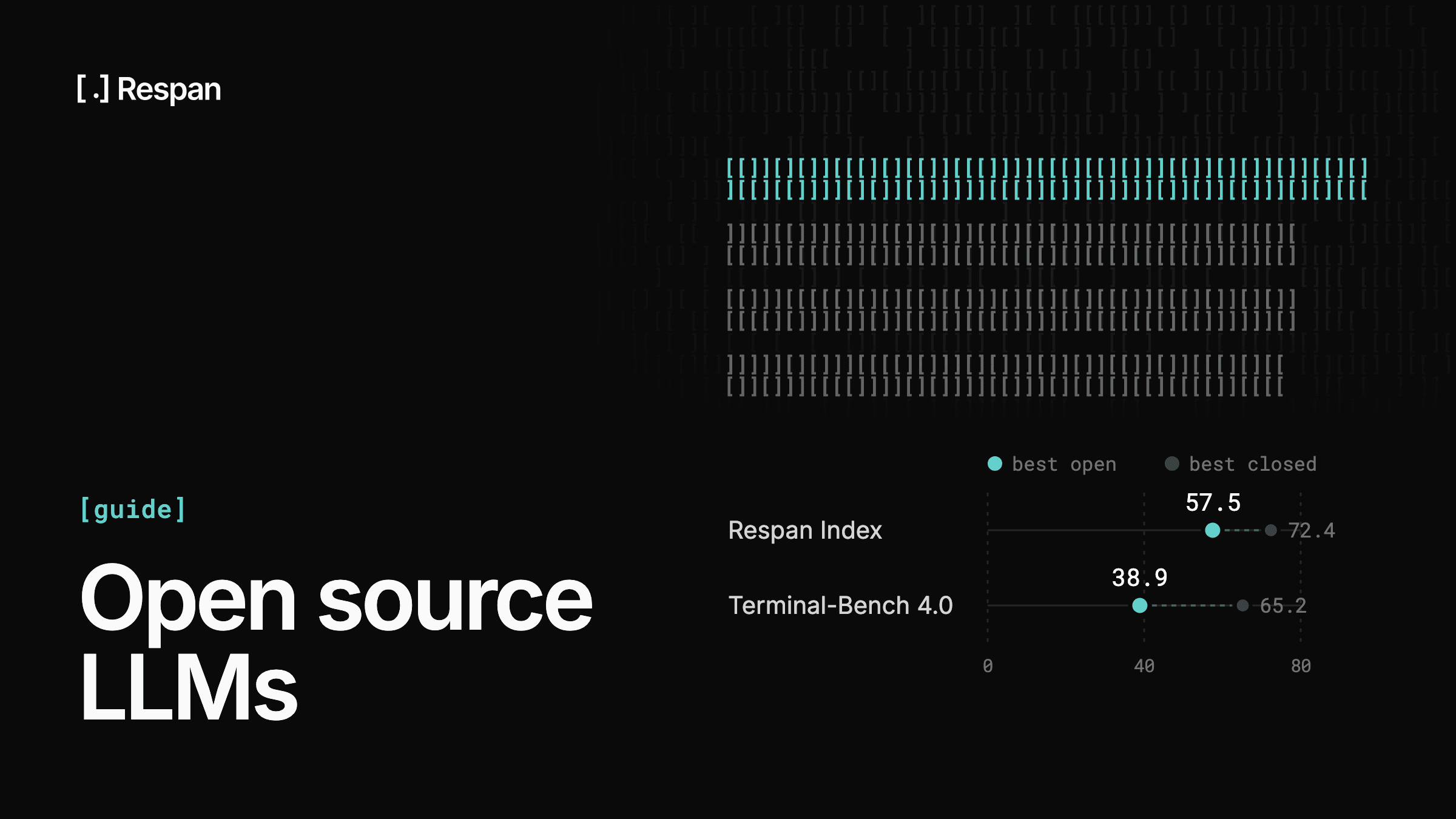
Z.ai's GLM-5.3, released in August, scores 38.9% on Vals AI's Terminal-Bench 4.0, the top open-weight result on that leaderboard as of October 29, and 69.0% on Datacurve's DeepSWE v1.1. On the Respan Index it scores 52.1, with a coding score of 44.5 that sits just behind DeepSeek V4.1 Flash 1017, MiMo-V2.6-Pro, and Step 5 Preview.
GLM-5.3 uses the same base model as GLM-5.2, so its gains over that release come from post-training. It takes text only, supports a 1M-token context with up to 128K output tokens, and Z.ai's API charges $1.40 per 1M input tokens and $4.40 per 1M output tokens. Z.ai also reports 84.5 on CyberGym, a vulnerability-discovery benchmark.
The GLM-5.3 License reads like MIT with one added condition, which only affects model-as-a-service companies with more than $10B in revenue over 12 months: they must pass a Z.ai security review before commercial use.
GLM-5.3-Flash is the smaller sibling, with 320B total and 18B active parameters, image input, and a plain MIT license. It scores 45.1 on the Respan Index and costs $0.15 / $0.50 per 1M tokens on Z.ai's API. For closed and open options side by side, see Respan's best LLM for coding ranking.
- Weights and license: zai-org/GLM-5.3, GLM-5.3 License
- Size: 744B total, 40B active (same architecture as GLM-5)
- Context: 1M tokens, 128K max output
- Respan Index: 52.1 overall · Coding 44.5 · Agents 64.3
- Use it for: Terminal-heavy coding agents and security work
7. Muse Spark Open
Muse Spark Open is the first Muse model with downloadable weights, released by Meta on October 15. It's an 816B-total, 42B-active mixture-of-experts model that takes text, image, video, and audio input with a 1M-token context, and Meta describes it as an open version of Muse Spark with extra safety post-training for standalone use.
Its results are uneven. Meta reports 89.2 on MCP-Atlas, but its own card shows it behind Kimi K3 on OSWorld Verified (80.4 vs 84.8) and Terminal-Bench 2.1 (76.4 vs 85.0). Independent numbers sit lower: 42.9 on the Respan Index, with a coding score of 21.8, and 6.6% on Vals AI's Terminal-Bench 4.0.
The Muse Model License requires products built on the model to display "Built with Muse Spark Open," and model-as-a-service businesses with more than $20M in annual revenue need a separate agreement with Meta. For local use, Meta's Muse Glimmer-30B, released in August under Apache 2.0, is a roughly 30B dense model with image input and a 131K context, and Meta says a 4-bit build fits in 24 to 32 GB of memory.
- Weights and license: meta-models/Muse-Spark-Open-816B-A42B, Muse Model License
- Size: 816B total, 42B active
- Context: 1M tokens
- Respan Index: 42.9 overall · Coding 21.8 · Agents 44.7
- Use it for: Multimodal workloads that mix audio or video with text, where the attribution terms fit
Smaller open source LLMs for a single machine
These three need far less hardware. OpenAI says gpt-oss-120b fits on a single 80 GB GPU, and Google positions Gemma 4's larger sizes for consumer GPUs and workstations. They trail the frontier models on benchmarks, but they're the realistic choice for local development, on-prem servers, and fine-tuning.
8. Qwen3.8-27B
Qwen3.8-27B has the highest Respan Index score in this group by a wide margin. The 27B dense model scores 42.1, against 18.6 for Gemma 4 31B and 16.5 for gpt-oss-120b, and it reaches 47.5% on Mercor's APEX-Agents. It understands images and video, has a native 262K context that extends to 1M, and is licensed under Apache 2.0. Qwen also publishes an official FP8 checkpoint.
Qwen reports 73.0 on Terminal-Bench 2.1, up from 63.4 for the previous Qwen3.6-27B.
- Weights and license: Qwen/Qwen3.8-27B, Apache 2.0
- Size: 27B dense
- Context: 262K native, extensible to 1M
- Respan Index: 42.1 overall · Coding 23.3 · Agents 56.3
- Use it for: Self-hosted agents and coding, and as a base model for fine-tuning
9. Gemma 4
Google's Gemma 4 family, released in April, comes in five sizes: E2B and E4B for phones and laptops, a 12B Unified model, a 26B A4B mixture-of-experts model with 25.2B total and 3.8B active parameters, and a 31B dense model. All five are Apache 2.0. The 12B and larger sizes support 256K context and the two small ones 128K, all of them take images, and E2B, E4B, and 12B also take audio.
Google reports 85.2% on MMLU Pro, 80.0% on LiveCodeBench v6, and 84.3% on GPQA Diamond for the 31B model. Independent results are thinner: Epoch AI's GPQA Diamond run, at minimal reasoning, measured 75.8%, and the 31B scores 18.6 on the Respan Index, where its agents score is estimated because the index has no agent results for it yet. The 26B A4B is the faster option, since it activates under 4B parameters per token.
- Weights and license: google/gemma-4-31B-it, Apache 2.0
- Size: 31B dense; 26B A4B has 25.2B total, 3.8B active
- Context: 256K (12B and up), 128K (E2B, E4B)
- Respan Index (31B): 18.6 overall
- Use it for: On-device and workstation deployments, multilingual apps (Google pre-trained it on over 140 languages), and small fine-tuned specialists
Gemma 4 shares its research lineage with Google's proprietary models, and the Gemma vs Gemini comparison walks through when the open weights win on cost, data control, and fine-tuning.
10. gpt-oss-120b
OpenAI released gpt-oss-120b in August 2025, and it remains OpenAI's main open-weight language model. It has 117B total and 5.1B active parameters and fits on a single 80 GB GPU thanks to MXFP4 weights, while gpt-oss-20b, with 21B total and 3.6B active, runs within 16 GB of memory. Both are Apache 2.0, support a 128K context, and offer low, medium, and high reasoning effort.
It's the oldest model here and the benchmarks show it: 16.5 on the Respan Index, 75.8% on Epoch AI's GPQA Diamond run, and 4.4% on APEX-Agents. It earns its place on footprint and license. OpenAI notes that both models only work correctly with its harmony response format.
- Weights and license: openai/gpt-oss-120b, Apache 2.0
- Size: 117B total, 5.1B active (gpt-oss-20b: 21B total, 3.6B active)
- Context: 128K tokens
- Respan Index: 16.5 overall
- Use it for: High-volume, simpler tasks on one GPU where license terms and footprint matter more than top scores
Benchmark comparison
Both score sources in the table rate every model the same way. The Respan Index combines public and lab-reported results into one score, and Vals AI's Terminal-Bench 4.0 runs every model in the same agent harness, so its results compare across labs in a way self-reported numbers don't. "n/a" means Vals AI hasn't published a result for that model.
| Model | Respan Index | Coding | Agents | Terminal-Bench 4.0 (Vals AI) |
|---|---|---|---|---|
| DeepSeek V4.1 Flash 1017 | 59.4 | 47.7 | 76.8 | 31.8% |
| MiMo-V2.6-Pro | 56.1 | 45.6 | 64.6 | 31.3% |
| Step 5 Preview | 55.8 | 45.1 | 58.2 | 31.8% |
| Kimi K3 | 53.0 | 39.6 | 61.7 | 17.2% |
| Qwen3.8 (as Qwen3.8-Max)* | 52.9 | 40.5 | 68.0 | 34.3% |
| GLM-5.3 | 52.1 | 44.5 | 64.3 | 38.9% |
| Muse Spark Open | 42.9 | 21.8 | 44.7 | 6.6% |
| Qwen3.8-27B | 42.1 | 23.3 | 56.3 | n/a |
| Gemma 4 31B | 18.6 | 8.1 | 12.6† | n/a |
| gpt-oss-120b | 16.5 | 7.1 | 7.5 | n/a |
* Third-party results for Qwen3.8 come from Alibaba's hosted Qwen3.8-Max, which is built on the open weights. † Estimated, since the Respan Index has no agent results for this model yet. Vals AI results are as of October 29, 2026.
A few things stand out:
- DeepSeek's update moved the top of the field - V4.1 Flash 1017 leads MiMo-V2.6-Pro by 3.3 points, while Kimi K3, Qwen3.8, and GLM-5.3 sit within 0.9 points of each other.
- The Index and the terminal benchmark disagree on coding - DeepSeek V4.1 Flash 1017 has the highest Respan Index coding score at 47.7, while GLM-5.3 leads Vals AI's Terminal-Bench 4.0 at 38.9%, so the right pick depends on the workload.
- Closed models still lead overall - Claude Opus 5.5 scores 74.0 on the Respan Index and 65.2% on Vals AI's Terminal-Bench 4.0, against 59.4 and 38.9% for the best open models.
Scores for every model, with lab-reported results kept apart from independent runs, are on Respan's LLM benchmarks page.
Other open source LLMs worth knowing
These didn't make the main list, but each is a reasonable choice for specific needs:
- Hy4 preview (Tencent) - A 770B-total, 49B-active model with a 1M context under Apache 2.0, released in late August. It scores 47.6 on the Respan Index, but Tencent describes it as an early version with known issues, and it scores 8.1% on Vals AI's Terminal-Bench 4.0.
- Inkling (Thinking Machines) - A 975B-total, 41B-active model released July 15 under Apache 2.0, with text, image, and audio input and up to 1M tokens of context, which makes it the largest Apache 2.0 model here. Its results are uneven: Epoch AI measured 88.3% on GPQA Diamond and Thinking Machines reports 77.6% on SWE-bench Verified, but it scores 0.5% on Vals AI's Terminal-Bench 4.0 and 32.0 on the Respan Index.
- MiniMax M3 (MiniMax) - About 428B total and 23B active, trained on text, image, and video from the first step, with a 1M context, released in June. The MiniMax Community License grants non-commercial rights by default, commercial use requires displaying "Built with MiniMax M3" and a one-time notice to MiniMax, and companies with more than $20M in yearly revenue need written authorization first. It scores 31.2 on the Respan Index.
- Nemotron 3 Ultra (NVIDIA) - 550B total, 55B active, 1M context, under the OpenMDW-1.1 license. NVIDIA publishes training data and recipes along with the weights, which matters if you need to audit or reproduce training. It scores 28.8 on the Respan Index, and NVIDIA lists eight B200s or sixteen H100s as the minimum hardware. The newer Nemotron 3.5 Lightning (30B total, 3B active) is the small option.
- Mistral Medium 3.5 (Mistral AI) - A 128B dense model with a 256K context and image input, which Mistral reports at 77.6% on SWE-bench Verified, and a Respan Index score of 26.4. Its Modified MIT license grants no rights to companies with more than $20M in monthly revenue, and Mistral Small 4 (119B total, 6.5B active, 256K context) is the Apache 2.0 option.
Hy4 preview is the one to watch, since its score already sits above every model in the smaller group and above Muse Spark Open, and a full release could move it onto the main list.
How to choose an open source LLM
Benchmark rank narrows the field, and a handful of practical questions usually settle the choice:
- Start with the license - The MIT and Apache 2.0 models put no conditions on commercial use beyond keeping the license notice: DeepSeek V4.1 Flash 1017, MiMo-V2.6, and GLM-5.3-Flash under MIT, and Qwen3.8-27B, Gemma 4, and gpt-oss under Apache 2.0. Kimi K3, the Qwen3.8 flagship, GLM-5.3, and Step 5 Preview use custom licenses that are permissive for most teams but add terms for very large companies or products, and Muse Spark Open requires "Built with Muse Spark Open" on any product that uses it. Treat these summaries as a starting point rather than legal advice, and read the license file in each model's Hugging Face repo before you ship.
- Match the model to the job - For coding agents, start with GLM-5.3 and DeepSeek V4.1 Flash 1017. For general agent work, DeepSeek V4.1 Flash 1017 and Qwen3.8 have the highest agents scores on the Respan Index. For image, video, or audio input, look at MiMo-V2.6-Pro or Muse Spark Open, which handle all four modalities, or Kimi K3 for images and video. For long inputs on a budget, DeepSeek V4.1 Flash 1017.
- Size it to your hardware - If you're self-hosting on one machine, the choice is Qwen3.8-27B, Gemma 4, or gpt-oss. Everything in the frontier group needs a multi-GPU node, though Step 5 Preview's example FP8 setup fits on a single node of eight H200s.
- Budget for reasoning tokens - Most published scores use maximum reasoning effort, and most of these models let you turn effort down, so production cost depends heavily on that setting. DeepSeek's card notes that the 1017 update produces shorter outputs than the version it replaced, which lowers cost per task at the same token price.
- Test on your own traffic - Public benchmarks get you to a shortlist of two or three. The deciding test is how each one does on your prompts, at your volume and cost.
When two models are close on paper, running both on a sample of real requests settles the choice faster than another benchmark will.
How to run open source LLMs
There are two ways to run these models, and you can mix them.
Self-host the weights. The model cards for the frontier models point to vLLM and SGLang as the main serving engines, and most link to deployment recipes. Gemma 4 and Muse Glimmer also ship quantized builds for running locally, and quantization is one of the main ways to optimize AI models you host yourself. Watch for format quirks when you switch: DeepSeek V4 models ship an encoding script and the deepseek-recipe library instead of a Jinja chat template, and gpt-oss only works with OpenAI's harmony format.
Call a hosted API. DeepSeek, Z.ai, Moonshot AI, Alibaba, and Xiaomi each run their own API, and inference providers host most of these open weights as well. Prices and context limits differ by host, so check the current providers and rates on each model's Respan page, linked in the table above.
If you want to compare a few of these models without integrating each provider separately, Respan's LLM gateway routes them, along with the rest of its 1,000+ models, through one OpenAI-compatible API, so moving a workload from GLM-5.3 to Kimi K3 is a change to the model string. You can set a fallback chain so traffic moves to the next model when a provider errors or rate-limits, and every request is logged as a trace with its cost and latency. From there, you can build a dataset from real production requests and run an experiment that scores two open models against it, so you see which one holds up on your traffic before you commit.
If you self-host the weights, Respan's open-source gateway can run next to them. It's dual-licensed under MIT or Apache-2.0 and currently pre-alpha, and it puts models served through vLLM or Ollama and hosted APIs behind one endpoint that any OpenAI, Anthropic, or Gemini SDK can call. Turning on its Respan plugin sends each request into the platform as a trace, so self-hosted and hosted models show up in the same place.
FAQ
What is the best open source LLM in 2026?
On the Respan Index, DeepSeek V4.1 Flash 1017 scores highest among open models at 59.4, followed by MiMo-V2.6-Pro at 56.1 and Step 5 Preview at 55.8. For terminal-heavy coding agents, GLM-5.3 has the top open-weight result on Vals AI's Terminal-Bench 4.0, and for a model you can run on one machine, Qwen3.8-27B leads its group by a wide margin.
What is the newest open source LLM?
As of November 4, 2026, the newest model on this list is DeepSeek V4.1 Flash 1017, released October 17. Meta's Muse Spark Open and StepFun's Step 5 Preview both published weights two days earlier, on October 15.
What is the difference between open source and closed source AI?
Open source AI models publish their weights, so you can download them, run them on your own hardware, fine-tune them, and keep prompts inside your own infrastructure, under whatever terms the license sets. Closed source models keep their weights private, so you can only reach them through the lab's API or apps, and the lab decides the price, the data handling, and when the model behind an endpoint changes. Most open models, including every one on this list, publish weights but not their training data, which makes them open weight rather than fully open source in the strict sense.
In practice, many teams use both, sending routine steps to an open model and harder ones to a closed model. Respan routes open and closed models through one API, with fallbacks between them and every request traced with its cost and latency, so you can see which one holds up on your own traffic.
Are open source LLMs as good as closed models?
Not at the top yet. Claude Opus 5.5 scores 74.0 on the Respan Index against 59.4 for the best open model, and on Vals AI's Terminal-Bench 4.0 the best open-weight result, GLM-5.3's 38.9%, trails Opus 5.5's 65.2%.
Which open source LLMs can be used commercially?
All ten on this list allow commercial use. The MIT and Apache 2.0 models only require keeping the license notice. Kimi K3, Qwen3.8, GLM-5.3, and Step 5 Preview add conditions for very large companies or products, and Muse Spark Open requires displaying "Built with Muse Spark Open" in any product that uses it.
Can I run an open source LLM locally?
Yes, at the smaller sizes. OpenAI says gpt-oss-20b runs within 16 GB of memory, Google built Gemma 4 E2B and E4B for phones and laptops, and Meta says a 4-bit Muse Glimmer-30B fits in 24 to 32 GB. The frontier-scale models need multi-GPU servers.
Is DeepSeek open source?
DeepSeek publishes the weights for DeepSeek V4.1 Flash 1017 and DeepSeek V4 Pro on Hugging Face under the MIT license, so you can download, modify, and use them commercially. The release covers weights and inference code, including the encoding scripts. Like most labs on this list, DeepSeek doesn't publish its training data.