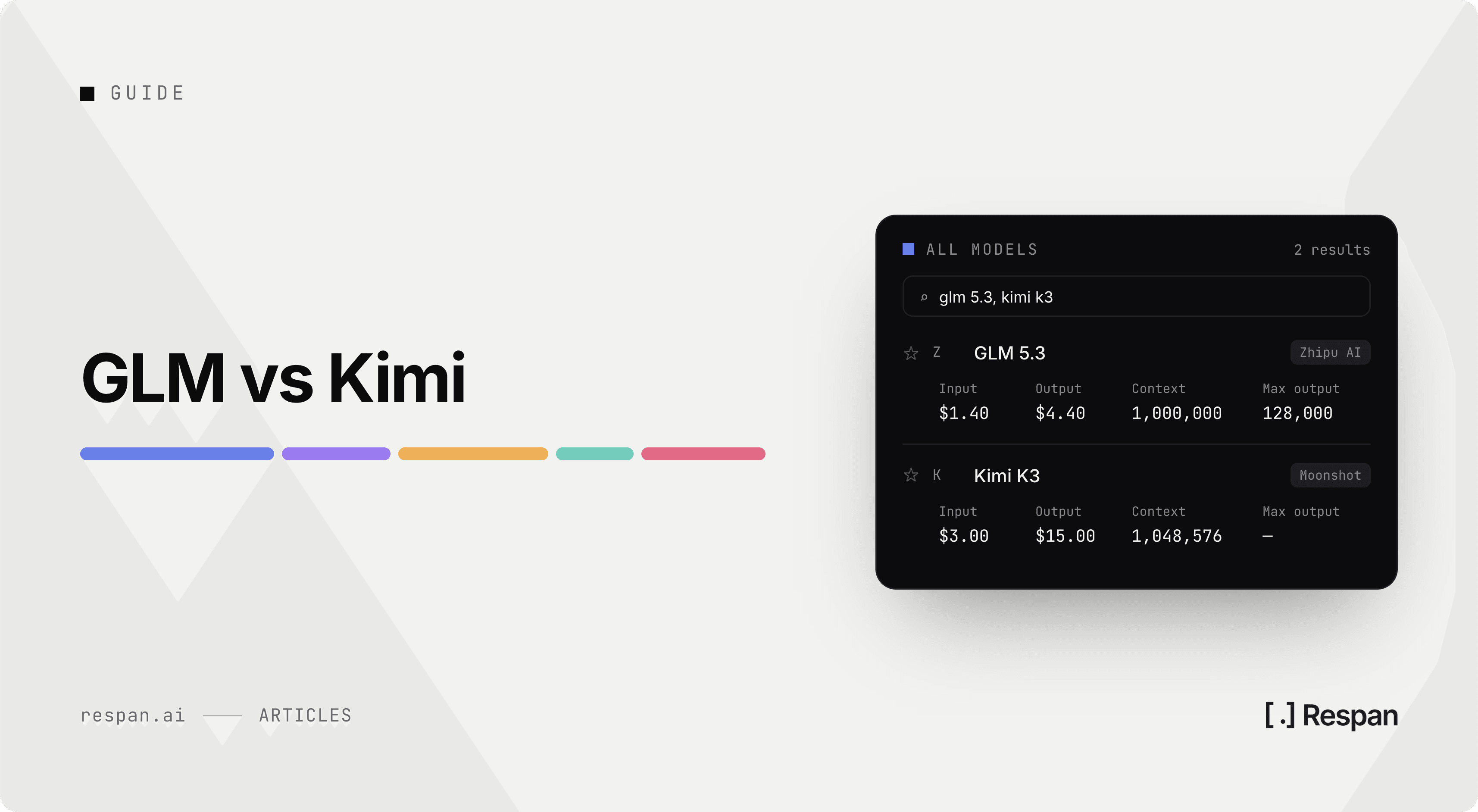
Z.ai shipped GLM 5.3 in August, about a month after Moonshot AI released Kimi K3, and both companies aimed their model at the same job: running coding agents. Both come with open weights and a 1M-token context window, so for a team choosing an open model to build agents on, these are the two names on the shortlist right now.
The headline numbers don't separate them much. On the older Terminal-Bench suite the two land within a rounding error of each other, while their API prices sit far apart, and that gap compounds quickly in an agent loop that runs thousands of calls a day.
On the numbers, GLM 5.3 is the better default for coding and agent work, since it leads on the majority of shared benchmarks and costs a fraction of Kimi K3 per output token. Kimi K3 earns its higher price in two places: image input and long, multi-file repo tasks.
Here's how GLM 5.3 vs Kimi K3 compares on benchmarks, pricing, coding, and agent work, and which one to use.
TLDR: GLM 5.3 vs Kimi K3
GLM 5.3 is the model to start with. It leads Kimi K3 on 10 of the 15 benchmarks both models report in Z.ai's launch table, at under a third of Kimi K3's price per output token. Kimi K3 is the better pick when your agent needs to read images, or when the job is a long, multi-file engineering task where its repo-scale scores come out ahead.
| GLM 5.3 | Kimi K3 | |
|---|---|---|
| Developer | Z.ai | Moonshot AI |
| Input types | Text | Text, image, video |
| Context window | 1M tokens | 1M tokens |
| API price (input / output per 1M) | $1.40 / $4.40 | $3.00 / $15.00 |
| Intelligence Index (Artificial Analysis) | 45 | 44 |
| Output speed (Artificial Analysis) | 83 tokens/s | 41.7 tokens/s |
| Benchmarks led (Z.ai table) | 10 of 15 | 4 of 15 |
| Pick it for | Coding, terminal work, cost | Image input, long repo tasks |
GLM 5.3 vs Kimi K3: Benchmarks
The only vendor source that scores both models side by side is Z.ai's GLM 5.3 model card. Because Z.ai built GLM 5.3, the table works better as a starting point than a final word, and it covers 15 benchmarks where both models have a result:
| Benchmark | GLM 5.3 | Kimi K3 |
|---|---|---|
| Terminal-Bench 2.1 | 88.2 | 88.3 |
| Terminal-Bench 3.0 | 28.3 | 17.4 |
| DeepSWE (v1.1) | 66.9 | 67.5 |
| NL2Repo | 58.0 | 58.0 |
| ProgramBench | 19.0 | 17.5 |
| SWE-Marathon (v1.1) | 42.5 | 48.1 |
| PostTrainBench | 39.8 | 32.0 |
| CyberGym | 84.5 | 80.0 |
| ExploitGym (2h / 6h) | 105 / 130 | 36 / 70 |
| ExploitBench | 54.4 | 32.2 |
| Toolathlon Verified | 73.0 | 76.5 |
| AutomationBench (v1.0.6) | 48.2 | 46.7 |
| Agents' Last Exam (ALE-CLI) | 28.5 | 27.6 |
| HLE with tools | 62.5 | 59.8 |
| GDPval-AA v2 | 1769 | 1682 |
GLM 5.3
GLM 5.3's leads in that table cluster around security work and harder terminal tasks. It's ahead on CyberGym (84.5 vs 80.0), ExploitBench (54.4 vs 32.2), and ExploitGym, and on Terminal-Bench 3.0 it scores 28.3 to Kimi K3's 17.4. It also comes out ahead on knowledge-work evals, including HLE with tools (62.5 vs 59.8) and GDPval-AA (1769 vs 1682).
Artificial Analysis, which runs its own evaluations, puts GLM 5.3 one point ahead on its Intelligence Index, 45 to 44. A one-point gap is close to a tie on general capability, so the case for GLM 5.3 rests more on the specific benchmarks above than on the index.
Kimi K3
Kimi K3 wins four rows, and two of them are close: Terminal-Bench 2.1 by a tenth of a point and DeepSWE by 0.6. Its clearer leads are on long-running software engineering tasks (SWE-Marathon, 48.1 vs 42.5) and tool use (Toolathlon Verified, 76.5 vs 73.0).
Moonshot's own model card doesn't include GLM 5.3 at all. It measures K3 against GLM 5.2 and closed models like Claude Fable, which is the matchup in Kimi K3 vs Fable 5.1, and it reports K3 at 81.2 on FrontierSWE. That's above the 78.1 Z.ai reports for GLM 5.3, though the two scores come from different vendors' runs.
Winner: GLM 5.3, which leads 10 of the 15 shared benchmarks and edges Kimi K3 by a point on Artificial Analysis's index.
GLM 5.3 vs Kimi K3: Pricing & Costs
GLM 5.3
Z.ai prices GLM 5.3 at $1.40 per 1M input tokens, $0.26 for cached input, and $4.40 per 1M output tokens, with cached storage free for a limited time. For agent workloads the output rate is the one to watch, because reasoning models spend heavily on output tokens, and GLM 5.3's is under a third of Kimi K3's.
The per-token price may not carry through to every task, though. Artificial Analysis found GLM 5.3 used more output tokens than Kimi K3 to work through its evaluations (209M vs 161M), so on output-heavy tasks some of the per-token savings goes to the extra tokens.
Z.ai also sells GLM 5.3 through its GLM Coding Plan, a monthly subscription starting at $18 for use inside coding tools like Claude Code and Cline.
Kimi K3
Moonshot charges $3.00 per 1M input tokens on a cache miss and $0.30 on a cache hit, with output at $15.00 per 1M. Cache writes are billed separately, at $3.00 per 1M tokens for the default 5-minute TTL and $6.00 for the 1-hour TTL, so caching pays off on long agent sessions that keep reusing the same context and less on short one-off calls.
At launch, K3 ran at max thinking effort only, with lower-effort modes promised in later updates. Before estimating cost, it's worth checking which effort levels your provider exposes, since full reasoning on every simple step adds up.
Winner: GLM 5.3. Its per-token price may not carry through to every task, but it still wins on list price, with output at under a third of Kimi K3's rate.
GLM 5.3 vs Kimi K3: Coding
GLM 5.3
Terminal work is where GLM 5.3 separates from Kimi K3. On Terminal-Bench 3.0 it scores 28.3 to 17.4 in Z.ai's table, and Artificial Analysis's own Terminal-Bench 4.0 run shows a wider gap, 42% to 13%.
Speed matters too in an agent loop, where every tool call waits on the model. Artificial Analysis measures GLM 5.3 at 83 output tokens per second with a 2.65-second time to first token on Z.ai's API, roughly double Kimi K3's output speed.
Kimi K3
Kimi K3's coding case rests on long, repo-scale work. Its SWE-Marathon lead is a 5.6-point gap (48.1 vs 42.5), and it ties GLM 5.3 on NL2Repo at 58.0.
For interactive coding, though, it's the slower of the two. Artificial Analysis clocks it at 41.7 output tokens per second with a 3.52-second time to first token on Kimi's API. Moonshot also notes in its launch post that K3 is sensitive to its own thinking history and recommends against switching models mid-session, which matters if you planned to hand work between models inside one conversation.
Winner: GLM 5.3, on terminal work and speed, while Kimi K3 keeps an edge on long, repo-scale tasks.
GLM 5.3 vs Kimi K3: Agents & Image Input
GLM 5.3
On agent automation benchmarks, GLM 5.3 holds narrow leads: 48.2 to 46.7 on AutomationBench and 28.5 to 27.6 on Agents' Last Exam. It can't help with anything visual, though, since GLM 5.3 takes text in and returns text out with no image or audio path, per DataNorth's launch coverage. Screenshots and scanned documents have to go to another model.
Kimi K3
Kimi K3 leads on Toolathlon Verified (76.5 vs 73.0), a tool-use benchmark, and Moonshot built it to handle text, images, and video in one model. That makes it the option for agents that read screenshots or parse document scans.
Moonshot's model card reports K3 at 91.1 on OmniDocBench and 81.6 on MMMU-Pro. GLM 5.3 has no comparable scores, because it doesn't accept images.
Winner: Kimi K3. The agent benchmarks split narrowly, and image input is something GLM 5.3 doesn't offer.
GLM 5.3 vs Kimi K3: Which to Use
For a team picking one open model to run coding agents on, GLM 5.3 is the default the numbers support, and Kimi K3 is the one to add when a workload needs something GLM 5.3 can't do.
- Pick GLM 5.3 - For terminal-heavy coding agents and security work, and anywhere output-token cost and response speed add up at volume.
- Pick Kimi K3 - For agents that need to read images, and for long, multi-file engineering tasks where its SWE-Marathon lead matters more than the price difference.
- Use both - Run GLM 5.3 as the default and send image tasks to Kimi K3. Because Moonshot recommends against switching models mid-session, route at the start of a task rather than handing a conversation from one model to the other.
Either way, vendor and lab benchmarks only get you to a shortlist. The deciding test is how each model scores on your own tasks, at your own cost.
Run GLM 5.3 and Kimi K3 Through One API with Respan
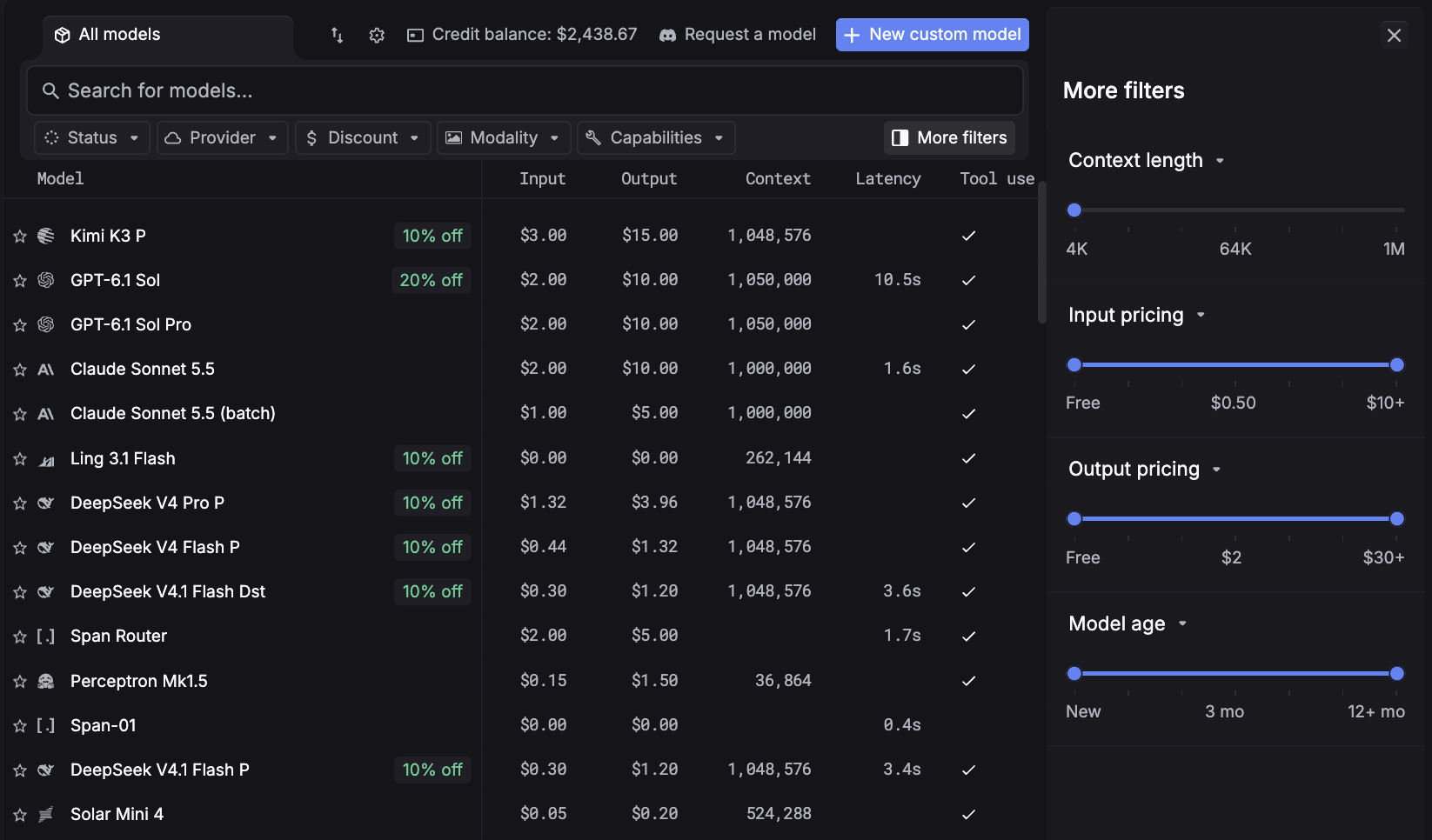
Running GLM 5.3 as a default with Kimi K3 for image work means two providers to integrate and two bills to reconcile, with no shared view of which model produced which result. Respan puts both behind one API with observability and automated evals built in, so every call is traced, priced, and scored in the same place.
With the Respan LLM gateway, switching between GLM 5.3 and Kimi K3 means changing one word in the request, and you can measure how each one performs on your own traffic before committing to a default.
- One API, 1,000+ models - Call GLM 5.3, Kimi K3, and every other major model through one endpoint, with your own provider keys or Respan credits.
- Automatic fallbacks - List the models to fall back to once, and Respan moves to the next the moment a provider errors or rate-limits.
- Know where every dollar goes - See costs broken down by model, by request, and by end customer, with monitors and hard spend limits.
- Evals before and after shipping - Score output on a test set before you switch models, then on live production traffic after.
- Traces behind every score - Click any score and land on the trace that produced it, with every LLM call and tool run captured as a span.
Instead of reading logs after the fact, use Respan to run observability in production, know when production shifts, and act before it spreads.
FAQ
Is Kimi K3 free?
Kimi K3's weights are free to download and run under the Kimi K3 License, which allows commercial use, with extra terms for model-as-a-service businesses above $20M in revenue and for products past 100M monthly users. Using K3 through Moonshot's API is pay-as-you-go with no free tier listed, and Kimi's paid chat plans start at $19 per month.
Is there a Kimi K3 subscription?
Yes. Kimi's memberships run from Moderato at $19 per month to Vivace at $199, with Allegretto at $39 and Allegro at $99 in between, and all four draw on a shared credit pool that resets each billing cycle. Allegro and Vivace add K3 extra-long chat of up to 1M tokens.
The memberships cover Kimi's own apps and Kimi Code, while API usage is billed separately on a pay-as-you-go basis.
How do you use Kimi K3?
You can use Kimi K3 in Kimi's web chat and mobile apps, in the terminal through Kimi Code by selecting K3 with the /model command, or through Moonshot's API with the model ID kimi-k3, which offers OpenAI- and Anthropic-compatible endpoints. To run it in production next to GLM 5.3, Kimi K3 on Respan uses the same API as every other model, with tracing, cost tracking, and evals on every call.
Can you use Kimi K3 on OpenRouter?
Yes. OpenRouter lists Kimi K3 under the model ID moonshotai/kimi-k3, served by a range of inference providers. An OpenRouter alternative, Respan's gateway also serves Kimi K3, and every request routed through it is traced, priced, and scored with evals in the same place.