DeepSeek's API looks very different than it did in the spring. V4 Pro and V4 Flash launched in April, V4 Pro reached general availability in August, V4.1 Flash replaced V4 Flash in September, and on October 17 DeepSeek upgraded V4.1 Flash in place to a new 1017 checkpoint.
The old IDs weren't switched off along the way. A request to deepseek-flash, or to the retired deepseek-v4-flash, now gets the 1017 checkpoint, so outputs and costs can change under code nobody touched.
That leaves two active models, and on DeepSeek's own benchmarks the cheaper one beats the bigger one on most coding and agent tasks, with the 1017 update widening that lead. Because of that, the usual rule of reaching for the larger model when quality matters doesn't hold for DeepSeek right now.
For most API workloads in 2026, the best DeepSeek model is V4.1 Flash, while V4 Pro still earns its higher price on knowledge-heavy work.
TL;DR: What Is the Best DeepSeek Model?
- Best overall - V4.1 Flash (
deepseek-flash), now on its October 17 checkpoint. It scores ahead of V4 Pro on most of DeepSeek's coding and agent benchmarks, at under a quarter of V4 Pro's input price. - Best for knowledge-heavy work - V4 Pro (
deepseek-v4-pro). It leads V4.1 Flash on GPQA Diamond and by a wide margin on factual recall. - Best for images and documents - V4.1 Flash, since V4 Pro doesn't accept image input.
- Best for high-volume, low-cost jobs - V4.1 Flash with thinking turned off, run during off-peak hours when rates drop by half.
- Best open-weight model - V4.1 Flash 1017, released under the MIT license.
- What to stop calling -
deepseek-v4-flash,deepseek-v4-flash-vision-exp,deepseek-chat, anddeepseek-reasoner, which are retired or past their announced retirement date.
Active DeepSeek Models and API IDs
DeepSeek's API serves two models today, while several older IDs either route to the newer model or have passed their announced retirement date.
| Model | API ID | Status |
|---|---|---|
| DeepSeek V4.1 Flash | deepseek-flash | Active, 1017 checkpoint since Oct 17, 2026 |
| DeepSeek V4 Pro | deepseek-v4-pro | Active, GA Aug 13, 2026 |
| V4 Flash (retired) | deepseek-v4-flash | Routes to V4.1 Flash 1017 |
| V4 Flash Vision Exp (retired) | deepseek-v4-flash-vision-exp | Routes to V4.1 Flash 1017 |
| Legacy aliases | deepseek-chat, deepseek-reasoner | Retirement announced for Jul 24, 2026 |
V4.1 Flash is a 552B-parameter mixture-of-experts model that activates 8B parameters on input and 16B on output, and it's the only active DeepSeek model with native vision.
Both retired Flash IDs still accept requests, and DeepSeek serves them with the 1017 checkpoint at V4.1 Flash rates. V4 Pro's status is less clear-cut. DeepSeek's September announcement said V4 Pro would be phased out until a V4.1 Pro launches, but DeepSeek's changelog and its pricing page both keep deepseek-v4-pro available at its own rates. For now, treat it as active, with a V4.1 Pro on the way.
What Changed in V4.1 Flash 1017
DeepSeek released the 1017 checkpoint on October 17, 2026 as a minor update to V4.1 Flash, and it took over the deepseek-flash ID from the September checkpoint. The API ID, pricing, context window, and feature set stayed the same, so code that already called V4.1 Flash picked up the new checkpoint without a change.
What moved is the model itself. According to the V4.1 Flash 1017 model card, the update raises reasoning, coding, agent, and vision scores over the September release, and it finishes tasks faster with shorter outputs.
| Benchmark | V4.1 Flash 1017 | V4.1 Flash (Sep) |
|---|---|---|
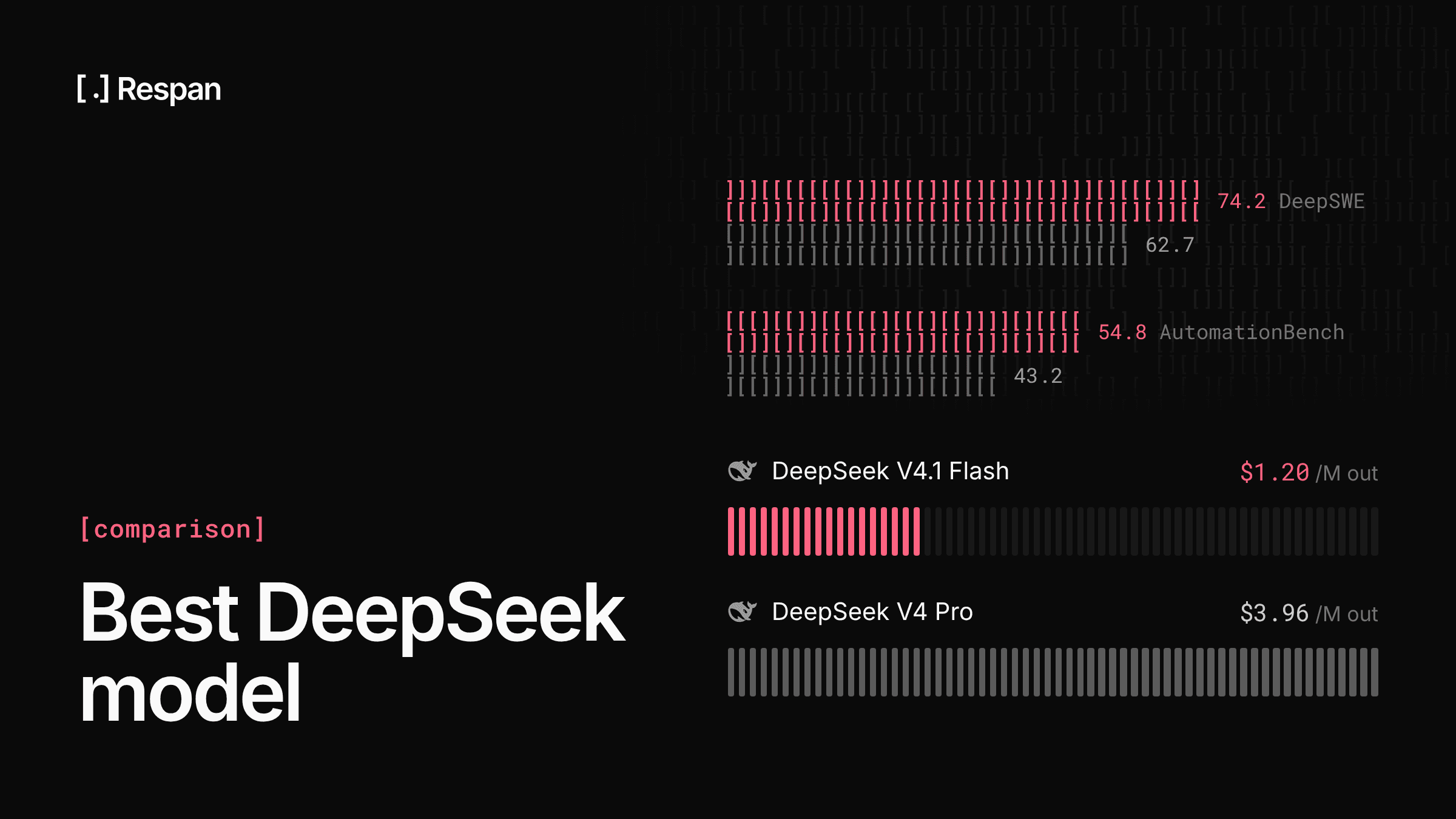
| DeepSWE v1.1 | 77.0 | 74.2 |
| Terminal-Bench 4.0 | 42.3 | 31.2 |
| ProgramBench | 29.1 | 20.3 |
| AutomationBench | 60.5 | 54.8 |
| HLE (text-only) | 44.0 | 39.1 |
| Chartography (with tools) | 83.0 | 78.9 |
The biggest jumps are on terminal and programming tasks, where Terminal-Bench 4.0 gained about 11 points and ProgramBench about 9. DeepSeek ran Terminal-Bench 4.0 in the Claude Code harness and DeepSWE in Mini-SWE-V2, so your own agent scaffold may land at a different number.
If you validated V4.1 Flash on your own evals in September, it's worth rerunning them, since the model behind deepseek-flash changed without a new name.
DeepSeek Model Comparison 2026
The two active models share a context window and most API features, so the real differences sit in benchmarks, price, vision, and concurrency.
| V4.1 Flash | V4 Pro | |
|---|---|---|
| API ID | deepseek-flash | deepseek-v4-pro |
| Checkpoint | V4.1-Flash-1017 | V4-Pro-0813 |
| Parameters (total / active) | 552B / 8B-16B | 1.6T / 49B |
| Context window | 1M tokens | 1M tokens |
| Max output | 384K tokens | 384K tokens |
| Vision | Yes | No |
| Input, cache miss (peak) | $0.30 / 1M | $1.32 / 1M |
| Output (peak) | $1.20 / 1M | $3.96 / 1M |
| Concurrency limit | 2,500 | 500 |
| License | MIT | MIT |
Benchmarks and Capabilities
DeepSeek scores both models at maximum reasoning effort on its V4.1 Flash model card, and the 1017 card adds new scores for the checkpoint deepseek-flash serves today. Where the 1017 card reports a benchmark, the table uses its score, and V4.1 Flash comes out ahead on most of the coding and agent rows.
| Benchmark | V4.1 Flash | V4 Pro |
|---|---|---|
| DeepSWE v1.1 (resolved) | 77.0 | 62.7 |
| Terminal-Bench 2.1 | 90.6* | 87.9 |
| Codeforces (rating) | 3471* | 3348 |
| AutomationBench | 60.5 | 43.2 |
| HLE with tools | 63.9* | 60.0 |
| HLE (text-only) | 44.0 | 42.7 |
| GPQA Diamond | 90.9* | 92.4 |
*Score from the September checkpoint, since the 1017 card doesn't report this benchmark.
The 1017 update widened Flash's lead on DeepSWE and AutomationBench, and it moved Flash ahead of V4 Pro on text-only HLE, which V4 Pro led in September. V4 Pro still leads on GPQA Diamond, and by a wider margin on factual recall: on the base model results in the September card, V4 Pro scores 55.2 on SimpleQA-Verified to V4.1 Flash's 42.3. One caveat is that the card doesn't say which V4 Pro checkpoint it tested, so the gap to the August GA release could differ.
Best pick: V4.1 Flash for coding, agents, and tool use. V4 Pro for factual recall and graduate-level knowledge questions.
Our recommendation: Start on V4.1 Flash and move a workload to V4 Pro only when your own evals show a knowledge gap.
Keep in mind: These are DeepSeek-reported scores, and an agent's score depends heavily on the scaffold around the model.
Pricing and Cost per Task
DeepSeek charges per token with two time windows, and off-peak rates run at half the peak rate. Peak hours are 01:00-04:00 and 06:00-10:00 UTC on weekdays, excluding Chinese public holidays, and everything else, including weekends, bills at the off-peak rate.
| Per 1M tokens (peak / off-peak) | V4.1 Flash | V4 Pro |
|---|---|---|
| Input, cache hit | $0.006 / $0.003 | $0.044 / $0.022 |
| Input, cache miss | $0.30 / $0.15 | $1.32 / $0.66 |
| Output | $1.20 / $0.60 | $3.96 / $1.98 |
Those rates come from DeepSeek's pricing page, which DeepSeek says can change, and the 1017 update left them as they were. At peak rates, an agent step with 20,000 input tokens that miss the cache and 2,000 output tokens costs about $0.0084 on V4.1 Flash and $0.0343 on V4 Pro. If 80% of that input hits the cache, the same step drops to about $0.0037 on Flash and $0.0139 on Pro.
Thinking mode is on by default, and the model writes its reasoning before the answer, so real output counts usually run higher than a plain completion would. DeepSeek reports that the 1017 checkpoint produces shorter outputs than the September one, which lowers the cost of a task on Flash even though the per-token rates didn't change.
Best pick: V4.1 Flash, at roughly a quarter of V4 Pro's cost per step.
Our recommendation: Move batch and backfill jobs into off-peak hours and keep long system prompts stable so they stay cache hits.
Keep in mind: Concurrency is capped at 2,500 for V4.1 Flash and 500 for V4 Pro, so a high-traffic app may hit V4 Pro's limit long before its budget.
Context Window and Output Limits
Both models accept 1M tokens of context and return up to 384K tokens of output, so neither forces you to chunk a large codebase or document set differently. DeepSeek's 1017 model card recommends setting max_tokens to at least 256K for V4.1 Flash.
Where the two models differ is how well they use that context. On LongBench-V2 in the September card's base model results, which the 1017 card doesn't update, V4 Pro scores 51.5 against V4.1 Flash's 45.2.
Best pick: V4 Pro for long-document question answering.
Our recommendation: Test both on your longest real inputs before paying Pro rates, since the benchmark gap is moderate.
Keep in mind: A 1M-token prompt that misses the cache costs $0.30 on V4.1 Flash and $1.32 on V4 Pro at peak, every time it's sent.
Thinking Modes
Both models run in thinking or non-thinking mode, and thinking is on by default at high effort. According to DeepSeek's thinking mode guide, the API accepts low, high, and max effort, set with reasoning_effort in OpenAI format or output_config in Anthropic format, and other values like medium or xhigh are mapped onto those three.
A few behaviors change in thinking mode. temperature and the penalty parameters have no effect, and top_p works differently on each model: deepseek-flash applies it only in thinking mode and treats values below 0.95 as 0.95, while deepseek-v4-pro ignores it in thinking mode. If a request includes tools, you have to pass reasoning_content back on every later turn or the API returns a 400 error. Fill-in-the-middle completion only works with thinking turned off.
Best pick: high effort for most work, and max for hard coding or math problems.
Our recommendation: Turn thinking off for classification, extraction, and autocomplete, where reasoning tokens add cost without changing the answer.
Keep in mind: The reasoning_content requirement breaks agent loops written for models that don't return reasoning, so check your tool-calling code before switching.
Open Weights and Licensing
DeepSeek publishes open weights for its V4 and V4.1 releases, and V4.1 Flash 1017, V4 Pro, and R1 are all released under the MIT license, which allows commercial use and modification. The distilled R1 models are the exception, since each carries the license of its base model: Apache 2.0 for the Qwen-based versions and the Llama license for the Llama-based ones.
Everything is downloadable from DeepSeek on Hugging Face, where the 1017 checkpoint sits in its own repository next to the September release, so you can pin either one if you run the model yourself. Running V4.1 Flash is a multi-GPU job at 552B parameters, and the release ships without a Jinja chat template, so you format prompts with DeepSeek's Python reference encoder or its separate deepseek-recipe toolkit.
DeepSeek's weights sit alongside Qwen, Kimi, and GLM in the current set of open source LLMs, which matters if you need a fallback you can run on your own infrastructure.
Best pick: V4.1 Flash 1017, which pairs the MIT license with the smaller active parameter count.
Our recommendation: Use the hosted API unless data residency or volume makes your own GPUs cheaper.
Keep in mind: Self-hosting trades DeepSeek's per-token rates and off-peak discount for GPU costs you carry whether or not traffic shows up.
Which DeepSeek Model to Use for Each Task
The benchmark and pricing gaps above point to V4.1 Flash for most jobs, with V4 Pro reserved for work that depends on what the model knows.
- Coding agents and terminal tasks - V4.1 Flash at
highormaxeffort, which leads V4 Pro on DeepSWE v1.1 and Terminal-Bench 2.1. - Tool use and multi-step automation - V4.1 Flash, which scores higher on AutomationBench and on HLE with tools.
- Screenshots, charts, and scanned documents - V4.1 Flash, the only active DeepSeek model that accepts images.
- Factual Q&A and research assistants - V4 Pro, where the SimpleQA-Verified gap shows up as fewer wrong answers to factual questions.
- Long-document analysis - V4 Pro if your evals confirm the LongBench-V2 edge on your own documents, otherwise V4.1 Flash.
- Classification, extraction, and routing steps - V4.1 Flash with thinking off, during off-peak hours where possible.
- Code autocomplete (fill-in-the-middle) - Either model, with thinking off.
- High-concurrency production traffic - V4.1 Flash, which allows five times V4 Pro's concurrent requests.
If you're weighing DeepSeek against other providers' tiers, the same task-by-task approach applies when picking the best Claude model or the best Gemini model, and the provider-level tradeoffs are covered in DeepSeek vs ChatGPT.
Route, Compare, and Evaluate DeepSeek Models With Respan
DeepSeek has changed the model behind a fixed ID several times this year. It re-post-trained V4 Flash in July without renaming it, routed the retired Flash IDs to V4.1 Flash in September, and moved deepseek-flash to the 1017 checkpoint on October 17. If the model is hardcoded in your app, each of those changes reaches users before it reaches your test suite.
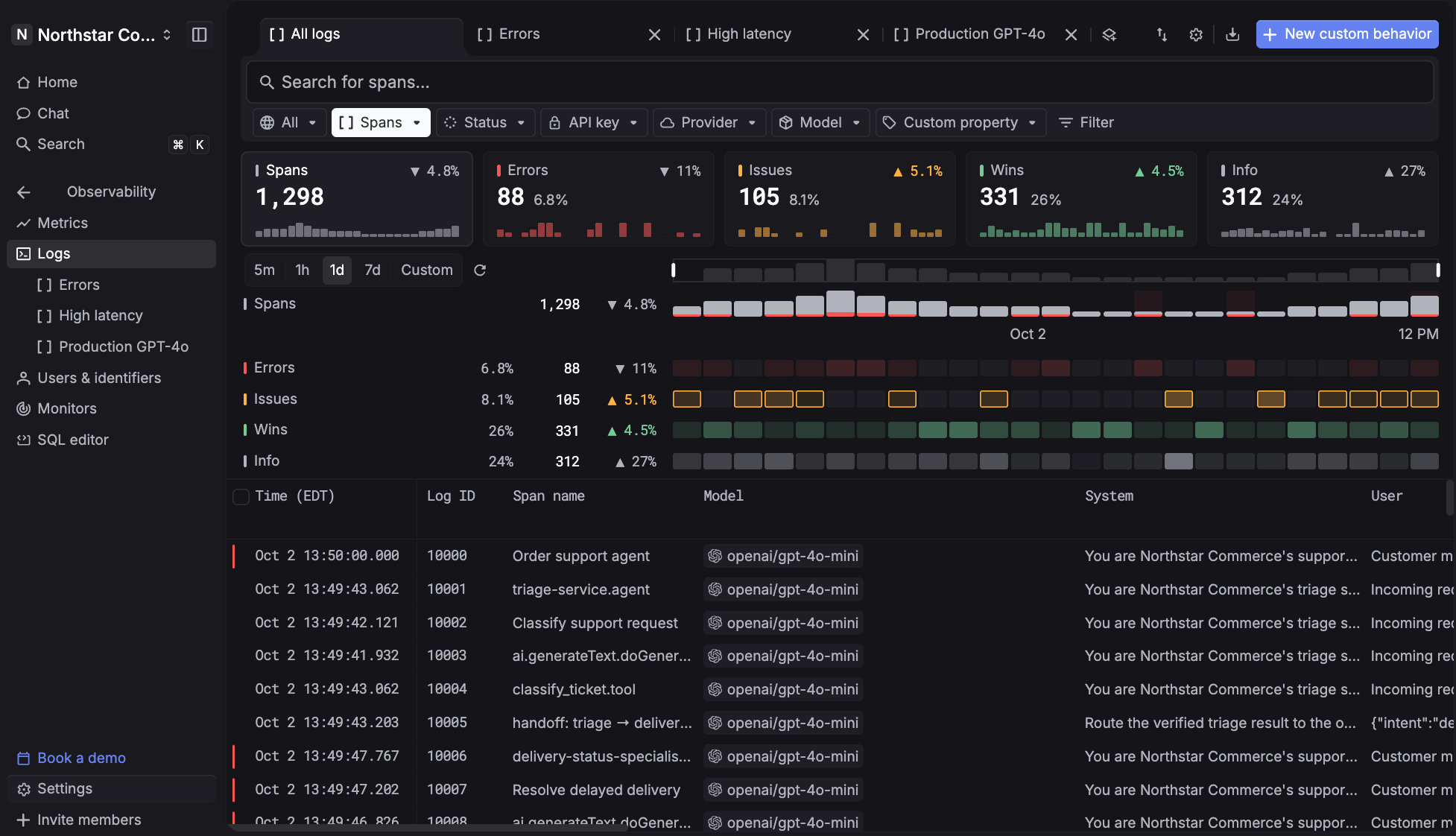
Respan is the AI router with built-in observability and automated evals. You call DeepSeek and 1,000+ other models through one API, and every request is traced, priced, and ready to score in the same place. That turns "which DeepSeek model should we use" into a question you answer with your own traffic.
- Switch models by changing one word - Call
deepseek/deepseek-flashordeepseek/deepseek-v4-prothrough the AI gateway, and move a workload between them, or to another provider, without touching application code. - Stay up when DeepSeek rate-limits - Set a fallback chain once, and traffic moves to the next model the moment one errors or hits its concurrency limit.
- Know what each model costs - See spend broken down by model, by request, and by end customer, with hard spend limits that stop a runaway job at the ceiling.
- Compare Flash and Pro on real requests - Build a dataset from production traffic, run both models through the same evaluators, and click from any score into the trace behind it.
- Catch regressions when DeepSeek ships - Automated evals score live production traffic, and monitors alert you in Slack or email when a score or cost metric breaches.
- Use your own key or Respan credits - You can route DeepSeek through Respan with your own DeepSeek API key or with Respan credits, which need no DeepSeek account.
Instead of reading logs after the fact, use Respan to run observability in production, know when production shifts, and act before it spreads.
Frequently Asked Questions
What Is the Latest DeepSeek Model?
The latest DeepSeek model is V4.1 Flash 1017, an update to V4.1 Flash that DeepSeek released on October 17, 2026. You call it with the API ID deepseek-flash, which moved to the new checkpoint with no change to pricing. V4.1 Flash first launched on September 10, replacing V4 Flash and the experimental V4 Flash Vision model, and DeepSeek has said a V4.1 Pro is coming. If you route through Respan, moving to that release when it ships is a one-word change to the model string.
Is DeepSeek R1 Still Available?
DeepSeek R1 is no longer available as an API model. Its role passed to the thinking mode in the V4 models, and DeepSeek set July 24, 2026 as the discontinuation date for the deepseek-reasoner alias that served that mode. The R1 weights are still downloadable under the MIT license, but for R1-style reasoning through the API, V4.1 Flash with thinking enabled is the replacement.
Which DeepSeek Model Is Best for Coding?
V4.1 Flash is the best DeepSeek model for coding. In DeepSeek's own results, the 1017 checkpoint resolves 77.0% of DeepSWE v1.1 tasks to V4 Pro's 62.7%, and the September checkpoint already led V4 Pro on Terminal-Bench 2.1, 90.6 to 87.9, while costing far less per token. Use max effort for hard problems and turn thinking off for autocomplete. To confirm the pick on your own repository, Respan can run both models against the same coding tasks and score the results side by side.
Is DeepSeek Free?
The DeepSeek API isn't free: it charges per token, with V4.1 Flash at $0.15 per million uncached input tokens and $0.60 per million output tokens during off-peak hours, according to DeepSeek's API pricing.
Is It Safe to Send Company Data to the DeepSeek API?
That depends on your compliance requirements. DeepSeek's privacy policy says it stores and processes data in the People's Republic of China and may use it to train its models, with an opt-out right listed but no process described. If that doesn't meet your requirements, the open weights let you run DeepSeek on your own infrastructure instead.
Routing through Respan doesn't change where DeepSeek processes a request, but it does let you keep sensitive workloads on a different provider by changing one model string. Respan itself is SOC 2, HIPAA with a BAA, GDPR, and ISO 27001 compliant, and supports PII masking and omitting logs for requests you don't want stored.