
For most of Claude's history, choosing a model meant picking one of three sizes: Haiku for speed, Sonnet for balance, and Opus for the hardest work.
That changed in 2026. Anthropic opened a tier above Opus to everyone with Fable 5 in June, then shipped Sonnet 5, Opus 5, and Fable 5.1 over the following three months. The lineup is now four tiers wide, and each new release moved the line between what needs a top-tier model and what doesn't.
A lineup that wide makes a single default harder to justify. Anthropic's model guidance points most workloads at Opus 5, while its pricing guidance recommends Haiku for simple tasks and Sonnet for most production work, and each is right for different steps of the same application.
So the best Claude model in 2026 comes down to a comparison of pricing and capability for each step, rather than one pick for the whole application.
What Is the Best Claude Model in 2026?
Claude Fable 5.1 is the top of Anthropic's generally available lineup in 2026, and Claude Opus 5 is the stronger default for most workloads at half the price. In production, the best setup is usually a mix: Sonnet 5 or Haiku 4.5 for high-volume steps, Opus 5 for decisions, and Fable 5.1 when Opus falls short.
| Model | Best for | Input / output per MTok | Context |
|---|---|---|---|
| Claude Fable 5.1 | Long-horizon, ambiguous work | $10 / $50 | 1M |
| Claude Opus 5 | Complex coding and decisions | $5 / $25 | 1M |
| Claude Sonnet 5 | High-volume production steps | $2 / $10 | 1M |
| Claude Haiku 4.5 | Simple, bounded steps | $1 / $5 | 200K |
Per-token price is only part of the decision. A cheaper model that needs two extra turns to finish a step can cost more than a pricier one that gets it right the first time, which is why cost per completed task is the number that settles which tier a step belongs on.
Measured latency for every Claude model sits next to its price in Respan's Anthropic model catalog, which makes it the quickest way to compare the lineup on the numbers that affect a routing decision.
What Is the Newest Claude Model?
The newest Claude model is Claude Fable 5.1, which Anthropic released on September 1, 2026, alongside Claude Mythos 5.1. It replaces Fable 5 at the top of the generally available lineup and keeps the same list price of $10 per million input tokens and $50 per million output tokens.
The change that matters most for production cost is cache reads. Anthropic cut Fable 5.1's cache read price by 75%, to $0.25 per million tokens, so agent loops that reread the same prompt prefix on every turn get noticeably cheaper even though the headline rate didn't move.
Anthropic also made Fable's safeguards more precise. Fable 5.1 can now be used to find software vulnerabilities, though not to develop exploits for them, and eligible customers can run it with zero data retention until Anthropic's Enterprise Frontier Safeguards roll out later this fall. New API accounts, however, can no longer edit Claude's prior context in a multi-turn conversation while keeping its earlier thinking intact, and Anthropic plans to extend that restriction to all accounts with future model releases.
Claude Mythos 5.1 is the same underlying model with more permissive safeguards for cybersecurity and life sciences work. It's available only through Anthropic's trusted access programs, currently to a set of US organizations, which makes Fable 5.1 the practical ceiling for most teams.
Being newest doesn't make Fable 5.1 the default, though. Opus 5 is still the right starting point for most workloads, and Fable 5.1 earns its rate on demanding reasoning, long-horizon agentic work, or steps where Opus 5 at higher effort still falls short.
List of All Current Claude Models
Anthropic's current lineup has four generally available models, one per tier, from Haiku at the bottom to Fable at the top. Older versions such as Fable 5, Opus 4.8, and Sonnet 4.6 are still available on the Claude API, but new work should target the four below them.
Claude Fable 5.1
Anthropic positions Claude Fable 5.1 (claude-fable-5-1) for demanding reasoning and long-horizon agentic work, the kind of task that runs unattended for hours and has to check its own progress along the way. Adaptive thinking is always on and can't be turned off, and its comparative latency is the slowest in the lineup.
Because one of Anthropic's stated reasons for moving to Fable is that Opus 5 at higher effort still falls short, raising effort on Opus is the step to try before doubling the rate.
Claude Opus 5
Most teams should start on Claude Opus 5 (claude-opus-5), according to Anthropic, which describes it as the model for complex agentic coding and enterprise work. It costs $5/$25, the same as Opus 4.8, and it's the default model in Claude Code on Max, Team Premium, Enterprise, and API accounts.
Opus 5 shares Sonnet 5's 1M context window and 128K output ceiling, so moving work between the two is usually just a model-string change. It also supports Fast mode, in research preview, at $10/$50 for significantly faster output, which has no Sonnet equivalent.
Claude Sonnet 5
At $2/$10, Claude Sonnet 5 (claude-sonnet-5) costs 40% of Opus 5 on both input and output, and Anthropic describes it as the best combination of speed and intelligence in the lineup. That rate launched as introductory pricing, but Anthropic has since made it the standard price and cancelled a planned increase to $3/$15.
Sonnet 5 is the natural default for well-specified production steps, where the output gets checked by a test or a schema before it does anything. It's also the default model in Claude Code for Pro and Team Standard plans.
Claude Haiku 4.5
Claude Haiku 4.5 (claude-haiku-4-5-20251001) is the fastest and cheapest current model at $1/$5, and it's built differently from the three above it. It has a 200K context window and a 64K output cap, uses extended thinking rather than adaptive, and doesn't support the effort parameter.
It's also the oldest model in the current lineup. Its reliable knowledge cutoff is February 2025, and its earliest retirement date on Anthropic's deprecations page is October 15, 2026, with no replacement announced yet. Haiku 4.5 remains Active and Anthropic commits to at least 60 days' notice before retiring a model, but a routing setup that leans on Haiku should be able to swap its bottom tier without a code change.
In-Depth Claude Model Comparison
Fable 5.1, Opus 5, and Sonnet 5 share the same request shape, so the differences between them come down to price, speed, and how much reasoning each call buys. Haiku 4.5 is the exception, and most of the fit constraints in the lineup come from it.
| Fable 5.1 | Opus 5 | Sonnet 5 | Haiku 4.5 | |
|---|---|---|---|---|
| Context window | 1M | 1M | 1M | 200K |
| Max output | 128K | 128K | 128K | 64K |
| Thinking | Adaptive, always on | Adaptive | Adaptive | Extended |
| Default effort | High | High | High | Not supported |
| Knowledge cutoff | Jun 2026 | May 2026 | Jan 2026 | Feb 2025 |
| Comparative latency | Slower | Moderate | Fast | Fastest |
Each of those rows changes a routing decision in a different way:
- Context and output - The top three models include the full 1M-token window at standard pricing, with no premium past 200K. A request that needs 300K tokens of context or more than 64K tokens of output doesn't get cheaper on Haiku, it fails. On the Message Batches API, Opus 5 and Sonnet 5 can also return up to 300K output tokens with a beta header.
- Thinking and effort - Adaptive thinking lets the model decide how much to think on each step, steered by an effort level that defaults to
high. Lowering effort is the cheaper lever for routine steps on Opus and Sonnet, and Fable 5.1 can't turn thinking off at all. - Latency - Anthropic ranks Haiku fastest and Fable slowest, though real latency depends on prompt length, output length, and effort. The ordering rarely matters for asynchronous work, but it can decide the tier for interactive steps, where TTFT (time to first token) is what users actually feel.
- Knowledge cutoff - The gap only matters when a prompt assumes the model knows something recent without being told. Sonnet 5's cutoff is January 2026 and Haiku's is February 2025, against May 2026 for Opus 5.
- Safety classifiers - Fable 5.1 and Opus 5 run classifiers that most often flag cybersecurity and biology content. In Claude Code, flagged requests on Fable re-run on Opus 5 or Opus 4.8 depending on the category, so security and life sciences teams can't assume the top tier answers every request in those domains.
Put together, the tiers above Haiku differ mainly in how much reasoning a call gets, and Haiku differs in what a call can hold. The first routing question for any step is whether it fits Haiku at all, and the second is how much reasoning it needs once it doesn't.
Claude Models Pricing & Costs Comparison
Claude API pricing is per million tokens, with separate rates for input, output, cache reads, and batch jobs. At list price, the four current models span a tenfold range on both input and output.
| Model | Input | Output | Cache read | Batch input / output |
|---|---|---|---|---|
| Claude Fable 5.1 | $10 | $50 | $0.25 | $5 / $25 |
| Claude Opus 5 | $5 | $25 | $0.50 | $2.50 / $12.50 |
| Claude Sonnet 5 | $2 | $10 | $0.20 | $1 / $5 |
| Claude Haiku 4.5 | $1 | $5 | $0.10 | $0.50 / $2.50 |
All prices are per million tokens, from Anthropic's pricing page.
List price is the easy part of the comparison. What a workload actually costs depends on how many calls a task takes on each tier, how long those calls run, and how often a cheaper model has to retry a step that a more capable one would have finished.
The tokenizer also shifts the math at the bottom of the lineup. Anthropic's models from 4.7 onward use a newer tokenizer that produces roughly 30% more tokens for the same text, while Haiku 4.5 still uses the previous one. As a result, the same prompt costs closer to 2.6 times as much on Sonnet 5 as on Haiku 4.5, not the 2x that list prices suggest.
To see what routing does to the bill, take a hypothetical agent task that makes ten calls, each with 20K input tokens and 2K output tokens, and set caching aside:
| Setup | Cost per task |
|---|---|
| All ten calls on Fable 5.1 | $3.00 |
| All ten calls on Opus 5 | $1.50 |
| 1 call on Opus 5, 6 on Sonnet 5, 3 on Haiku 4.5 | $0.60 |
The mixed setup costs 40% of the all-Opus run, and the Haiku share is slightly overstated because the same text tokenizes shorter there. The saving only holds if the Sonnet and Haiku steps still produce acceptable output, though, which is what AI evaluation tools built for production measure by scoring each step on real requests.
Discounts don't change the ranking much. Batch jobs take 50% off every model through the Anthropic Message Batches API, for work that doesn't need an answer right away. Cache reads cost 10% of base input on every model except Fable 5.1, where they cost 2.5%, which narrows Fable's gap on cache-heavy agent loops and is worth modeling with the Claude prompt caching TTL math if most of a workload's input is a repeated prefix.
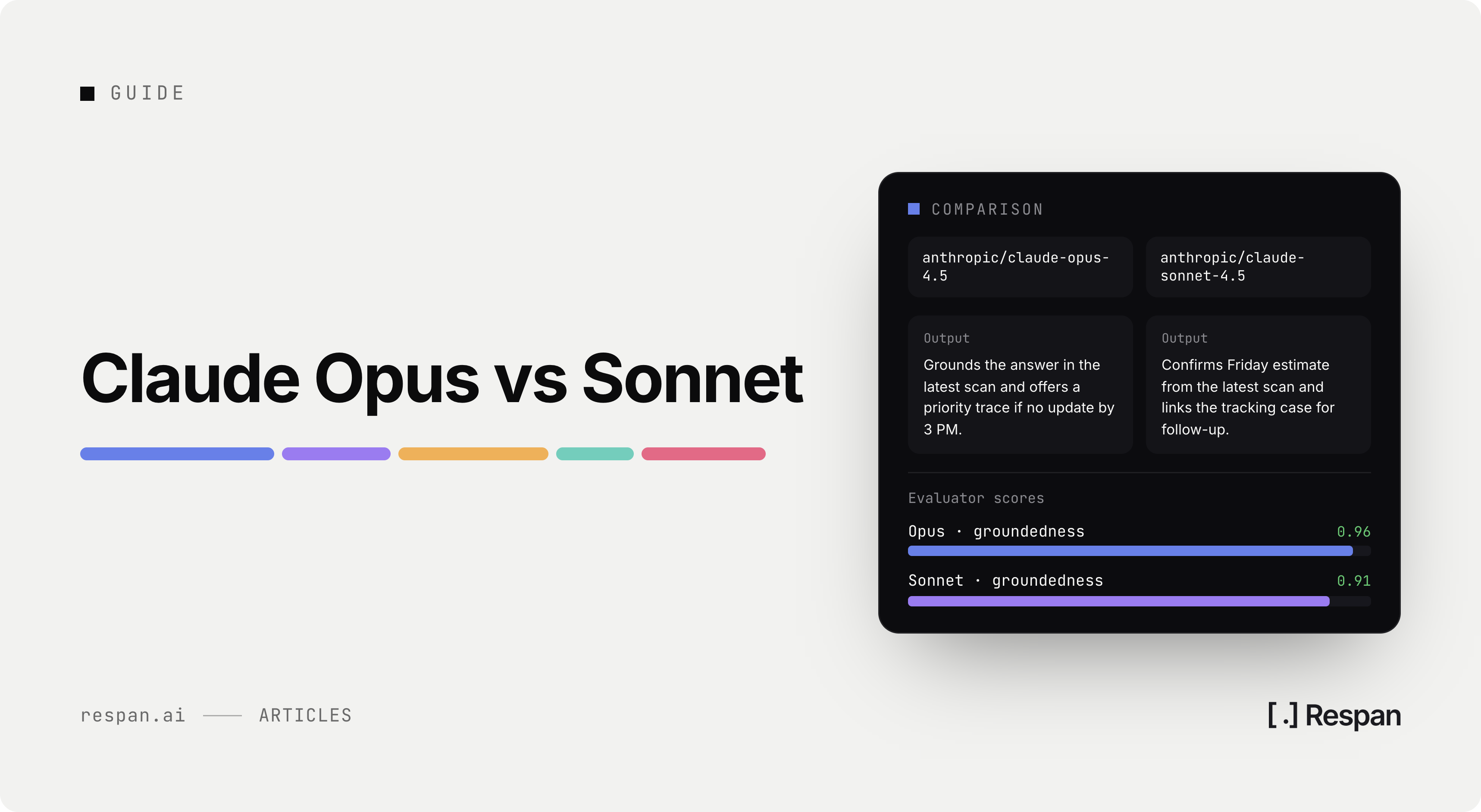
Older versions are priced differently from the current lineup. Sonnet 4.6 and Sonnet 4.5 still cost $3/$15, more than Sonnet 5, and every Opus back to 4.5 costs the same $5/$25 as Opus 5, so staying on an older model rarely saves money, a point the Claude Opus vs Sonnet comparison works through version by version.
Find the cheapest Claude model that passes
Respan runs Fable 5.1, Opus 5, Sonnet 5, and Haiku 4.5 against your own production requests, scores every output, and shows each model's quality next to what it costs. Route every step to the lowest tier that clears your evals, and start free.
Best Claude Models by Use Case
Coding, writing, and research each mix steps that need very different amounts of reasoning. The best Claude model for each is usually a primary tier, with cheaper ones handling the routine parts.
Best Claude Model for Coding
For most coding work, Claude Opus 5 is the model to start with, since Anthropic describes it as built for complex agentic coding. A coding agent rarely needs Opus on every call, though. Planning a change and deciding where it belongs is the expensive reasoning, while making a scoped edit, running tests, and reading files are steps that Sonnet 5 or Haiku 4.5 can often take.
Claude Code already splits work this way. Its opusplan setting runs Opus in plan mode and switches to Sonnet for execution, and its alias descriptions pitch sonnet for daily coding, haiku for simple tasks, and fable for the hardest and longest-running work.
Fable 5.1 pays off on root-cause investigations, outage debugging, and architecture decisions, where extra investigation before acting saves more time than it costs. That makes it a model to escalate to for a specific kind of problem rather than one to leave running on every edit.
Best Claude Model for Writing
Writing pipelines that generate text at volume, such as documentation drafts or release notes, usually belong on Claude Sonnet 5, since each output gets reviewed downstream and cost scales with every request. Bounded rewriting steps, like normalizing tone or trimming length, fit Haiku 4.5 at half the rate.
Long-form analytical and technical writing is where Opus 5 earns its price, because the work depends on holding an argument together across a long document. Output length matters here too: Opus 5 and Sonnet 5 can return up to 128K tokens in one response, against 64K on Haiku.
Knowledge cutoff is the other writing constraint. Sonnet 5's reliable knowledge runs through January 2026 and Haiku's through February 2025, so a pipeline writing about anything recent should pass the source material in rather than rely on what the model already knows.
Best Claude Model for Research
Research workloads are usually context-bound before they're reasoning-bound. Synthesizing across a large document set rules out Haiku 4.5 at 200K tokens, while Opus 5 and Sonnet 5 both take the full 1M-token window at standard pricing, so the choice between them comes down to how much judgment the synthesis needs.
Research agents that search, read, and revise over hours are the case Anthropic built Fable 5.1 for, and it describes the model as setting a new standard on long-running problem-solving tasks. The retrieval and extraction steps inside that agent can still sit on Sonnet 5 or Haiku 4.5, with Fable reserved for deciding what to look at next and what the results mean.
Life sciences research has one more constraint. Fable 5.1 directs life sciences research and development queries to Opus models, and Opus 5 refuses biology requests its own classifiers flag, so teams in that field may need Anthropic's Life Sciences Verification Program for access with more permissive biology safeguards.
Route, Compare, and Evaluate Claude Models
Routing each step to the cheapest tier that handles it depends on two things. Switching models has to be cheap, and you need proof that a step still works after you move it down a tier.
Respan's LLM gateway and evals cover both, so you can route, observe, and evaluate every LLM call in one platform, with the tier decision resting on scores from your own traffic.
- Browse and pick models - The model catalog lists every model on the gateway with its context limit, token pricing, and capabilities. Pick the ones you want and call them through one OpenAI-compatible endpoint to 1,000+ models, so moving a step from
claude-opus-5toclaude-sonnet-5is a config change rather than a deploy. - Fall back across tiers - Set a fallback chain once, at org level or per request, and traffic reroutes to the next model automatically when a provider errors or rate-limits.
- Compare models side by side - Test the same prompt on Opus 5, Sonnet 5, and Haiku 4.5 in the playground, on the same input, with parameter overrides and tools, and see which models teams actually route the most traffic and spend to on the Respan LLM leaderboard.
- Simulate real conversations - Simulations run a committed prompt version against generated multi-turn conversations with different users, goals, and interaction styles, then evaluate each conversation against its scenario's criteria. Scenarios are saved, so you can rerun the same set against a version on a cheaper Claude model and see where it breaks before it reaches production.
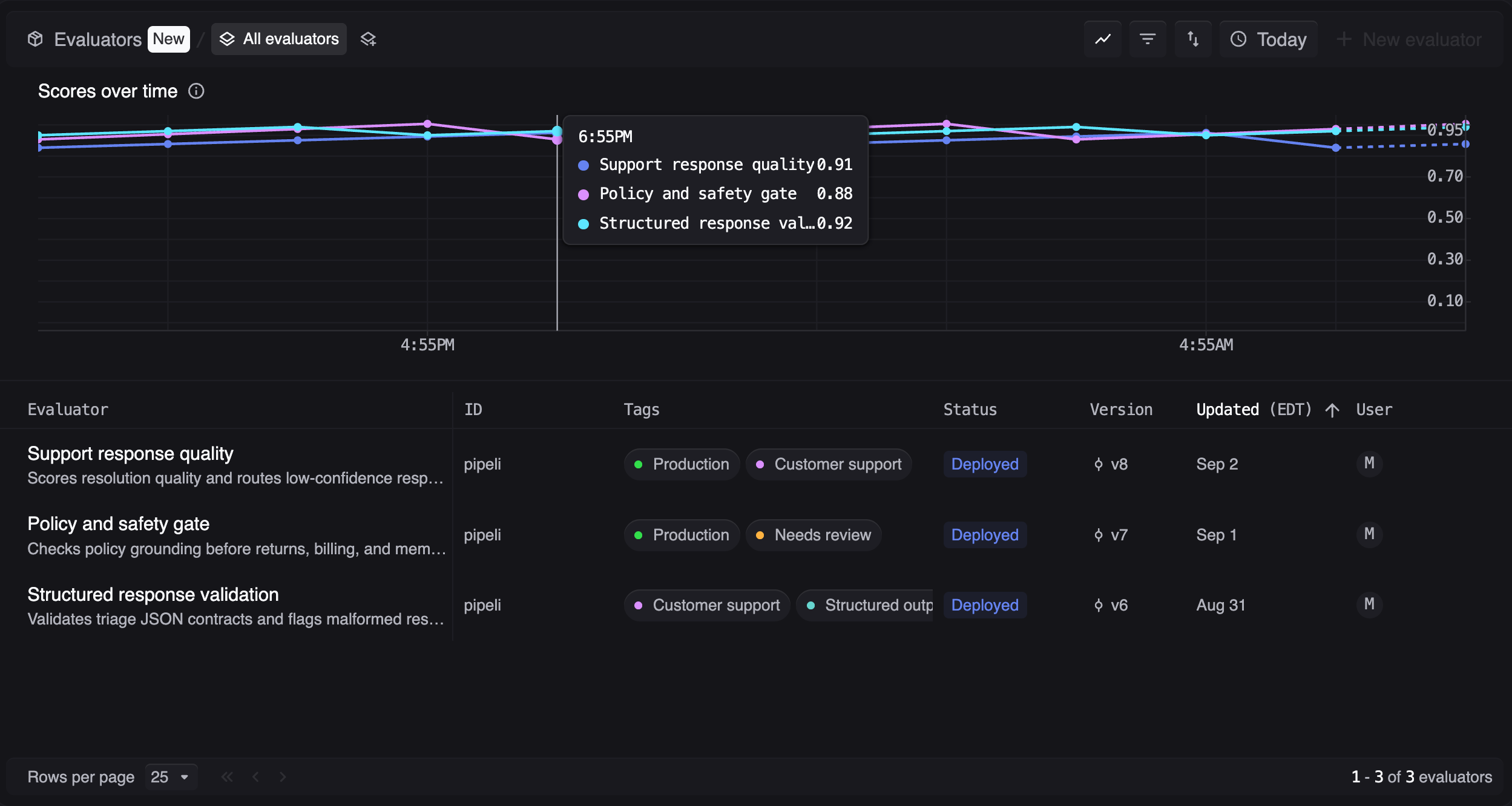
- Pick the model with real data - Sample production requests into a dataset, run each Claude model through the same evaluators as an experiment, and compare score distributions before deploying the winner. An evaluator can combine an LLM judge, a deterministic code check, or a human reviewer into a single score, and any row clicks straight into the trace behind it.
- Catch a tier that slips - Deploy the same evaluator on live production spans, sampled to control cost, so a step that degrades after a model update shows up as a score change instead of a user complaint.
- Version prompts per model - Commit and compare prompt versions and deploy them without shipping code, so a prompt tuned for Sonnet 5 can be tested against Haiku 4.5 before it replaces what's live.
- See cost by model and customer - Costs break down by model, by request, and by end customer, with soft and hard spend limits that stop a runaway experiment at a ceiling you set.
With routing and scoring in one place, each step's tier becomes a decision backed by its own score and cost. Revisiting it after the next Claude release means rerunning the experiment rather than starting the comparison over.
Route every step to the right Claude model
Compare Claude tiers on your own production data, score every step, and switch models with a single string. Free to start.
Frequently Asked Questions
Is Claude a Large Language Model?
Yes. Claude is a family of large language models developed by Anthropic, and the current generally available lineup is Fable 5.1, Opus 5, Sonnet 5, and Haiku 4.5. Every current model accepts text and image input and supports tool use, and developers can reach them through the Claude API, Amazon Bedrock, Google Cloud, and Microsoft Foundry.
How to Change the Model in Claude Code
Run /model inside a session to open the model picker, or type /model opus to switch directly. By default, /model also saves your choice for new sessions, and pressing s on a row in the picker switches for the current session only. To set a model at launch, use claude --model sonnet, and for a persistent default, set the model field in your settings file or the ANTHROPIC_DEFAULT_MODEL environment variable.
The opus, sonnet, haiku, and fable aliases point to the recommended version for your provider, and opusplan runs Opus in plan mode and Sonnet for execution. Fable 5.1 requires Claude Code v2.1.257 or later and isn't the default on any plan, so select it explicitly with /model fable. The full list of aliases and settings is in Anthropic's Claude Code model configuration docs.