Anthropic and OpenAI have spent 2026 trading frontier model releases at a pace that leaves little room between launches. For teams building on these models, every release means another round of re-testing prompts and deciding whether production traffic should move.
Anthropic's side of that race picked up in September. Fable 5.1 replaced Fable 5, which had only launched in June, and Opus 5.5 followed on September 22 at a lower price than the Opus models before it. New versions of both the Fable and Opus tiers landing within weeks of each other made it one of the biggest Claude stories of the year, and it reopened the question of which model your agents should run on.
For most production agents, start with Opus 5.5, since it costs less, runs faster, and led Fable 5.1 on the benchmarks Anthropic published at launch. Keep Fable 5.1 for the specific tasks where your own evals show Opus 5.5 missing, even at higher effort.
So regarding the Fable 5.1 vs Opus 5.5 debate, which Claude model is better? Let's find out.
TLDR: Fable 5.1 vs Opus 5.5
Opus 5.5 is the better default for most work. It costs less per token and per completed task, it generates output faster, and it leads on the benchmarks Anthropic published at launch.
| Fable 5.1 | Opus 5.5 | |
|---|---|---|
| Input / output price | $10 / $50 | $4 / $20 |
| Cache reads | $0.25 | $0.20 |
| AA Intelligence Index | 53 | 58 |
| Output speed | 68.2 tokens/s | 92.6 tokens/s |
| Cost per index task | $7.63 | $5.98 |
| Default effort | High | Medium |
| Context / max output | 1M / 128K | 1M / 128K |
| Use it for | Escalating hard tasks | Default for most work |
Prices are per million tokens. Fable 5.1 earns its place on the tasks where Opus 5.5 at higher effort still misses a requirement you can check.
What is Fable 5.1?
Fable 5.1 is the generally available model in Anthropic's Fable tier, released in September 2026. It shares its underlying model with Mythos 5.1, which is restricted to vetted cybersecurity and life sciences programs, while Fable 5.1 ships with additional safeguards so it can be offered to everyone.
Anthropic positions Fable 5.1 for demanding reasoning and long-horizon agentic work. It replaced Fable 5 at the same input and output price while cutting cache reads by 75%, which keeps it at the top of the Claude model lineup on price per token.
What is Opus 5.5?
Opus 5.5 is Anthropic's Opus-tier model released on September 22, 2026, built for long-running agentic coding and knowledge work. Anthropic lists it as the recommended starting point for most workloads and says it performs at the level of Fable 5.1 on most work.
Thinking is always on with Opus 5.5, so the per-token price understates what a request actually costs, which is a central point in the Opus 5.5 pricing and benchmarks guide.
Fable 5.1 vs Opus 5.5
Both models share a context window, a knowledge cutoff, and most of their safeguards. Where they separate is price, speed, and how much thinking each does by default.
Pricing
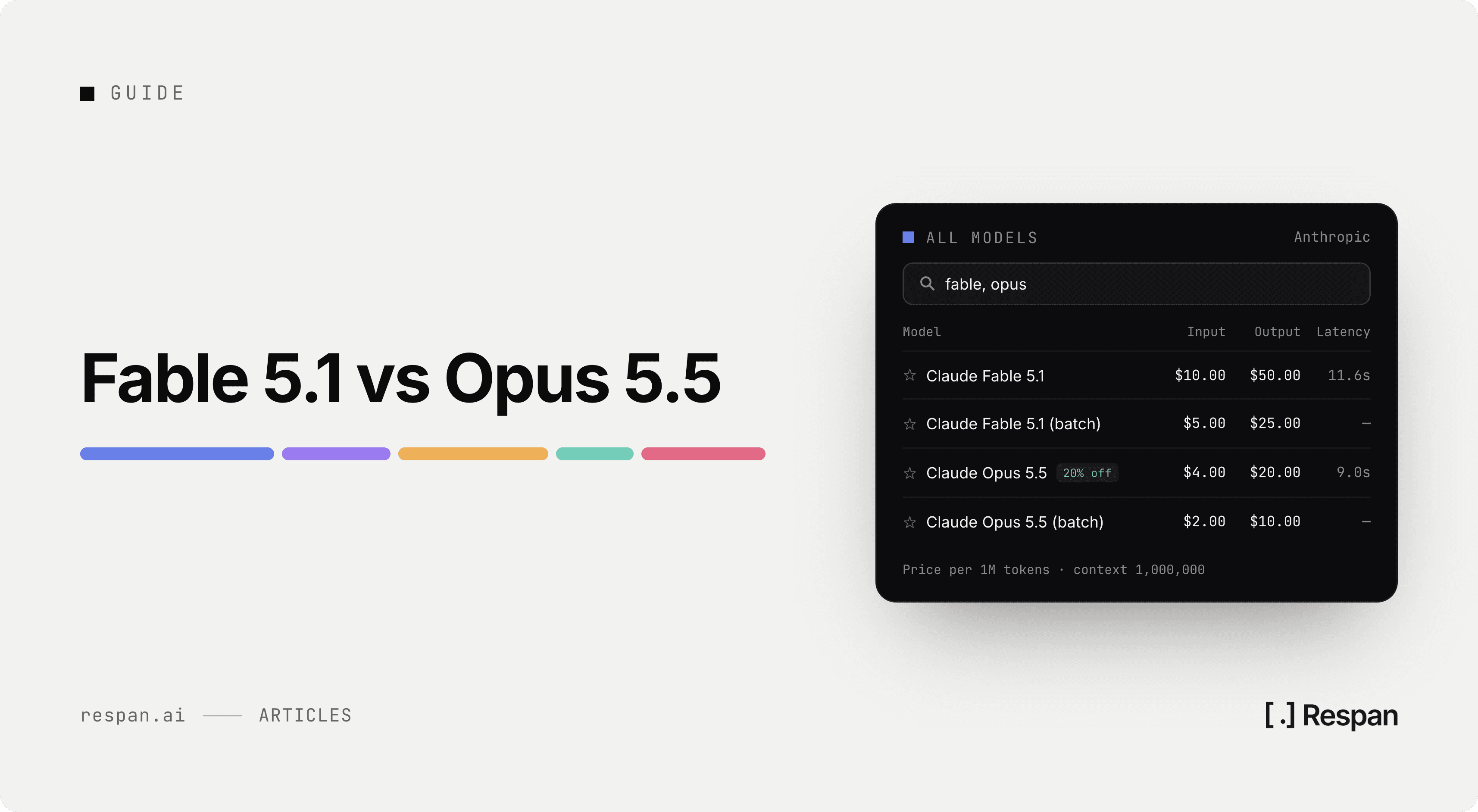
Anthropic's pricing puts the two models 2.5 times apart on input and output, while cache pricing sits much closer together:
- Fable 5.1 - $10 per million input tokens and $50 per million output tokens, with cache reads at $0.25 and five-minute cache writes at $12.50. Batch processing halves input and output to $5 and $25, and there is no fast mode.
- Opus 5.5 - $4 input and $20 output, with cache reads at $0.20 and five-minute cache writes at $5. Batch brings it to $2 and $10, and fast mode is available at $8 and $40 for latency-sensitive calls.
Agent loops that reread a large context on every turn spend much of their budget on cached tokens, and Anthropic says cache reads make up the majority of cost in agentic and coding work. On those reads the gap is $0.25 against $0.20, so how you structure your Claude prompt caching can matter as much as which model you pick.
Benchmarks
Anthropic's launch figures, which test both models on the same benchmark versions, have Opus 5.5 ahead on every task category it reported. Artificial Analysis, which runs its own independent index, lands in the same place:
- Fable 5.1 - Anthropic reported 55.8% on Terminal-Bench 4.0, 50.3% on FrontierCode v1.1, 1735 Elo on GDPval-AA v2.1, and 31.4% on AutomationBench. Artificial Analysis scores it 53 on its Intelligence Index at max effort.
- Opus 5.5 - Anthropic reported 66.4% on Terminal-Bench 4.0, 54.4% on FrontierCode v1.1, 1846 Elo on GDPval-AA v2.1, and 40.0% on AutomationBench. Artificial Analysis scores it 58.
The margins are smaller on computer use and multidisciplinary reasoning, where Anthropic reported 81.8% vs 80.7% on OSWorld 2.1 and 67.7% vs 65.6% on Humanity's Last Exam with tools. Keep in mind that benchmark tasks are not your prompts, so a lead on Terminal-Bench says little about whether Opus 5.5 handles the edge cases in your own traffic.
Speed and latency
Anthropic's model docs label Fable 5.1 "slower" and Opus 5.5 "moderate," and the throughput numbers back that up:
- Fable 5.1 - 68.2 output tokens per second on Artificial Analysis. It runs at high effort by default, so it can spend longer thinking before the answer starts.
- Opus 5.5 - 92.6 output tokens per second, roughly 36% more throughput. Fast mode raises output speed by up to 2.5x according to Anthropic, at double the standard price.
For an agent that chains a dozen calls while a user waits, that throughput difference compounds across every step of the run.
Cost per completed task
Per-token price only tells you part of the story, because Opus 5.5 tends to produce more output to finish the same work. On Artificial Analysis's index run at max effort:
- Fable 5.1 - generated 190M output tokens and cost $7.63 per task.
- Opus 5.5 - generated 260M output tokens and still cost $5.98 per task, about 22% less than Fable 5.1.
Both models were tested at max effort there, while in production Opus 5.5 defaults to medium and Fable 5.1 to high, so the gap on your workload could be wider. Also, a task that fails and gets rerun costs more than either figure, which is why the number worth tracking is cost per task that passes your own checks.
Context window and output limits
Anthropic's models overview lists identical limits for both:
- Fable 5.1 - 1M token context window, 128K max output, and a June 2026 knowledge cutoff.
- Opus 5.5 - 1M token context window, 128K max output, and the same June 2026 cutoff.
Neither model charges a long-context surcharge, so a 900K-token request bills at the same per-token rate as a short one. Context only becomes a deciding factor when you combine it with price, since filling 1M tokens on Fable 5.1 costs 2.5 times as much as on Opus 5.5.
Effort settings
Both models use adaptive thinking that cannot be turned off, but they start from different defaults:
- Fable 5.1 - defaults to high effort on the API and in Claude Code, and to medium on claude.ai.
- Opus 5.5 - defaults to medium effort, which is part of why it costs less per task out of the box.
Anthropic's model docs suggest reaching for Fable 5.1 when higher effort on Opus 5.5 still falls short. Raising effort on Opus 5.5 first keeps you on the cheaper model while you test whether more thinking closes the gap.
Coding and agent workflows
Anthropic positions Opus 5.5 for long-running agentic coding and Fable 5.1 for long-horizon work that depends on harder reasoning. In practice, that maps to a split between building and planning:
- Fable 5.1 - suited to planning a large change, untangling an ambiguous spec, or reviewing work before it ships, where one wrong decision early on costs more than the extra tokens.
- Opus 5.5 - suited to implementation, refactors, and the bulk of tool-calling turns in an agent loop, where it also posted Anthropic's higher coding scores.
Claude Code supports this split directly. Running Opus 5.5 as the main model and setting Fable 5.1 as the advisor with /advisor lets Fable weigh in at decision points, such as before committing to an approach or marking a task done. Outside Claude Code, the same split has to live in your application's routing logic, and it can extend one tier down as well, since routine, high-volume turns raise the same cost question covered in the Opus 5.5 vs Sonnet 5.5 comparison.
Safeguards and availability
Anthropic applied the same tier of cyber and biology safeguards to both models:
- Fable 5.1 - safeguards intervene around 60% less often per session than on Fable 5, and biology safeguards fire 85% less often on benign requests, according to Anthropic. Penetration testing, exploit generation, and binary vulnerability scanning still get redirected to Opus models.
- Opus 5.5 - carries safeguards similar to Fable 5.1, with most cybersecurity tasks routed to Opus 4.8.
Since both models hand offensive security work to an older Opus, safeguards are not a reason to pick one over the other. Both are available on the Claude API, Amazon Bedrock, Google Vertex AI, and Microsoft Foundry.
Fable 5.1 vs Opus 5.5: Which Is Better?
Opus 5.5 is the better model for most work, while Fable 5.1 is better for a narrower set of tasks:
- Opus 5.5 - The better default. It led Fable 5.1 on every benchmark in Anthropic's launch comparison, scored higher on Artificial Analysis's index, generated output about 36% faster, and cost about 22% less per index task even while producing more tokens. Use it for implementation, agent loops, and any request a user is waiting on.
- Fable 5.1 - The better choice when a task keeps failing on Opus 5.5 after you raise its effort, such as planning a large change or reviewing work before it ships. Its higher price and higher default effort pay off only where a wrong first decision costs more than the extra tokens.
Our take: Run Opus 5.5 as your default and send only the task types your evals flag to Fable 5.1, since paying Fable 5.1's price on every request rarely buys better results than Opus 5.5 at a higher effort setting.
Route Fable 5.1 and Opus 5.5 per task with Respan
Choosing a model per task means writing routing logic into your application and then proving that each Fable 5.1 call is worth 2.5 times the price. Without that proof, you either overpay by defaulting to Fable 5.1 or risk regressions by moving everything to Opus 5.5.
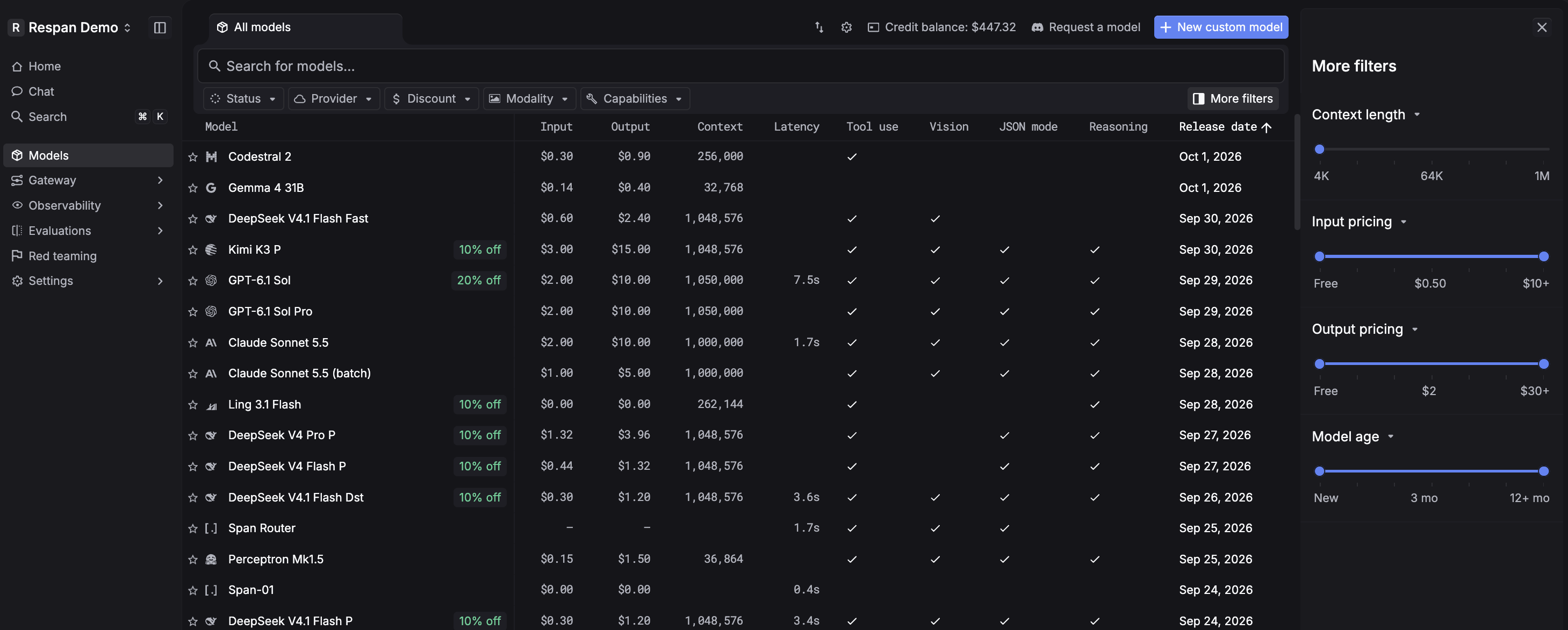
With Respan's LLM gateway, you can route, observe, and evaluate every LLM call through one API, so the split between Fable 5.1 and Opus 5.5 becomes a setting you can test and change instead of code you maintain:
- One API for both models - Call
claude-fable-5-1andclaude-opus-5-5through one endpoint alongside 1,000+ models, and switch between them by changing the model name. - Fallbacks you set once - Define a fallback chain at the org level or per request, and when a provider errors or rate-limits, traffic moves to the next model automatically.
- Cost by model, request, and customer - Every request is logged as a span with latency and cost attached, so you can see which tasks are driving Fable 5.1 spend and set hard limits before the bill surprises you.
- Evals on real traffic - Build a dataset from production requests, run it through both models in one experiment, and compare scores and cost row by row, with a click into the trace behind any result.
- Online evals in production - Run the same evaluators on live traffic so a regression after switching models surfaces in real time.
- Task-aware routing (beta) - Set the model to
span-routerand Respan Router picks the model for each task, weighing cached context before it switches. It is enabled per organization on request and bills at the serving model's price with no markup.
When every request is already traced, priced, and scored, deciding which tasks belong on Fable 5.1 turns into reading a dashboard.
FAQ
Should I switch from Opus 5.5 to Fable 5.1?
For most workloads, no. Opus 5.5 costs less per task, runs faster, and leads on Anthropic's reported benchmarks, so a full switch usually means paying more for the same results. A better approach is to raise Opus 5.5's effort on the tasks where it struggles, then move only those tasks to Fable 5.1 if your evals still show a gap. Respan lets you run that comparison on a dataset built from your own production requests before you change anything live.
Can you use Fable 5.1 and Opus 5.5 together?
Yes. With Respan, both models sit behind one API, so you can send most traffic to Opus 5.5, route specific task types to Fable 5.1, and set each as the other's fallback. Every request is traced and priced, so you can see whether the Fable 5.1 share of traffic is improving results enough to justify its cost.
How do you compare Fable 5.1 and Opus 5.5 on your own traffic?
Pull a sample of production requests into a Respan dataset, then run an experiment that sends the same rows to both models through your evaluators. You get per-row and average scores, side-by-side score distributions, and the cost of each run, so the decision rests on your prompts rather than a public benchmark. Once you pick a split, online evals keep scoring live traffic so you know if quality shifts later.
Is Opus 5.5 good enough for production agents?
Anthropic recommends Opus 5.5 as the starting point for most workloads, and it is faster and cheaper per task than Fable 5.1. Whether it is good enough for your agent depends on the failure cases your evals catch, which is why it helps to run Opus 5.5 behind Respan's LLM gateway with online evals and monitors watching live traffic. If a task class starts failing, you can route just that class to Fable 5.1 instead of moving the whole agent.