
Grok 4.7 shipped on September 21, 2026, and Claude Opus 5.5 followed a day later, putting two frontier models on the market within the same week. The timing is a big part of why Grok 4.7 drew so much attention. It went live on every Cursor plan and as the default model in Grok Build on day one, and it kept Grok 4.6's per-token price.
Grok 4.7 has the lower list price and Opus 5.5 posts the higher scores, but effort level changes how those two facts combine. Both are reasoning models, so the tokens each one spends to finish a task set the real cost, which can make the model that's cheaper per token the more expensive one per task. Grok 4.7's clearer edge is how quickly it starts responding.
Here's how Grok 4.7 and Claude Opus 5.5 compare on pricing and benchmarks.
TL;DR: Grok 4.7 vs Opus 5.5
Grok 4.7 and Opus 5.5 trade places depending on whether you compare per-token prices, benchmark scores, or cost per completed task.
- Pricing - Grok 4.7 costs $2 input and $6 output per million tokens, against $4 and $20 for Opus 5.5. Cached input is the exception, at $0.50 on Grok 4.7 and $0.20 on Opus 5.5.
- Cost per task - Effort level and token use decide what each model costs per completed task, so Grok 4.7's lower list price doesn't guarantee a lower bill.
- Benchmarks - On CursorBench 4.0, Anthropic reports 52.5% for Opus 5.5 at its default effort, and xAI reports 46.3% for Grok 4.7 at xhigh.
- Speed - Both vendors sell a faster tier at twice standard rates, with Grok 4.7 Fast inside Cursor and Grok Build and Opus 5.5 fast mode at $8 input and $40 output per million tokens.
- Context - Opus 5.5 has a 1M-token context window, twice Grok 4.7's 500,000.
Grok 4.7 wins on list price and Opus 5.5 on reported scores, with cost per task depending on the effort level you run.
Has Grok 4.7 been released?
Grok 4.7's release date was September 21, 2026, and it's available now through xAI's API, in Cursor on every plan, and in Grok Build, where it's the default model. It replaced Grok 4.6 as xAI's flagship at the same per-token price.
In xAI's launch post, the company describes Grok 4.7 as built on a new, larger base model than Grok 4.6, trained with a longer reinforcement learning run weighted toward problems that take hours to finish. xAI says the result is better at checking its own work and managing long context, which is what matters if you run long agent loops.
Grok AI pricing
Grok 4.7 keeps Grok 4.6's per-token rates, and several of the charges that move a real bill sit outside the headline input and output prices.
- API pricing - Grok 4.7 costs $2 per million input tokens and $6 per million output tokens on the xAI API, and it has no Batch API discount, so async jobs run at full price. Server-side tools add a per-call fee on top of tokens, such as $5 per 1,000 web search calls, and a US regional endpoint that keeps inference in the United States bills at a 10% premium.
- Cached input and long-context pricing - Cached input costs $0.50 per million tokens. xAI recommends setting a
prompt_cache_keyso a conversation's requests reach the same server, since without it requests often land on a cache-cold server and pay full input price, the same hit-rate problem any prompt caching setup has to solve. Once a prompt reaches 200,000 tokens, every token in that request bills at double rate: $4 input, $1 cached, and $12 output. - Grok 4.7 Fast - Grok 4.7 Fast is the same model on faster infrastructure at twice the standard rates, $4 input and $12 output per million tokens below 200,000 prompt tokens. It's only available in Cursor and Grok Build, not on the public API, so it isn't an option for production traffic you route yourself.
On a cache-heavy agent loop, cached input is the line to watch, since it's the one price where Opus 5.5 comes in lower than Grok 4.7.
Grok AI benchmarks
xAI's launch table compares Grok 4.7 with Grok 4.6 and other frontier models, though not with Opus 5.5, which shipped a day later. The scores are xAI's own, with Grok 4.7 at xhigh and Grok 4.6 at high unless noted.
Coding and agentic benchmarks
Grok 4.7 scores 46.3% on CursorBench 4.0, up from 40.4% for Grok 4.6, and 37.6% on Terminal-Bench 4.0, up from 20.3%. At high effort it scores 71.0% on DeepSWE v1.1, and on EEBench, an electrical engineering benchmark, it scores 64.0% against 53.0% for Grok 4.6.
The Terminal-Bench result nearly doubles Grok 4.6's, which lines up with xAI's description of a model trained on tasks that take hours to complete.
Knowledge work benchmarks
On GDPval, which grades professional deliverables across a range of occupations, Grok 4.7 scores an Elo of 1,695, up from 1,605 for Grok 4.6. It also scores 1,657 on AA-Briefcase v1.1, a multi-hour office work evaluation, up from 1,546.
Outside general office work, Grok 4.7 scores 56.7% on HealthBench Professional, up from 48.5% for Grok 4.6.
How to get started with Grok 4.7
Grok 4.7 is reachable through two coding tools and the API, and the right starting point depends on whether you want an agent or a model ID.
Grok 4.7 in Cursor and Grok Build
Grok 4.7 is available in Cursor on every plan and is the default model in Grok Build, xAI's coding agent. Grok Build has a free tier, which makes it the quickest way to see how the model handles your own repository before writing any API code:
curl -fsSL https://x.ai/cli/install.sh | bashGrok 4.7 Fast is limited to these two tools, and it isn't included in Grok Build's free tier.
Grok 4.7 API
On the API, the model ID is grok-4.7. It supports xAI's Responses API and Chat Completions, and because the endpoint is OpenAI-compatible, the OpenAI SDK works once you point it at xAI's base URL:
import os
from openai import OpenAI

client = OpenAI(
    api_key=os.environ["XAI_API_KEY"],
    base_url="https://api.x.ai/v1",
)

response = client.responses.create(
    model="grok-4.7",
    input="Find and fix the bug: function median(a){a.sort();return a[a.length/2]}",
)
print(response.output_text)
xAI's model docs list a 500,000-token context window and a May 2026 knowledge cutoff, with text and image input. Reasoning effort runs from low to xhigh and defaults to high, so any request that doesn't set reasoning_effort runs at high.
One integration detail matters for multi-turn agents. On the Responses API, Grok 4.7 always returns encrypted reasoning content, and those reasoning items should be passed back unchanged in the next request's input.
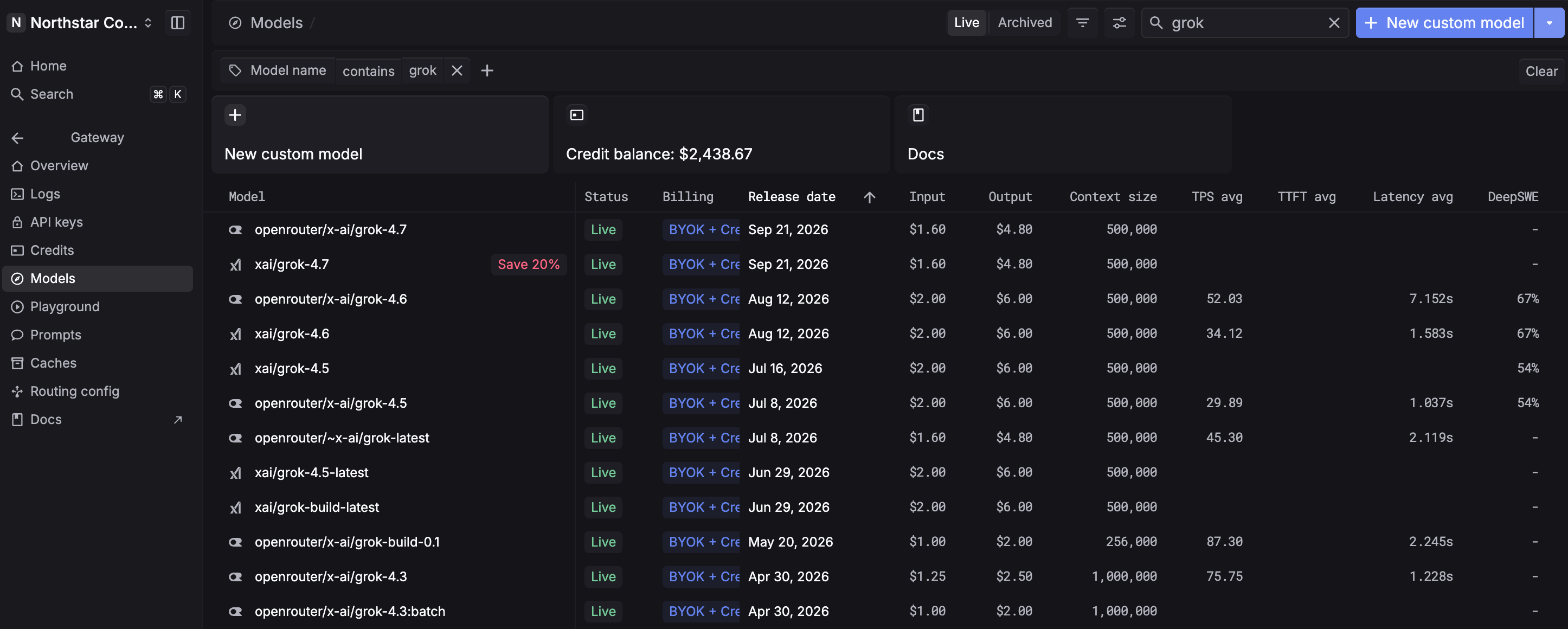
Try Grok 4.7 on Respan, now 20% off
Grok 4.7 is 20% off on Respan. Route it alongside Opus 5.5 through one gateway and compare cost per task on your own traffic. Respan is free to try.
Grok 4.7 vs Opus 5.5: comparison
Grok 4.7 and Opus 5.5 side by side, with cost per task and time to first token measured at each model's default effort:
| Grok 4.7 | Claude Opus 5.5 | |
|---|---|---|
| Input / output (per 1M) | $2 / $6 | $4 / $20 |
| Cached input (per 1M) | $0.50 | $0.20 |
| Batch discount | None | 50% |
| Context window | 500K tokens | 1M tokens |
| Default effort | High | Medium |
| CursorBench 4.0 (vendor-reported) | 46.3% (xhigh) | 57.8% (max) |
| Cost per task | $2.73 | $1.34 |
| Time to first token | 0.85s | 21.8s |
| Model ID | grok-4.7 | claude-opus-5-5 |
Pricing: rate card vs cost per task
Grok 4.7 undercuts Opus 5.5 on every token type except cached input, so the real difference between them comes down to how many tokens each model spends on the same work.
- Grok 4.7: At its default high effort, Grok 4.7 cost $2.73 per task in Artificial Analysis's independent runs and used about 66,000 output tokens per task. Moving to xhigh raised that to $3.74.
- Opus 5.5: Its default medium effort cost $1.34 per task on about 26,000 output tokens in the same runs, even though each output token costs more than three times what it does on Grok 4.7. Beyond the Opus 5.5 pricing on the rate card, Anthropic's Message Batches API takes 50% off work that can wait.
Those figures come from one independent task mix. They show that per-token prices can point the wrong way, and your own prompts and effort settings decide which model costs less on your traffic.
Performance
The two launch tables report what appears to be the same knowledge-work benchmark, GDPval. Both list Fable 5.1 at 1,735 Elo, which gives the vendors' numbers a common reference point.
- Grok 4.7: xAI reports a GDPval Elo of 1,695 at xhigh. Its table also includes the Harvey Legal Agent Benchmark, where Grok 4.7 scores 19.6% against 6.7% for Fable 5.1.
- Opus 5.5: Anthropic reports 1,846 on GDPval-AA v2.1. Its table adds 67.7% on Humanity's Last Exam with tools.
Measured against that shared anchor, Opus 5.5 sits about 110 points above Fable 5.1 on GDPval and Grok 4.7 about 40 below it.
Coding and agentic workflows
On the two coding benchmarks both launch tables include, Opus 5.5 leads even at its default effort.
- Grok 4.7: At xhigh, it scores 46.3% on CursorBench 4.0 and 37.6% on Terminal-Bench 4.0, per xAI. For long agent loops, xAI recommends pairing it with context compaction.
- Opus 5.5: It scores 52.5% on CursorBench 4.0 at its default medium effort and 57.8% at max, plus 66.4% on Terminal-Bench 4.0 at xhigh, per Anthropic. Thinking stays on for every request, so the effort parameter is the lever for controlling cost on coding agents.
Because Anthropic's models run natively in Claude Code while Grok 4.7 is built into Grok Build and ships in Cursor, the harness a team already uses can shape this decision as much as the scores, which is the same tradeoff at the center of any Claude Code vs Cursor comparison.
Speed and latency
Neither vendor publishes time to first token, but Artificial Analysis measured about 0.85 seconds for Grok 4.7 at high effort and about 22 seconds for Opus 5.5 at medium, since Opus 5.5's thinking runs before the answer. Both vendors also sell a faster tier for when latency matters more than price.
- Grok 4.7: Grok 4.7 Fast runs the same model on faster infrastructure at twice the standard rates. It's only available in Cursor and Grok Build, so API traffic runs at standard speed.
- Opus 5.5: Fast mode costs $8 input and $40 output per million tokens, double the standard rate. Lowering effort is the cheaper lever, since less thinking before the answer brings the first token forward.
Which number matters depends on the product. Time to first token decides how a chat interface feels, while a background agent cares more about how long the whole task takes.
Context window
Context size is the one spec where the gap between the two is simple.
- Grok 4.7: The window holds up to 500,000 tokens, but any request whose prompt reaches 200,000 tokens bills every token at double rate, so a long-context agent pays $4 input and $12 output per million.
- Opus 5.5: It takes up to 1M tokens, twice Grok 4.7's window, and its $0.20 cache reads make a long repeated prefix cheaper to replay.
For codebase-wide work or large document sets, Opus 5.5 leaves more room before a task has to be split, and Grok 4.7's price advantage narrows once prompts cross 200,000 tokens.
Should I use Grok 4.7 or Claude Opus 5.5?
Neither model fits every step of a production workload, so the choice usually comes down to what a given step needs.
- Use Grok 4.7 - Choose it when time to first token is the constraint, such as a user-facing assistant where the response has to start right away. It also fits teams already working in Cursor or Grok Build that want a frontier model at a low per-token price, keeping in mind that prompts past 200,000 tokens bill at double rate.
- Use Claude Opus 5.5 - Choose it for long coding and agent tasks where finishing the work matters more than how fast the first token arrives. It scored higher on the benchmarks both vendors report, its higher list price doesn't necessarily mean a higher cost per task, and its 1M-token window fits larger codebases. If the real question is which Claude tier fits, the Claude model comparison covers Sonnet and Haiku too.
Since both models can sit behind the same gateway, you don't have to pick one for the whole application. Sending latency-sensitive steps to one and long-running tasks to the other is a per-step decision you can test.
Compare Grok 4.7 and Opus 5.5 on your own traffic with Respan
Every published number for Grok 4.7 and Opus 5.5 comes from someone else's workload. Cost per task on your traffic depends on how your prompts cache and how many tokens each model spends at the effort level you run, and neither shows up until real requests are flowing.
Respan puts an LLM gateway, observability, and evals in one platform, so the choice between Grok 4.7 and Opus 5.5 becomes a comparison you can read off your own data. Route, observe, and evaluate every LLM call:
- Both models behind one endpoint - Grok 4.7 is live on the Respan gateway at 20% off, alongside Opus 5.5 and 1,000+ other models, so switching between them is a one-word change.
- Cost per request - Every call is logged as a span with latency and cost attached, and spend breaks down by model, by request, and by end customer, so the per-task gap shows up in your own numbers.
- Experiments on real traffic - Pull production requests into a dataset, run Grok 4.7 and Opus 5.5 through the same evaluators, and compare scores row by row, with a click through to the trace behind any result.
- Evals on live traffic - Online evals score production spans as they arrive, so a quality drop after switching models shows up as a score change instead of a customer complaint.
- Fallback chains - Set a chain once, at the org level or per request, so a provider error or rate limit on one model sends traffic to the next model you picked.
- Spend limits - Hard caps per key, per customer, or org-wide stop a runaway effort setting at the ceiling you set.
Together, those turn "Grok 4.7 or Opus 5.5" from a judgment call into a comparison you run on the traffic you already have.
Run Grok 4.7 on Respan at 20% off
Grok 4.7 is 20% off on Respan. Route it next to Opus 5.5, trace every call, and compare cost per task on your own traffic before you commit. Try Respan free.
FAQ
Is Grok 4.7 cheaper than Claude Opus 5.5?
Per token, yes. Grok 4.7 costs $2 input and $6 output per million tokens against $4 and $20 for Opus 5.5, though Opus 5.5 is cheaper on cached input. Per completed task, it depends on effort level and how many tokens each model spends on your workload, so the lower list price doesn't guarantee a lower bill. Running both through the Respan gateway shows which one costs less on your own traffic.
Is Grok 4.7 better than Opus 5.5 for coding?
On the coding benchmarks both vendors report, Opus 5.5 scores higher. Anthropic reports 52.5% on CursorBench 4.0 for Opus 5.5 at default effort, and xAI reports 46.3% for Grok 4.7 at xhigh. Grok 4.7's advantages for coding are its lower list price and its sub-second time to first token.
What is the Grok 4.7 model ID?
The model ID is grok-4.7 on the xAI API, which supports both the Responses API and Chat Completions. On the Respan gateway, Grok 4.7 is available alongside 1,000+ other models behind one endpoint.
What is Grok 4.7's context window?
Grok 4.7 has a 500,000-token context window. Requests with prompts of 200,000 tokens or more bill every token at double rate, which is $4 input and $12 output per million. Opus 5.5's window is 1M tokens.
Can I use Grok 4.7 and Opus 5.5 together?
Yes. With Respan, both models sit behind one endpoint, so each step of an agent can call the model that fits it, with cost and quality compared per request in the same dashboard. Any LLM gateway that carries both models makes the split possible, and Respan adds tracing, evals, and fallback chains on top of the routing.