Anthropic released Claude Opus 5.5 on September 22, 2026, and it went straight to the top of the Respan Index, ranking first overall and first on coding. For a lot of teams building agents, it has become the default model for hard work.
The issue is what that default costs once traffic grows, along with rate limits you don't control and weights you can't run yourself. Open-weight models have closed part of the gap, and the strongest now trail Opus by about 13 points on the same index.
None of them replaces Opus across the board. Where they earn a place is task by task, on the steps where a cheaper model holds up, while Opus keeps the work it's still best at.
Below are the top 5 open-weight Claude Opus alternatives, how close each one gets to Opus 5.5, and how to migrate without breaking your agents.
TL;DR: Top 5 Claude Opus 5.5 alternatives
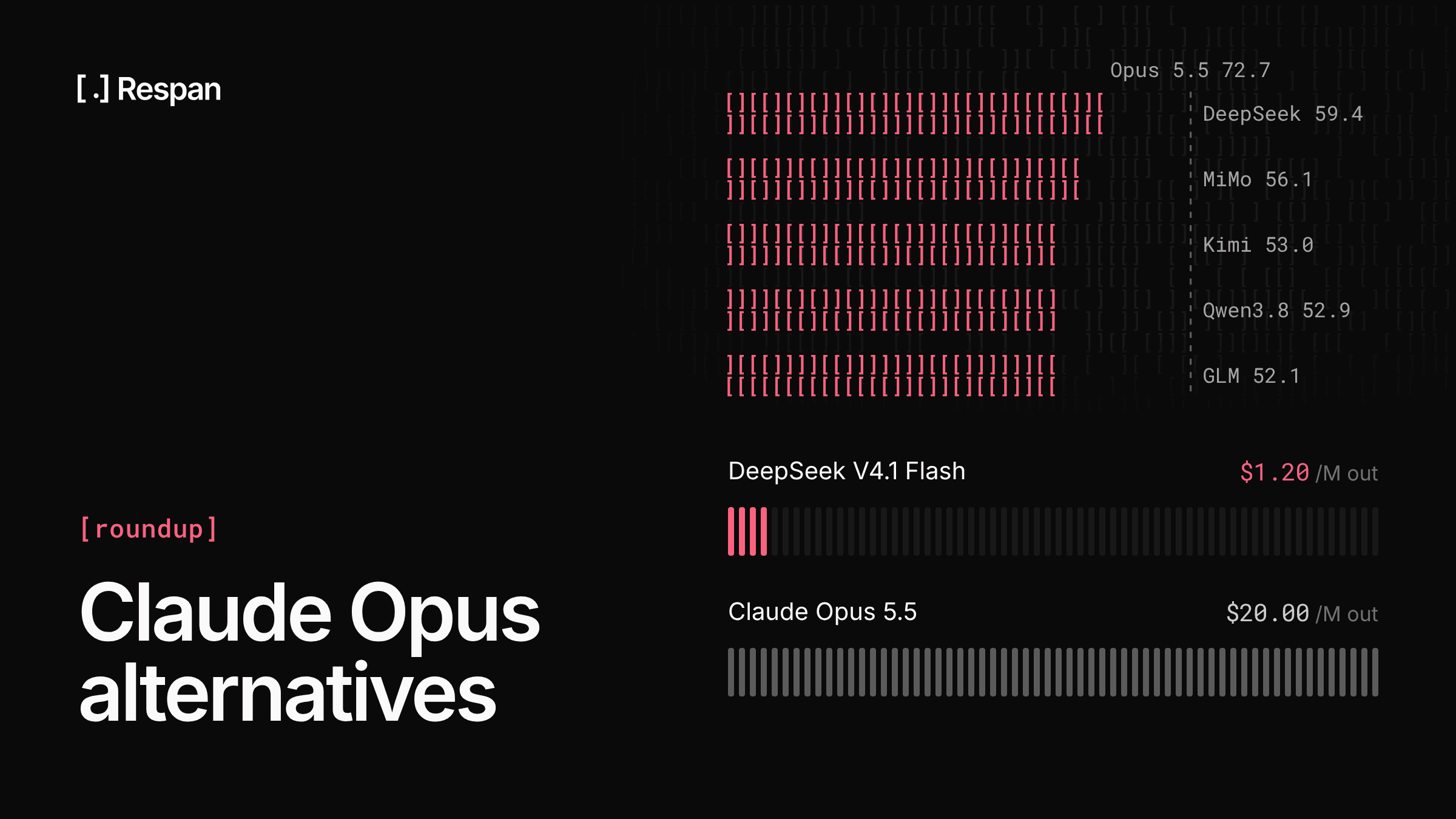
Ranked by Respan Index score, with Opus 5.5 at 72.7 as the baseline:
- DeepSeek V4.1 Flash 1017 - The closest open model to Opus at 59.4, under MIT, with output priced at a small fraction of Opus's.
- MiMo-V2.6-Pro - MIT-licensed, and the only model here that takes video and audio input as well as text and images.
- Kimi K3 - Moonshot reports it ahead of Opus 4.8 on several browsing and tool-use benchmarks, though hosted prices sit closer to Opus than the rest.
- Qwen3.8 (2.4T-A95B) - The open checkpoint behind Qwen3.8-Max, text-only, with license terms that reach AI coding products at scale.
- GLM-5.3 - Text-only, with the lightest conditions of the three custom licenses here.
If you only test one, start with DeepSeek V4.1 Flash 1017, since it scores highest of the five and costs the least off-peak.
Why look for a Claude Opus 5.5 alternative?
Opus 5.5 is a strong default, and for the hardest coding and reasoning work it's often still the right call. The pressure to look elsewhere usually comes from what happens around the model once it's in production:
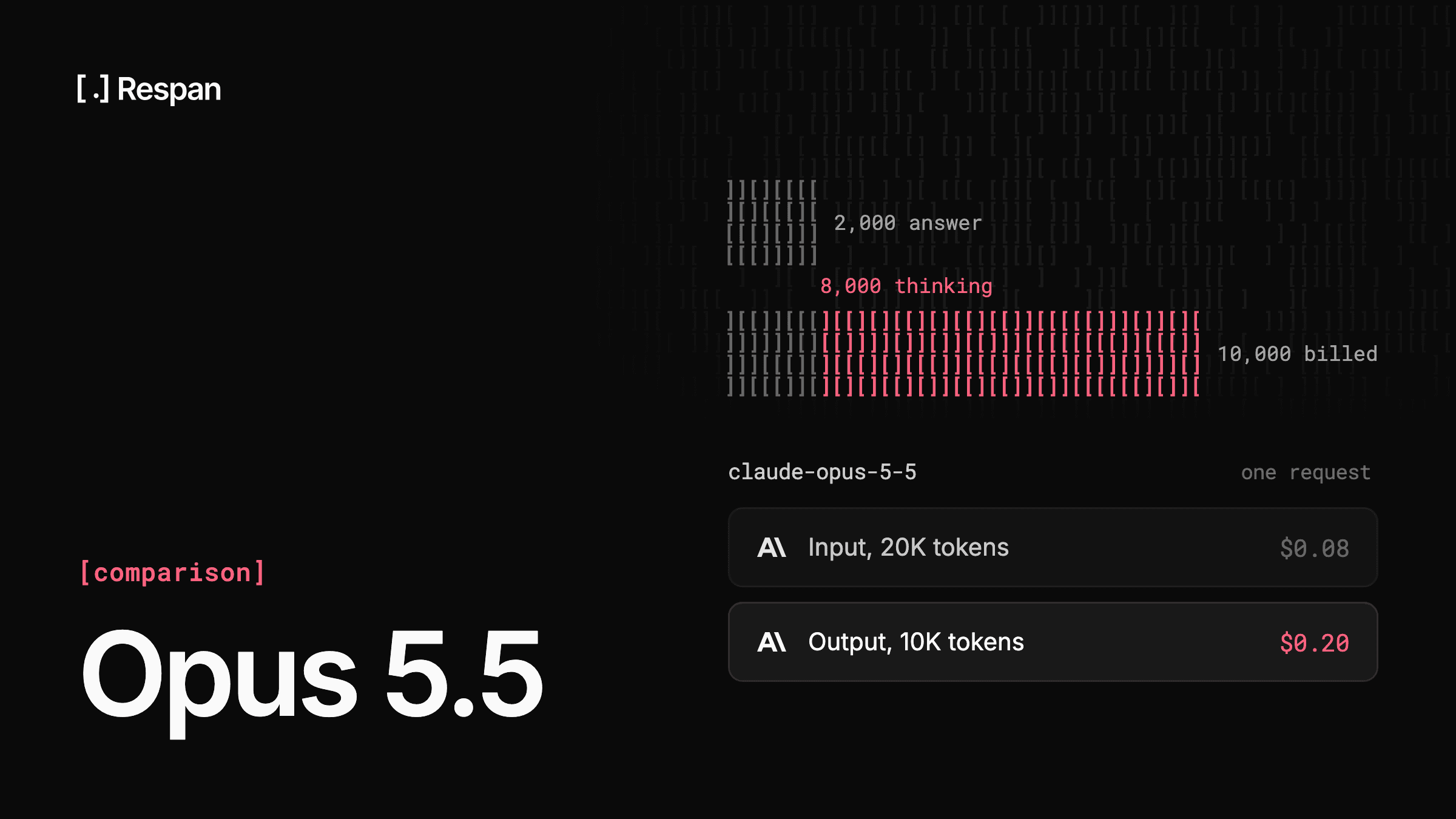
- Cost at volume - Anthropic prices Claude Opus 5.5 at $4 per million input tokens and $20 per million output tokens. Agents that loop through tool calls produce a lot of output, so simple steps end up billed at frontier rates.
- Rate limits and outages - Every request depends on one provider's capacity, and Anthropic rate limits or 529 overload errors can stall a product that has no other model to fall back to.
- Data control - Anthropic doesn't publish Opus's weights, so prompts and outputs leave your infrastructure on every call, which can be a blocker for regulated data.
- No access to the weights - Without them, you can't fine-tune Opus on your own data or quantize it to run on hardware you choose.
Open-weight models address each of these in different ways, and every one of them comes with a tradeoff.
Open-weight models vs Claude Opus 5.5: pros and cons
Switching to open weight models trades some capability for control. How much capability you give up depends on the task, and how much control you gain depends on whether you self-host or call a hosted API.
Pros
- Lower cost per token - Hosted versions of DeepSeek V4.1 Flash 1017 and MiMo-V2.6-Pro charge as little as $0.60 and $0.87 per million output tokens, against $20 for Opus 5.5.
- More than one provider - The same weights are served by many providers. GLM-5.3, for example, is available through 24 routes on Respan's gateway, so one provider going down doesn't take the model with it.
- Your own infrastructure - With the weights, prompts and outputs can stay inside hardware you control.
- Fine-tuning and quantization - You can train on your own data and quantize the weights to fit the GPUs you have.
- Permissive licenses - DeepSeek and MiMo ship under MIT, which allows commercial use with no conditions beyond keeping the notice.
Most of these gains depend on how you run the model, since self-hosting delivers the control and hosted APIs deliver the price.
Cons
- A capability gap - The highest-scoring open model, DeepSeek V4.1 Flash 1017, sits at 59.4 on the Respan Index against 72.7 for Opus 5.5, and Opus ranks first on coding.
- Hardware at frontier scale - These five range from 753B to 2.8T total parameters, so self-hosting any of them means multi-GPU nodes.
- License conditions at scale - Kimi K3, Qwen3.8, and GLM-5.3 use custom licenses that add terms above set revenue or user thresholds.
- Integration work - Request formats, reasoning output, and tool-call handling differ from Anthropic's API, so switching takes code changes.
- Hosted and open versions can differ - Qwen3.8's open checkpoint is text-only, while the hosted Qwen3.8-Max adds image input and built-in tools.
The cost and control gains are immediate, while the capability gap shows up task by task, which is why the migration section below starts with testing.
Top 5 open-weight Claude Opus 5.5 alternatives
Respan Index scores aggregate published benchmark results and are as of November 4, 2026. Output prices are per million tokens on the provider's own API or the most common hosted route.
| Model | License | Respan Index | Output price (1M) | Input |
|---|---|---|---|---|
| Claude Opus 5.5 | Proprietary | 72.7 | $20 | Text, image |
| DeepSeek V4.1 Flash 1017 | MIT | 59.4 | $0.60 off-peak | Text, image |
| MiMo-V2.6-Pro | MIT | 56.1 | $0.87 | Text, image, video, audio |
| Kimi K3 | Kimi K3 License | 53.0 | $9.50 to $22.50 | Text, image |
| Qwen3.8 (2.4T-A95B) | Qwen3.8-Max License | 52.9 (hosted Max) | $6 | Text |
| GLM-5.3 | GLM-5.3 License | 52.1 | $4.40 | Text |
1. DeepSeek V4.1 Flash 1017
DeepSeek V4.1 Flash 1017 is the open model that gets closest to Opus 5.5 on the Respan Index, at 59.4. It ships under MIT, takes text and image input, and matches Opus's 1M-token context, with 763B total parameters.
Its strongest ground is agent work. Its Respan Index agents score of 76.8 ranks sixth across all models, while Opus 5.5 ranks second in that category. DeepSeek's own model card compares it against Opus 5 rather than 5.5 and reports it ahead on DeepSWE v1.1 (77.0 vs 74.0) and Automation-Bench (60.5 vs 50.3), with Opus 5 ahead on Terminal-Bench 4.0 (51.8 vs 42.3) and on Humanity's Last Exam without tools. Since Opus 5.5 is the newer model, the gap on those weaker categories is likely wider than DeepSeek's table shows.
Price is where the case gets strong. Among the DeepSeek models, it's the one DeepSeek's API serves as deepseek-flash, at $0.15 input and $0.60 output off-peak, doubling to $0.30 and $1.20 during weekday peak windows. Even at peak, output costs about a sixteenth of Opus's.
If you self-host it, check your serving stack first. The release has no Jinja chat template, so prompts go through DeepSeek's Python encoding script or its deepseek-recipe library, with vLLM and SGLang both supported.
- License: MIT
- Context: 1M tokens, with up to 384K output on DeepSeek's API
- Cost vs Opus: $0.60 vs $20 per 1M output tokens off-peak
- Tradeoffs: Trails Opus on terminal work and hard reasoning, with no standard chat template
- Use it instead of Opus for: High-volume agent steps and tool calls
2. MiMo-V2.6-Pro
If your agents work with more than text, Xiaomi's MiMo-V2.6-Pro covers more input types than Opus 5.5, taking text, image, video, and audio in a single model. It has 1.02T total and 42B active parameters, a 1M-token context, and an MIT license.
On the Respan Index it scores 56.1, second of the five, with coding at 45.6 and agents at 64.6. Xiaomi's model card also compares it against Opus 5 and shows it ahead only on Terminal Bench 2.1 (89.9 vs 89.1). It trails on DeepSWE v1.1 (71.9 vs 74.0), and the gap widens on ProgramBench (26.5 vs 37.0) and ExploitBench (47.9 vs 70.0). In practice, that puts it close to Opus on terminal-style agent tasks and further behind on harder code generation.
Hosted pricing is consistent, at about $0.435 input and $0.87 output per million tokens on DeepInfra, Novita, and OpenRouter, and five providers serve it through Respan's gateway. Self-hosting is heavier, since Xiaomi's example SGLang launch spreads the model across two nodes.
- License: MIT
- Context: 1M tokens
- Cost vs Opus: About $0.87 vs $20 per 1M output tokens
- Tradeoffs: Wider gap on code generation and security benchmarks, and multi-node to self-host
- Use it instead of Opus for: Agents that read images, video, or audio
3. Kimi K3
Moonshot AI's Kimi K3 is the largest model here, at 2.8T total and 104B active parameters, with text and image input and a 1M-token context. Moonshot benchmarks it against Opus 4.8 and reports it ahead on MCPMark-Verified (94.5 vs 76.4), BrowseComp (91.2 vs 84.3), and OSWorld-Verified (84.8 vs 83.4), while Opus 4.8 leads on Humanity's Last Exam.
Those results point toward browsing and MCP-heavy agents rather than coding. Its Respan Index score is 53.0 overall, but its coding score of 39.6 is the lowest of the five, so for code-heavy work the GLM 5.3 vs Kimi K3 tradeoff favors GLM on coding scores.
Pricing is less of a win than with the first two. Across 27 routes on Respan's gateway, output runs from $9.50 to $22.50 per million tokens and averages $15.59, close to Opus's $20. Moonshot's own API serves it as kimi-k3 with both OpenAI- and Anthropic-compatible endpoints, which makes it one of the easier models to try from existing Opus code.
Two details matter in integration. Thinking is always on with reasoning effort defaulting to max, and multi-turn and tool-call conversations have to send back the full assistant message, including reasoning_content and tool_calls. The license also adds terms at scale: a model-as-a-service business above $20M in revenue over 12 months needs a separate agreement with Moonshot, and products above 100M monthly active users or $20M in monthly revenue must display "Kimi K3." Internal use is exempt.
- License: Kimi K3 License
- Context: 1M tokens
- Cost vs Opus: $9.50 to $22.50 vs $20 per 1M output tokens
- Tradeoffs: Lowest coding score of the five, and little savings on many routes
- Use it instead of Opus for: Browsing and MCP-heavy agents
4. Qwen3.8 (2.4T-A95B)
Qwen3.8-2.4T-A95B is the open checkpoint behind Alibaba's hosted Qwen3.8-Max, and that relationship matters more than any single score. Its 52.9 on the Respan Index belongs to the hosted Max, which adds image input, a non-thinking mode, a 1M-token default context, and built-in tools. The open weights are text-only, thinking can't be disabled, and the native 262,144-token context extends to about 1M.
It's the frontier-scale option among the Qwen 3.8 models, with 2.4T total and 95B active parameters. Qwen's model card compares Qwen3.8-Max against Opus 4.8 but doesn't say whether those results come from the hosted model or the open weights, so test the checkpoint itself before you assume it behaves like the API.
Four providers serve it through Respan's gateway at the same price: $2 input, $6 output, and $0.25 for cache reads per million tokens. That's less than a third of Opus's output price, though well above DeepSeek and MiMo.
The license deserves a close read if you're replacing Opus for coding. Products above 100M monthly active users or $20M in monthly revenue must display the model name, and a model-as-a-service or "AI Work Assistant" business above $50M in revenue over 12 months needs a separate license. Qwen defines AI Work Assistant as an AI product built mainly for coding or office productivity. Internal use is exempt.
- License: Qwen3.8-Max License
- Context: 262K native, extends to about 1M
- Cost vs Opus: $6 vs $20 per 1M output tokens
- Tradeoffs: Text-only, scored as the hosted Max, with license terms aimed at coding products
- Use it instead of Opus for: Text-only reasoning agents that can run with thinking always on
5. GLM-5.3
Z.ai's GLM-5.3 splits its vendor results against Opus 4.8 more evenly than the other four. Z.ai reports it ahead on Terminal Bench 2.1 (88.2 vs 85.0), Terminal Bench 3.0 (28.3 vs 21.1), and Humanity's Last Exam with tools (62.5 vs 57.9). Opus 4.8 leads on NL2Repo (69.7 vs 58.0), SWE-Marathon (48.8 vs 42.5), and Toolathlon Verified (76.2 vs 73.0).
That split suggests terminal work and tool-assisted reasoning rather than long, repo-scale coding. On the Respan Index it scores 52.1, with coding at 44.5 and agents at 64.3. It's text-only, with a 1M-token context and 753B parameters per Z.ai's card.
Two defaults are worth changing before you compare it with Opus. Reasoning effort starts at max, and clear_thinking is off by default, which Z.ai recommends turning on for chat. Serving options include vLLM, SGLang, and KTransformers, plus Ascend NPU deployment for teams outside Nvidia hardware.
Z.ai and most providers charge $1.40 input and $4.40 output per million tokens, across 24 routes on Respan's gateway. The license reads as MIT plus one condition: a model-as-a-service business above $10B in revenue over 12 months must pass a Z.ai security review, and end-user products that embed the model in specific features don't count.
- License: GLM-5.3 License
- Context: 1M tokens
- Cost vs Opus: $4.40 vs $20 per 1M output tokens
- Tradeoffs: Text-only, and trails Opus on repo-scale coding
- Use it instead of Opus for: Terminal and tool-assisted reasoning tasks
Which Claude Opus alternative is the best?
The answer depends on the task, and on the hardest coding work Opus 5.5 is still ahead of all five, ranking first on coding in the Respan Index. Picked by job:
- Agents and tool calling - DeepSeek V4.1 Flash 1017, with the highest agents score of the five (76.8) and the lowest off-peak price.
- Coding - Keep Opus for the hardest work. Among the open models, DeepSeek (47.7) and MiMo (45.6) have the highest coding scores.
- Images, video, and audio - MiMo-V2.6-Pro, the only model here that takes all four input types.
- Browsing and MCP-heavy agents - Kimi K3, based on Moonshot's reported results, if the hosted price works for your volume.
- Terminal work under a light license - GLM-5.3, whose only license condition applies above $10B in revenue.
Because all five match Opus's 1M-token context, context length won't decide it. The wider field of open source LLMs adds smaller models that run on a single GPU, and if you're open to closed models from other labs as well, Claude alternatives covers those.
How to migrate from Claude Opus to an open-weight model
Swapping Opus out everywhere at once is the riskiest way to switch. A safer path is to move one task at a time: change the code, test the open model on real requests, and route only the tasks where it holds up, with Opus still available behind it.
What changes in your code when you swap
Opus speaks Anthropic's Messages API, while most open models are served behind OpenAI-compatible endpoints, whether you run vLLM or SGLang yourself or call a hosted provider. Beyond the request format, a few model-specific details can break agents that were built around Opus:
- Reasoning defaults - Opus 5.5 runs adaptive thinking with effort defaulting to medium. Kimi K3 and GLM-5.3 default to max reasoning effort, which can raise latency and output tokens until you change it, and Qwen3.8's open weights can't turn thinking off.
- Multi-turn and tool calls - Kimi K3 needs the full assistant message sent back on every turn, including
reasoning_contentandtool_calls, not only the content field. - Prompt formatting - DeepSeek V4.1 Flash 1017 ships no Jinja chat template, so prompts go through its encoding script or the deepseek-recipe library.
- Caching - Claude prompt caching charges $0.20 per million cached reads on Opus 5.5, with a 512-token minimum. Open-model providers price and handle cache reads differently, from $0.003 on DeepSeek's API to $0.25 for Qwen3.8, so rerun your cost math.
- Prompts written for Claude - System prompts tuned on Opus, including XML-style structure, might need adjusting before an open model follows them the same way.
You can avoid rewriting client code in a couple of ways. Moonshot's API offers an Anthropic-compatible endpoint for Kimi K3, and Respan's open-source gateway, currently pre-alpha, runs on your own infrastructure. A single binary lets any SDK call any model, so the Anthropic client you already use for Opus can call an open model, with tools, streaming, and reasoning translated on the way.
Test the open model on your own traffic
Benchmarks tell you where to start, but your own prompts decide whether an open model can take over a task. Respan's AI evals score Opus and the candidate on the same requests, so the decision rests on your data instead of a leaderboard:
- Datasets from production - Pull requests from your logs by filter and sampling rate, so every test case is one your users actually sent.
- Experiments - Run Opus 5.5 and the open model through the same evaluators, whether an LLM judge, a code check, or a human reviewer, and compare per-row and average scores.
- Traces behind every score - Click any row and land on the full trace, so a low score points straight at the prompt, tool call, or step that caused it.
- Online evals after the switch - Deploy the same evaluator on live traffic, sampled to control cost, so a regression shows up before your users report it.
Once a task scores within your tolerance of Opus, it's ready to route.
Route each task to the right model
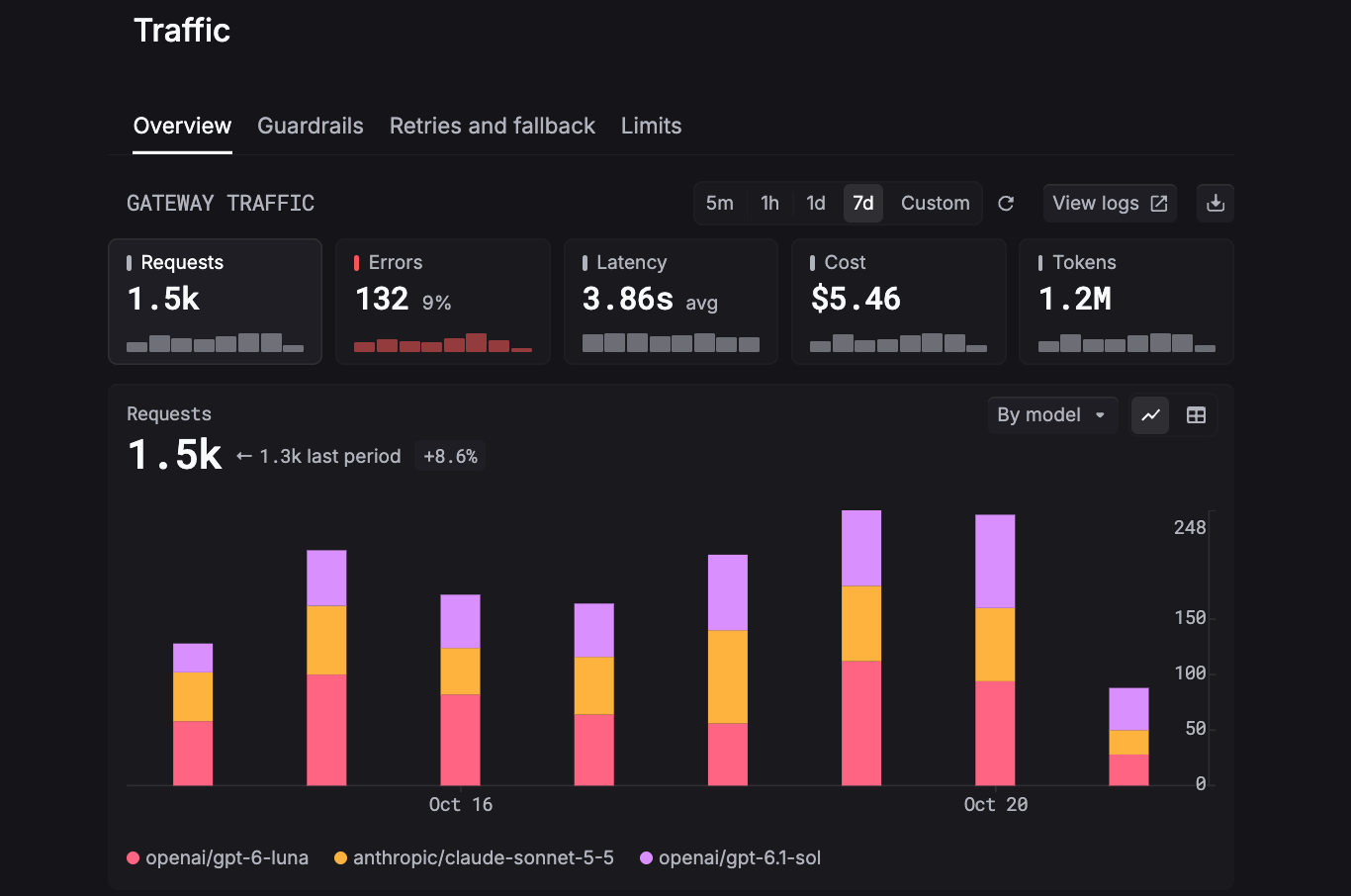
Once a task passes, routing is where the savings show up. Respan's AI gateway puts 1,000+ models behind one API, including Opus 5.5 and all five models above, so moving a task to an open model means changing the model name in the request:
- Fallback chains - List the models to fall back to once, and when one errors or rate-limits, Respan moves to the next. You can put an open model first with Opus behind it, or the reverse.
- Spend you can see - Costs are broken down by model, by request, and by end customer, with soft and hard limits per key or org-wide.
- Every request traced - Each routed call is logged with its latency and cost, so you can compare Opus and open-model traffic side by side.
- Respan Router (beta) - Set the model to
span-routerand Respan picks the model for each request, on Respan credits and separately from fallback chains.
Instead of reading logs after the fact, use Respan to run observability in production, know when production shifts, and act before it spreads.
FAQ
What is the best open-source alternative to Claude Opus?
DeepSeek V4.1 Flash 1017 comes closest, with a Respan Index score of 59.4 against 72.7 for Opus 5.5 as of November 4, 2026, and it ships under MIT. No open model matches Opus across every task, so testing a candidate on your own requests in Respan before switching shows where it holds up and where Opus should stay.
Is there a cheaper alternative to Claude Opus 5.5?
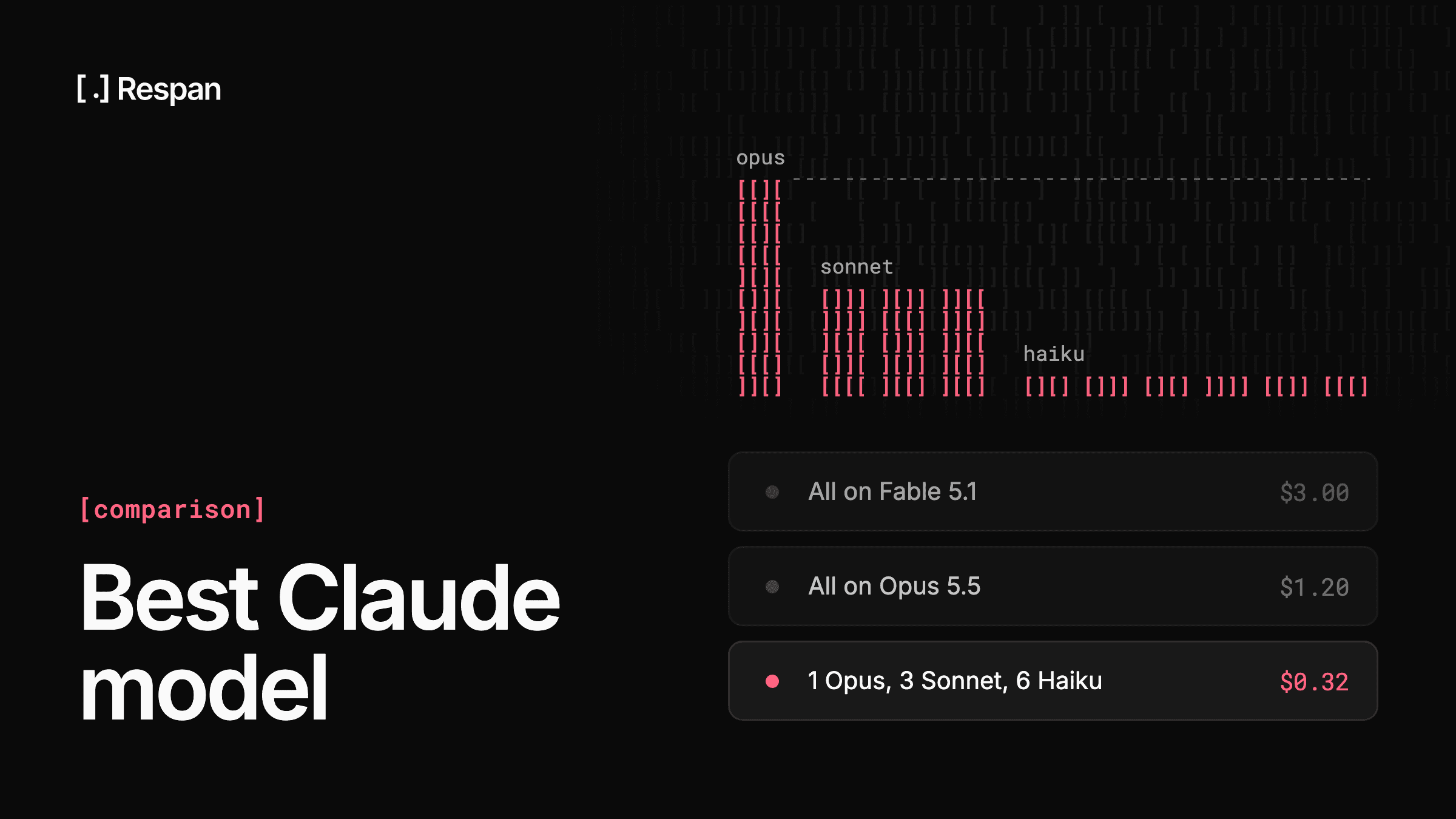
Yes. DeepSeek V4.1 Flash 1017 costs $0.60 per million output tokens off-peak on DeepSeek's API, against $20 for Opus 5.5, and MiMo-V2.6-Pro runs about $0.87. If you'd rather stay with Anthropic, Claude Opus vs Sonnet covers when the cheaper Sonnet 5.5 is enough. Respan logs each request's cost by model, so you can measure the savings on your own traffic.
Can open-weight models match Claude Opus for coding and agents?
On some agent tasks they come close, and on the hardest coding work they still trail. DeepSeek reports V4.1 Flash 1017 ahead of Opus 5 on DeepSWE v1.1 and Automation-Bench, while Opus 5.5 ranks first on coding in the Respan Index. The practical approach is to route the agent steps an open model handles well to it and keep Opus for the rest.
Can you self-host Claude Opus?
No. Anthropic doesn't publish Opus's weights, so it runs only through Anthropic's API and cloud platforms such as Amazon Bedrock, Google Cloud, and Microsoft Foundry. If you need a model inside your own infrastructure, all five models above publish their weights, and Respan's open-source gateway can run on the same infrastructure in front of them.
Is there a free Claude Opus alternative?
The weights of all five models are free to download, but running them isn't, since you pay for GPUs or for per-token pricing on a hosted API. Respan's free plan lets you route, trace, and evaluate those models against Opus with no platform fee, including 100k logs, 5 datasets, and 2 evaluators, while model usage is billed separately.