Google released two new Gemini models in the space of four weeks. Gemini 3.8 Flash arrived on September 2, Gemini 4 Argon followed on September 30, and both launched on introductory rates that Google has already scheduled to go up.
If your app is pinned to an older Flash or a 3.x Pro preview, the lineup you're choosing from has moved, and so has the price gap between the flagship and the cheaper tiers. Picking the wrong tier either costs you on every request or caps quality on the steps that need it.
The flagship isn't automatically the right default. Google's own recommendation for new projects is 3.8 Flash or 3.5 Flash-Lite, and an app with several steps can get a better result from more than one tier.
So, what is the best Gemini model in 2026? It depends on the step you're asking about.
TL;DR: 2026 Gemini Model Comparison
Gemini 3.8 Flash is the default pick for production work, with Argon for the steps Flash can't handle and Flash-Lite for volume.
| Model | Use it for | Input / output per 1M tokens | Free API tier |
|---|---|---|---|
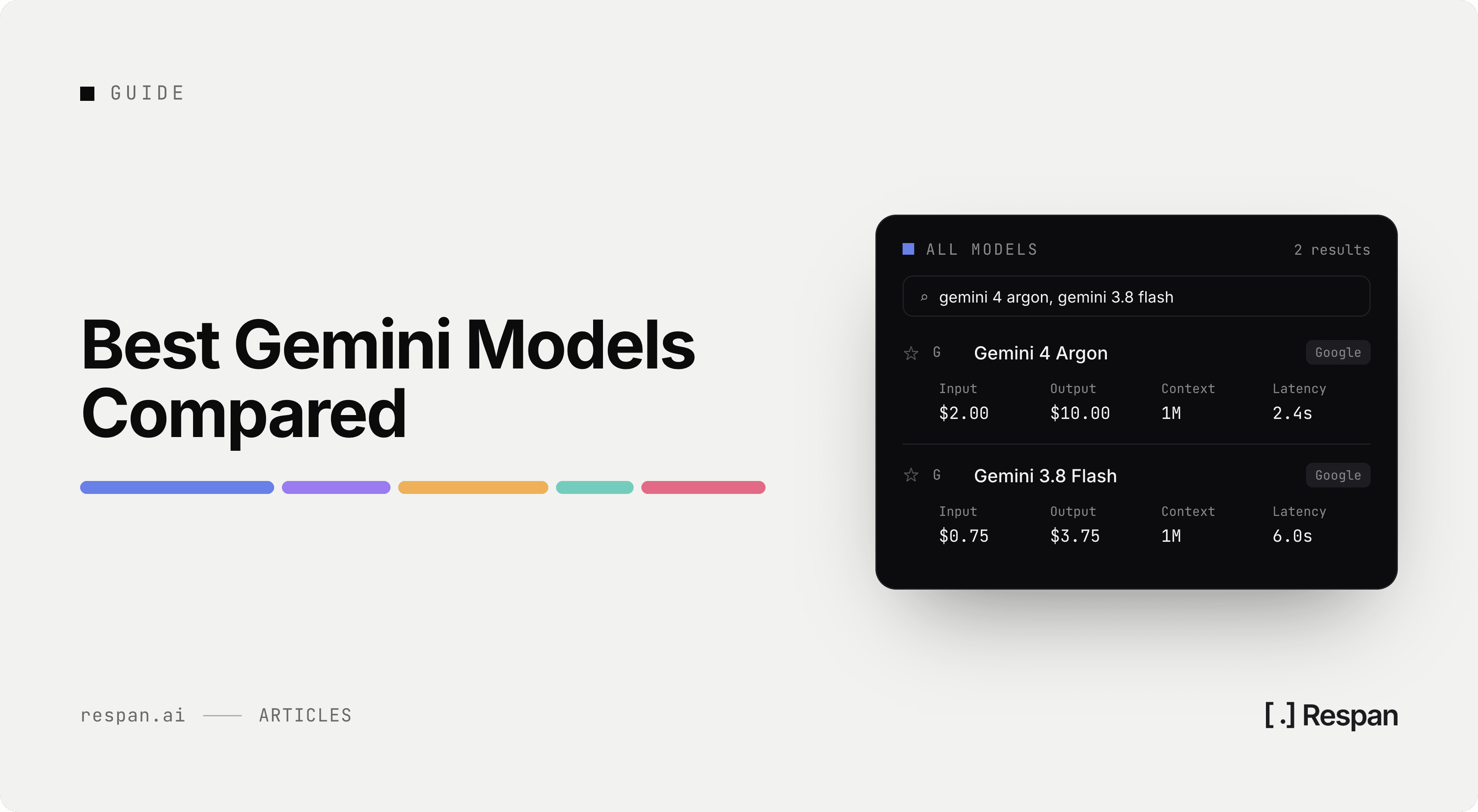
| Gemini 4 Argon | Hardest coding and agent steps | $2.00 / $10.00* | No |
| Gemini 3.8 Flash | Default for production and coding | $0.75 / $3.75* | Yes |
| Gemini 3.5 Flash-Lite | Subagents, parsing, extraction | $0.30 / $2.50 | Yes |
| Gemini 3.1 Flash-Lite | Lowest-cost simple tasks | $0.25 / $1.50 | Yes |
| Gemini 3.8 Live | Real-time voice agents | $0.75 / $4.50 (text) | Yes |
*Introductory rates. Argon moves to $4.00 / $20.00 on December 1, 2026, and 3.8 Flash moves to $1.50 / $7.50 on January 1, 2027.
Every text model in the table accepts up to 1M tokens of input, so context size rarely decides between them.
What Is Gemini's Newest Model?
Gemini 4 Argon is Google's newest Gemini model and the flagship of the current lineup. Google launched Gemini 4 Argon on September 30, 2026, aimed at software engineering and enterprise knowledge work like legal and finance, and raised the model's output limit from 64K to 1M tokens in the process.
Rollout started with trusted testers and cyber defenders before opening to paid API customers and Google AI Ultra subscribers. Unlike the Flash tiers, Argon has no free tier in the Gemini API.
The newest model below the flagship is Gemini 3.8 Flash, released September 2, which Google built for long-horizon coding and autonomous agents while keeping Flash-level speed and cost. On Google's own benchmark table, Argon is measured against GPT-6 Astra, Claude Fable 5.1, and Claude Opus 5.5, which places it among the current frontier AI models rather than ahead of all of them.
Currently Supported Gemini Models
Google's current lineup spans a flagship, two Flash generations, two Flash-Lite generations, a Live model for voice, and a Pro model that's still in preview.
- Gemini 4 Argon - Google's flagship for complex software engineering, multi-step agents, and any task that needs more than 64K tokens of output, since Argon supports long decode up to 1M output tokens.
- Gemini 3.8 Flash - One of Google's two recommended starting points for new projects, aimed at coding and agent work at Flash pricing.
- Gemini 3.6 Flash - Still stable and billed at the same rates as 3.8 Flash, which leaves little reason to stay on it beyond avoiding a migration you haven't tested yet.
- Gemini 3.5 Flash-Lite - Google's other recommended starting point, meant for subagent tasks, document parsing, and high-volume extraction where latency and cost come first.
- Gemini 3.1 Flash-Lite - The previous Flash-Lite generation, still listed as stable, with a lower per-token price than 3.5 Flash-Lite.
- Gemini 3.8 Live - An audio-to-audio model for low-latency voice agents, with an Extended Thinking variant that does more reasoning in the background.
- Gemini 3.1 Pro - Available in preview with separate pricing above 200K tokens of context, though Argon now sits above it as the flagship.
Access to older models is narrowing too. The Gemini 2.5 family is limited to developers who already used it, and Gemini 3 Flash Preview is now listed as legacy, so a new project should start on one of the stable models in this lineup.
How Gemini Model Names Work
Gemini model names carry a generation number and a tier. The number is the release generation, so 3.8 Flash is newer than 3.6 Flash, while the tier tells you where the model sits on cost and capability: Pro was the tier for complex tasks, Flash is Google's price-performance tier for low-latency, high-volume work, Flash-Lite is the faster and cheaper tier below it, and Live covers real-time conversational agents.
Generation numbers don't line up across tiers, though. The newest Flash is 3.8 while the newest Flash-Lite is 3.5, so comparing models by version number alone will mislead you.
Argon breaks the pattern. It's named rather than tiered, and Google hasn't said whether the Pro line continues beyond 3.1 Pro Preview.
Model IDs carry a release stage as well, and Google treats stable and preview models differently. A stable ID points to a fixed model, a preview ID can run in production but gets deprecated with at least two weeks' notice, and a -latest alias moves to each new release with two weeks' notice before breaking changes. For production traffic, pin a stable ID so a model update never changes your output without a test run first.
In-Depth Gemini Model Comparison
Every current text model accepts text, image, video, audio, and PDF input, returns text, and supports thinking, function calling, code execution, and structured outputs. Because the feature lists overlap that much, choosing between tiers comes down to how they perform on agentic work and what that work costs.
Benchmarks and Capabilities
Google doesn't publish one table that puts Argon, Flash, and Flash-Lite side by side. Each tier gets its own page with its own benchmarks and its own comparison models, so Google's numbers alone can't give you a clean cross-tier ranking.
For the flagship, Google's published results for Argon measure it against GPT-6 Astra, Claude Fable 5.1, and Claude Opus 5.5. Google reports Argon at 77.9% on DeepSWE v1.1, a long-horizon software engineering benchmark, and 51.3% on AutomationBench.
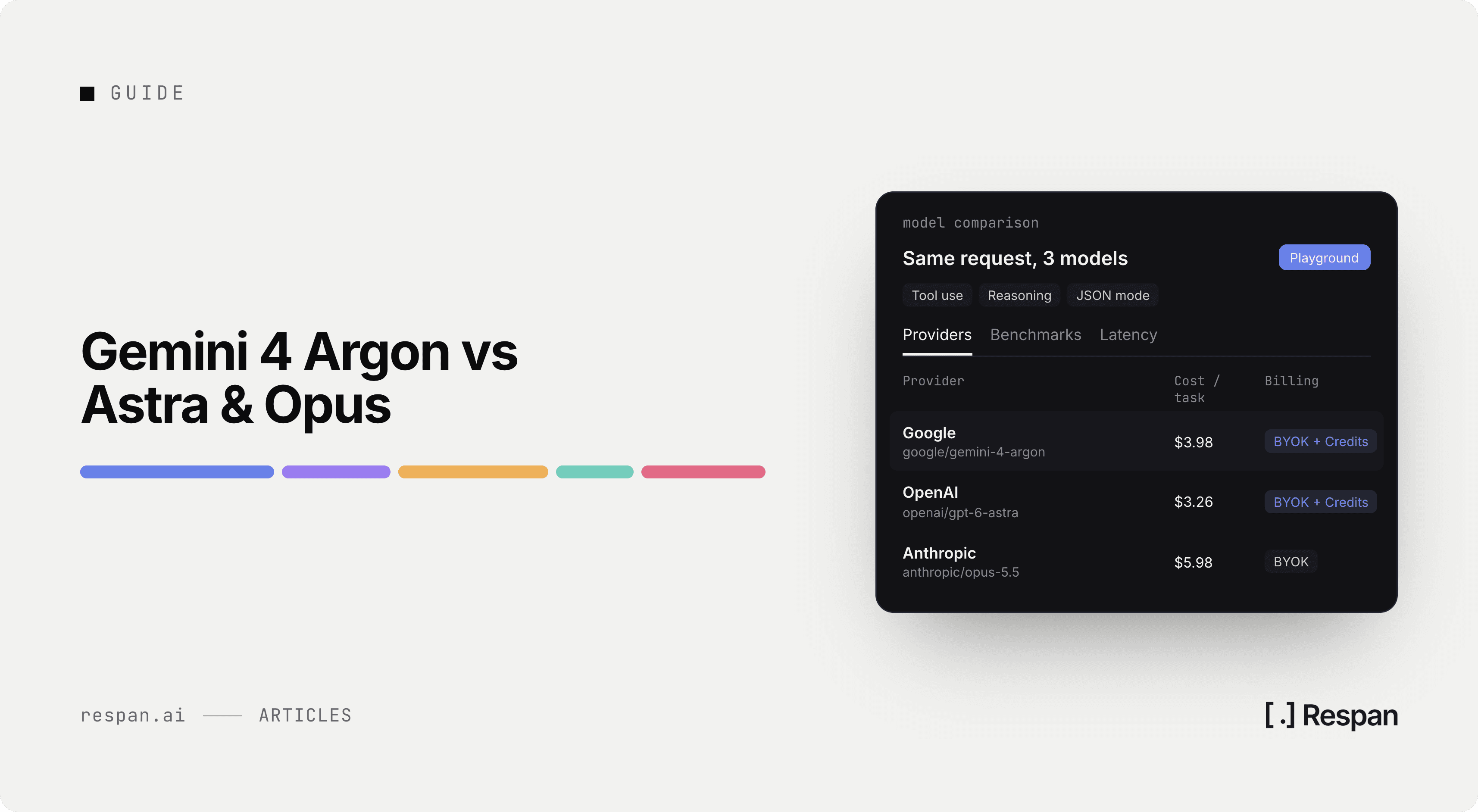
The same table has Argon behind Opus 5.5 on Terminal-bench 4.0 (57.4% vs 66.4%) and behind GPT-6 Astra on FrontierSWE (55.0% vs 65.5%). If you're choosing across providers rather than within Gemini, the Gemini 4 Argon vs GPT-6 Astra vs Claude Opus 5.5 matchup matters more than Argon's lead on any single benchmark.
Flash and Argon only meet on a couple of benchmarks. Google's 3.8 Flash scores include 61.4% on Vals Finance Agent v2 and 10.0% on Harvey's Legal Agent Benchmark, against Argon's 65.4% and 19.6% on the same tests. On DeepSWE v1.1, Google shows 3.8 Flash above 70% in a chart without an exact figure.
On features, the tiers differ less than on scores. Argon supports only implicit caching while 3.8 Flash and Flash-Lite support explicit caching too, and Argon is the one model of the three with long decode for outputs up to 1M tokens.
Best pick: Gemini 4 Argon, which scores higher than 3.8 Flash on both benchmarks where Google publishes exact scores for each.
Our recommendation: Start with 3.8 Flash and move a step to Argon only where your own evals show a gap, since the margin ranges from a few points on finance agent work to nearly double on legal agent work.
Keep in mind: Google doesn't run its tiers on a shared benchmark suite, so its published scores can't rank Flash-Lite against Flash or Argon.
Pricing and Cost per Task
On the Gemini API pricing page, Argon costs about 2.7 times as much as 3.8 Flash per token on both input and output, and that ratio holds once both models move to their post-introductory rates.
Batch requests run at half the standard rate on every current text model. Caching is where the tiers split, since Argon only offers implicit caching, billed at 95% off cached input, while 3.8 Flash supports explicit caching with an hourly storage fee.
Per-token price is only part of the bill, however. Google notes that 3.8 Flash uses more tokens at higher effort levels, and a tier that needs retries to finish a task can cost more per completed task than the tier above it.
Best pick: Gemini 3.8 Flash, which gets you Google's recommended production model at a little over a third of Argon's per-token price.
Our recommendation: Run evals and backfills through the Batch API, and compare tiers on cost per completed task from your own traffic rather than on per-token rates.
Keep in mind: Argon's rates double on December 1 while 3.8 Flash stays on its introductory price until January 1, 2027, so the gap between them runs above five times for all of December.
Context Window and Output Limits
Every current Gemini text model accepts up to 1,048,576 input tokens, so a large codebase or a long document set fits in a single request on any tier. Output is where they differ, with Flash and Flash-Lite capped at 65,536 tokens, the same default Argon uses for synchronous requests.
Argon's long decode raises that to 1M output tokens, which Google pitches for full-repository generation and large refactors done in one pass. Argon also has no separate long-context rate, so a 900K-token prompt costs the same per token as a short one, a change from 3.1 Pro's higher rate above 200K tokens.
Best pick: Argon, since its long decode returns up to 1M tokens in a single response.
Our recommendation: Keep Flash or Flash-Lite on any step whose output fits in 64K tokens, and send only long-output steps like full-repository generation to Argon.
Keep in mind: A 1M-token Argon response bills at output rates, which comes to $10 at the introductory price and $20 after December 1.
Speed and Latency
Google describes 3.8 Flash as delivering Flash-level latency and positions Flash-Lite as the tier for latency-sensitive, high-throughput work. The one number Google cites is for 3.5 Flash-Lite, at 350 output tokens per second according to the Artificial Analysis Index.
The setting you control that changes speed on any tier is the thinking level. Argon and 3.8 Flash support low, medium, and high thinking, and higher levels generate more tokens before the answer. Keep in mind that 3.8 Flash doesn't accept the minimal level and returns an error if you send it.
Best pick: Gemini 3.5 Flash-Lite for text steps, and Gemini 3.8 Live for voice.
Our recommendation: Set thinking to low on latency-sensitive steps, and use Priority inference, available on Argon, 3.8 Flash, and Flash-Lite, where response time matters more than cost.
Keep in mind: Google publishes no latency or throughput figures for Argon or 3.8 Flash, so measure both on your own requests before building a latency budget around either.
What Is the Best Gemini Model?
For most new production work, the best Gemini model to start with is 3.8 Flash, but the right answer changes with the step you're running.
- Best for most production work - Gemini 3.8 Flash, one of the two models Google recommends for new projects, built for multi-step agent work at Flash pricing.
- Best for the hardest agent steps - Gemini 4 Argon, for steps where 3.8 Flash falls short in your evals. On Google's own numbers, that's more likely on legal agent work than on finance agent work.
- Best for long outputs - Gemini 4 Argon again, whenever a step needs more than 64K tokens in a single response.
- Best for high-volume steps - Gemini 3.5 Flash-Lite, for subagents, document parsing, and extraction where volume and latency outweigh peak capability.
- Best for the lowest per-token cost - Gemini 3.1 Flash-Lite, for simple tasks where an older generation is good enough.
- Best for voice - Gemini 3.8 Live, built for low-latency, real-time conversation.
In practice, an app with several steps often uses more than one tier. The same reasoning applies when picking the best Claude model for an agent, since the question in both lineups is which steps actually need the flagship.
Route, Compare, and Evaluate Gemini Models With Respan
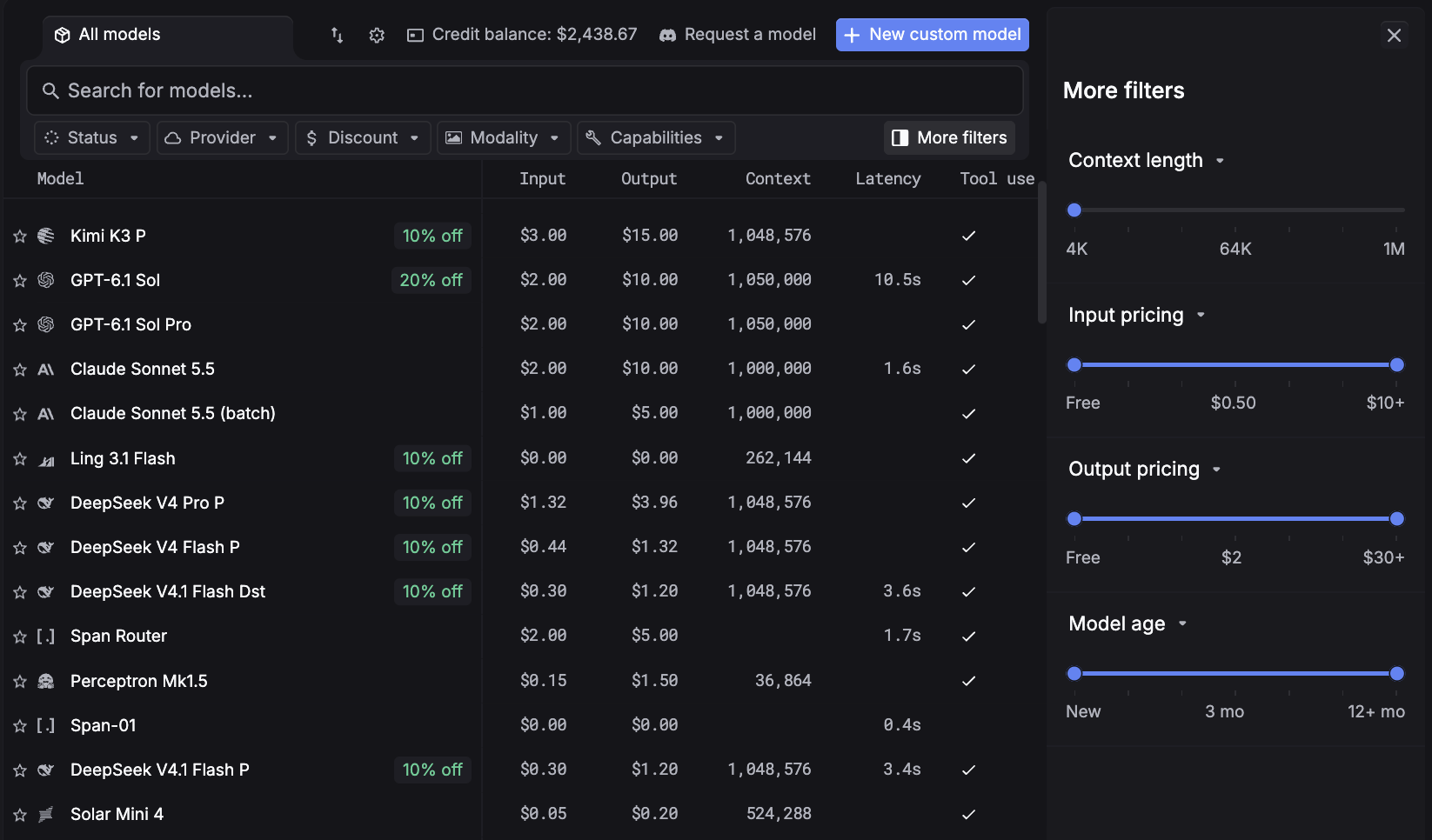
Matching each step to a tier only works if you can measure the result. Respan is an AI gateway with observability and automated evals built in, so every Gemini request it routes is traced, priced, and scored in one place, and a score always ties back to the run behind it.
That turns "is 3.8 Flash good enough for this step?" into a number. Build a dataset from real production requests, run 3.8 Flash and Argon through the same evaluator, and route each step to the cheapest tier that passes.
- One API for every model - Call Argon, 3.8 Flash, Flash-Lite, and 1,000+ other models through one endpoint, and switch by changing a single word.
- Routing per task - With task-aware routing, set the model to
span-routerand Respan picks the model for each task, weighing cached reads and writes before it switches so a cheaper model doesn't end up costing more. Currently in beta. - Fallbacks - Define a fallback chain once, and traffic moves to the next model the moment one errors or rate-limits.
- Spend you can see and cap - Costs break down by model, request, and end customer, with hard limits that stop spend at the ceiling before a price change shows up on the invoice.
- Evals before and after shipping - Score a test set before switching tiers, then run the same evaluator on live production traffic so a regression surfaces before users report it.
- Scores that lead to traces - Click any score and land on the trace behind it, with every LLM call, tool run, and agent step in one view.
When Google's scheduled rate changes land, the same evaluator tells you whether the tier split you picked still holds at the new prices.
Frequently Asked Questions
Which Gemini Model Is Best for Coding?
Gemini 3.8 Flash is the best starting point for most coding work, since Google built it for long-horizon software engineering at a fraction of the flagship's cost. Move to Gemini 4 Argon for repository-wide generation, large refactors, and long-running coding agents, where its 77.9% on DeepSWE v1.1 and 1M-token output limit come into play.
Coding benchmarks don't always predict how a model handles your codebase, so run both tiers against real tasks from your repo before committing. Respan's experiments run 3.8 Flash and Argon through the same evaluators side by side, with a click into the full trace behind any row.
Can You Use Multiple Gemini Models in One App?
Yes. Every Gemini model runs through the same API, so one app can send subagent work to 3.5 Flash-Lite, its main loop to 3.8 Flash, and its hardest steps to Argon.
Writing that routing by hand means logic you have to maintain as models and prices change, which is the job an LLM router takes over. Respan routes across Gemini tiers and every other major provider from one API, with fallbacks and per-step cost tracking built in.
Is Gemini a Large Language Model?
Gemini is a family of multimodal large language models from Google DeepMind. The current text models accept text, image, video, audio, and PDF input and generate text, while the Live models work audio-to-audio for real-time voice.