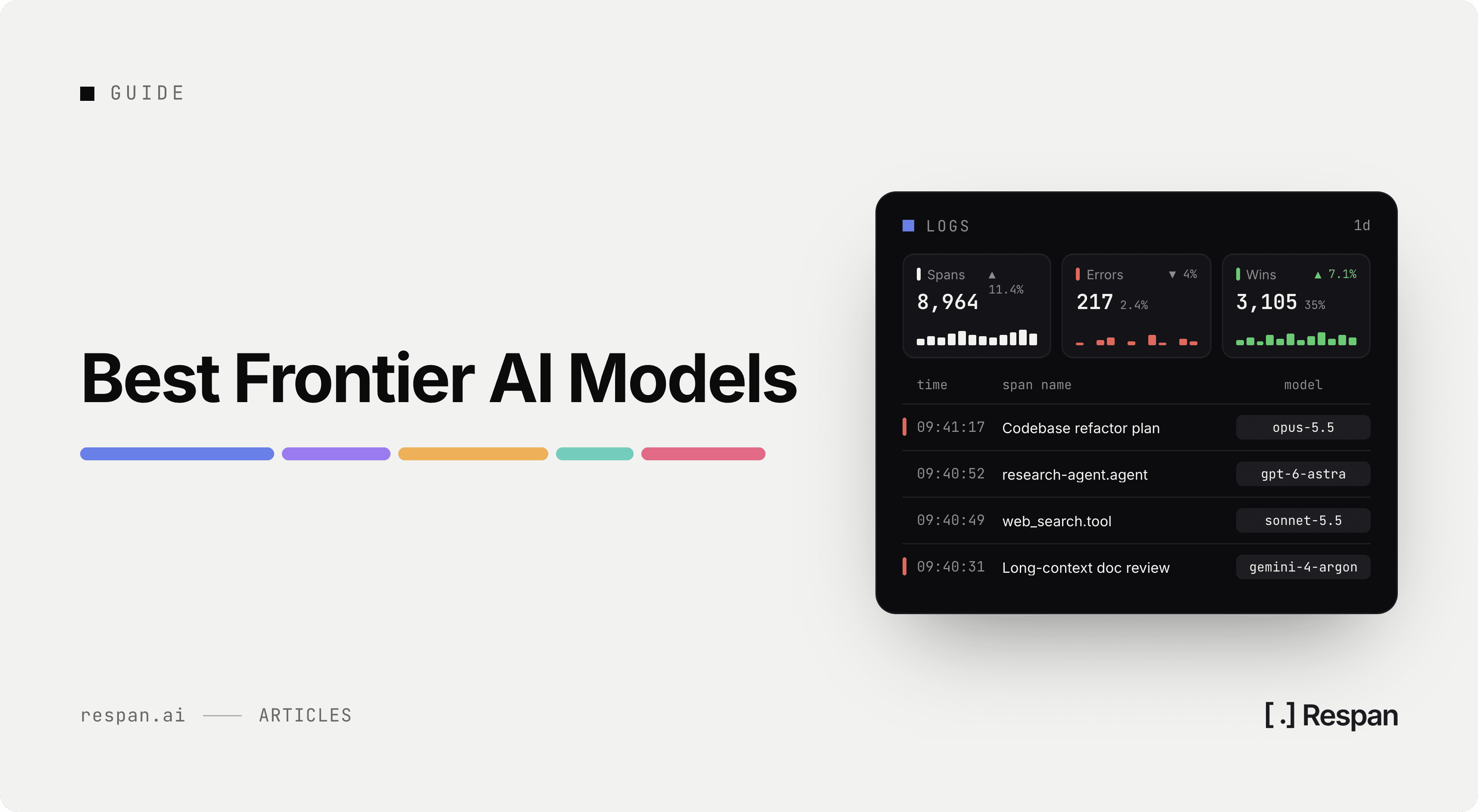
Frontier models are the most capable general-purpose AI models available right now, the newest releases from the few labs at the top of the benchmarks. September brought more of them than most teams can evaluate in a quarter. Anthropic released Claude Fable 5.1, Opus 5.5, and Sonnet 5.5, OpenAI shipped GPT-6 Astra and then GPT-6.1 Sol at DevDay, and Google closed the month by announcing Gemini 4 Argon.
Each of those launches reopens the question of which model your agent should call. The top of the market is also closer than the price tags suggest, with several models landing within a few points of each other on benchmarks while costing very different amounts per token.
A ranking of the top AI models tells you where each one sits, but the right model for your app is the one that holds up on your own traffic, and for most production teams that ends up being two or three models behind a router rather than one.
Here are the 10 best frontier AI models in 2026 by benchmark score, with what each one costs and which workloads to route to it.
TL;DR: Best frontier AI models
The top of the ranking is a race between three labs, and which model wins for you depends on what you need it to do and what you're willing to pay for it.
- #1 overall - Claude Opus 5.5 (72.4), scoring above 70 in coding, agents, reasoning, and knowledge.
- Reasoning-heavy work - GPT-6.1 Sol (69.4), with a reasoning score of 78.6 at one-fifth of GPT-6 Astra's price.
- Agent steps - Claude Sonnet 5.5 (68.5), with an agents score of 78.1 at the same price as GPT-6.1 Sol.
- Close behind, limited access - Gemini 4 Argon (70.3), which is still rolling out to a gated group of cyber defenders.
- Budget pick - DeepSeek V4.1 Flash (50.9), with off-peak pricing that halves the cost of batch work.
None of them wins on every axis, which is why most production teams end up routing between two or three of them.
What is a frontier AI model?
A frontier AI model is a general-purpose model at or near the current edge of capability, which in practice means the newest releases from a small group of labs. The boundary moves with every launch, so a model that defined the frontier in January can be two generations behind by October.
Regulators draw the line with training compute instead. California's SB 53 and New York's RAISE Act both define a frontier model as one trained with more than 10^26 operations, while the EU AI Act applies its stricter general-purpose AI rules above 10^25 FLOPs and calls those models ones with "systemic risk."
Every frontier model is a foundation model, but most foundation models aren't frontier. Smaller open-weight and distilled models share the same pretraining approach without competing at the top of the benchmarks.
What do frontier AI models do? Common use cases
Frontier models are worth their price on work where a smaller model's failure rate is the expensive part. The labs' positioning for this year's releases clusters around a handful of jobs:
- Agentic coding - Long-running coding agents that plan changes, edit across a repository, run tests, and recover from their own errors.
- Multi-step agents and tool use - Workflows where the model chains dozens of tool calls and has to hold context across all of them.
- Professional knowledge work - Legal and financial analysis where an expert reviews the output and mistakes are costly to catch.
- Math and scientific reasoning - The kind of problems FrontierMath and GPQA Diamond measure, both of which feed the reasoning scores below.
- Cybersecurity defense - Vulnerability discovery and analysis, which is also why several labs now gate their models' cyber capabilities.
Most production traffic isn't any of these. Classification and extraction steps usually run fine on cheaper models, so the practical question is which steps in your app actually need a frontier model.
10 best frontier AI models in 2026
The top six come from three labs, and the gap between them and the rest of the field says as much about the current market as any single position.
Comparison and ranking criteria
Every model below is ranked by its overall Respan Index benchmark scores, which group 62 public benchmarks and lab-reported results into scores for coding, agents, reasoning, knowledge, and human preference, then blend them into one overall number. The scores come from published results rather than traffic on Respan, and where two models tie, the higher agents score breaks it.
The list takes the current model from each frontier lab and leaves out versions their own labs have replaced, such as GPT-6 Sol and Claude Opus 5. Those older models would otherwise take four of the ten slots.
Every model scoring above 60 overall comes from OpenAI, Google, or Anthropic, and on this list the drop from Claude Sonnet 5.5 (68.5) to Muse Spark 1.3 (54.1) is 14.4 points. That gap holds up statistically, since Sonnet's 95% interval bottoms out at 63.5 while Muse Spark's tops out at 61.3, and below it Meta, DeepSeek, Moonshot AI, and xAI compete on price and, for DeepSeek and Moonshot, open weights.
Inside the top six, the opposite is true. Overall scores span less than four points and their intervals overlap, while list prices vary by 5x, which is the case for routing between models instead of committing to one.
| Model | Overall | Coding | Agents | Reasoning | Knowledge | Preference | Pricing (in / out per 1M) |
|---|---|---|---|---|---|---|---|
| Claude Opus 5.5 | 72.4 | 72.8 | 76.9 | 75.5 | 70.5 | 60.6 | $4 / $20 |
| GPT-6 Astra | 70.5 | 61.8 | 77.0 | 77.1 | 75.8 | 59.7 | $10 / $50 |
| Gemini 4 Argon | 70.3 | 64.4 | 75.9 | 78.0 | 71.2* | 57.4 | $2 / $10 intro |
| Claude Fable 5.1 | 69.4 | 69.4 | 74.0 | 70.4 | 71.5 | 58.9 | $10 / $50 |
| GPT-6.1 Sol | 69.4 | 61.1 | 72.5 | 78.6 | 74.5 | 59.0 | $2 / $10 |
| Claude Sonnet 5.5 | 68.5 | 70.1 | 78.1 | 70.7 | 48.4 | 59.5 | $2 / $10 |
| Muse Spark 1.3 | 54.1 | 42.0 | 65.9 | 49.0 | 63.2 | 56.7 | $1.25 / $4.25 |
| DeepSeek V4.1 Flash | 50.9 | 40.1 | 61.2 | 48.2 | 51.5 | 55.7 | $0.15 / $0.60 off-peak |
| Kimi K3 | 50.6 | 37.2 | 63.1 | 47.0 | 52.7 | 56.7 | $3 / $15 |
| Grok 4.7 | 49.8 | 43.2 | 65.6 | 34.5 | 55.7 | 56.0 | $2 / $6 |
*Estimated score.
1. Claude Opus 5.5
Claude Opus 5.5 leads the ranking at 72.4, and it's the one model in the top six that scores above 70 in coding, agents, reasoning, and knowledge. Anthropic launched it September 22 as the first model in its 5.5 family, reports that it performs close to Claude Fable 5.1, and puts it at 67.7% on Humanity's Last Exam with tools.
Its coding score of 72.8 is what makes it a fit for long-running agent work, and Anthropic's docs recommend it as the starting point for most workloads. Thinking is always on, though, so short, simple calls can still bill thinking tokens they never needed. Cyber-flagged requests get rerouted to Opus 4.8, and zero data retention is available for teams with stricter data terms.
- Benchmark scores: 72.4 overall (#1) · Coding 72.8 · Agents 76.9 · Reasoning 75.5 · Knowledge 70.5 · Preference 60.6
- Pricing: $4 / $20 per 1M input / output
- Context: 1M tokens, 128K output
- Route it for: Long-running agentic coding and knowledge work
2. GPT-6 Astra
OpenAI calls GPT-6 Astra its most capable model for demanding work, and it places second overall at 70.5, carried by a knowledge score of 75.8 and a reasoning score of 77.1. OpenAI reports it at 96.0% on GPQA Diamond and 57.2% on Humanity's Last Exam with tools, while its coding score of 61.8 trails Opus 5.5 by 11 points.
At $10 / $50 per 1M tokens, Astra costs five times what GPT-6.1 Sol does, and fast mode doubles that again. Enterprise admins have to switch it on, and OpenAI refuses advanced cyber tasks on it for now. As a result, it fits as the model you escalate to when a failure costs more than the tokens, while cheaper models handle routine traffic.
- Benchmark scores: 70.5 overall (#2) · Coding 61.8 · Agents 77.0 · Reasoning 77.1 · Knowledge 75.8 · Preference 59.7
- Pricing: $10 / $50 per 1M input / output
- Context: 1.05M tokens, 128K output
- Route it for: High-stakes knowledge work and computer use
3. Gemini 4 Argon
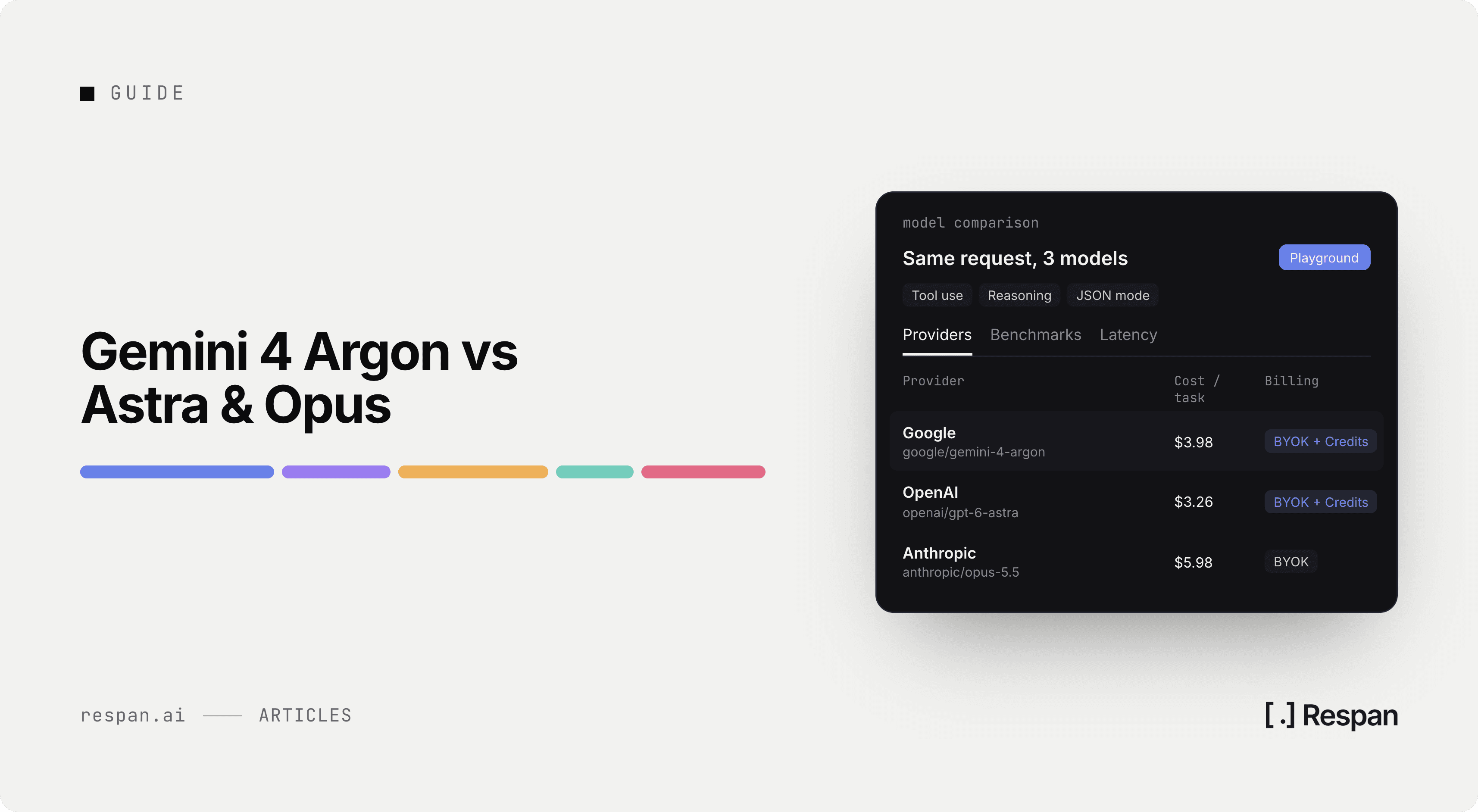
Google announced Gemini 4 Argon on September 30, and it lands third overall at 70.3, just behind GPT-6 Astra and Opus 5.5, the same three-way matchup in Gemini 4 Argon vs GPT-6 Astra vs Opus 5.5.
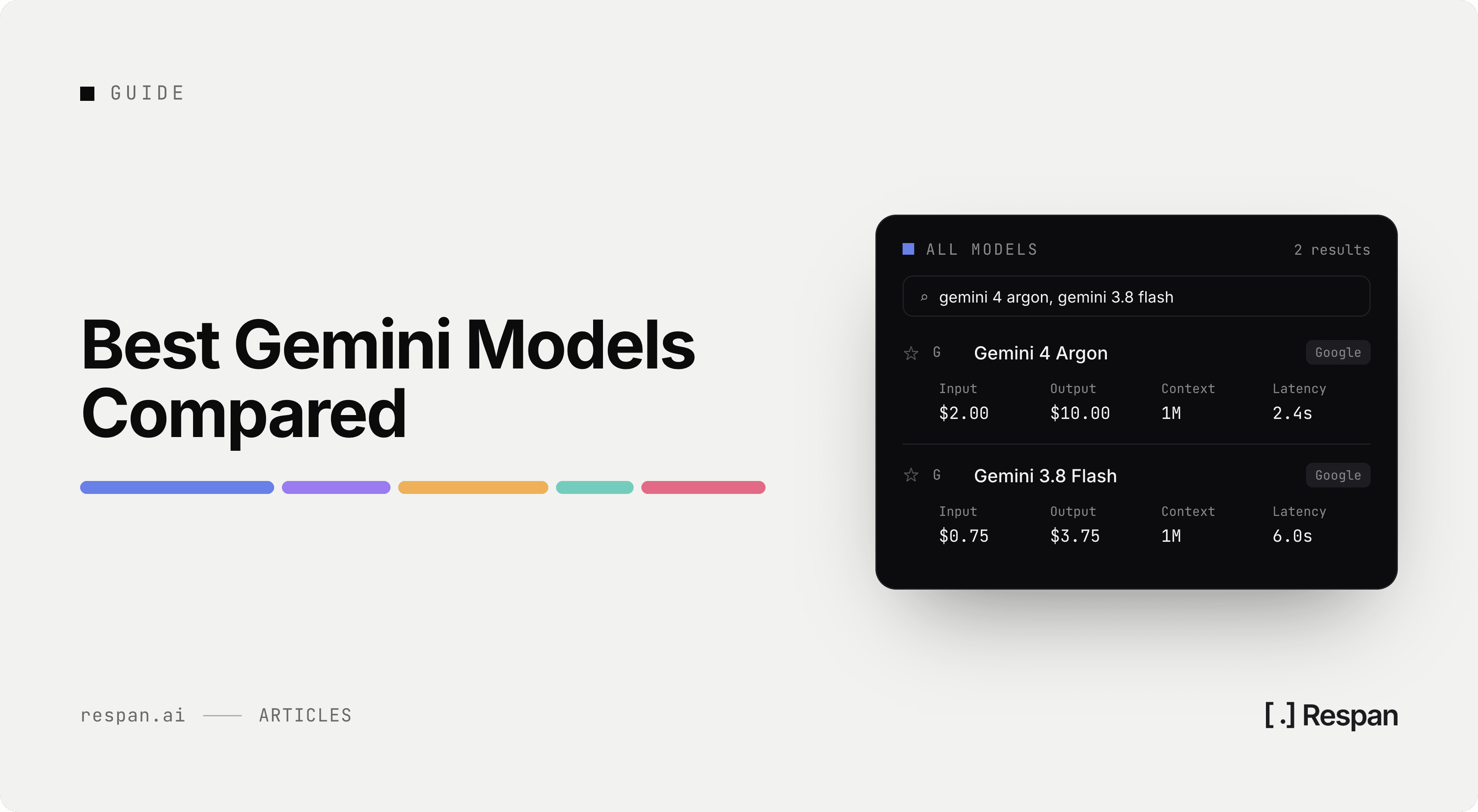
One of their best models, its reasoning score of 78.0 sits within a point of GPT-6.1 Sol's, and Google positions it for software engineering and cyber defense. It also raises the output limit to 1M tokens, up from 64K, which matters for jobs that generate a whole codebase or a long document in one pass.
The catch is access. Argon is rolling out first to trusted cyber defenders through Google's Fairwind Program, released to them without its cyber guardrails, and paid API customers come next with no date attached. Its introductory $2 / $10 rate rises to $4 / $20 at a point Google hasn't set, so it's safer to budget at the list price if you plan around it.
- Benchmark scores: 70.3 overall (#3) · Coding 64.4 · Agents 75.9 · Reasoning 78.0 · Knowledge 71.2 (estimated) · Preference 57.4
- Pricing: $2 / $10 per 1M input / output (introductory), $4 / $20 list
- Context: Not published by Google, 1M output
- Route it for: Cyber defense and long outputs, once available
4. Claude Fable 5.1
Anthropic positions Claude Fable 5.1 as its most capable model for coding and knowledge work, and it ties GPT-6.1 Sol at 69.4 overall, placing fourth on a higher agents score (74.0 to 72.5). Anthropic reports 60.9% on Humanity's Last Exam without tools and 65.0% with them, though it scores below Opus 5.5 in every category except knowledge while costing 2.5 times as much.
Fable 5.1 is the same model as Claude Mythos 5.1 with stricter safeguards, and those safeguards shape how it behaves in production. Classifiers can refuse requests, with some refusals billed since September 24, and flagged cyber and biology requests get rerouted to Opus 4.8 and Opus 5. Data is also retained for 30 days unless Anthropic authorizes zero retention, and every output carries a statistical watermark, so it works better as an escalation tier than a default.
- Benchmark scores: 69.4 overall (#4, tied) · Coding 69.4 · Agents 74.0 · Reasoning 70.4 · Knowledge 71.5 · Preference 58.9
- Pricing: $10 / $50 per 1M input / output
- Context: 1M tokens, 128K output
- Route it for: Escalation when Opus 5.5 falls short
5. GPT-6.1 Sol
If your workload leans on reasoning, GPT-6.1 Sol is the model to test first. OpenAI's September 29 upgrade to GPT-6 Sol tops the reasoning ranking at 78.6 and ties Fable 5.1 at 69.4 overall, held back mainly by a coding score of 61.1. OpenAI positions it as near-Astra performance at one-fifth of Astra's API price, though it hasn't published GPQA or Humanity's Last Exam results for this model.
The pricing stays simple until your prompts get long. Requests over 272K tokens bill input at 2x and output at 1.5x, so an agent that carries a large context through many turns can cost noticeably more than the headline rate suggests. It also isn't in ChatGPT's main chat yet and doesn't support fine-tuning, and for most API teams the real decision is how much traffic to keep on Sol versus sending up to Astra, the same tradeoff that runs through GPT-6 Sol vs Luna vs Astra.
- Benchmark scores: 69.4 overall (#5, tied) · Coding 61.1 · Agents 72.5 · Reasoning 78.6 · Knowledge 74.5 · Preference 59.0
- Pricing: $2 / $10 per 1M input / output
- Context: 1.05M tokens, 128K output
- Route it for: High-volume reasoning and analysis
6. Claude Sonnet 5.5
Claude Sonnet 5.5 ranks sixth overall at 68.5, but its agents score of 78.1 edges out both Opus 5.5 (76.9) and GPT-6 Astra (77.0). A knowledge score of 48.4 is what pulls its overall number down, and Anthropic released it September 28 as the faster, lower-cost complement to Opus 5.5, aimed at well-scoped tasks like bug fixing, with 64.5% on Humanity's Last Exam with tools.
It costs the same $2 / $10 as GPT-6.1 Sol, so the two split cleanly by workload, with Sol taking reasoning-heavy requests and Sonnet taking the many small decisions an agent makes between them. Like Opus, it hands higher-risk cyber requests to an older model (Sonnet 5), and the Opus 5.5 vs Sonnet 5.5 comparison covers when it can stand in for Opus on everything else.
- Benchmark scores: 68.5 overall (#6) · Coding 70.1 · Agents 78.1 · Reasoning 70.7 · Knowledge 48.4 · Preference 59.5
- Pricing: $2 / $10 per 1M input / output
- Context: 1M tokens, 128K output
- Route it for: High-volume agent steps and tool calls
7. Muse Spark 1.3
The scores drop sharply after Sonnet, and Muse Spark 1.3 from Meta is the next model on the list at 54.1. Its agents score of 65.9 is its strongest category, while coding sits at 42.0. Meta announced it at Connect on September 24 and positions it for agentic workflows and competitive coding, although its reasoning score sits below the older Muse Spark 1.2's.
Pricing comes in two tiers, and the difference is your data. The standard tier is $1.25 / $4.25 per 1M tokens, while the contributor tier drops to $0.10 / $0.20 in exchange for Meta using your data to improve its products, which likely rules it out for anything touching customer data. Meta Model API is still in public preview, and the model is also available through Oracle Cloud.
- Benchmark scores: 54.1 overall (#7) · Coding 42.0 · Agents 65.9 · Reasoning 49.0 · Knowledge 63.2 · Preference 56.7
- Pricing: $1.25 / $4.25 per 1M input / output, standard tier
- Context: 1M tokens
- Route it for: Low-cost agent steps
8. DeepSeek V4.1 Flash
DeepSeek V4.1 Flash, released September 10, is a 552B-parameter mixture-of-experts model with native vision and weights published on Hugging Face, which DeepSeek describes as the smallest model in its new architecture family. It scores 50.9 overall, though its 95% interval runs from 39.6 to 62.7, so its position is less certain than its neighbors'.
Pricing depends on the clock. Off-peak rates are $0.15 / $0.60 per 1M tokens and double during peak hours (01:00 to 04:00 and 06:00 to 10:00 UTC on weekdays), so scheduling batch jobs off-peak halves the cost. DeepSeek says a V4.1-Pro is coming without giving a date, and teams with data-residency requirements may prefer running the open weights over sending traffic to the hosted API.
- Benchmark scores: 50.9 overall (#8) · Coding 40.1 · Agents 61.2 · Reasoning 48.2 · Knowledge 51.5 · Preference 55.7
- Pricing: $0.15 / $0.60 per 1M input / output off-peak, 2x at peak
- Context: 1M tokens, 384K output
- Route it for: Off-peak batch jobs
9. Kimi K3
Moonshot AI describes Kimi K3 as a 2.8T-parameter open model, several times the size of DeepSeek V4.1 Flash. It scores 50.6 overall, with agents at 63.1 and coding at 37.2, and Moonshot itself says K3 trails Claude Fable 5 and GPT-5.6 Sol overall.
At $3 / $15 per 1M tokens, the hosted API costs more than GPT-6.1 Sol, which scores well above it in every category but human preference, so the case for K3 is the open weights rather than the API, the same tradeoff Kimi K3 vs Fable 5.1 weighs against Anthropic's hosted option. With a 1M-token context and weights you can run yourself, it fits teams that need a long-context model they control.
- Benchmark scores: 50.6 overall (#9) · Coding 37.2 · Agents 63.1 · Reasoning 47.0 · Knowledge 52.7 · Preference 56.7
- Pricing: $3 / $15 per 1M input / output
- Context: 1M tokens
- Route it for: Open-weight long-context agents
10. Grok 4.7
xAI released Grok 4.7 on September 21 as its frontier model for coding and agentic tasks, and its scores split along that line, with 65.6 on agents but 34.5 on reasoning, 12.5 points below Kimi K3. xAI's own launch benchmarks focus on the same ground, including 71.0% on DeepSWE v1.1 and 37.6% on Terminal-Bench 4.0, with no reasoning or math results published.
Output is the cheap part at $6 per 1M tokens, and Grok 4.7 vs Opus 5.5 shows what that saves against Opus 5.5's $20. However, the 500K context window is half what most models here offer, and Grok 4.7 Fast is limited to Cursor and Grok Build rather than the public API.
- Benchmark scores: 49.8 overall (#10) · Coding 43.2 · Agents 65.6 · Reasoning 34.5 · Knowledge 55.7 · Preference 56.0
- Pricing: $2 / $6 per 1M input / output
- Context: 500K tokens
- Route it for: Output-heavy agent loops
Are frontier AI models safe?
Every lab at the top of this list publishes a safety framework, with Anthropic's Responsible Scaling Policy, OpenAI's Preparedness Framework, and Google DeepMind's Frontier Safety Framework setting the capability thresholds that trigger stronger safeguards. Because of those frameworks, frontier models are tested for misuse risks like cyberattacks and biological weapons before release, and for ordinary production use they're generally safe to build on.
For a team building on these models, safety shows up less as a policy document and more as API behavior. Claude Fable 5.1 refuses some requests outright and reroutes flagged cyber and biology requests to older models, Opus 5.5 and Sonnet 5.5 fall back on cyber-flagged requests, and Gemini 4 Argon reached its first users through a gated program for cyber defenders. OpenAI also refuses advanced cyber tasks on GPT-6 Astra for now.
Access itself can change too. In June, a US government export-control directive led Anthropic to suspend Claude Fable 5 and Mythos 5 for every customer for nearly three weeks, so any app hard-wired to one of those models lost it overnight. The practical safety question for production teams is whether your stack keeps serving users when a model refuses a request or disappears, which comes down to fallbacks and monitoring more than to any one lab's framework.
How to route and monitor frontier models in production
Nothing in this ranking points to one model for everything. GPT-6.1 Sol leads on reasoning at a fifth of Astra's price, Sonnet 5.5 scores higher than Sol on agent work, DeepSeek V4.1 Flash halves its own cost off-peak, and any of them can be restricted or rate-limited without much notice. Production apps that hard-code one provider pay for that in either cost or downtime.
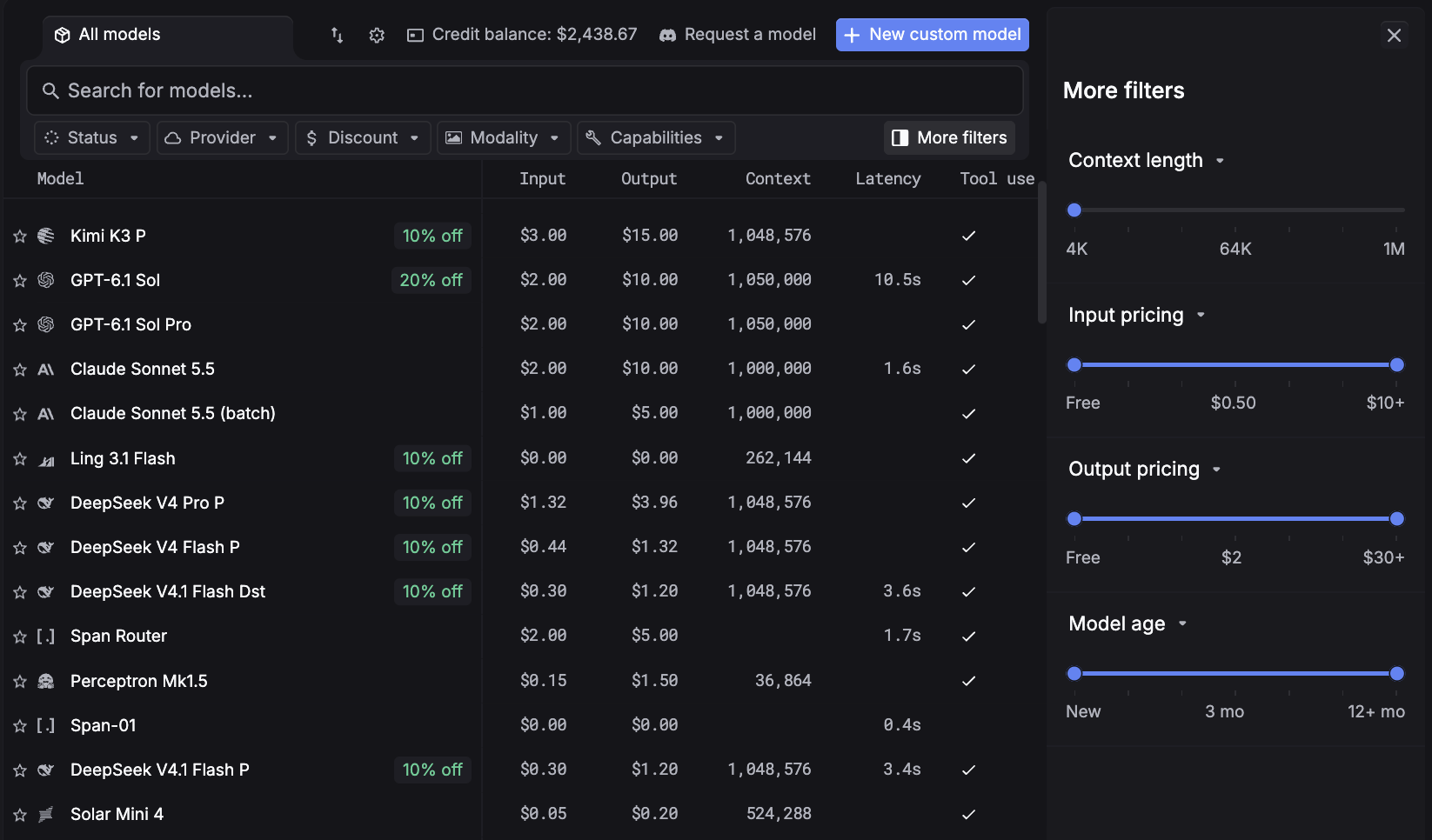
The Respan AI gateway puts every model behind one API, so switching between frontier models is a config change instead of a rewrite, and every request is traced, priced, and scored in the same place. Instead of reading logs after the fact, use Respan to run observability in production, know when production shifts, and act before it spreads.
- One API for 1,000+ models - Call Claude Opus 5.5, GPT-6.1 Sol, Kimi K3, and the rest through one endpoint, and switch models by changing a single word.
- Automatic fallbacks - Define a fallback chain once, and traffic moves to the next model the moment one errors or rate-limits.
- Task-aware routing - Respan Router, in beta, picks the model for each task, checking context length and required capabilities and weighing cache costs before it switches. In Respan's own evaluation, it came within 0.2 points of the most accurate single model's pass rate at 37% lower cost.
- Spend limits - Set soft and hard caps per key, per customer, or org-wide, so a leaked key or runaway agent stops at the ceiling instead of on your invoice.
- Tracing - Every LLM call, tool run, and agent turn lands as a span in one trace, with its input, output, latency, and cost attached.
- Evals on live traffic - Score outputs with LLM judges, code checks, or human review, on a test set before you ship and on sampled production traffic after.
- Monitors and alerts - Watch cost, errors, latency, or tokens, and get alerted in Slack, email, or a webhook the moment a metric breaches.
That loop turns a public ranking into a decision for your app. Send a slice of real traffic to two frontier models, score both on your own cases, and move the rest once the numbers settle.
Frontier AI model news
Most of the models above shipped in the last six weeks, and each lab's release pattern says something about where it's heading.
OpenAI frontier models
OpenAI has shipped two model generations since July. The GPT-5.6 family arrived July 9 with Sol, Terra, and Luna as capability tiers, then GPT-6 Astra followed on September 3, GPT-6 Sol and Luna on September 22, and GPT-6.1 Sol at DevDay on September 29. On the API side, gpt-5.1, gpt-5.3-codex, and gpt-5.4-nano shut down April 1, 2027, with GPT-6 Sol and Luna as the named replacements.
Despite the name, OpenAI Frontier isn't a model. It's an enterprise platform for building and managing AI agents that OpenAI launched in February 2026, and it runs on OpenAI's models.
Anthropic frontier models
Claude Fable 5 and Mythos 5 launched June 9, and three days later a US government export-control directive forced Anthropic to suspend both for every customer. The controls lifted June 30, Fable 5 returned July 1, and Mythos 5 came back only for a set of US organizations.
The release pace hasn't slowed since. Claude Opus 5 shipped July 24, Fable 5.1 and Mythos 5.1 on September 1, Opus 5.5 on September 22, Sonnet 5.5 on September 28, and Claude Haiku 5.5 on October 7. Separately, Claude Mythos Preview remains limited to Project Glasswing's security partners, and Anthropic has said it doesn't plan to make that model generally available.
Gemini frontier models
Google's summer cadence ran through the Flash line, with Gemini 3.6 Flash and 3.5 Flash-Lite on July 21, 3.7 Flash on August 13, and 3.8 Flash on September 2. That last release is generally available, alongside a 3.8 Flash Cyber variant restricted to Google's Fairwind Program.
Gemini 4 Argon, announced September 30, is the first Gemini 4 model and follows the same gated pattern, reaching cyber defenders first and paid API customers later. Google hasn't announced other Gemini 4 variants yet.
FAQ
What are some frontier AI companies?
OpenAI, Anthropic, and Google currently hold the top six benchmark scores, with Meta, xAI, DeepSeek, and Moonshot AI shipping models a tier below. The Frontier Model Forum, the industry group for safety work on these models, counts Amazon, Anthropic, Google, Meta, Microsoft, and OpenAI as members. Respan routes to models from most of these labs through a single API, so using more than one doesn't mean maintaining separate integrations.
What are the recent frontier AI regulation updates?
Most frontier AI rules apply to the labs training the models, not to teams building on their APIs. In the EU, general-purpose AI obligations under the AI Act applied from August 2025, and the Commission's enforcement powers began in August 2026. California's SB 53, signed in September 2025, requires developers of models trained above 10^26 operations to publish safety frameworks and report critical incidents, and New York's RAISE Act, amended in March 2026, takes effect January 1, 2027 with similar thresholds.
At the federal level, no statute preempts these state laws, though a December 2025 executive order on state AI laws directs federal agencies to challenge ones the administration considers onerous. For your own app, the obligations that matter are usually about data, which is where Respan's SOC 2, HIPAA with a BAA, GDPR, and ISO 27001 coverage comes in.
Are frontier LLMs better than smaller models?
On the hardest tasks, yes. Every model scoring above 60 overall on the Respan benchmark leaderboard comes from OpenAI, Google, or Anthropic, and the gap from the frontier tier to the next model on this list is more than 14 points. For most production steps, though, that margin doesn't change the output, while the price difference shows up on every call, which is why Respan Router, currently in beta, picks the model per task so simple steps go to cheaper models and hard ones go to the frontier.
Is ChatGPT a frontier model?
No. ChatGPT is OpenAI's app, and it runs on OpenAI's frontier models. As of October 2026, OpenAI is rolling GPT-6 out to ChatGPT, with Plus and Pro users getting GPT-6 Sol and Free and Go users moving to GPT-6 Luna, while GPT-6 Astra is available on paid plans. If you're building an app, you'd call those models through the API, or through a gateway like Respan alongside models from other labs.