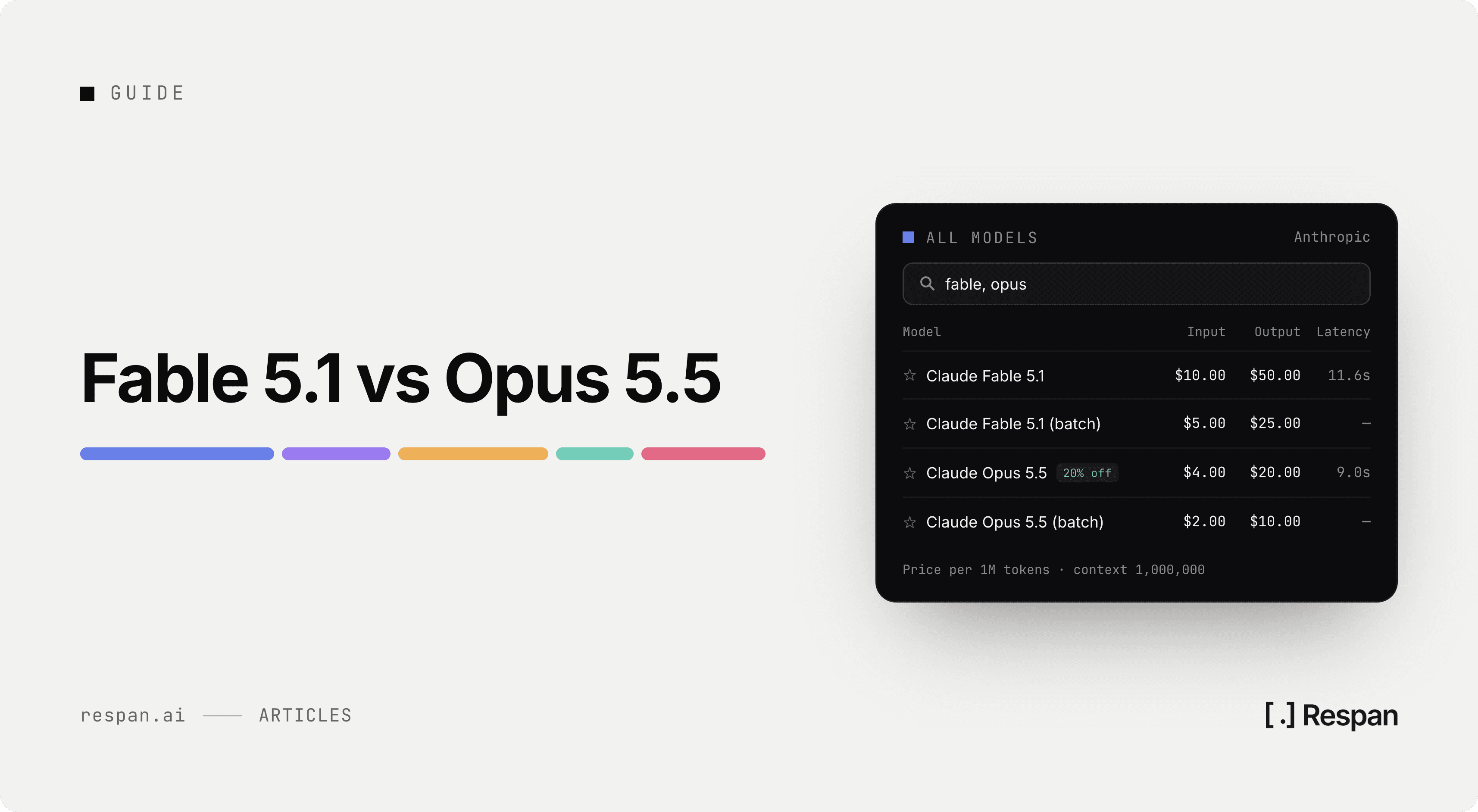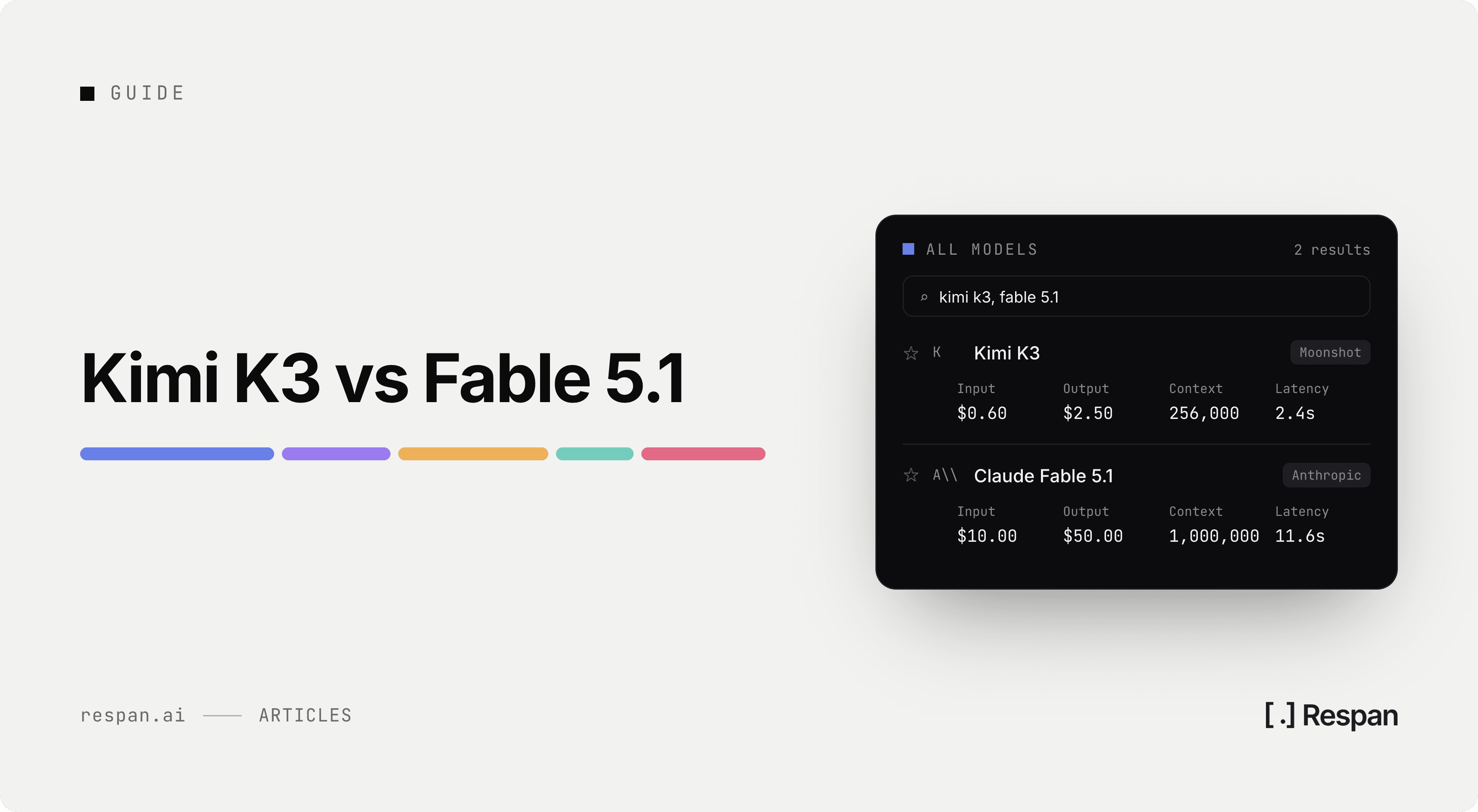
Moonshot AI released Kimi K3 in July with open weights, and Anthropic followed in September with Fable 5.1, the generally available model in its Mythos tier. Developers building coding and research agents now have two serious options at very different price points: an open-weights model you can self-host, and a closed model built for long-horizon agentic work.
For agent workloads, the model sets both the quality ceiling and the monthly bill. With thousands of calls a day, small differences in price, latency, and token use add up quickly.
Kimi K3's per-token price overstates how much cheaper it is, because it tends to write more tokens per task. A practical setup is Kimi K3 as the default and Fable 5.1 for the steps that need it, with evals on your own traffic deciding which steps those are.
Here's how Kimi K3 vs Fable 5.1 compares on pricing, benchmarks, speed, and which to use for each kind of work.
TLDR: Kimi K3 vs Fable 5.1
| Kimi K3 | Fable 5.1 | |
|---|---|---|
| Input / output (per 1M) | $3 / $15 | $10 / $50 |
| Cache reads (per 1M) | $0.30 | $0.25 |
| Context window | 1M tokens | 1M tokens |
| AA Intelligence Index | 44 (Max) | 51 (High) |
| Time to first token | 3.83s | 22.68s (High) |
| Weights | Open, custom license | Closed |
Kimi K3 is the cheaper default with lower latency, and Fable 5.1 scores higher on reasoning and knowledge work, so send the bulk of traffic to Kimi K3 and the steps that fail on it to Fable 5.1.
What Is Kimi K3?
Kimi K3 is Moonshot AI's flagship model, released in July 2026 as a 2.8-trillion-parameter mixture-of-experts model with a 1M-token context window and native vision. Moonshot published the weights on Hugging Face, so you can call it through Moonshot's API, through a gateway, or run it on your own hardware.
At launch, K3 runs only at Max thinking effort, with low and high effort modes planned. That matters for cost, because every request pays for full reasoning whether the task needs it or not. Moonshot also notes in its own release that K3 has a noticeable gap in user experience compared with Claude Fable 5, which is worth keeping in mind for work where output polish counts.
What Is Fable 5.1?
Fable 5.1 is Anthropic's Mythos-tier model for general use, released in September 2026 for demanding reasoning and long-horizon agentic work. Anthropic positions it as the step up from Claude Opus 5.5, for tasks where Opus 5.5 still falls short at higher effort.
Thinking is always on, and an effort setting that defaults to high controls how much the model reasons before answering. Because of that, Fable 5.1's cost and speed move a lot with the effort level you pick.
How to Evaluate Models for Coding & Knowledge Work
Public benchmarks are a reasonable first filter, but they rarely match your workload. If you're choosing between Kimi K3 and Fable 5.1, the more reliable signal comes from running both on your own tasks. The basics of how to evaluate an LLM apply, with a few points specific to coding and knowledge work:
- Test set from real tasks - Use requests your agent actually handled, including the ones that failed, rather than synthetic prompts. For coding, a task passes when the tests pass.
- Cost per completed task - Multiply tokens used by price, then divide by the number of tasks that passed. A model that's cheaper per token can cost more per finished task if it writes more tokens or fails more often.
- Latency budget - Time to first token matters a lot for an interactive coding assistant and very little for an overnight batch job, so set the budget per workload.
- Scoring - Use code checks where output is verifiable, and an LLM judge or human review where it isn't, like summaries or research answers.
These are also the measures where Kimi K3 and Fable 5.1 differ most, since one is cheaper per token and the other used fewer output tokens on Artificial Analysis's testing at its default effort.
Kimi K3 vs Fable 5.1
Pricing
Kimi K3: Per Moonshot's API pricing, K3 costs $3 per million input tokens, $0.30 per million on cache hits, and $15 per million output tokens. Each cache hit also refreshes the entry's lifetime without a write charge, which helps long agent loops that resend the same context.
Fable 5.1: Anthropic lists Fable 5.1 at $10 per million input tokens and $50 per million output tokens, with cache reads at $0.25 per million. US-only inference adds a 1.1x multiplier to input and output.
On the rate card, Kimi K3 is about 3.3x cheaper on both input and output, while Fable 5.1 is slightly cheaper on cache reads. The per-task gap is smaller than that, though. Kimi K3 generated 160M output tokens on Artificial Analysis's Intelligence Index, against 62M for Fable 5.1 on High effort, so the output cost of that run comes to roughly $2,400 for Kimi K3 and $3,100 for Fable 5.1, about a 1.3x difference. At Max effort, Fable 5.1 used 190M output tokens, which would put the same run near $9,500.
Winner: Kimi K3, by a smaller margin than the rate card suggests.
Coding
Kimi K3: Moonshot reports a 67.3 on DeepSWE. Cursor hasn't published a number for K3, but says it has the highest CursorBench score from an open model that Cursor has measured.
Fable 5.1: Anthropic reports 73.4% on CursorBench 3.2 and 55.8% on Terminal-Bench 4.0.
Neither vendor reports the other's coding benchmarks, and the Terminal-Bench figures each vendor publishes come from different versions, so no public number puts these two side by side on the same coding test.
Winner: Tie on published evidence. Run both against your own repository before committing.
Agentic Work and Tool Use
Kimi K3: Moonshot reports 90.4 on BrowseComp, run with the full 1M context and no compaction, which suits research agents that read a lot before answering.
Fable 5.1: Anthropic reports 77.9% on OSWorld 2.0 under partial scoring and 41.7% under strict scoring, plus 31.4% on AutomationBench.
Agent runs also compound per-step differences in latency and token use, since a 30-step run pays each of them 30 times.
Winner: No clear winner. The two vendors report different agentic benchmarks, so the comparison has to happen on your own agent loop.
Reasoning and Knowledge
Kimi K3: K3 at Max effort scores 44 on Artificial Analysis's Intelligence Index, and 1538 on GDPval-AA, which tests models on professional knowledge work tasks.
Fable 5.1: Fable 5.1 scores 51 on the Intelligence Index at High effort and 53 at Max. On GDPval-AA it reaches 1635 at High and 1758 at Max, and Anthropic reports 60.9% on Humanity's Last Exam without tools and 65.0% with them.
Fable 5.1 on Medium effort scores 1549 on GDPval-AA, close to Kimi K3 at Max, so lowering Fable's effort is also a real option for knowledge work, alongside switching to Kimi K3.
Winner: Fable 5.1.
Speed and Latency
Kimi K3: Artificial Analysis measures K3 at 45 output tokens per second, with a 3.83-second time to first token.
Fable 5.1: On High effort, Fable 5.1 streams faster at 53.6 tokens per second, but its time to first token is 22.68 seconds, since it reasons before it writes.
In an interactive coding assistant, a 20-second wait before the first token is what users notice, while a batch job or background agent barely feels it.
Winner: Kimi K3 for interactive work, while Fable 5.1 streams faster once it starts.
Context Window
Kimi K3: 1,048,576 tokens.
Fable 5.1: 1M tokens, with up to 128K max output tokens per response.
The windows are effectively the same size, so for long-context work the deciding factor is what it costs to fill one. There, Kimi K3's lower input price and Fable 5.1's cheaper cache reads pull in different directions, depending on how much of your context repeats between calls.
Winner: Tie.
Openness, Self-Hosting, and Data Retention
Kimi K3: Moonshot released the weights on Hugging Face under the Kimi K3 License. Commercial use is allowed, but a product earning more than $20M over 12 months needs a separate agreement with Moonshot, and products with 100M+ monthly active users or $20M+ in monthly revenue must display "Kimi K3" in their interface. Self-hosting keeps data on your own infrastructure, although at 2.8T parameters, even with native MXFP4 quantization, it takes substantial multi-GPU hardware running an inference engine like vLLM or SGLang.
Fable 5.1: Fable 5.1's weights are closed, and it runs through Anthropic's API, Amazon Bedrock, Google Cloud Vertex AI, and Microsoft Foundry. Anthropic retains data for 30 days by default for safety monitoring, with zero data retention available to eligible enterprise customers.
Winner: Kimi K3.
Which to Use: Kimi K3 vs Fable 5.1?
Kimi K3 and Fable 5.1 sit at different points on the cost and capability curve, so the useful question is which steps go to which model rather than picking one for everything:
- Kimi K3 - Use it as the default for high-volume steps, interactive coding where time to first token matters, research agents that read long context, and anything you need to self-host.
- Fable 5.1 - Use it for the hardest reasoning and knowledge work, long-horizon agent tasks, and steps that keep failing on Kimi K3.
- Fable 5.1 at lower effort - For knowledge work, Fable on Medium scores close to Kimi K3 on Max, so test it before splitting traffic across two providers.
Running both in production means sending each request to the right model, which is the job of an LLM router. Decide the split from cost per completed task on your own traffic, since the per-token gap between these two shrinks once token usage is counted.
Route Kimi K3 and Fable 5.1 with Respan
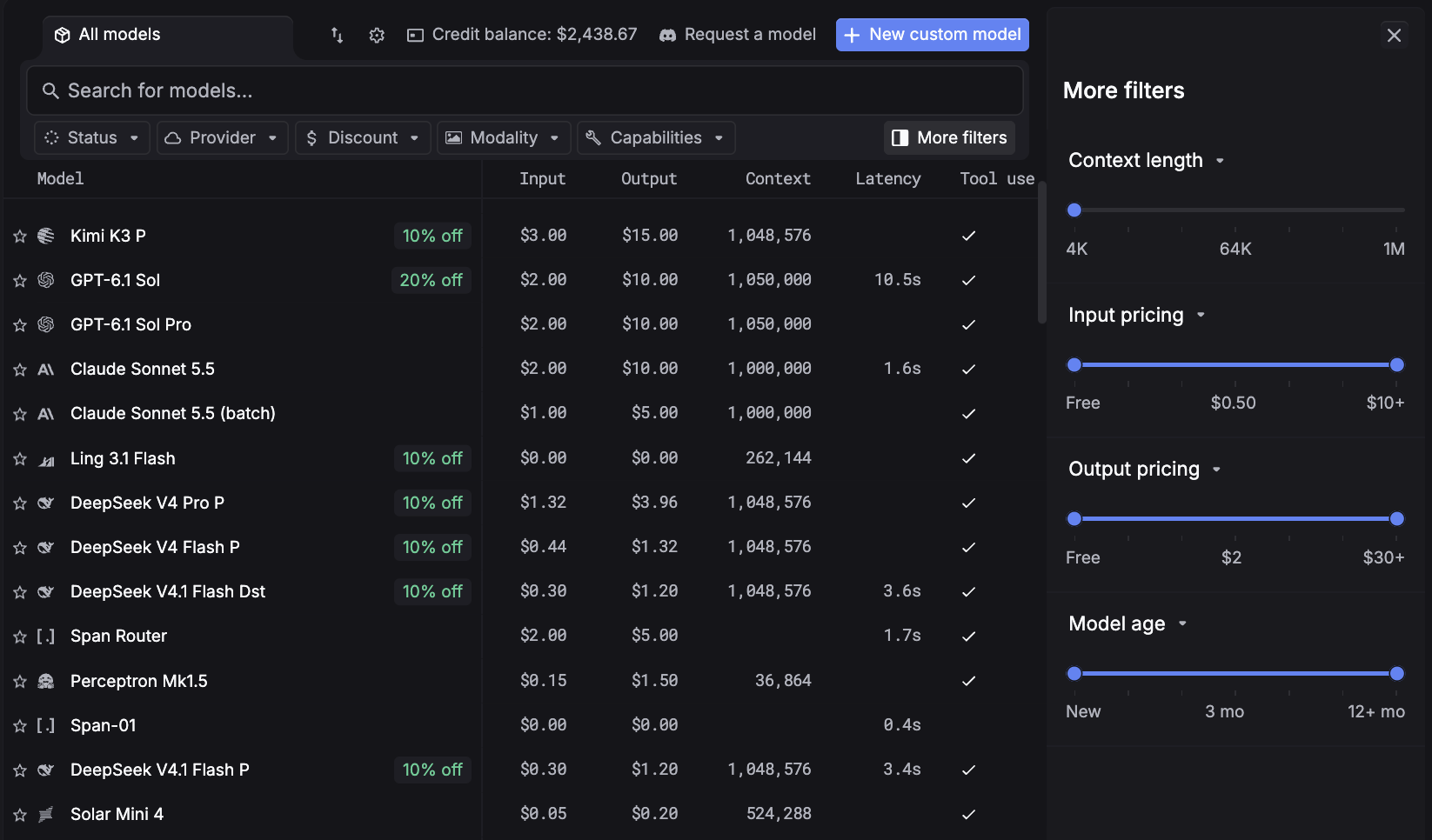
Respan is the AI router with built-in observability and automated evals. Route, observe, and evaluate every LLM call, so the split between Kimi K3 and Fable 5.1 comes from measured cost and quality instead of a benchmark average.
Kimi K3 and Fable 5.1 are both on the gateway, so moving a step from one to the other is a one-word change.
- One API for every model - Reach 1,000+ models across every major provider through one endpoint, with your own provider keys or Respan credits.
- Stay up when a model fails - Set a fallback chain once, such as Kimi K3 then Fable 5.1, and traffic moves to the next model when one errors or rate-limits.
- Know where every dollar goes - Every call is logged with its latency and cost, broken down by model, request, and end customer, with monitors and hard spend limits.
- Test sets from real traffic - Build datasets from your production logs and run both models through the same evaluators in an experiment, with per-row scores side by side.
- Evals in production - Score live traffic with an LLM judge, code checks, or human review, and click any score to land on the trace behind it.
Instead of reading logs after the fact, use Respan to run observability in production, know when production shifts, and act before it spreads.
FAQ
Is Kimi K3 better than Fable 5.1 for coding?
Kimi K3 costs less per token and starts responding sooner, while Fable 5.1 scores higher on broader reasoning and knowledge tests. The reliable way to decide is to run both on your own repository through Respan, which routes both models through one API and scores the results side by side.
How much cheaper is Kimi K3 than Fable 5.1?
Per token, Kimi K3 is about 3.3x cheaper, at $3 input and $15 output per million against Fable 5.1's $10 and $50. Per task the gap is smaller, because Kimi K3 used more output tokens than Fable 5.1 on High in Artificial Analysis's testing, which brought the output cost difference on that run to about 1.3x. Fable 5.1's cache reads are slightly cheaper, at $0.25 per million against $0.30.
Is Kimi K3 open source?
Kimi K3's weights are open on Hugging Face, but under the custom Kimi K3 License rather than a standard open-source license. Commercial use is allowed, with a separate agreement required above $20M in revenue over 12 months and a requirement for very large products to display "Kimi K3" in their interface.
Can you use Kimi K3 and Fable 5.1 together?
Yes. Respan routes both through one API, so you can send default traffic to Kimi K3, set Fable 5.1 as the fallback or the model for harder steps, and compare cost and eval scores for each. Moving a step between them is a one-word model change.
Which model is better for long-context work?
Neither has a size advantage, since both context windows are roughly 1M tokens. Fable 5.1 scores higher on knowledge work benchmarks like GDPval-AA, while on price Kimi K3 is cheaper to fill on uncached input and Fable 5.1 is cheaper on cache reads. Running your long-context requests through both in Respan shows which costs less per request on your actual traffic.