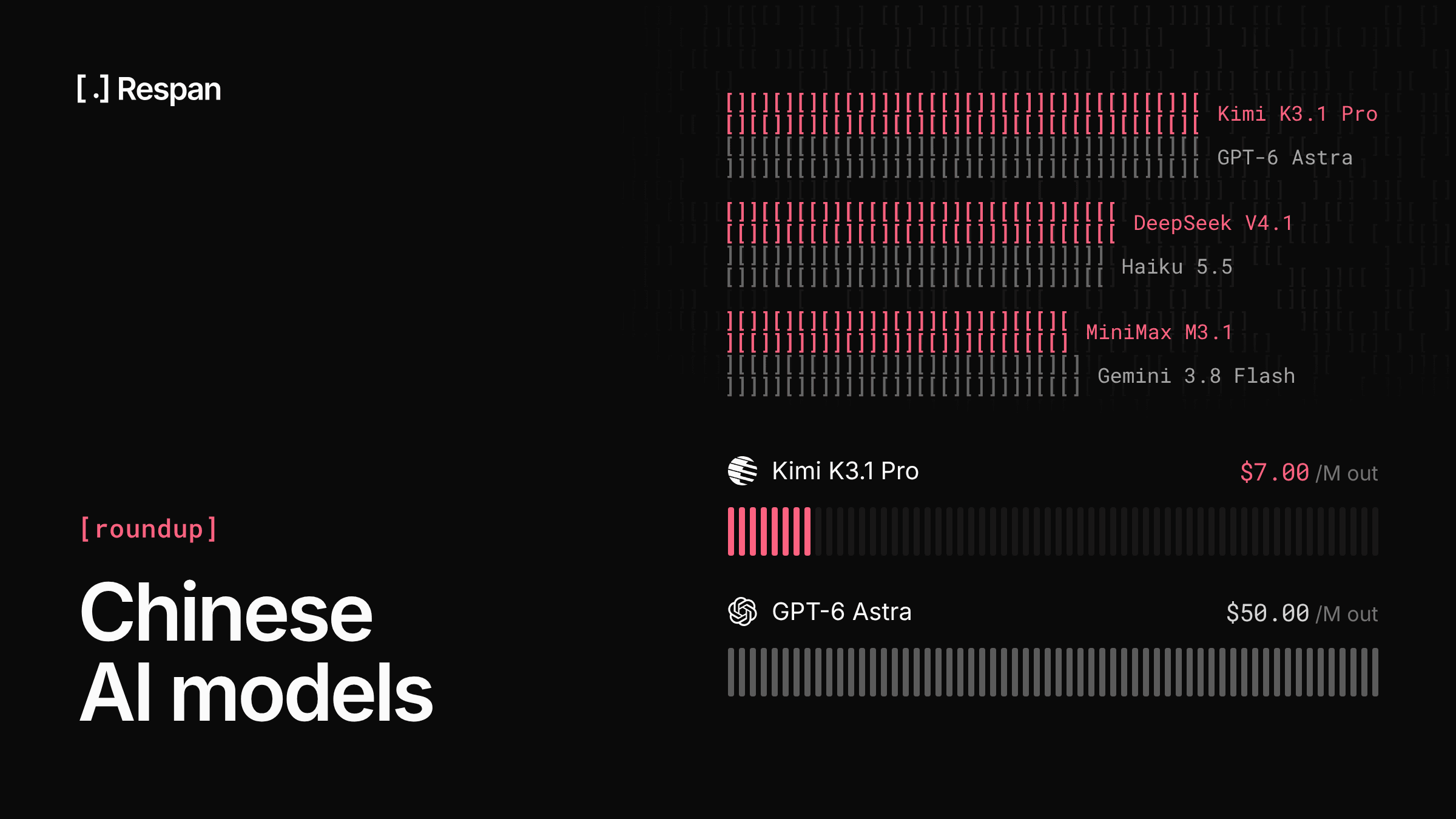
Moonshot AI published the weights for Kimi K3.1 Pro on November 4, and the model now ranks seventh on the Respan Index, 0.6 points behind GPT-6 Astra. No other Chinese model reaches the top 10, but most of the next nine land at roughly the level of Claude Haiku 5.5 and Gemini 3.8 Flash, and nearly all of them can be downloaded.
For teams that pick models task by task, that changes the math on a lot of agent steps. A Chinese model that holds up on one step can take it over at a lower price than the US model it replaces, although that isn't true of every model, and the license terms and the question of where your prompts go come along with it.
Below are the top 20 Chinese AI models of 2026, ranked against US models on the Respan Index, with prices, licenses, and where each one fits.
TL;DR: Top 20 Chinese AI models in 2026
Kimi K3.1 Pro is the best Chinese AI model as of November 13, 2026. It scores 71.4 on the Respan Index, seventh overall and 0.6 points behind GPT-6 Astra, and Moonshot AI publishes its weights. The top five are:
- Kimi K3.1 Pro (Moonshot AI) - 71.4, and the only Chinese model in the overall top 10, with a coding score of 68.8.
- DeepSeek V4.1 Flash 1017 (DeepSeek) - 59.5, with an agents score of 76.7 and MIT-licensed weights.
- MiMo-V2.6-Pro (Xiaomi) - 56.1, taking text, image, video, and audio input in one MIT-licensed model.
- Step 5 Preview (StepFun) - 55.7, a 600B-parameter preview with 27B active parameters.
- Kimi K3 (Moonshot AI) - 52.8, tied with Qwen3.8-Max and now well behind its K3.1 Pro successor.
Ranked score isn't the same as the right pick for a job, so if you're deciding what to test first:
- Frontier coding - Kimi K3.1 Pro in place of GPT-6 Astra, at $7 against $50 per million output tokens.
- Cheap agent steps - DeepSeek V4.1 Flash 1017 in place of Claude Haiku 5.5, at $0.37 against $0.50.
- Low-cost multimodal - MiMo-V2.6-Flash in place of Gemini 3.8 Flash, at $0.25 against $3.75.
- Self-hosting on modest hardware - Qwen3.8 27B, a 27B dense model under Apache 2.0.
Prices are the cheapest provider route on Respan's gateway, and the entries below cover where each pick falls short.
What are Chinese AI models?
Chinese AI models are large language models built by labs based in China, including DeepSeek, Moonshot AI (Kimi), Alibaba (Qwen), Z.ai (GLM), MiniMax, Xiaomi (MiMo), StepFun, Tencent (Hy), ByteDance (Seed), and Baidu (ERNIE). The label describes who built the model, not the language it is built for.
Most of them ship two ways at once. The lab serves the model through its own API, and it also publishes the weights on Hugging Face, where inference providers outside the lab pick them up and serve them from their own infrastructure. Of the 20 models ranked below, 17 have downloadable weights, Qwen3.8-Max runs on an open checkpoint that Alibaba also publishes, and only ByteDance's Dola Seed 2.0 Pro and Baidu's ERNIE 5.0 keep their weights closed.
That split matters once a model is in production, because the same model can be a call to the lab's own API or a model running on a provider you chose, depending on how you reach it.
Why are Chinese AI models becoming so popular?
Chinese AI models became a regular part of developer stacks in 2026. Chinese labs released new flagship weights nearly every month this year, from Kimi K3 in July through DeepSeek V4.1 Flash 1017 and MiniMax M3.1 Flash in October, and Kimi K3.1 Pro now ranks seventh overall on the Respan Index.
The usage numbers show the same shift. OpenRouter figures in Respan's LLM market share breakdown show Chinese labs carrying 69% of developer tokens on that platform in September 2026. On Respan's own LLM leaderboard, US models still carry most gateway traffic, but DeepSeek V4.1 Flash is the top trending model week over week at 29.7 billion tokens.
Price is a large part of why. MiniMax M3.1 Flash and Gemini 3.8 Flash sit within two points of each other on the Respan Index, yet the cheapest route for MiniMax on Respan's gateway charges $0.45 per million output tokens against $3.75 for Gemini.
Open weights are the other part. Nearly every Chinese lab publishes its weights, so you can self-host a model, fine-tune it, or pick which provider serves it, none of which is possible with the GPT, Claude, and Gemini API models they compete with.
Top 20 Chinese AI models, ranked
The ranking follows the Respan Index, which combines public and lab-reported benchmark results into one 0 to 100 score, with sub-scores for coding, agents, reasoning, knowledge, and human preference.
| Model | Lab | Respan Index | Weights | Output price (1M) |
|---|---|---|---|---|
| Kimi K3.1 Pro | Moonshot AI | 71.4 | Open (custom license) | $7.00 |
| DeepSeek V4.1 Flash 1017 | DeepSeek | 59.5 | Open (MIT) | $0.37 |
| MiMo-V2.6-Pro | Xiaomi | 56.1 | Open (MIT) | $0.87 |
| Step 5 Preview | StepFun | 55.7 | Open (custom license) | $2.70 |
| Kimi K3 | Moonshot AI | 52.8 | Open (custom license) | $9.50 |
| Qwen3.8-Max | Alibaba | 52.8 | Hosted, open base | $4.95 |
| MiniMax M3.1 Flash | MiniMax | 52.6 | Open (custom license) | $0.45 |
| MiMo-V2.6-Flash | Xiaomi | 52.3 | Open (MIT) | $0.25 |
| GLM-5.3 | Z.ai | 52.1 | Open (custom license) | $1.80 |
| DeepSeek V4 Pro | DeepSeek | 49.1 | Open (MIT) | $1.50 |
| Hy4 preview | Tencent | 47.3 | Open (Apache 2.0) | $2.50 |
| GLM-5.3-Flash | Z.ai | 45.4 | Open (MIT) | $0.08 |
| Qwen3.8-Flash-Next | Alibaba | 44.3 | Open (custom license) | Not listed |
| Qwen3.8 27B | Alibaba | 42.4 | Open (Apache 2.0) | $0.50 |
| Dola Seed 2.0 Pro | ByteDance | 40.2 | Closed | $3.00 |
| Kimi K2.7 Code | Moonshot AI | 36.1 | Open (Modified MIT) | $3.50 |
| MiniMax M3 | MiniMax | 31.2 | Open (custom license) | $0.90 |
| Step 3.5 Flash | StepFun | 26.6 | Open (Apache 2.0) | $0.30 |
| ERNIE 5.0 | Baidu | 22.1 | Closed | Not listed |
| LongCat Flash Chat | Meituan | 16.7 | Open (MIT) | Not listed |
Scores come from the Respan Index as of November 13, 2026. The coding and agents scores quoted in the entries are measured, while the index estimates a category score when a model has no published results in it, which applies to some reasoning and knowledge scores. Prices are per million output tokens on the cheapest provider route on Respan's gateway, after gateway discounts, so a lab's own API can charge more, and the cheapest route can differ from it in context length, tool support, and rate limits.
1. Kimi K3.1 Pro (Moonshot AI)
Kimi K3.1 Pro comes closer to the US frontier than any other Chinese model on the index, at 71.4 against 72.0 for GPT-6 Astra. Moonshot AI launched it through its API on October 23 and published the weights on November 4 under the Kimi K3.1 Pro License, which grants MIT-style rights but requires a separate agreement for model-as-a-service businesses above $20 million in revenue over 12 months.
Its coding score of 68.8 sits about 20 points above the next Chinese model, and its agents score of 70.2 is within roughly eight points of Astra's 78.3. The index estimates its reasoning and knowledge scores rather than measuring them, so those two categories rest on less evidence. It still trails Claude Fable 5.2 by 9.8 points overall, a gap the Kimi K3.1 Pro vs Fable 5.2 comparison breaks down by category.
Price is where the comparison with Astra tilts hard. The cheapest of 14 routes on Respan's gateway charges $1.40 input and $7 output per million tokens, against $10 and $50 for Astra, and Moonshot's own API serves it as kimi-k3.1-pro with OpenAI- and Anthropic-compatible endpoints. Self-hosting is a separate commitment: the weights total 2.8T parameters with 104B active, and Moonshot's model card lists vLLM, SGLang, and TokenSpeed as serving engines without a hardware minimum, so plan on multi-GPU servers.
- Lab: Moonshot AI
- Weights: Open (Kimi K3.1 Pro License)
- Respan Index: 71.4 · Coding 68.8 · Agents 70.2
- Nearest US match: GPT-6 Astra (72.0)
- Output price (1M): $7.00
- Tradeoffs: Multi-GPU hardware to self-host, and a license condition for large model-as-a-service businesses
- Best for: Coding and agent work you'd otherwise send to a frontier US model
2. DeepSeek V4.1 Flash 1017 (DeepSeek)
Agent work is where DeepSeek V4.1 Flash 1017 earns its place. Its agents score of 76.7 is well ahead of Claude Haiku 5.5's 65.9 and within two points of GPT-6 Astra's 78.3, even though its overall score is 59.5 and its coding score falls back to 48.1.
DeepSeek released it on October 17 as an update to V4.1 Flash, under MIT, with 763B total parameters, text and image input, and a 1M-token context. Among the DeepSeek models, it now outscores the larger V4 Pro by 10.4 points.
The price structure depends on where you call it. DeepSeek's own API charges $0.30 input and $1.20 output per million tokens at peak and half that off-peak, while the cheapest of 22 routes on Respan's gateway charges $0.035 and $0.37. That cheapest route is a third-party host rather than DeepSeek itself, which changes who handles your prompts as well as what you pay.
- Lab: DeepSeek
- Weights: Open (MIT)
- Respan Index: 59.5 · Coding 48.1 · Agents 76.7
- Nearest US match: Claude Haiku 5.5 (56.7)
- Output price (1M): $0.37
- Tradeoffs: Coding trails its agent score by almost 30 points, and DeepSeek's own API stores data in China
- Best for: High-volume agent steps and tool calls
3. MiMo-V2.6-Pro (Xiaomi)
Xiaomi's MiMo-V2.6-Pro takes text, image, video, and audio input in a single model, which Claude Haiku 5.5, its nearest US match on score, doesn't. Xiaomi released it on September 21 under MIT, with 1.02T total and 42B active parameters and a 1M-token context.
On the index it scores 56.1, close to Haiku's 56.7, with agents at 64.6 against Haiku's 65.9. The gap shows up in coding, where Haiku leads 53.7 to 45.9.
That makes the price harder to justify for text-only work. The cheapest route on Respan's gateway charges $0.43 input and $0.87 output per million tokens, against $0.10 and $0.50 for Haiku 5.5, so unless audio or video input matters to your agent, Haiku might give you a similar score for less.
- Lab: Xiaomi
- Weights: Open (MIT)
- Respan Index: 56.1 · Coding 45.9 · Agents 64.6
- Nearest US match: Claude Haiku 5.5 (56.7)
- Output price (1M): $0.87
- Tradeoffs: Costs more than Haiku 5.5 at a similar score, and a trillion-parameter model to self-host
- Best for: Agents that read audio or video alongside text
4. Step 5 Preview (StepFun)
StepFun ships Step 5 Preview as exactly what the name says. Its model card notes that the full BF16 Transformers workflow hasn't been validated end to end, and that usable context and concurrency vary with the serving setup.
The model itself is a 600B mixture-of-experts with 27B active parameters, up to 1M tokens of context, and text and image input. For its size it's manageable to host, since StepFun's example FP8 configurations fit on a single node of four B300 or eight H200 GPUs. It scores 55.7 overall, about level with Claude Haiku 5.5, but behind it on both coding (45.4 vs 53.7) and agents (57.1 vs 65.9).
It ships under the StepFun Model License 1.0, which follows Apache 2.0 with added attribution and commercial-license conditions. On Respan's gateway the cheapest route charges $1 input and $2.70 output per million tokens, more than five times Haiku's output rate.
- Lab: StepFun
- Weights: Open (StepFun Model License 1.0)
- Respan Index: 55.7 · Coding 45.4 · Agents 57.1
- Nearest US match: Claude Haiku 5.5 (56.7)
- Output price (1M): $2.70
- Tradeoffs: Preview status, and a higher output price than Haiku 5.5 at a similar score
- Best for: Evaluating StepFun's next generation on a single GPU node
5. Kimi K3 (Moonshot AI)
Moonshot's previous flagship, Kimi K3, released July 16, scores 52.8, tying Qwen3.8-Max and sitting 18.6 points below K3.1 Pro. It has 2.8T total and 104B active parameters, a context of about 1M tokens, and ships under the Kimi K3 License.
Against Gemini 3.8 Flash at 54.4, it leads slightly on coding (38.8 vs 36.1) and trails on agents (61.7 vs 66.3). Against Z.ai's model at nearly the same overall score, the GLM 5.3 vs Kimi K3 tradeoff comes down to coding, where GLM-5.3 scores 44.4.
The cheapest route on Respan's gateway charges $9.50 per million output tokens, above both Gemini 3.8 Flash at $3.75 and the $7 route for K3.1 Pro. For new work, K3.1 Pro scores higher and costs less on output, so K3 mostly makes sense where it's already integrated.
- Lab: Moonshot AI
- Weights: Open (Kimi K3 License)
- Respan Index: 52.8 · Coding 38.8 · Agents 61.7
- Nearest US match: Gemini 3.8 Flash (54.4)
- Output price (1M): $9.50
- Tradeoffs: Output costs more than both Gemini 3.8 Flash and Kimi K3.1 Pro
- Best for: Existing Kimi K3 deployments
6. Qwen3.8-Max (Alibaba)
Alibaba serves Qwen3.8-Max through Qwen Cloud, and it's built on an open checkpoint, Qwen3.8-2.4T-A95B, that anyone can download. The two aren't the same product: the hosted Max adds image input, a non-thinking mode, a 1M-token default context, and built-in tools, while the open weights are text-only, can't turn thinking off, and run 262K tokens natively, extendable to about 1M.
Its agents score of 68.4 is above Gemini 3.8 Flash's 66.3, even though its overall score of 52.8 is lower, and its coding score of 39.2 is about level with Gemini's 36.1. Among the Qwen 3.8 models, it's the flagship, and the 27B and Flash-Next versions further down trade score for size.
Six providers serve it through Respan's gateway, and the cheapest charges $1.65 input and $4.95 output per million tokens, which puts output above Gemini 3.8 Flash's $3.75.
- Lab: Alibaba
- Weights: Hosted, on an open checkpoint (Qwen3.8-2.4T-A95B)
- Respan Index: 52.8 · Coding 39.2 · Agents 68.4
- Nearest US match: Gemini 3.8 Flash (54.4)
- Output price (1M): $4.95
- Tradeoffs: The open weights behave differently from the hosted model, and output costs more than Gemini 3.8 Flash
- Best for: Multi-step agent work through Qwen's API
7. MiniMax M3.1 Flash (MiniMax)
MiniMax M3.1 Flash scores 52.6, within two points of Gemini 3.8 Flash, and the cheapest of 11 routes on Respan's gateway charges $0.45 per million output tokens against Gemini's $3.75. MiniMax launched it through its API on October 19 and published the weights four days later, with about 428B total and 23B active parameters, a 1M-token context, and text, image, and video input.
Its coding score of 40.8 is ahead of Gemini 3.8 Flash's 36.1, while agents trail at 58.4 against 66.3. The license is where the extra work sits. Under the MiniMax Community License, commercial use requires a "Built with MiniMax M3.1-Flash" notice on a related website, interface, or product documentation, plus a one-time notice to MiniMax, and products earning more than $20 million a year need MiniMax's prior written authorization instead.
- Lab: MiniMax
- Weights: Open (MiniMax Community License)
- Respan Index: 52.6 · Coding 40.8 · Agents 58.4
- Nearest US match: Gemini 3.8 Flash (54.4)
- Output price (1M): $0.45
- Tradeoffs: Attribution and notice terms for commercial use, and agents trail Gemini 3.8 Flash
- Best for: High-volume coding tasks on a tight budget
8. MiMo-V2.6-Flash (Xiaomi)
Xiaomi released MiMo-V2.6-Flash alongside the Pro on September 21, under the same MIT license and with the same four input types: text, image, video, and audio. It's the smaller of the two, with 309B total and 15B active parameters and a 1M-token context.
It gives up 3.8 points to the Pro overall, mostly in coding (40.3 vs 45.9), while its agents score of 62.1 stays close. The price drops further than the score, since the cheapest route on Respan's gateway charges $0.11 input and $0.25 output per million tokens, under a third of the Pro's output rate and about a fifteenth of Gemini 3.8 Flash's.
- Lab: Xiaomi
- Weights: Open (MIT)
- Respan Index: 52.3 · Coding 40.3 · Agents 62.1
- Nearest US match: Gemini 3.8 Flash (54.4)
- Output price (1M): $0.25
- Tradeoffs: Weaker coding than the Pro, and still a 309B model to self-host
- Best for: Low-cost multimodal agents, including audio and video input
9. GLM-5.3 (Z.ai)
Z.ai's GLM-5.3 leans toward coding. Its coding score of 44.4 sits above Gemini 3.8 Flash's 36.1 even though its overall score, 52.1, is 2.3 points lower, and its agents score of 64.5 is close to Gemini's 66.3.
It's a text-only, 753B-parameter model with a 1M-token context. Z.ai released it through its API in August and published the weights about two weeks later under the GLM-5.3 License, which reads like MIT with one added condition: a model-as-a-service provider with more than $10 billion in revenue over 12 months must pass a Z.ai security review before commercial use. End-user products that only embed the model in specific features don't count as model-as-a-service.
Z.ai's own API charges $1.40 input and $4.40 output per million tokens, while the cheapest of 23 routes on Respan's gateway charges $0.08 and $1.80, so the provider you pick changes the bill more than the model does.
- Lab: Z.ai
- Weights: Open (GLM-5.3 License)
- Respan Index: 52.1 · Coding 44.4 · Agents 64.5
- Nearest US match: Gemini 3.8 Flash (54.4)
- Output price (1M): $1.80
- Tradeoffs: Text-only, and a security review for model-as-a-service providers above $10 billion in revenue
- Best for: Coding agents
10. DeepSeek V4 Pro (DeepSeek)
DeepSeek V4 Pro is the larger of DeepSeek's V4 models, at 1.6T total and 49B active parameters under MIT, with text input and a 1M-token context. DeepSeek released a preview in April and a production checkpoint in August, and the Flash model it updated in October now ranks above it.
At 49.1 overall it sits level with GPT-6 Luna at 48.8, and the two are close on coding (29.8 vs 28.4) and agents (59.4 vs 60.4). Where it still beats DeepSeek's own Flash 1017 is knowledge, 52.6 against 42.6.
The cheapest route on Respan's gateway charges $0.28 input and $1.50 output per million tokens, three times GPT-6 Luna's $0.50 output rate. For most new work, V4.1 Flash 1017 scores higher and costs less.
- Lab: DeepSeek
- Weights: Open (MIT)
- Respan Index: 49.1 · Coding 29.8 · Agents 59.4
- Nearest US match: GPT-6 Luna (48.8)
- Output price (1M): $1.50
- Tradeoffs: Scores below DeepSeek's own Flash model and costs more than GPT-6 Luna
- Best for: Knowledge-heavy tasks, or teams already running V4 Pro
Other Chinese AI models
Ranks 11 through 20 score between 47.3 and 16.7. A couple are early releases still in preview, and the rest are smaller or older models that still fit specific jobs:
- Hy4 preview (Tencent) - 47.3, under Apache 2.0, with 770B total and 49B active parameters and a 1M-token context. Tencent calls it an early version with known issues, including spending more reasoning time than a task needs.
- GLM-5.3-Flash (Z.ai) - 45.4, under a standard MIT license with image input, at $0.08 per million output tokens on Respan's gateway.
- Qwen3.8-Flash-Next (Alibaba) - 44.3, with open weights under the Qwen Community License 1.0 and 125B total but 6B active parameters. Alibaba released it as an early look at the architecture behind Qwen4, and the hosted Qwen3.8-Flash is a separate product.
- Qwen3.8 27B (Alibaba) - 42.4, a 27B dense model under Apache 2.0 with image and video input, and far less hardware to self-host than the frontier-scale models above.
- Dola Seed 2.0 Pro (ByteDance) - 40.2, ByteDance's flagship Seed 2.0 model, with closed weights and a 256K-token context. Its overall score comes mostly from reasoning and agents, with coding at 12.1.
- Kimi K2.7 Code (Moonshot AI) - 36.1, a coding-focused release from June under a Modified MIT license. The Respan Index puts its coding score at 12.4, so check the individual coding benchmarks on its model page before treating it as a coding pick.
- MiniMax M3 (MiniMax) - 31.2, MiniMax's June flagship under the MiniMax Community License, now more than 20 points behind M3.1 Flash.
- Step 3.5 Flash (StepFun) - 26.6, under Apache 2.0, with 196B total and 11B active parameters, text-only, at $0.30 per million output tokens.
- ERNIE 5.0 (Baidu) - 22.1, a proprietary model from the ERNIE line behind Baidu's ERNIE Bot, served through Baidu's own platforms.
- LongCat Flash Chat (Meituan) - 16.7, a 560B MIT-licensed model from September 2025 and the oldest release in the ranking.
If cost or self-hosting drives the decision, GLM-5.3-Flash and Qwen3.8 27B are the two to test first.
How do Chinese AI models compare to US models?
At the top, US labs still lead. The six models above Kimi K3.1 Pro on the Respan Index all come from US labs, led by Claude Fable 5.2 at 81.2, Gemini 4 Carbon at 76.0, and Claude Opus 5.5 at 75.8. Below that, most of the Chinese top 10 match up with US fast-tier models rather than flagships:
| Chinese model | Index | Nearest US model | US index | Output price (CN vs US) |
|---|---|---|---|---|
| Kimi K3.1 Pro | 71.4 | GPT-6 Astra | 72.0 | $7.00 vs $50 |
| DeepSeek V4.1 Flash 1017 | 59.5 | Claude Haiku 5.5 | 56.7 | $0.37 vs $0.50 |
| MiMo-V2.6-Pro | 56.1 | Claude Haiku 5.5 | 56.7 | $0.87 vs $0.50 |
| Step 5 Preview | 55.7 | Claude Haiku 5.5 | 56.7 | $2.70 vs $0.50 |
| Kimi K3 | 52.8 | Gemini 3.8 Flash | 54.4 | $9.50 vs $3.75 |
| Qwen3.8-Max | 52.8 | Gemini 3.8 Flash | 54.4 | $4.95 vs $3.75 |
| MiniMax M3.1 Flash | 52.6 | Gemini 3.8 Flash | 54.4 | $0.45 vs $3.75 |
| MiMo-V2.6-Flash | 52.3 | Gemini 3.8 Flash | 54.4 | $0.25 vs $3.75 |
| GLM-5.3 | 52.1 | Gemini 3.8 Flash | 54.4 | $1.80 vs $3.75 |
| DeepSeek V4 Pro | 49.1 | GPT-6 Luna | 48.8 | $1.50 vs $0.50 |
US prices use the same basis, the cheapest route on Respan's gateway.
The category scores split the same way the table does. On agents, several Chinese models hold their own or lead, with DeepSeek V4.1 Flash 1017 at 76.7 against Claude Haiku 5.5's 65.9 and Qwen3.8-Max ahead of Gemini 3.8 Flash. On coding, the frontier AI models from US labs are still well ahead, with Claude Sonnet 5.5 at 78.6 and Opus 5.5 at 75.6, while Kimi K3.1 Pro reaches 68.8 and the rest of the Chinese top 10 sit between 29.8 and 48.1.
Price doesn't fall in one direction either. Five of the top 10 cost less on output than their US match, led by Kimi K3.1 Pro at about a seventh of GPT-6 Astra's rate, while the other five cost more, and Claude Haiku 5.5 undercuts MiMo-V2.6-Pro and Step 5 Preview at nearly the same score. If the model you want to replace is Opus specifically, the Claude Opus alternatives breakdown covers that swap step by step.
Weights are the clearest difference. Every US model in the table is API-only, while 18 of the 20 Chinese models in the ranking publish weights or run on a published checkpoint. Many of those use custom licenses rather than MIT or Apache 2.0, with conditions that start above a revenue threshold, so check the license file before you ship, and the wider field of open source LLMs shows how they compare with open models from US labs.
Data handling depends on how you call the model. Calling a lab's own API puts your prompts under that lab's terms, and DeepSeek's privacy policy states that it collects, processes, and stores personal data in the People's Republic of China. Open weights change that, because a third-party host or your own infrastructure can serve the same model without prompts reaching the lab at all. Hosting location isn't the only question, though, since some customer contracts and internal policies restrict Chinese-origin models wherever they run, so check those separately before you route production traffic to one.
Route Chinese and US models through one API with Respan
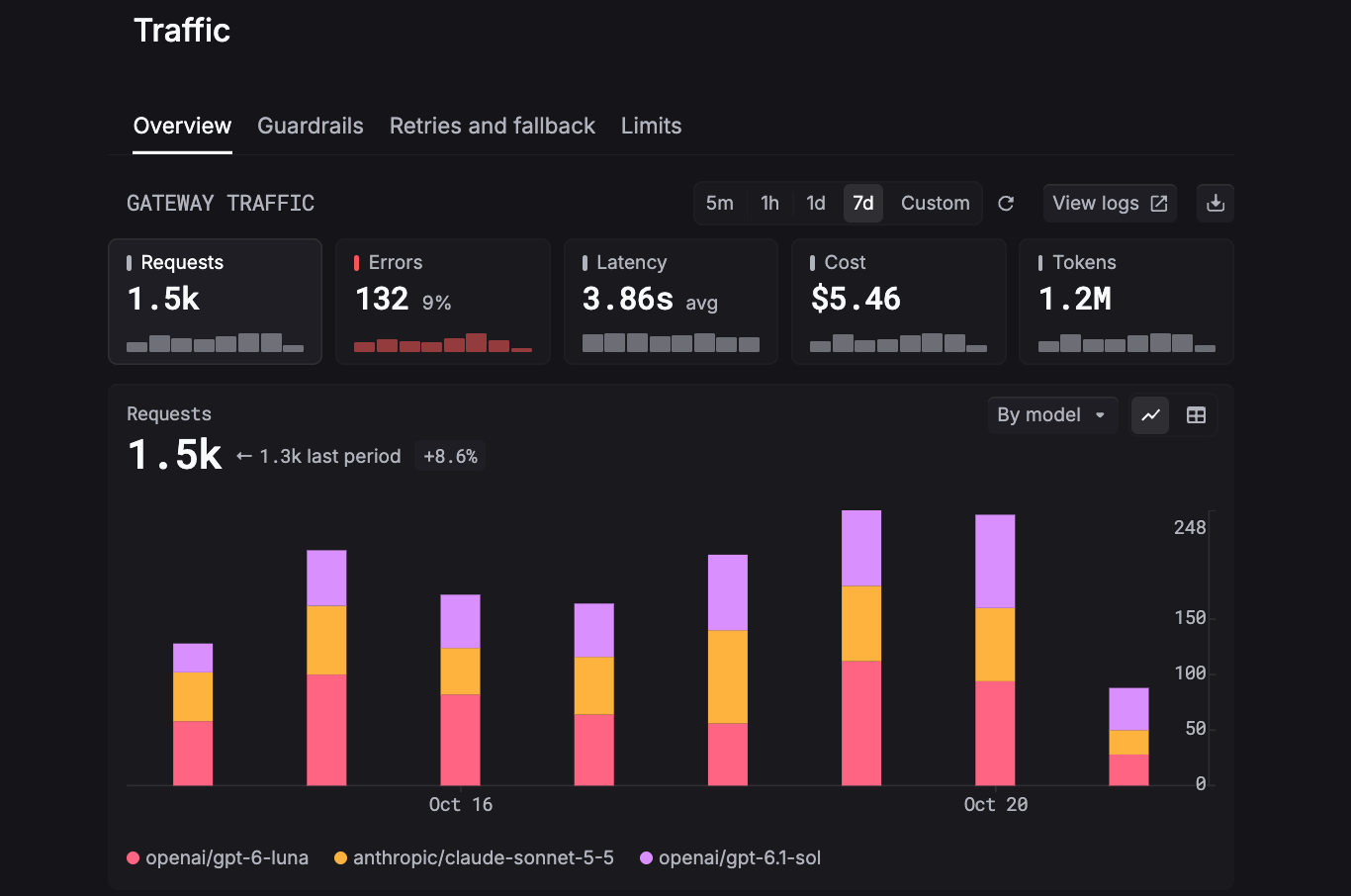
A Chinese model usually takes over some of an agent's steps rather than all of them, which means running it next to the US model you already use. Respan's AI gateway routes both through one API across 1,000+ models, and every request is traced, priced, and ready to score in the same place:
- One API for both - Call Kimi K3.1 Pro, DeepSeek, Qwen3.8-Max, GLM-5.3, and MiniMax alongside GPT, Claude, and Gemini, and switch models by changing a single word in the request.
- Choose who serves each model - Pin a request to a specific provider with that provider's model ID from the model's Providers tab, so your prompts go to the host you picked rather than to the lab's own API.
- Fallback chains you define - List the models to fall back to once, and when one errors or rate-limits, Respan moves to the next. Put a Chinese model first with a US model behind it, or the reverse.
- Know where every dollar goes - Costs are broken down by model, by request, and by end customer, with soft and hard limits per key, per customer, or org-wide.
- Test before you switch - AI evals build datasets from your production logs, run the Chinese model and your current model through the same evaluators, and keep scoring live traffic after the switch.
- Traces behind every score - Click any score and land on the trace behind it, so a regression points straight at the prompt, tool call, or step that caused it.
- Compliance built in - SOC 2, HIPAA with a BAA, GDPR, ISO 27001, PII masking, and omit-logs.
- Run the gateway yourself - Respan's open-source gateway, currently pre-alpha, runs on your own infrastructure with DeepSeek among its built-in providers and any OpenAI-compatible endpoint, including self-hosted weights behind vLLM. Turn on the Respan plugin when you want those requests traced, priced, and scored in the hosted platform.
Instead of reading logs after the fact, use Respan to run observability in production, know when production shifts, and act before it spreads.
FAQ
What is the famous Chinese AI called?
DeepSeek is the Chinese AI most people have heard of, largely because of the attention its R1 model drew in 2025. On today's Respan Index, though, Moonshot AI's Kimi K3.1 Pro scores highest among Chinese models, and DeepSeek V4.1 Flash 1017 ranks second. You can call both through Respan's gateway next to the US models you already use.
Is Kimi K3 Chinese?
Yes. Kimi K3 is built by Moonshot AI, a Beijing-based AI company, and its weights are published on Hugging Face under the Kimi K3 License. Because the weights are open, you can run it through a third-party host or on your own infrastructure instead of calling Moonshot's API.
Why are Chinese AI models primarily open source?
Publishing weights gets a model adopted quickly, because inference providers and developers can run it the day it ships instead of waiting on the lab's own API. US chip export controls also play a part, as CSIS has argued, since third-party hosts take on serving costs a Chinese lab would otherwise carry, although open releases make the models harder to monetize. Strictly speaking, most of these are open weight models rather than fully open source, since the training data stays private, and some flagships stay closed, including Baidu's ERNIE 5.0 and ByteDance's Dola Seed 2.0 Pro.
What was the first Chinese AI model?
Baidu's ERNIE Bot was the first major Chinese ChatGPT-style chatbot, opening for invited testing on March 16, 2023 and to the public in mainland China on August 31, 2023. Research models came earlier: Baidu's ERNIE line dates to a 2019 paper, and Wu Dao was described by its creators as the world's largest language model at 1.75 trillion parameters.