ChatGPT leads consumer use, Anthropic leads what enterprises spend on LLM APIs, and on developer platforms the most-used models come from Chinese labs. Depending on what you count, the LLM market has three different leaders right now.
That split matters if you're building on LLMs, because a provider that wins one measure can trail in another, and the rankings have shifted within months.
Below is LLM market share by company and category for Q4 2026, and what it means for teams choosing which models to build on.
TL;DR: LLM market share in Q4 2026
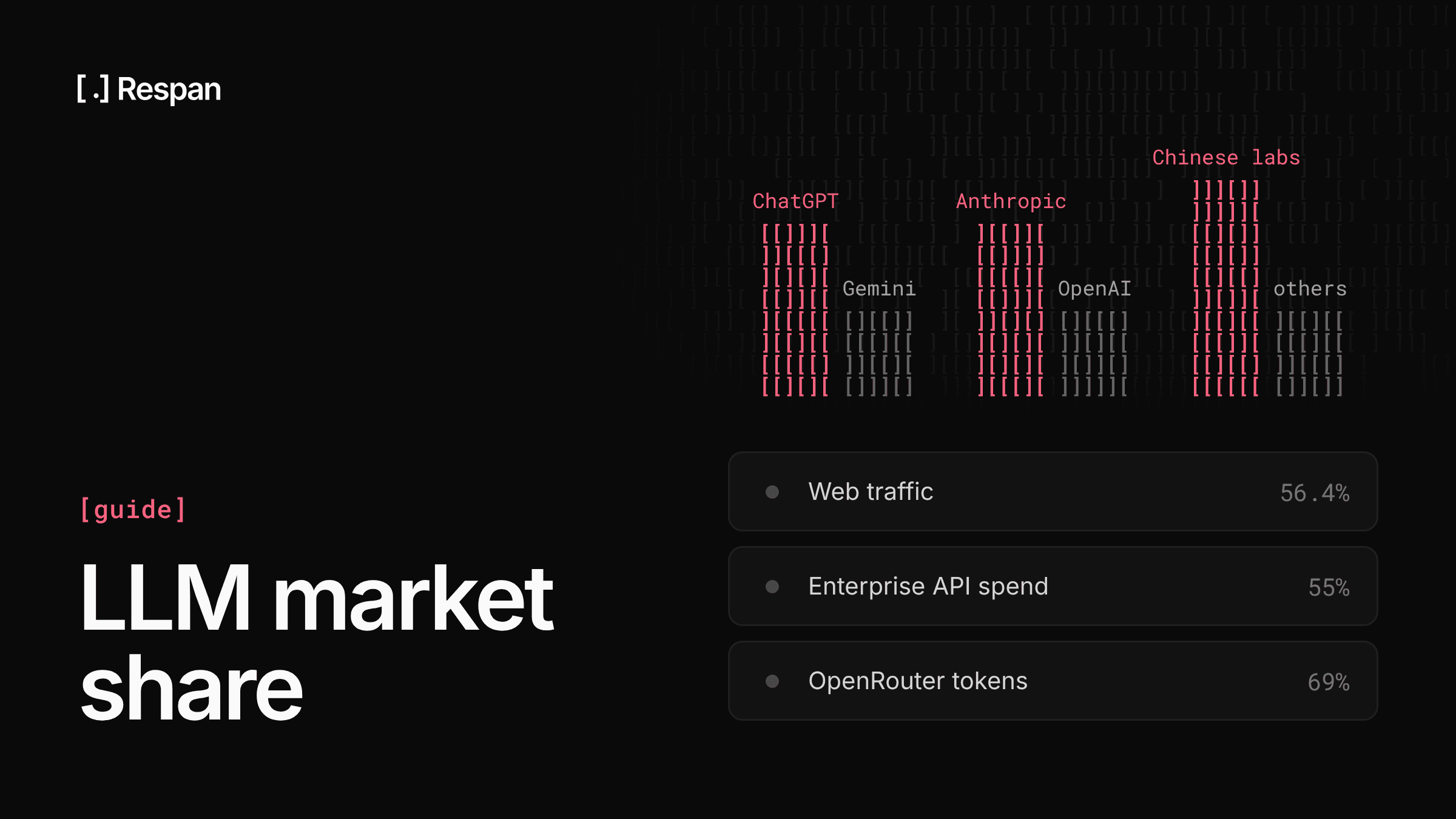
No single company leads LLM market share in Q4 2026. OpenAI's ChatGPT leads consumer use with 56.4% of generative AI web traffic, Anthropic leads enterprise API spend at 55%, and Chinese labs carry 69% of developer tokens on OpenRouter.
| Category | Leader | Share | Source, data date |
|---|---|---|---|
| Consumer chatbot web traffic | ChatGPT | 56.4% | Similarweb, Sep 2026 |
| Enterprise LLM API spend | Anthropic | 55% | Menlo Ventures, Sep 2026 survey |
| U.S. businesses paying for AI | Anthropic | 43.8% of businesses | Ramp, Sep 2026 |
| Developer API tokens (OpenRouter) | Chinese labs | 69% of tokens | OpenRouter, Sep 2026 |
| AI coding spend | Claude Code + Codex | 70% | Menlo Ventures, Sep 2026 survey |
| Open-weight vs closed, enterprise | Closed models | 96% of spend, 81% of tokens | Menlo Ventures, Sep 2026 survey |
To summarize, OpenAI has the widest consumer reach, Anthropic takes the largest share of enterprise API spend, and Chinese open-weight models carry the most volume on developer routers like OpenRouter, with each lead shifting within months. Because the right provider depends on the workload, Respan lets you route every model through one API and compare them on your own traffic before you commit.
LLM market share by category
The leader changes from one category to the next, and so does the direction each provider is moving.
Consumer chatbot usage
Consumer share gets the most attention, and ChatGPT still leads it. In Similarweb's September update, ChatGPT took 56.4% of worldwide generative AI website traffic, ahead of Gemini at 25.0% and Claude at 9.6%.
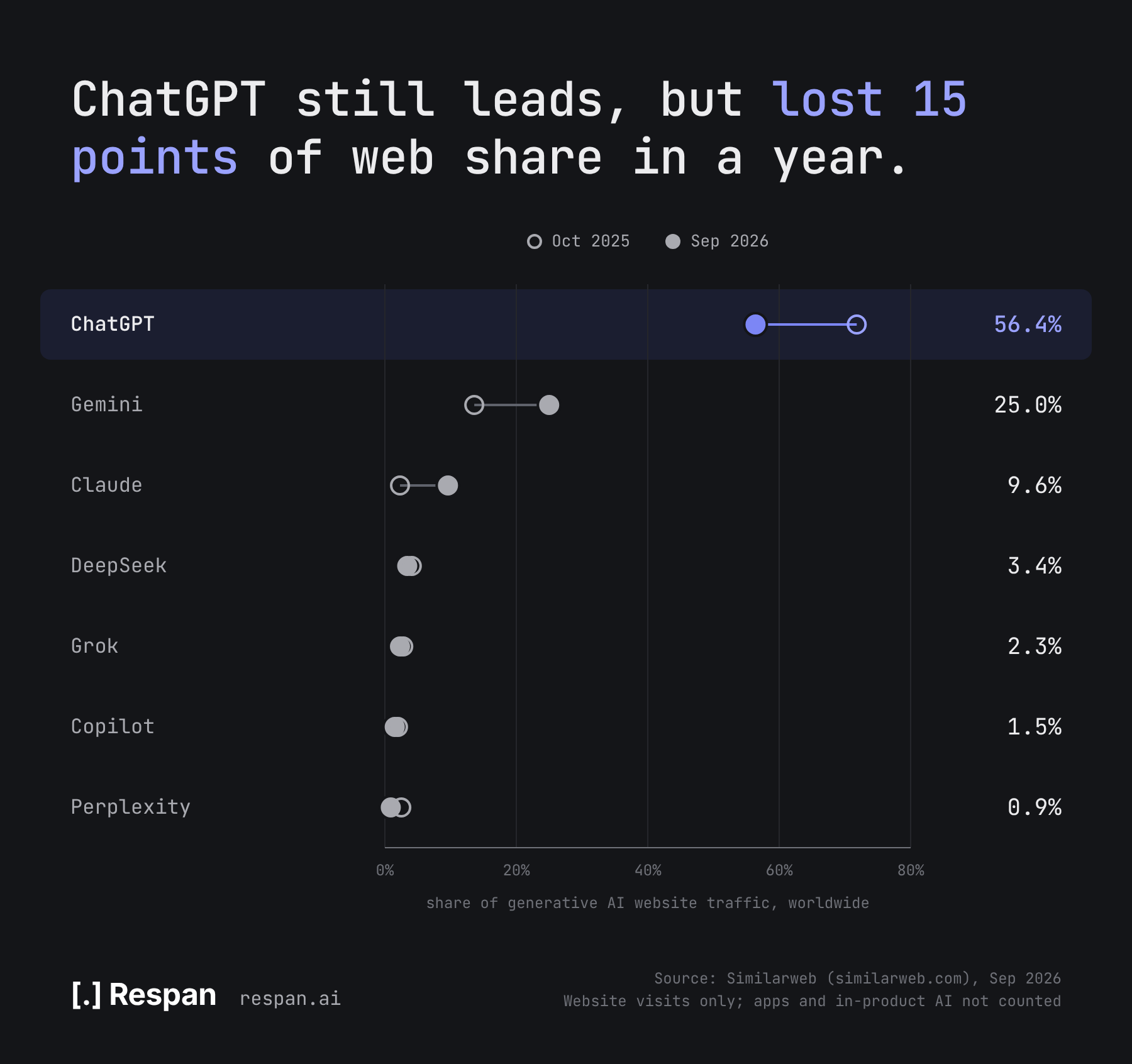
The lead has narrowed quickly. A year earlier ChatGPT held 71.8% and Gemini 13.6%, and over the same twelve months Claude went from 2.3% to 9.6%, while DeepSeek, Grok, Copilot, and Perplexity each lost ground.
Website visits leave a lot out. Gemini inside Google Search and Workspace, Grok inside X, and native mobile apps all sit outside the count. User counts fill part of the gap: Google says the Gemini app passed 1 billion monthly users in August 2026, and OpenAI said at the end of July that its products reach more than 1 billion active users, most of them through ChatGPT. Because the two companies count users differently, the figures can't be ranked against each other, and Anthropic hasn't published a user count for Claude.
Enterprise API spend
Enterprise spend tells a different story. In Menlo Ventures' 2026 State of Enterprise AI report, published November 3, Anthropic holds 55% of enterprise LLM API spend, up from 40% a year earlier. OpenAI is at 31%, and Google is down to 9%.
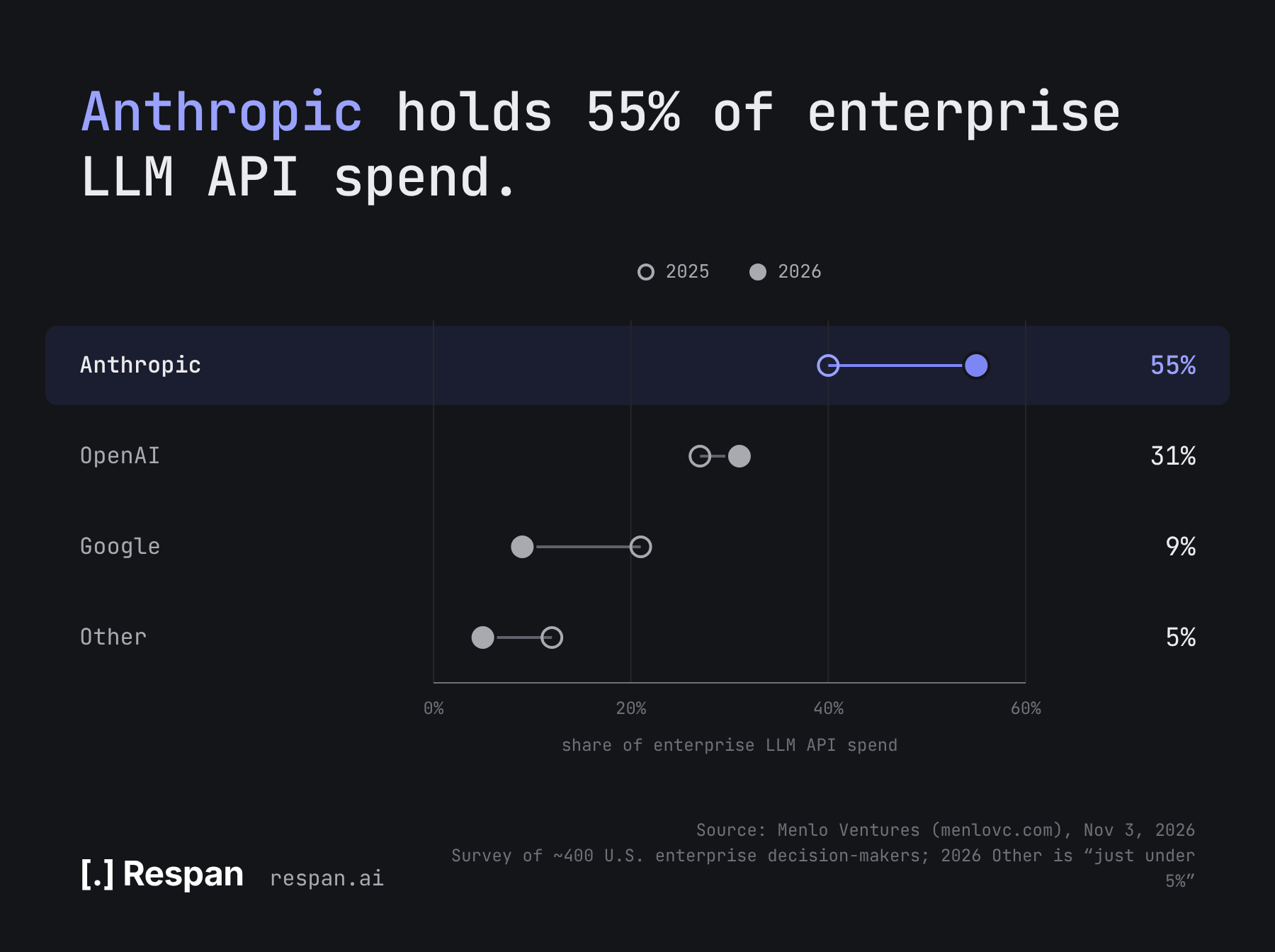
Together, Anthropic and OpenAI account for 86% of that spend, up from 67%. Models outside the top three, including Grok, Kimi, DeepSeek, and GLM, share just under 5%. The longer trend is just as sharp: OpenAI held about half of enterprise usage at the end of 2023, by Menlo's earlier count. Menlo surveyed nearly 400 U.S. enterprise decision-makers in September 2026 and estimates dollars from each model's share of production API usage, weighted by spend.
Transaction data points the same way, by a narrower margin. The Ramp AI Index, built from card and bill-pay data at more than 85,000 U.S. businesses, shows 43.8% of businesses paying Anthropic in September 2026 against 40.6% paying OpenAI. OpenAI gained faster that month, up 1.1 points against Anthropic's 0.2.
Ramp also tracks token spend in a smaller sample of businesses, and the split there is wider: Anthropic took 60.1% in the week ending October 11, OpenAI 36.4%, and Google 1.2%. Spend share and token share rarely match, since per-token prices vary by lab and by model, which is why OpenAI vs Anthropic pricing can shift a team's bill as much as the choice of lab does.
Developer API traffic
Developer traffic through API routers looks very different from the enterprise numbers. On OpenRouter, Chinese labs produced 69% of tokens in a mid-September week, and open-weight models 72%.
OpenRouter's rankings put DeepSeek V4.1 Flash 1017 first by tokens processed through November 9, at 55.4 trillion. That's more than the next three models combined, and seven of the top ten come from Chinese labs.
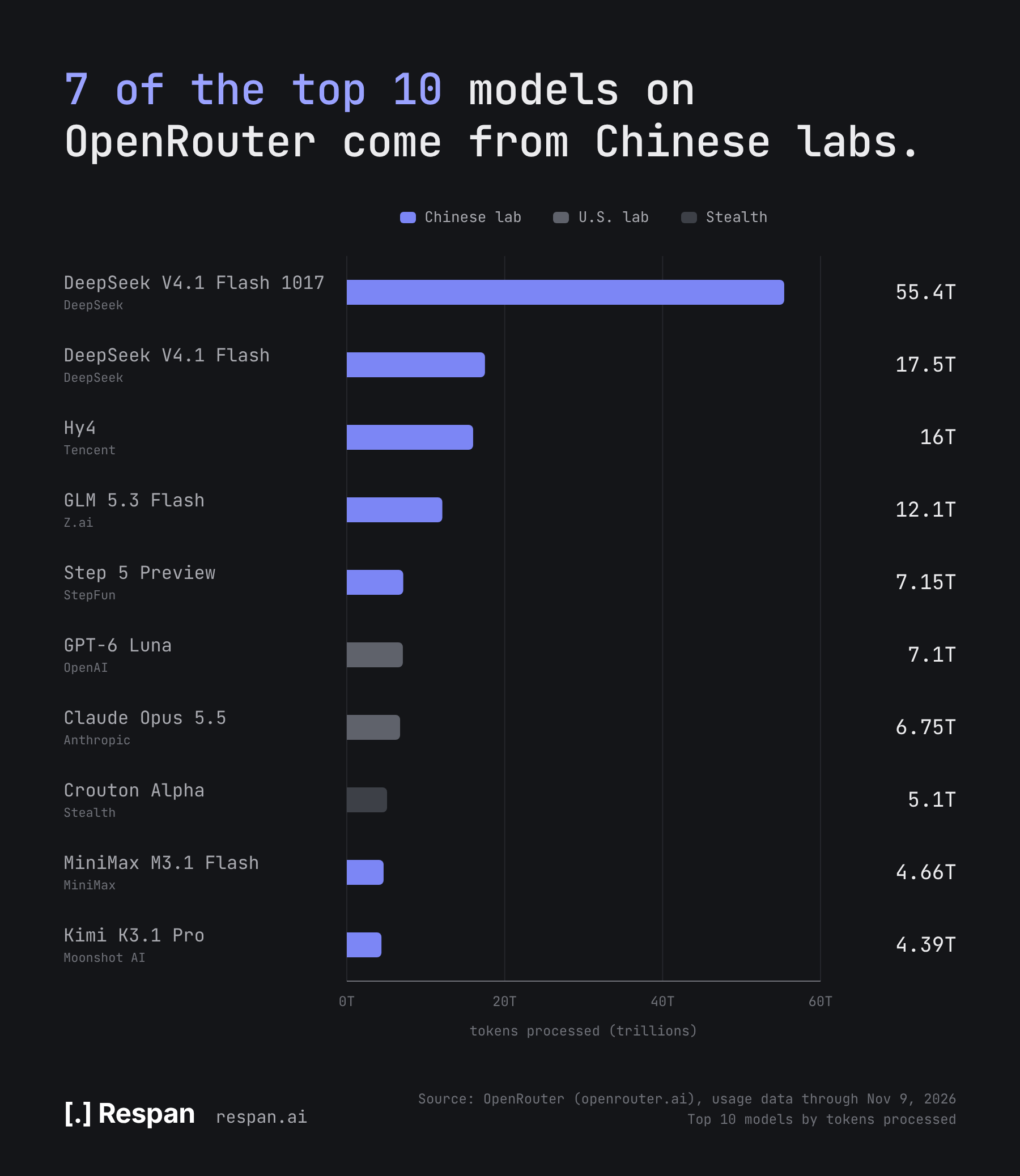
DeepSeek holds two of those slots with different V4.1 Flash versions, a split the best DeepSeek model comparison breaks down. Between the two largest U.S. labs, the balance on OpenRouter has also swung. In the first half of 2026, OpenAI took roughly a quarter of what OpenRouter users spent on OpenAI and Anthropic models combined, and by the week of September 7 it had just over half.
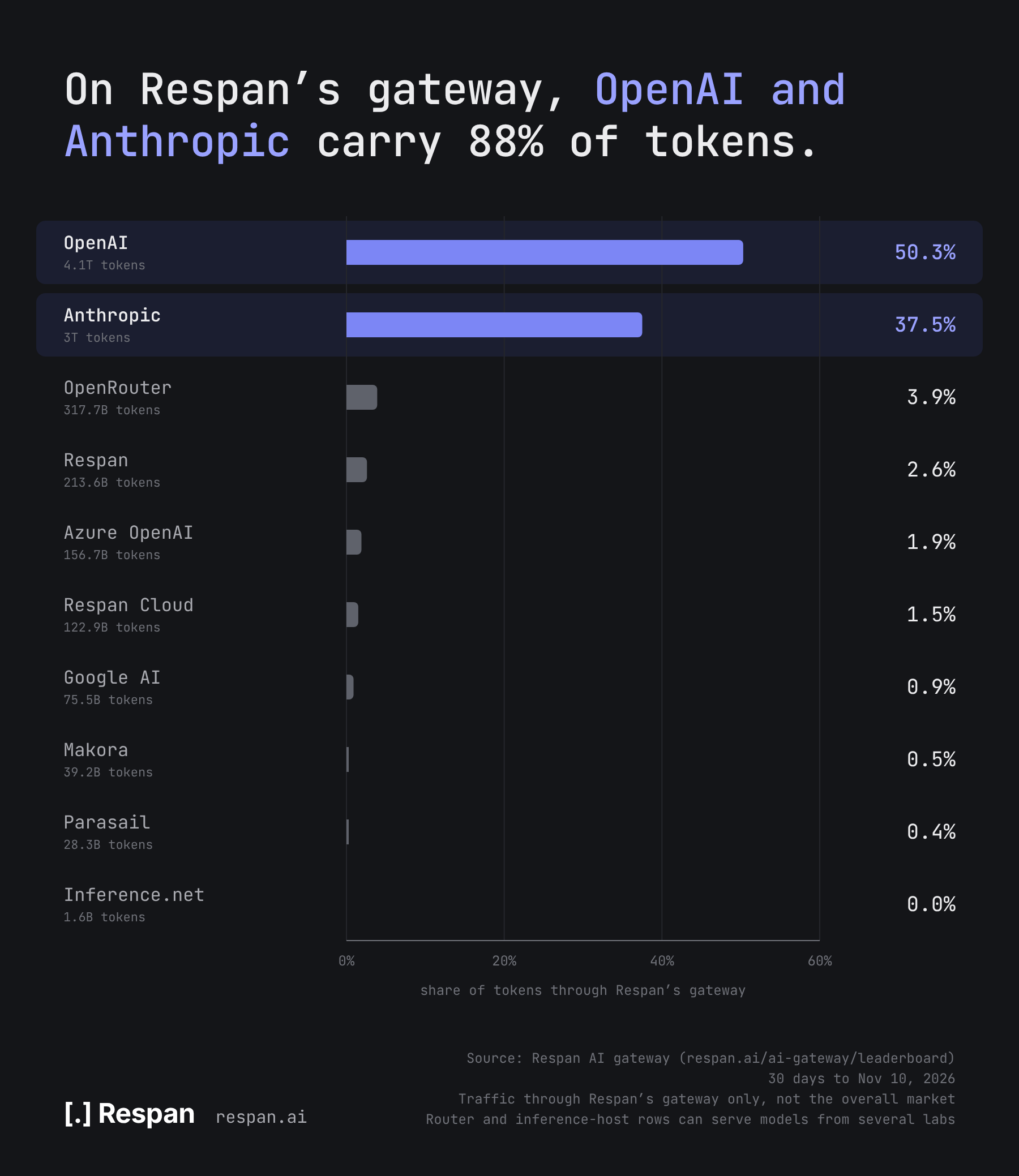
Who uses the platform shapes all of this, since Menlo notes that OpenRouter users skew toward individual developers and startups. On Respan's AI gateway, whose traffic reflects the teams that route through Respan, the split over the 30 days to November 10 ran the other way: OpenAI carried 50.3% of tokens and Anthropic 37.5%, a split that Respan's LLM leaderboard updates as traffic shifts.
Coding
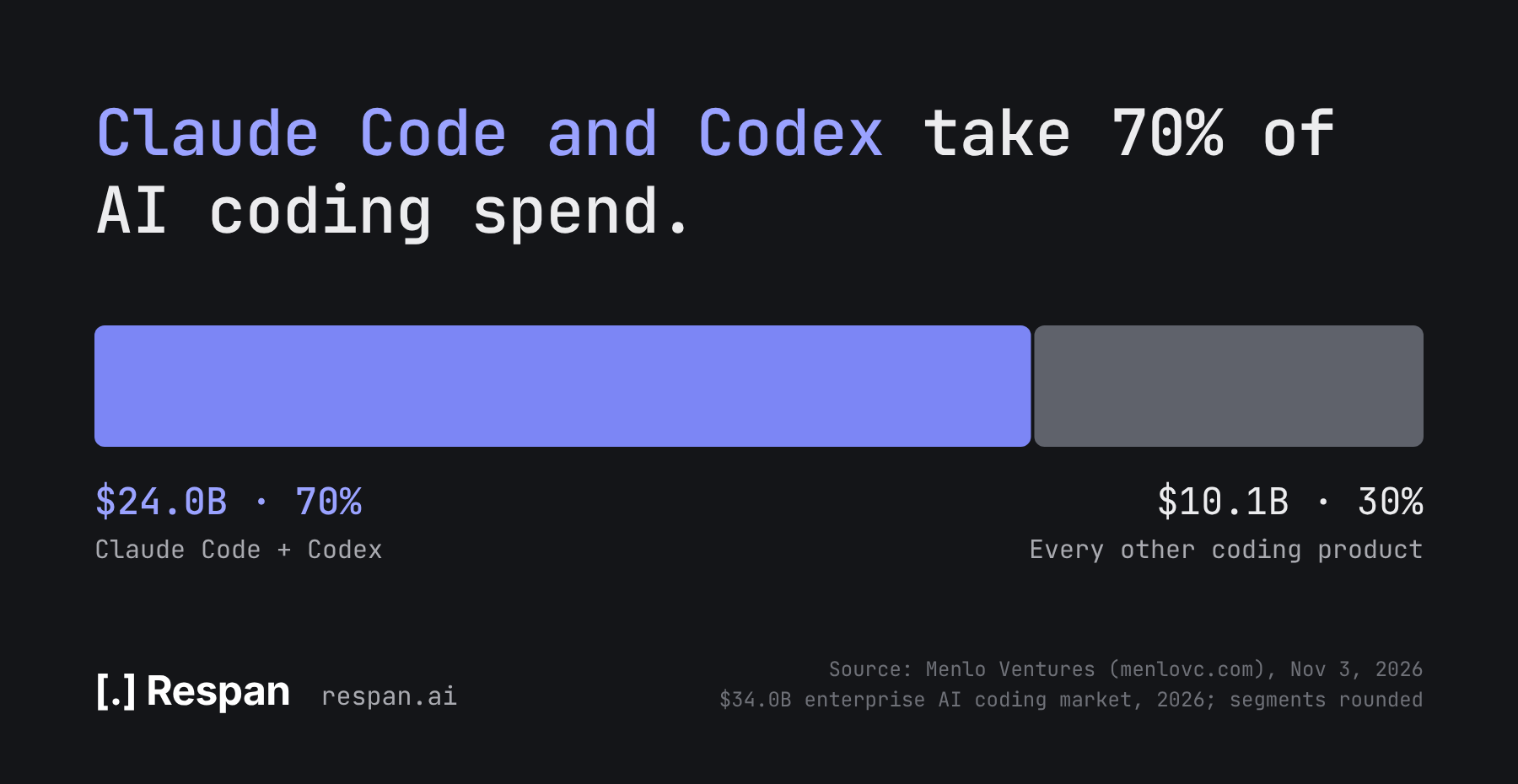
Coding is where spend concentrates. Menlo sizes the enterprise AI coding market at $34.0 billion in 2026, and Anthropic's Claude Code and OpenAI's Codex take $24.0 billion of it, or 70%. The remaining $10.1 billion grew 2.9x over the year.
Menlo doesn't split the coding figure between the two labs, and developer survey data doesn't settle it either. In Stack Overflow's 2026 Developer Survey, 74.6% of respondents to the survey's AI model question selected Anthropic and 74.3% selected OpenAI. Google came in at 54.5%, DeepSeek at 18.9%, and Alibaba's Qwen at 10.1%.
On quality, Anthropic holds the top two spots in Respan's ranking of the best LLM for coding. That ranking uses the Respan Index coding score, a 0-100 composite of public coding benchmarks, and puts Claude Sonnet 5.5 at 79.6 and Claude Opus 5.5 at 68.3. Moonshot AI's Kimi K3.1 Pro sits third at 67.8.
Open-weight vs closed models
Open-weight models win on volume and lose on dollars, and the gap shows up in both datasets that report each. Menlo puts open-weight models at 19% of enterprise tokens in 2026, up from 11%, but only 4% of spend, down from 6%. On OpenRouter, open-weight models carried 72% of tokens in mid-September, while closed models still took 73% of spend.
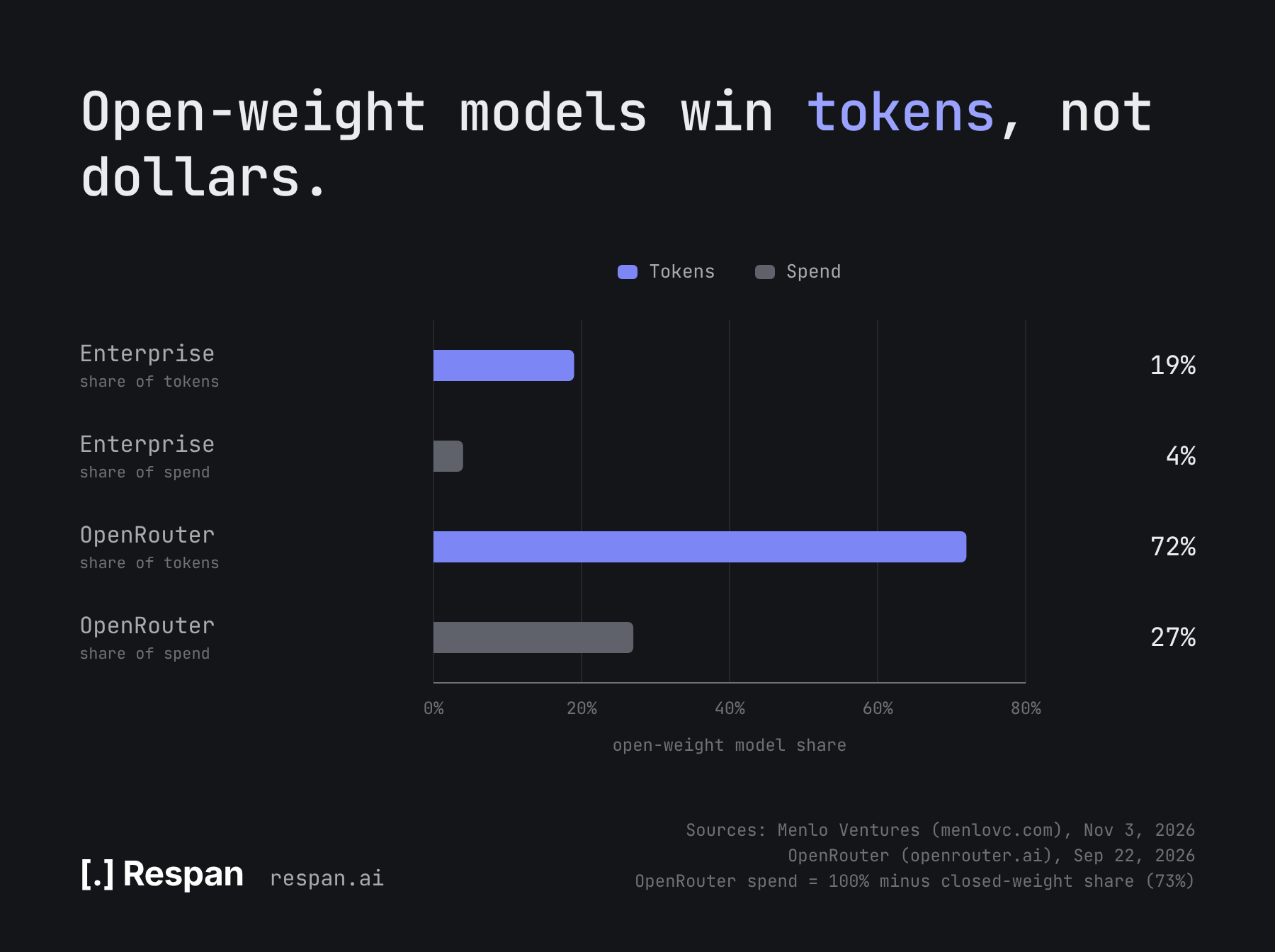
Chinese labs make up most of the open-weight side. On OpenRouter they produced 69% of tokens in the same week open-weight models produced 72%, and in Menlo's data Chinese models take 89% of enterprise open-source spend, led by Kimi at 61%, then DeepSeek at 15%, GLM at 11%, and Qwen at 3%.
The quality gap that once justified paying for closed models has also narrowed. Moonshot AI released the weights for Kimi K3.1 Pro on November 4, and it scores 70.9 on the overall Respan Index against 74.1 for Claude Opus 5.5, the top closed model. Running any of the open weight models yourself still depends on the license and your hardware, which is part of why so much of their usage goes through hosted APIs.
Why LLM market share numbers disagree
Each source counts a different unit, and each sees a different slice of the market. Similarweb counts website visits, Menlo estimates enterprise dollars from a survey, and Ramp counts businesses with a paid AI transaction. OpenRouter and Respan count tokens through their own routers.
Google shows how far apart the results can land. Gemini holds 25.0% of generative AI web traffic, yet Google has 9% of enterprise LLM API spend in Menlo's survey, 1.2% of token spend in Ramp's sample, and 0.9% of tokens on Respan's gateway. Much of Gemini's use likely happens inside Search and Workspace, which none of these API counts capture.
Who publishes the data matters too. Menlo Ventures is an investor in both Anthropic and OpenRouter, and Respan's gateway reflects the teams that chose to route through Respan. Neither fact makes the numbers wrong, but each source is one window onto the market, so the clearest picture comes from reading several side by side.
Key takeaways
Read together, the categories describe a market where the leader depends on what you measure, and where positions change within months.
- The leader depends on the metric - OpenAI leads consumer web traffic. Anthropic leads enterprise API spend and the share of U.S. businesses paying for AI, and a DeepSeek model carries the most tokens on OpenRouter.
- Share moves fast - Anthropic's share of enterprise LLM API use was 12% in 2023 by Menlo's count, and in 2026 it holds 55% of spend. Google fell from 21% to 9% in a single year.
- Share doesn't track benchmark scores - On Respan's LLM benchmarks, Gemini 4 Argon scores 69.6, inside the top ten, while Google holds 9% of enterprise API spend. Kimi K3.1 Pro scores 70.9, while open-weight models take 4% of enterprise spend.
- Tokens and dollars split - Cheaper open-weight models win volume on developer platforms, while closed frontier models keep most of the budget.
For a team building on LLMs, the practical read is that the right model for a given task can change faster than a vendor contract does. Comparing the best LLM APIs and the current frontier AI models on your own workload tells you more than a share chart can.
Route across every provider with Respan
Every figure above moved in the last year, and several moved by double digits. If your app is wired to one provider's SDK, each shift turns into an engineering project, whether it's a cheaper open-weight release or an outage at the provider you depend on.
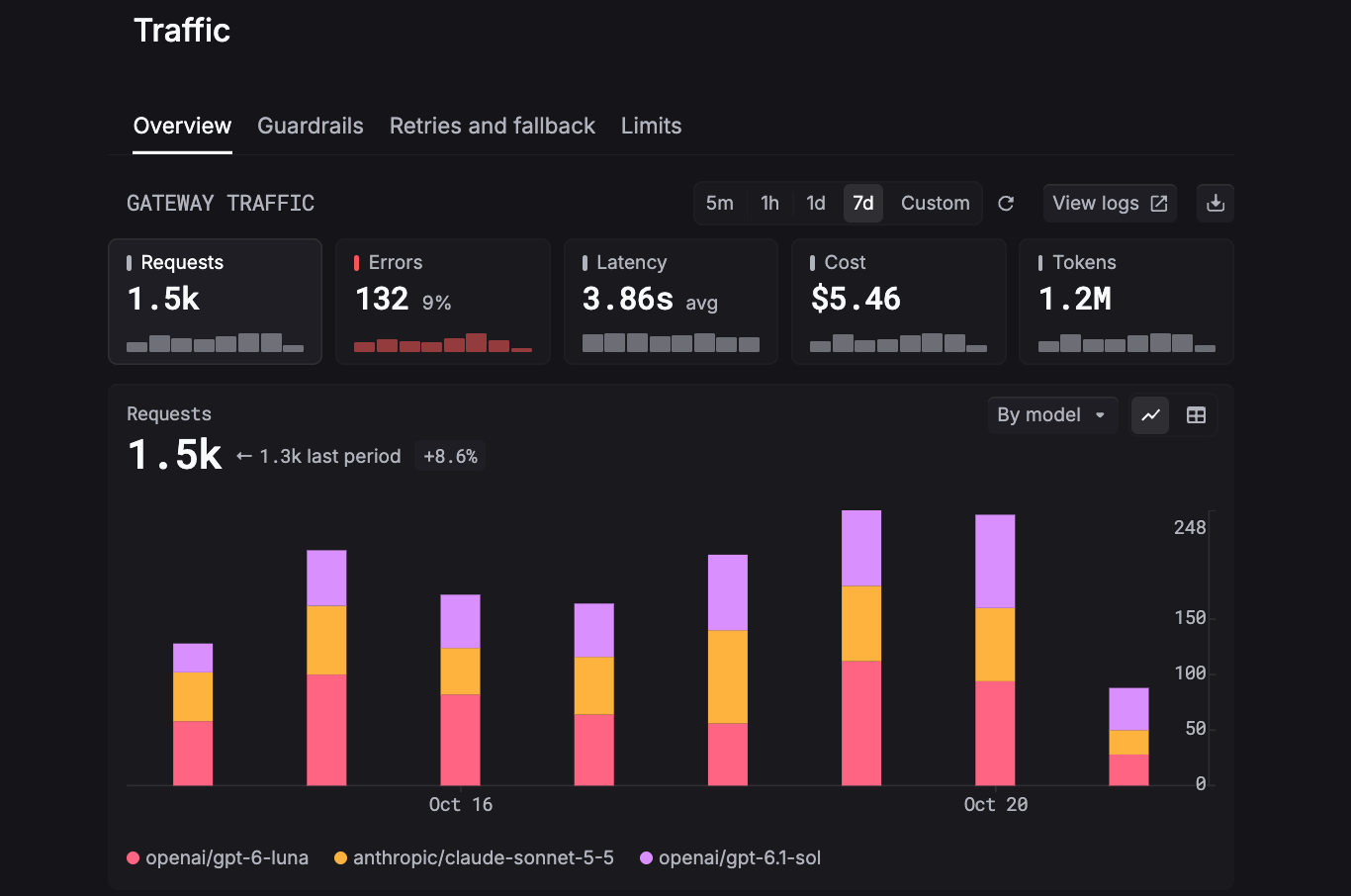
Respan is the AI router with built-in observability and automated evals. Route, observe, and evaluate every LLM call: requests go through one API to 1,000+ models, and every request is traced, priced, and scored in the same place. That lets you switch providers based on your own traffic.
- One API for 1,000+ models - Respan's AI gateway reaches every major provider through one endpoint, so switching models means changing a single word.
- Fallbacks when a provider fails - List the models to fall back to once, and Respan moves to the next the moment one errors or rate-limits.
- Cost by model, request, and customer - See where spend goes as you shift traffic, with monitors and hard spend limits to keep it in bounds.
- Evals before and after a switch - Score a candidate model on a dataset built from real requests before you move traffic, then keep scoring it on live production traffic after.
- Respan Router (beta, on request) - Set the model to
span-router, and Respan picks the model for each task, weighing cache cost before it switches.
Respan is free to start. You can route a slice of traffic to a new model and compare it against your current one before the next share shift shows up in your bill.
FAQ
Who has the largest LLM market share?
It depends on the measure. OpenAI's ChatGPT has the largest consumer share, at 56.4% of generative AI web traffic in September 2026. Anthropic has the largest share of enterprise LLM API spend at 55%, and DeepSeek V4.1 Flash 1017 is the most-used model by tokens on OpenRouter.
Is ChatGPT losing market share?
ChatGPT's share of generative AI web traffic is falling, from 71.8% in October 2025 to 56.4% in September 2026, but its audience is still growing, with OpenAI reporting more than 1 billion active users across its products at the end of July 2026. OpenAI's enterprise share also rose, from 27% to 31% of API spend, and OpenAI carries the most tokens on Respan's gateway, spread across the models in the GPT models comparison.
What is Claude's market share?
Claude's share ranges from 9.6% of generative AI web traffic to 55% of enterprise LLM API spend. Anthropic is also the provider the most U.S. businesses pay, at 43.8% in Ramp's September data, and it carries 37.5% of tokens on Respan's gateway. Most of that enterprise spend goes to the models in the best Claude model lineup, led by Opus 5.5 and Sonnet 5.5 on the Respan Index.
What is Gemini's market share?
Gemini holds 25.0% of generative AI web traffic, and the Gemini app passed 1 billion monthly users in August 2026. Google's share of enterprise LLM API spend is 9%, down from 21% a year earlier, even though Gemini 4 Argon ranks inside the top ten on the Respan Index. The best Gemini model comparison covers where each model in Google's lineup fits.
How big is the LLM market?
Menlo Ventures estimates that enterprise AI deployment spend reached $176.8 billion by September 2026, up 5.4x from $33 billion in 2025. That figure covers more than LLM APIs, and Menlo puts Anthropic, OpenAI, and Google at 69% of it, up from 50% a year earlier.