OpenAI has released two generations of GPT models since July, and GPT-6.1 Terra's launch on October 26 left four current tiers in the API at once: Astra, Sol, Terra, and Luna. Several older models are still running in production alongside them, with shutdown dates spread across the next five months.
More tiers would be easy to sort if the scores spread out with the prices, but they don't. The two cheaper upper tiers land within three points of the flagship on benchmarks, and the names in ChatGPT don't line up with the model IDs you call through the API, so "GPT-6" can mean a different model depending on where you use it.
For most apps, the right answer is a different GPT model for each step, at an effort setting that matches the work, because cost per task moves more with those two choices than with the per-token price.
Here's a GPT models comparison for 2026 with every current model's benchmark scores, pricing, and cost per task, and the best ChatGPT model for each kind of work.
TL;DR: GPT models comparison
GPT-6 Astra tops the lineup, but the gap to the next two tiers is small enough that price decides most of the choice.
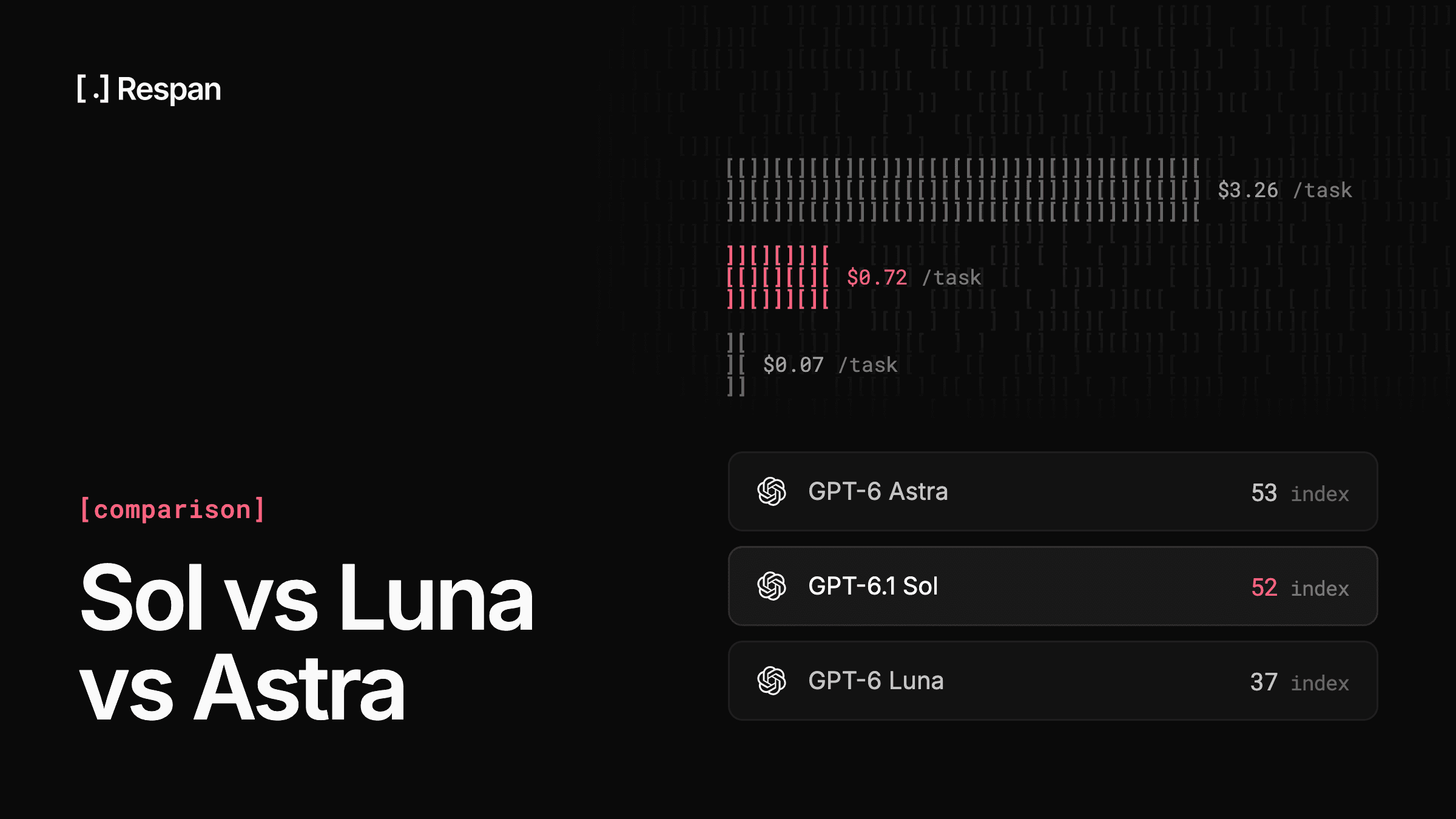
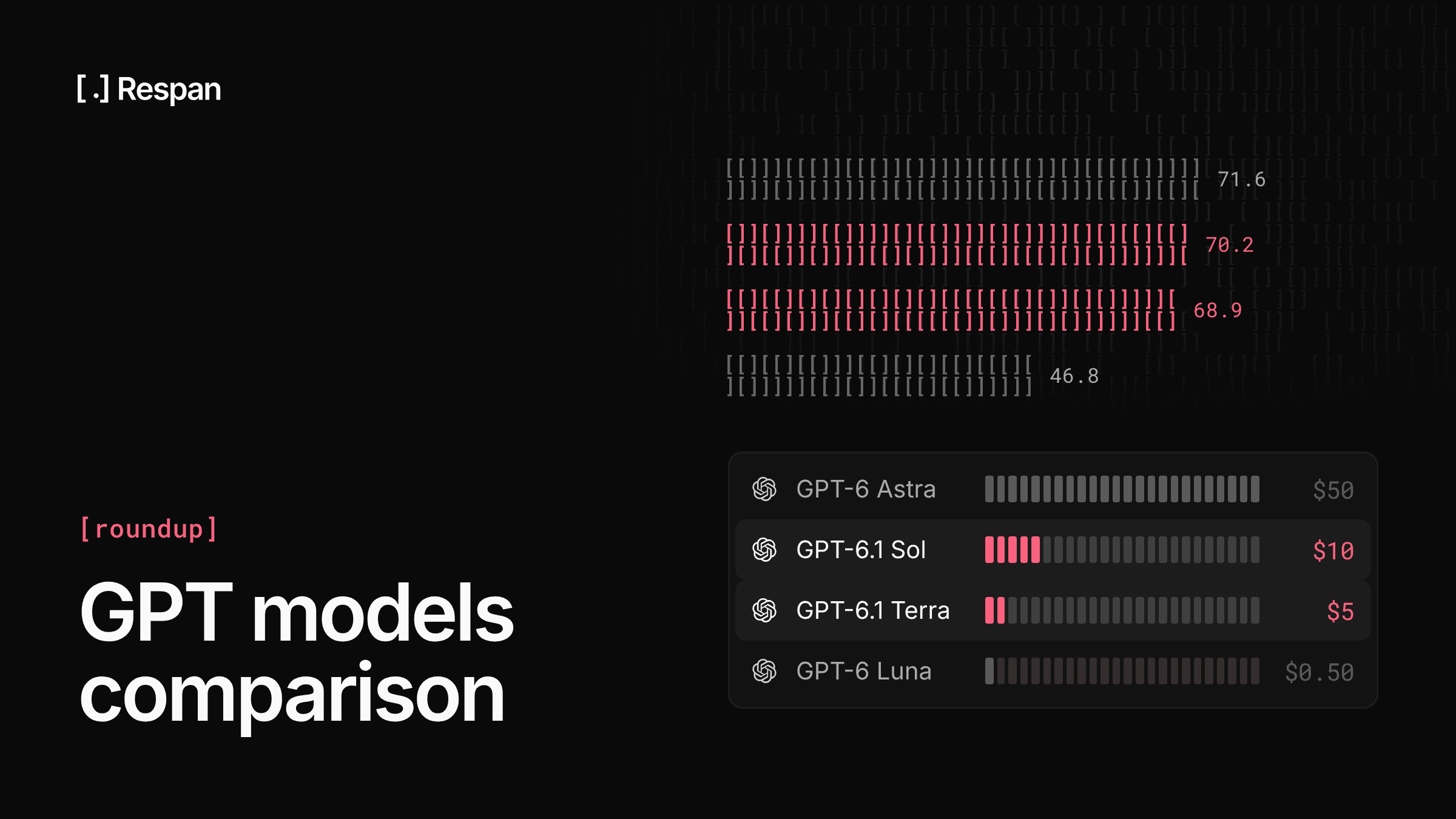
- Highest scoring - GPT-6 Astra (71.6 on the Respan Index), with the top agents and knowledge scores of any GPT model.
- Best default for the API - GPT-6.1 Sol (70.2), 1.4 points behind Astra at a fifth of the price, with the highest reasoning score in the lineup.
- Agent and coding steps at volume - GPT-6.1 Terra (68.9), with the top GPT coding score and an agents score just behind Astra's at a tenth of its price.
- Cheapest - GPT-6 Luna (46.8), for simple, high-volume steps like classification and extraction.
- Best in the ChatGPT app - GPT-6 Pro, which runs on Astra and comes with Pro, Business, and Enterprise plans.
Older models like GPT-6 Sol and the GPT-5.6 tiers still work, but they score lower and cost the same or more than the current lineup.
New OpenAI models in 2026
OpenAI's text model releases this year came in two waves. The GPT-5.6 family arrived July 9 with Sol, Terra, and Luna as capability tiers, followed by GPT-6 Astra on September 3, GPT-6 Sol and Luna on September 22, GPT-6.1 Sol on September 29, and GPT-6.1 Terra on October 26. GPT-5.6 Cyber also launched over the summer, restricted to organizations OpenAI approves through its Daybreak program.
In ChatGPT, GPT-6 Sol and Luna replaced the GPT-5.6 models in the Chat tab starting October 7, while GPT-6.1 Sol and Terra are limited to the Work tab and Codex. Outside of text, OpenAI shipped GPT Image 2 and 2.5, new realtime and audio models, and GPT-Live 1, while Sora 2 and the Videos API shut down September 24. Across labs, GPT-6 Astra and GPT-6.1 Sol both sit in the top 10 of the current frontier AI models, with Astra third behind Anthropic's Claude Opus 5.5 and Sonnet 5.5.
The next flagship is less certain. OpenAI shelved GPT-6.1 Astra in late September after it failed internal alignment tests, and it hasn't given a new date for it.
All GPT models compared
OpenAI's lineup includes four current GPT models, four previous-generation models still in the API, and two open-weight models you run yourself.
Comparison criteria
Each model is scored with its Respan Index benchmark scores, which group public benchmarks and lab-reported results into coding, agents, reasoning, knowledge, and human preference scores, then blend them into one overall number. Cost per task comes from Artificial Analysis, which measures what each model costs to complete an average task on its Intelligence Index at max effort, including the reasoning tokens a per-token price doesn't show.
| Model | Respan Index | Coding | Agents | Reasoning | Price (in / out per 1M, over 272K) | Cost per task | Context |
|---|---|---|---|---|---|---|---|
| GPT-6 Astra | 71.6 | 56.7 | 77.6 | 85.8 | $10 / $50 ($20 / $75) | $6.24 | 1.05M |
| GPT-6.1 Sol | 70.2 | 55.0 | 73.0 | 87.2 | $2 / $10 ($4 / $15) | $1.27 | 1.05M |
| GPT-6.1 Terra | 68.9 | 57.9 | 76.9 | 83.0 | $1 / $5 ($2 / $7.50) | $0.96 | 1.05M |
| GPT-6 Luna | 46.8 | 30.4 | 60.3 | 48.4 | $0.10 / $0.50 ($0.20 / $0.75) | $0.15 | 1.05M |
| gpt-oss-120b | 16.5 | 7.1 | 7.5 | 23.0 | Not hosted by OpenAI | Not published | 131K |
| gpt-oss-20b | 13.6 | 5.0 | 7.9* | 18.3 | Not hosted by OpenAI | Not published | 131K |
| GPT-6 Sol | 64.7 | 51.8 | 70.9 | 77.0 | $2 / $10 ($4 / $15) | Not published | 1.05M |
| GPT-5.6 Sol | 61.7 | 41.3 | 67.9 | 76.0 | $4 / $20 ($8 / $30) | Not published | 1.05M |
| GPT-5.6 Terra | 55.3 | 37.9 | 62.5 | 70.5 | $2 / $12 ($4 / $18) | Not published | 1.05M |
| GPT-5.6 Luna | 46.0 | 27.8 | 55.2 | 53.8 | $0.20 / $1.20 ($0.40 / $1.80) | Not published | 1.05M |
*Estimated score. Cost per task is at max effort.
GPT-6 Astra
GPT-6 Astra is OpenAI's flagship, released September 3, and its Respan Index score of 71.6 is the highest of any GPT model, carried by agents at 77.6 and knowledge at 75.6. Artificial Analysis also puts it at the top of the GPT lineup, at 57 on its Intelligence Index at max effort.
What you pay for that lead is steep. At $10 / $50 per 1M tokens, Astra costs five times what GPT-6.1 Sol does for 1.4 more points, and it averages $6.24 per task at max effort against Sol's $1.27. It also drops a few API options teams may rely on, since it has no temperature, top_p, or logprobs, and its fast mode doesn't offer EU data residency. That makes it a better fit as the model you escalate to than a default.
- Benchmark scores: 71.6 overall · Coding 56.7 · Agents 77.6 · Reasoning 85.8 · Knowledge 75.6 · Preference 60.3
- Pricing: $10 / $50 per 1M input / output, $1 cached input, $20 / $75 over 272K input tokens
- Context: 1.05M tokens, 128K output
- Limits: No fine-tuning, no
noneeffort, tool calling through the Responses API only - Route it for: High-stakes reasoning and knowledge work where a wrong answer costs more than the tokens
GPT-6.1 Sol
OpenAI's September 29 upgrade to Sol, GPT-6.1 Sol, scores 70.2, and its reasoning score of 87.2 is the highest in the GPT lineup, enough to put it among the best reasoning models from any lab. Coding at 55.0 is its weakest category.
At $2 / $10 it costs a fifth of Astra, and on Artificial Analysis it matches Astra at high effort (55) while costing $1.27 per task against Astra's $3.24. OpenAI uses it as the default in its Codex configuration examples, and it replaced GPT-5.5 in Codex for ChatGPT-signed-in users on October 14. In ChatGPT itself, though, it's only in the Work tab and Codex, not the main Chat tab.
- Benchmark scores: 70.2 overall · Coding 55.0 · Agents 73.0 · Reasoning 87.2 · Knowledge 74.4 · Preference 59.8
- Pricing: $2 / $10 per 1M input / output, $0.10 cached input, $4 / $15 over 272K input tokens
- Context: 1.05M tokens, 128K output
- Limits: No fine-tuning, effort from low to max with no
noneoption, tool calling through the Responses API only - Route it for: The default for reasoning, analysis, and most API traffic
GPT-6.1 Terra
Released October 26, GPT-6.1 Terra scores 68.9, 1.3 points behind 6.1 Sol at half the price. Its coding score of 57.9 is the highest of any GPT model on the Respan Index and its agents score of 76.9 is nearly four points above Sol's, while a knowledge score of 57.4 trails Sol by 17 points and accounts for most of the gap between them.
Terra supports none effort, unlike Astra and 6.1 Sol, so one model ID can cover both non-reasoning and reasoning steps. The per-token discount shrinks at max effort, however, because Terra spends more output tokens there than Sol does. At max it costs $0.96 per task for a score of 51, while Sol at high effort scores 50 for $0.59, so Terra's savings show up mainly at lower effort settings.
- Benchmark scores: 68.9 overall · Coding 57.9 · Agents 76.9 · Reasoning 83.0 · Knowledge 57.4 · Preference 57.9
- Pricing: $1 / $5 per 1M input / output, $0.05 cached input, $2 / $7.50 over 272K input tokens
- Context: 1.05M tokens, 128K output
- Limits: No fine-tuning, tool calling through the Responses API only
- Route it for: Agent and coding steps at volume, where knowledge depth matters less
GPT-6 Luna
GPT-6 Luna is the cheapest current GPT model at $0.10 / $0.50 per 1M tokens, and it scores 46.8, less than a point above the GPT-5.6 Luna it replaced. Agents at 60.3 is its strongest category, while reasoning at 48.4 and knowledge at 38.9 make it a poor fit for steps where the model has to know or work out the answer.
Its cost advantage depends on how you run it. At low effort it costs about $0.01 per task, but at max effort it scores 28 for $0.15, while Terra at low effort scores 29 for $0.07. Luna works best with reasoning set low or off, on simple steps that run at high volume, which is the same tradeoff Claude Haiku 5.5 vs GPT-6 Luna weighs against Anthropic's small model. It's also the named replacement for gpt-4o, gpt-4o-mini, gpt-4.1, and gpt-4.1-mini when they shut down January 14, 2027.
- Benchmark scores: 46.8 overall · Coding 30.4 · Agents 60.3 · Reasoning 48.4 · Knowledge 38.9 · Preference 54.5
- Pricing: $0.10 / $0.50 per 1M input / output, $0.01 cached input, $0.20 / $0.75 over 272K input tokens
- Context: 1.05M tokens, 128K output
- Limits: No fine-tuning, function calling in Chat Completions only at
noneeffort - Route it for: Classification, extraction, and other simple steps at high volume
gpt-oss-120b and gpt-oss-20b
gpt-oss-120b and gpt-oss-20b are OpenAI's open-weight models, released in August 2025 under the Apache 2.0 license, and they're the GPT models you can run on your own hardware. The 120b model has 117B total parameters with 5.1B active, and the 20b model has 21B total with 3.6B active.
They score 16.5 and 13.6 on the Respan Index, far below the hosted lineup, with a June 2024 knowledge cutoff, text-only input, and a 131K context window. OpenAI's docs list no API price or rate limits for either, so in practice you run them yourself or through another provider. For teams that need weights they control, the comparison that matters is against other best open-source LLMs rather than GPT-6, because open weights and hosted APIs are different types of AI models, with different tradeoffs on cost, control, and maintenance.
- Benchmark scores: gpt-oss-120b 16.5 overall · Coding 7.1 · Agents 7.5 · Reasoning 23.0 · gpt-oss-20b 13.6 overall · Coding 5.0 · Agents 7.9 (estimated) · Reasoning 18.3
- Pricing: Not hosted by OpenAI, so cost depends on your provider or infrastructure
- Context: 131K tokens, 131K output
- Limits: Text only, effort from low to high, June 2024 knowledge cutoff
- Route it for: Self-hosted workloads where data control outweighs benchmark scores
Previous-generation GPT models
GPT-6 Sol shipped September 22 and was superseded a week later by 6.1 Sol, which lists at the same $2 / $10 but halves the cached-input rate and scores 5.5 points higher. GPT-6 Sol still supports none effort, which 6.1 Sol dropped, and it's the model behind ChatGPT's Chat tab for Plus users and above. It's also the named replacement for gpt-5.1 and gpt-5.3-codex.
The GPT-5.6 family, released July 9, scores lower than its GPT-6 counterparts and costs more at every tier. GPT-5.6 Sol's $4 / $20 price is a promotion OpenAI lists as running at least through November 21, 2026, down from $5 / $30, so it may go back up. Even at the promotional price, GPT-6.1 Terra scores 7.2 points higher for a quarter of the cost, which leaves little reason to start new work on the 5.6 models.
- GPT-6 Sol: 64.7 overall · Coding 51.8 · Agents 70.9 · Reasoning 77.0 · $2 / $10, $0.20 cached
- GPT-5.6 Sol: 61.7 overall · Coding 41.3 · Agents 67.9 · Reasoning 76.0 · $4 / $20 (promotional)
- GPT-5.6 Terra: 55.3 overall · Coding 37.9 · Agents 62.5 · Reasoning 70.5 · $2 / $12
- GPT-5.6 Luna: 46.0 overall · Coding 27.8 · Agents 55.2 · Reasoning 53.8 · $0.20 / $1.20
- Context: 1.05M tokens and 128K output for all four
- Route it for: Existing workloads while you migrate to the GPT-6 lineup
GPT model shutdown dates and replacements
OpenAI announces retirements on its deprecations page, and three batches of text models are scheduled to shut down over the next five months.
| Shutdown date | Models | Replacement |
|---|---|---|
| December 11, 2026 | gpt-5, o3 | gpt-5.6-sol |
| December 11, 2026 | gpt-5-mini | gpt-5.6-terra |
| December 11, 2026 | gpt-5-nano | gpt-5.6-luna |
| December 11, 2026 | gpt-5-pro, o3-pro | gpt-5.6-sol with pro reasoning mode |
| January 14, 2027 | gpt-4o, gpt-4o-mini, gpt-4.1, gpt-4.1-mini | gpt-6-luna |
| April 1, 2027 | gpt-5.1, gpt-5.3-codex | gpt-6-sol |
| April 1, 2027 | gpt-5.4-nano | gpt-6-luna |
The December replacements point to the GPT-5.6 models, which are themselves a generation behind, so a team migrating off gpt-5 may end up migrating twice. OpenAI is also shutting down its Evals, Agent Builder, and the /v1/prompts endpoint on November 30, 2026, and it's winding down self-serve OpenAI fine-tuning, with new jobs ending January 6, 2027. None of the GPT-6 models support fine-tuning.
What is the best ChatGPT model? Which to use
The answer depends on whether you're picking a model in the ChatGPT app or calling one through the API, since the two don't offer the same models.
Best GPT model in the ChatGPT app
In ChatGPT's main Chat tab, Free and Go users get GPT-6 Luna and Plus users and above get GPT-6 Sol, with effort options from Instant up to Extra High. The strongest option in the app is GPT-6 Pro, which runs on GPT-6 Astra and comes with Pro, Business, and Enterprise plans.
The newer GPT-6.1 Sol and Terra are only in the Work tab and Codex, where Plus users and above can pick them alongside Luna, and Plus also gets Astra there. For most heavy work in the app, 6.1 Sol in the Work tab is the better daily choice, with GPT-6 Pro reserved for the problems that need it.
Best GPT model for the API
For API traffic, GPT-6.1 Sol is the default for most steps, with Astra as the escalation tier and Terra for agent and coding steps that run at volume. GPT-6 Luna covers simple steps, and steps that only need a typed answer, like a yes or no, a category, or a score, can go to Span-02, Respan's decision model, at about $0.01 per 1M input tokens. That's a narrower job than a general LLM does, and it's the case for using AI decision models on routing and classification steps instead of a chat model.
Two pricing rules apply to every current GPT model on OpenAI's pricing. Requests over 272K input tokens bill the whole request at 2x input and 1.5x output, which an agent with a growing context can cross without warning, and Batch and Flex processing cost half of standard rates for work that can wait. Every GPT-6 model is also available on Microsoft Foundry, which gives you a second quota pool if you're hitting OpenAI API rate limits on your current tier, though Azure OpenAI pricing varies by deployment type.
Effort levels and cost per task
Effort level can change a GPT model's cost and score as much as the choice of model does, because reasoning tokens bill as output.
| Model | Max effort | High effort | Low effort |
|---|---|---|---|
| GPT-6 Astra | 57 at $6.24 | 55 at $3.24 | 43 at $1.42 |
| GPT-6.1 Sol | 55 at $1.27 | 50 at $0.59 | 35 at $0.16 |
| GPT-6.1 Terra | 51 at $0.96 | 42 at $0.26 | 29 at $0.07 |
| GPT-6 Luna | 28 at $0.15 | 21 at $0.07 | 10 at $0.01 |
*Artificial Analysis Intelligence Index score and cost per task.
A few results stand out for routing. GPT-6.1 Sol at max effort matches Astra at high effort for under half the cost per task, and Sol at high effort comes within a point of Terra at max for less. At the low end, Terra at low effort outscores Luna at max for about half the cost. Neither direction wins every time, so test tier and effort together, and GPT-6.1 Sol vs Luna vs Astra breaks down how each tier performs at each setting.
ChatGPT model names vs API model names
The model you pick in ChatGPT and the model ID you call in the API don't always match:
- GPT-6 in ChatGPT - The Chat tab runs
gpt-6-sol, the September 22 release, while the API's current Sol isgpt-6.1-sol. - GPT-6 Pro - It isn't an API model. In the API, pro is a reasoning mode you set on a request with
reasoning.mode: "pro", billed at the model's standard rates with more tokens used. - Effort names - ChatGPT labels effort as Instant, Medium, High, Extra High, and Pro, while the API uses
none,low,medium,high,xhigh, andmax, depending on the model. - Context window - Codex and ChatGPT's Work tab default 6.1 Sol to a 500K context window with no long-context surcharge on subscriptions, while the API offers 1.05M and bills the 272K surcharge.
If you prototype in ChatGPT and then build on the API, test against the exact model ID and effort level you plan to ship, since the app's results may not carry over.
Compare and route GPT models with Respan
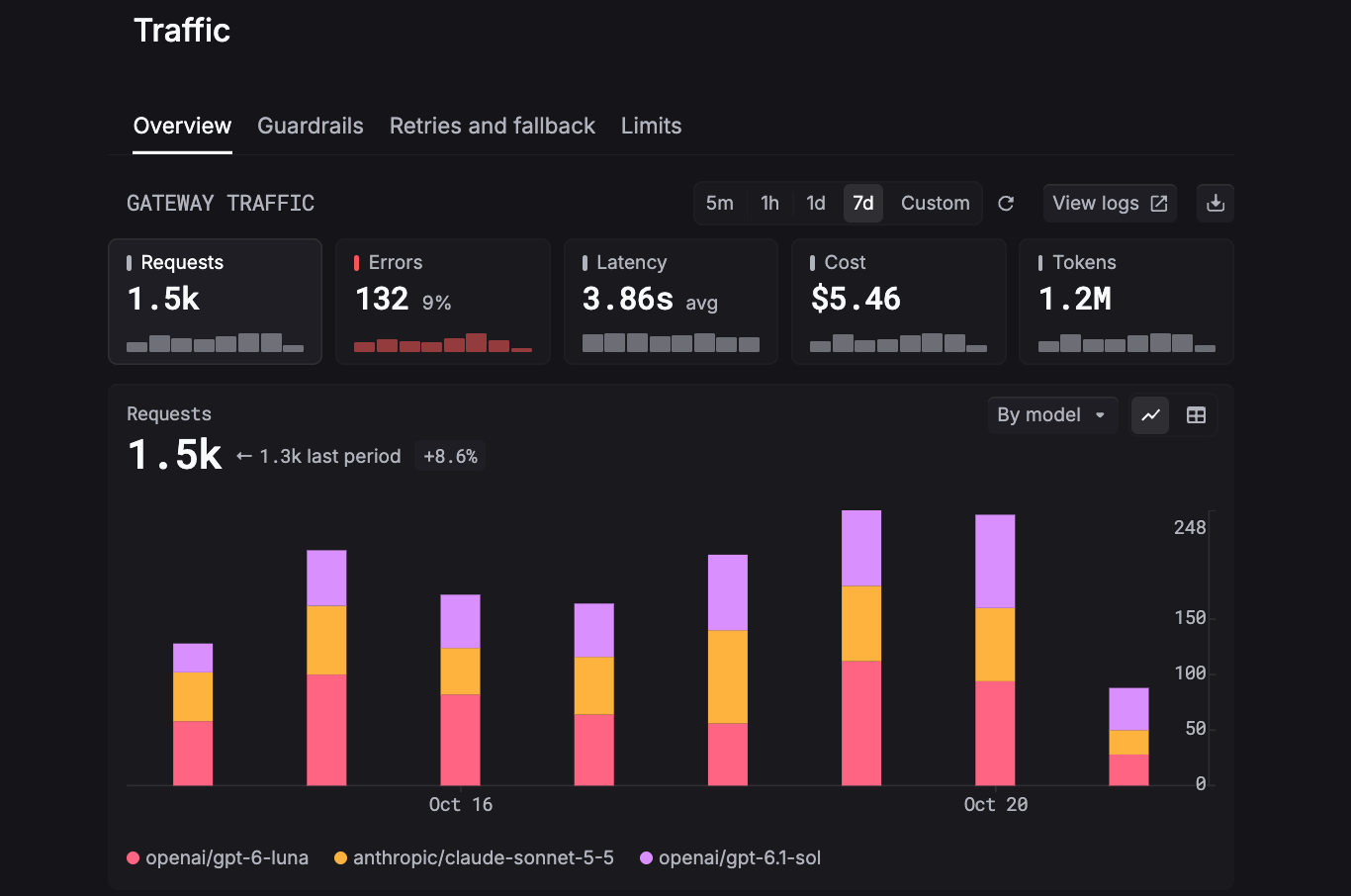
Choosing a GPT model per step only works if you can switch between them without rewriting code and measure what each one costs and returns on your own requests. The Respan AI gateway puts every GPT model behind one API, along with Claude, Gemini, and the rest of the market, and traces, prices, and scores every request in the same place.
- One API for 1,000+ models - Call GPT-6 Astra, 6.1 Sol, Terra, Luna, and models from other labs through one endpoint, and switch by changing the model name. Bring your own provider keys or use Respan credits.
- Fallback chains - Configure a chain once, and when a provider errors or rate-limits, the request moves to the next model in it.
- Cost on every request - Every call is logged as a span with latency and cost attached, broken down by model, so cost per task comes from your traffic instead of a benchmark average.
- Evals on live traffic - Score outputs with LLM judges, code checks, or human review, on a test set before you ship and on sampled production traffic after, which matters more with OpenAI's own Evals shutting down November 30.
- Prompt management - Version and test prompts across models in one place, with the /v1/prompts endpoint also going away on OpenAI's side.
- Span-02 for decision steps - Route yes-or-no, classification, and scoring steps to Respan's decision model through the same API you use for GPT.
- Spend limits - Set soft and hard caps per key, per customer, or org-wide, so a runaway agent stops at the ceiling instead of on your invoice.
With that in place, a model decision becomes something you test. Send a slice of real traffic to two GPT tiers or two effort levels, score both on your own cases, and move the rest once the numbers settle.
FAQ
What is the best GPT model for coding?
GPT-6.1 Sol is the best starting point for most coding work, with GPT-6 Astra for the hardest tasks. OpenAI's models page recommends Astra for complex coding, Codex's configuration examples default to 6.1 Sol, and GPT-6.1 Terra has the highest GPT coding score on the Respan Index (57.9) at $1 / $5 per 1M tokens. There are no GPT-6 Codex-specific models, and gpt-5.3-codex shuts down April 1, 2027.
Across labs, Claude Sonnet 5.5 scores 79.6 on coding, well above any GPT model, so it's worth testing alongside GPT on your own repository, and Codex vs Claude Code compares the two coding agents built on them. Respan lets you route the same coding requests to both and compare cost and output before you switch.
What is the smartest model in ChatGPT?
GPT-6 Pro, which runs on GPT-6 Astra, is the strongest model in ChatGPT, and it's available on Pro, Business, and Enterprise plans. In the API, Astra is OpenAI's top-scoring model, at 71.6 on the Respan Index and 57 on Artificial Analysis's Intelligence Index at max effort.
What is the cheapest GPT model?
GPT-6 Luna is the cheapest current GPT model at $0.10 / $0.50 per 1M tokens, with cached input at $0.01, and Batch processing halves those rates. On cost per task, though, GPT-6.1 Terra at low effort scores higher than Luna at max effort for about half the cost, so the cheapest setup depends on the effort level as well as the model. Respan's per-request cost tracking shows which combination is cheapest on your traffic, and reducing OpenAI API costs covers caching, batching, and other levers beyond model choice.