Anthropic released Claude Haiku 5.5 on October 7, a few weeks after OpenAI shipped GPT-6 Luna, and the two now sit at the same spot in each lineup: the cheap, fast model built for high-volume calls. They also launched at the same per-token price.
If you run extraction, classification, routing, or subagent steps at scale, that makes the choice between them a cost decision as much as a quality one, and an identical rate card doesn't mean an identical bill.
Haiku 5.5 is the stronger model on most shared benchmarks. Luna gets through the same work with far fewer output tokens and stays cheaper on long prompts, so the right pick depends on what each step needs.
That puts the Haiku vs Luna question on pricing beyond the sticker rate, and on which model to use for which job.
TL;DR: Haiku 5.5 vs GPT-6 Luna
Haiku 5.5 scores higher on most shared benchmarks, but Luna finishes the same task with about a third of the output tokens and costs less on long prompts, so use Haiku for agentic coding and reasoning-heavy steps and Luna for high-volume work where cost per task decides.
How the two compare on what should drive the decision:
| Haiku 5.5 | GPT-6 Luna | Winner | |
|---|---|---|---|
| Intelligence Index (max) | 43 | 38 | Haiku 5.5 |
| Terminal-Bench 4.0 | 32.8% | 12.6% | Haiku 5.5 |
| AutomationBench-AA | 35.4% | 53.2% | GPT-6 Luna |
| Output tokens on the index | 440M | 140M | GPT-6 Luna |
| Price up to 100K tokens | $0.10 / $0.50 | $0.10 / $0.50 | Tie |
| Price from 100K to 272K | $0.50 / $2.50 | $0.10 / $0.50 | GPT-6 Luna |
| Tool calling with reasoning on | Supported | Responses API only | Haiku 5.5 |
| Context window | 1M | 1.05M | Tie |
Context window, max output, and default effort are close to identical, which keeps the decision on quality and cost per task.
Haiku 5.5 vs GPT-6 Luna: Benchmark comparison
Artificial Analysis has run both models through the same evaluations at every effort level. Figures below are at max effort unless noted.
Overall intelligence
Claude Haiku 5.5 scores 43 on Artificial Analysis's Intelligence Index, which combines ten evaluations, while GPT-6 Luna scores 38. Effort matters as much as the model, though, since Haiku at high effort scores 38, the same as Luna at max.
Haiku 5.5: 43 (max effort)
GPT-6 Luna: 38 (max effort)
Winner: Haiku 5.5
Coding and agentic tasks
Haiku 5.5 scores 32.8% on Terminal-Bench 4.0 to Luna's 12.6%, the widest gap between the two in Artificial Analysis's results. Luna takes AutomationBench-AA, which tests agentic SaaS workflows, at 53.2% to Haiku's 35.4%.
On its own evaluations, OpenAI reports 66.6% for Luna on DeepSWE v1.1 at max effort, though Anthropic hasn't published a Haiku 5.5 score on that benchmark to compare against.
Haiku 5.5: 32.8% Terminal-Bench 4.0, 35.4% AutomationBench-AA
GPT-6 Luna: 12.6% Terminal-Bench 4.0, 53.2% AutomationBench-AA
Winner: Tie, with Haiku 5.5 ahead on terminal coding and GPT-6 Luna ahead on SaaS automation
Knowledge and hallucination
Humanity's Last Exam favors Haiku 5.5, 44.4% to 38.5%. On AA-Omniscience, which penalizes wrong answers and rewards declining to answer, Haiku scores 11 and Luna scores 1, so Haiku is less likely to make something up when it doesn't know. On AA-LCR, a long-context reasoning test, the two land within a point of each other.
Haiku 5.5: 44.4% Humanity's Last Exam, 11 AA-Omniscience
GPT-6 Luna: 38.5% Humanity's Last Exam, 1 AA-Omniscience
Winner: Haiku 5.5
Haiku 5.5 vs GPT-6 Luna: Pricing comparison
Standard pricing (prompts up to 100K tokens)
Up to 100K tokens, the two models cost exactly the same. Anthropic's Haiku 5.5 docs and OpenAI's Luna docs both list $0.10 per million input tokens and $0.50 per million output tokens, a rare case where the OpenAI vs Anthropic pricing comparison comes out even.
Haiku 5.5: $0.10 input / $0.50 output per 1M tokens
GPT-6 Luna: $0.10 input / $0.50 output per 1M tokens
Winner: Tie
Long-prompt pricing
Past 100K tokens, Haiku 5.5 moves to $0.50 input and $2.50 output, while Luna stays at its standard rate until 272K. OpenAI bills Luna requests over 272K at 2x input and 1.5x output, so above that line Luna costs $0.20 and $0.75 against Haiku's $0.50 and $2.50.
The band between 100K and 272K is the largest price difference in the comparison, with Luna at a fifth of Haiku's rate. RAG pipelines with large retrieved context and agents that carry long transcripts can land there without anyone noticing.
Haiku 5.5: $0.50 input / $2.50 output above 100K tokens
GPT-6 Luna: $0.10 / $0.50 up to 272K tokens, $0.20 / $0.75 above
Winner: GPT-6 Luna
Caching and batch pricing
Cache reads cost $0.01 per million tokens on both models at standard rates, and cache writes cost $0.125 on both (five-minute writes, on Haiku). Batch processing takes 50% off on each, bringing both to $0.05 input and $0.25 output.
For agent loops that reread the same prefix, Claude prompt caching and OpenAI's cached input both bill repeated input at a tenth of the base rate, so caching doesn't change the ranking.
Haiku 5.5: $0.01 cache reads, $0.05 / $0.25 batch
GPT-6 Luna: $0.01 cache reads, $0.05 / $0.25 batch
Winner: Tie
Haiku 5.5 vs GPT-6 Luna: Cost per task
Output tokens per task
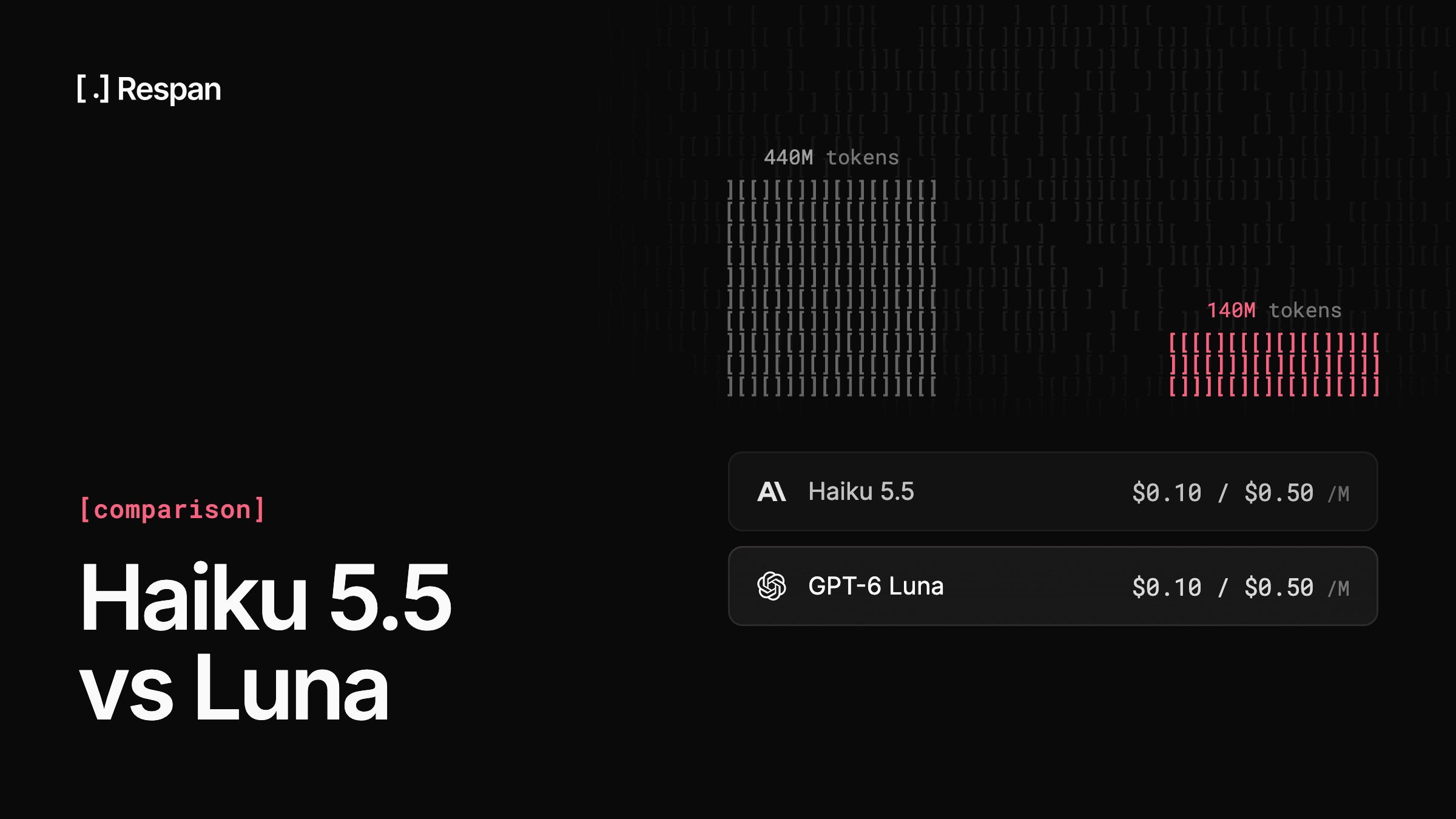
Matching per-token prices only produce matching bills if both models spend the same number of tokens, and these two don't. Artificial Analysis reports 440M output tokens to run its Intelligence Index on Haiku 5.5 against 140M on Luna, so Haiku writes roughly three times as much to get through the same set of tasks.
Haiku 5.5: 440M output tokens on the Intelligence Index
GPT-6 Luna: 140M output tokens on the Intelligence Index
Winner: GPT-6 Luna
Cost per task by effort level
Artificial Analysis puts the cost per Intelligence Index task at $0.21 for Haiku 5.5 at max effort and $0.07 for Luna at max, and Luna drops to $0.0045 per task at low effort. Haiku's extra tokens do buy a higher score, so the question for each step is whether it needs the five index points between them.
Haiku 5.5: $0.21 per task (max effort)
GPT-6 Luna: $0.07 per task (max effort), $0.0045 (low effort)
Winner: GPT-6 Luna
Haiku 5.5 vs GPT-6 Luna: Speed comparison
Both speed figures come from Respan's model pages, measured with each model's own vendor as the provider. Latency on both depends heavily on effort, because reasoning time counts before the answer starts.
Output speed
GPT-6 Luna generates 121 tokens per second through OpenAI, against 40 tokens per second for Claude Haiku 5.5 through Anthropic.
Haiku 5.5: 40 tokens per second
GPT-6 Luna: 121 tokens per second
Winner: GPT-6 Luna
Time to first token
Luna's page lists 1.1 seconds to first token. Haiku's page reports response latency instead, at 0.7 seconds against Luna's 7.7 seconds on the same measure. That gap reflects effort as much as the model, since Artificial Analysis measured Luna's first token at 0.76 seconds with reasoning off, which is the setting to reach for when time to first token matters in a chat interface.
Haiku 5.5: 0.7s response latency
GPT-6 Luna: 1.1s time to first token, 7.7s response latency
Winner: Haiku 5.5, on response latency
Haiku 5.5 vs GPT-6 Luna: Context window and limits
Context window and max output
Haiku 5.5 has a 1M-token context window and Luna has 1.05M, and both cap output at 128K tokens. The 50K difference rarely decides anything, while the pricing thresholds inside that window often do. Haiku's reliable knowledge cutoff is June 2026, a few weeks later than Luna's May 18.
Haiku 5.5: 1M context, 128K max output
GPT-6 Luna: 1.05M context, 128K max output
Winner: Tie
Effort settings and tool calling
Both models default to medium effort. Luna's range runs from none to max, and turning reasoning off is what gives it its quickest responses. The catch is tool use, since in Chat Completions Luna supports function calling only at "none" effort, so an agent that needs Luna to reason and call tools in the same step has to use the Responses API.
Haiku 5.5 uses adaptive thinking, which can skip thinking on simple requests at lower effort, and it doesn't split tool support by API.
Haiku 5.5: Medium effort by default, tools at any effort
GPT-6 Luna: Medium effort by default, Chat Completions tools only at "none"
Winner: Haiku 5.5
Which is better: Haiku 5.5 or GPT-6 Luna?
When to use Haiku 5.5
Anthropic built Haiku 5.5 for high-volume, cost-sensitive work like summaries, classification, and subagent roles under larger models. Its benchmark lead shows up most on terminal coding and agentic steps where a wrong move is expensive, and its AA-Omniscience score makes it the safer pick when a step should say it doesn't know rather than guess.
When a step outgrows Haiku, the next move is up the Claude lineup, and the benchmark gap in any Haiku vs Sonnet comparison shows what that buys.
When to use GPT-6 Luna
Luna fits extraction, classification, and routing at scale, where the output has a checkable answer and cost per task decides. It's also the cheaper model for prompts between 100K and 272K tokens, it leads on SaaS automation workflows, and with reasoning off it responds quickly.
Steps that need more than Luna gives can move up to Sol, the next tier in the GPT-6 Sol vs Luna vs Astra lineup.
Neither model wins every step, and an app doesn't have to pick one. Running Haiku on reasoning-heavy steps and Luna on high-volume ones gets each model's strength without paying for it everywhere.
Route between Haiku 5.5 and GPT-6 Luna with Respan
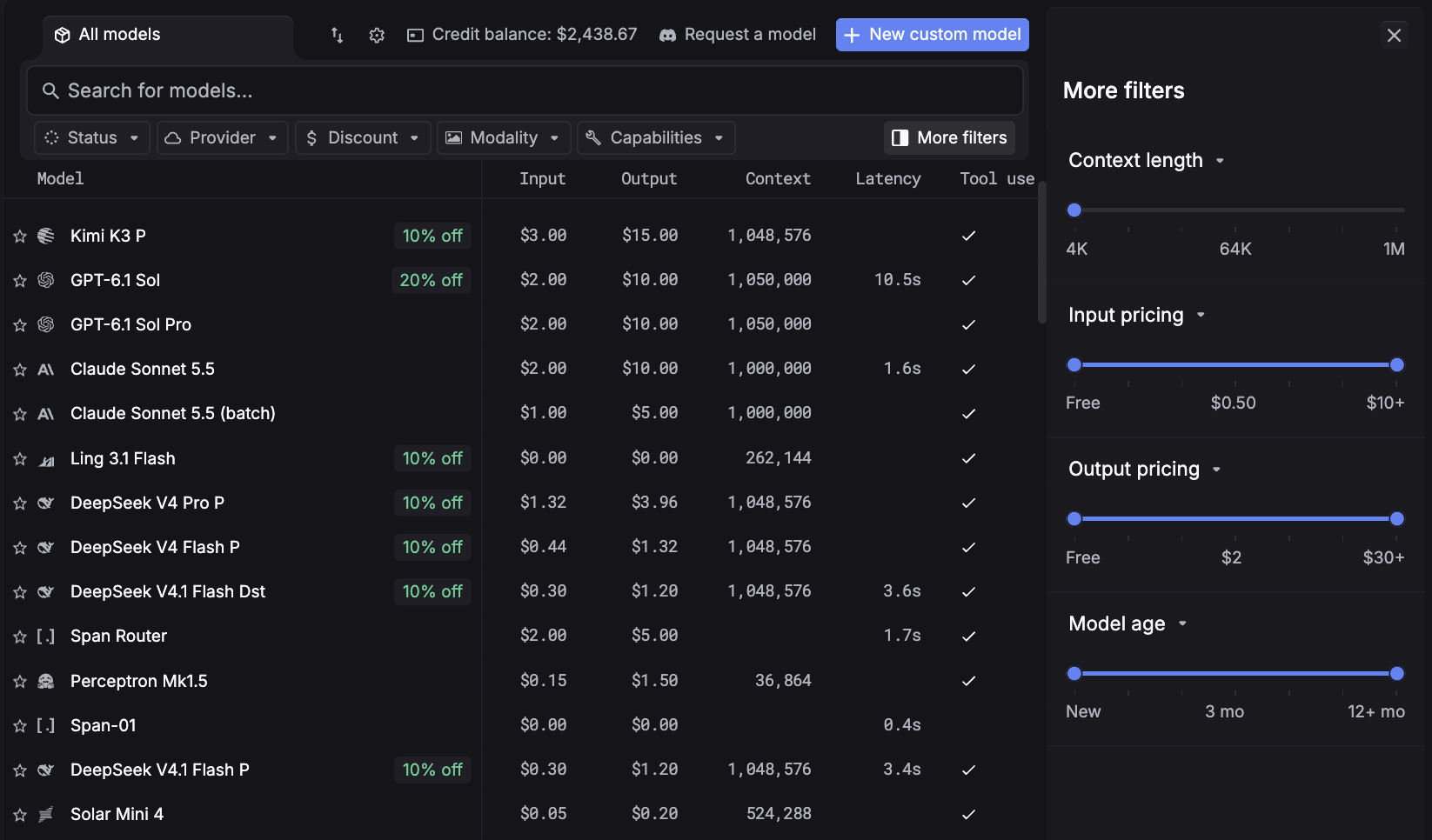
Respan puts Haiku 5.5, GPT-6 Luna, and 1,000+ other models behind one API, so moving a step from Anthropic to OpenAI is a one-line model name change. Route, observe, and evaluate every LLM call from the same AI gateway:
- Respan Router - Set the model to Respan Router and Respan picks the model for each request based on the task.
- Cost per request - Every request logs tokens, cost, and latency, so the token gap between Haiku and Luna shows up in dollars on your own traffic instead of a benchmark estimate.
- Side-by-side evals - Run both models against the same test set, built from your production logs, and compare score distributions in evaluations.
- Fallbacks across vendors - List a backup model from the other provider, and Respan moves to it when a request errors or hits a rate limit.
- Production monitoring - Evaluators score sampled live traffic to catch regressions, and alerts go to Slack, email, or a webhook when cost, latency, or errors cross a threshold you set.
- Spend controls - Set budgets and rate limits per key, per customer, or across the org.
Instead of reading logs after the fact, use Respan to run observability in production, know when production shifts, and act before it spreads.
FAQ
Is Haiku 5.5 better than GPT-6 Luna?
On most shared benchmarks, yes. Haiku 5.5 scores 43 to Luna's 38 on Artificial Analysis's Intelligence Index and leads on Terminal-Bench 4.0 and Humanity's Last Exam, while Luna leads on AutomationBench-AA. Whether it's better for your app depends on whether that lead justifies the roughly 3x output tokens Haiku spends.
Is Haiku 5.5 cheaper than GPT-6 Luna?
Not per token, and not per task in Artificial Analysis's testing. Both cost $0.10 input and $0.50 output per million tokens up to 100K, but Luna keeps that rate until 272K while Haiku rises to $0.50 and $2.50, and Haiku's cost per task at max effort is $0.21 to Luna's $0.07.
What is GPT-6 Luna's pricing?
GPT-6 Luna costs $0.10 per million input tokens, $0.01 for cached input, and $0.50 per million output tokens. Requests over 272K input tokens bill at 2x input and 1.5x output, or $0.20 and $0.75, and Batch and Flex processing take 50% off.
What is Haiku 5.5's context window?
Haiku 5.5 has a 1M-token context window and a 128K max output. Prompts over 100K tokens bill at $0.50 input and $2.50 output instead of $0.10 and $0.50.
Luna vs Haiku: which is better for coding?
Haiku 5.5, on the evidence so far. It scores 32.8% on Terminal-Bench 4.0 to Luna's 12.6% in Artificial Analysis's testing. OpenAI reports 66.6% for Luna on DeepSWE v1.1, but without a matching Haiku result, Terminal-Bench is the cleaner comparison.