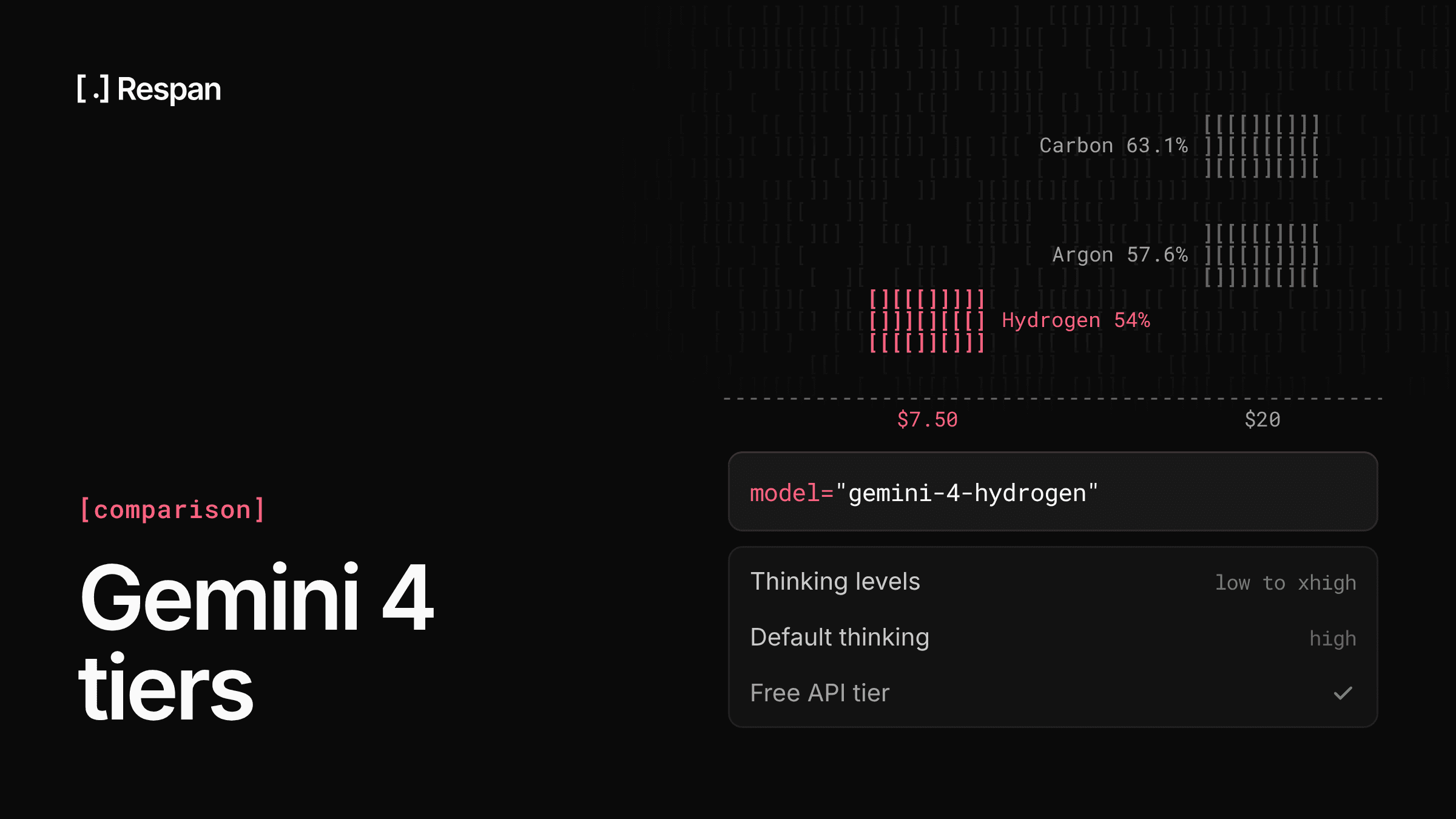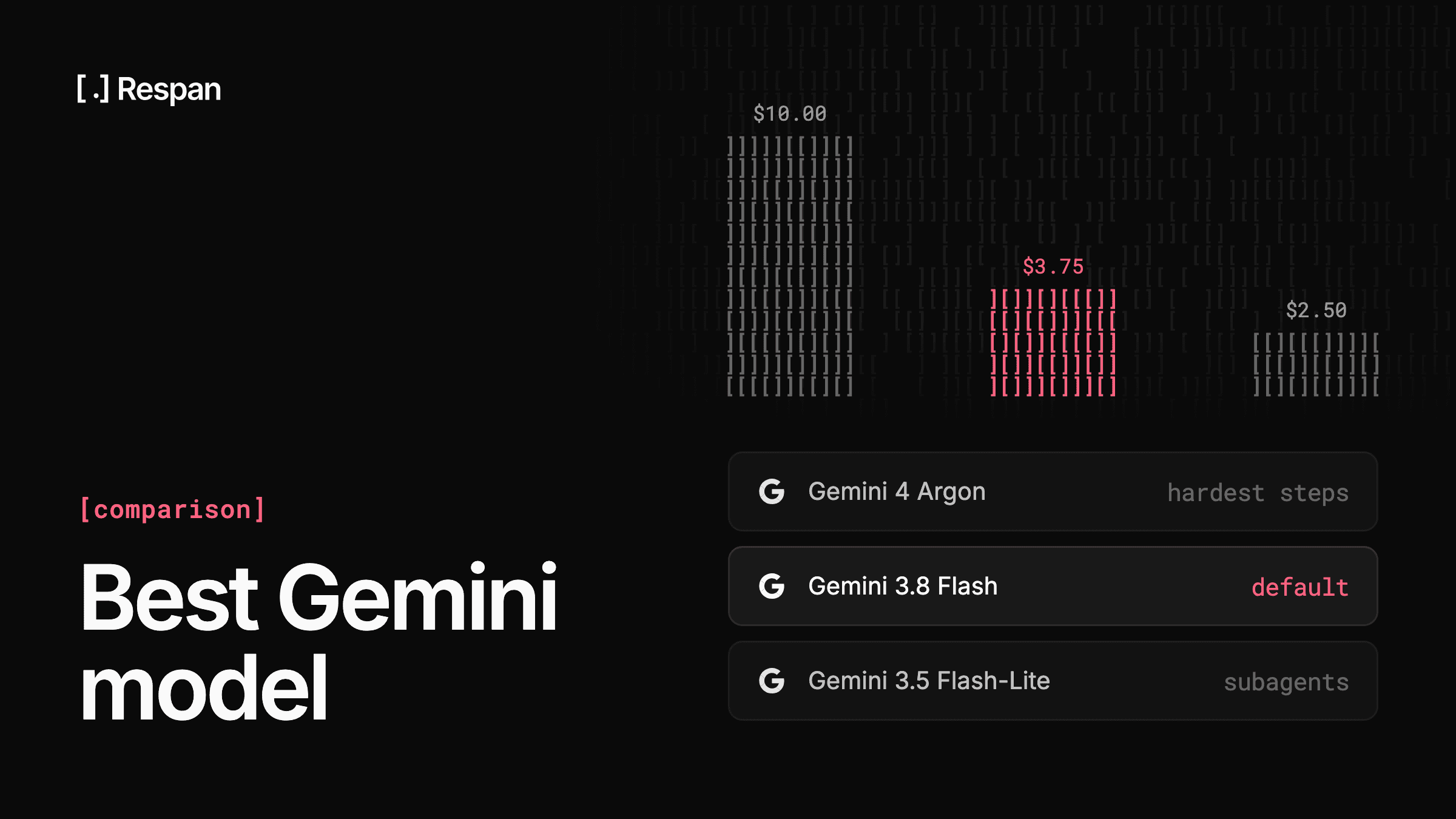
Google released Gemini 4 Hydrogen on November 12, 2026, and it now handles the everyday requests in the Gemini app and Google Search that Gemini 3.8 Flash used to. On the Gemini API, though, 3.8 Flash is still available with no shutdown date, so teams running it in production get to choose when they move.
Hydrogen scores higher on nearly every benchmark both models report, and Google positions it as the upgrade path from 3.8 Flash. What makes the choice less obvious is price, since Hydrogen costs more per token than 3.8 Flash does today, and that gap closes on January 1 when 3.8 Flash moves to standard pricing.
For a team already on 3.8 Flash, Gemini 4 Hydrogen vs Gemini 3.8 Flash is a question of when to switch and what has to change in your code first.
TL;DR: Gemini 4 Hydrogen vs Gemini 3.8 Flash
Gemini 4 Hydrogen is the stronger model, and on coding and agent work the gap is large. Gemini 3.8 Flash's main advantage is its introductory price, which ends on December 31, 2026.
- Quality - Hydrogen scores 70.8 on the Respan Index against 54.6 for 3.8 Flash, and leads in every category, with the widest gaps in reasoning and coding.
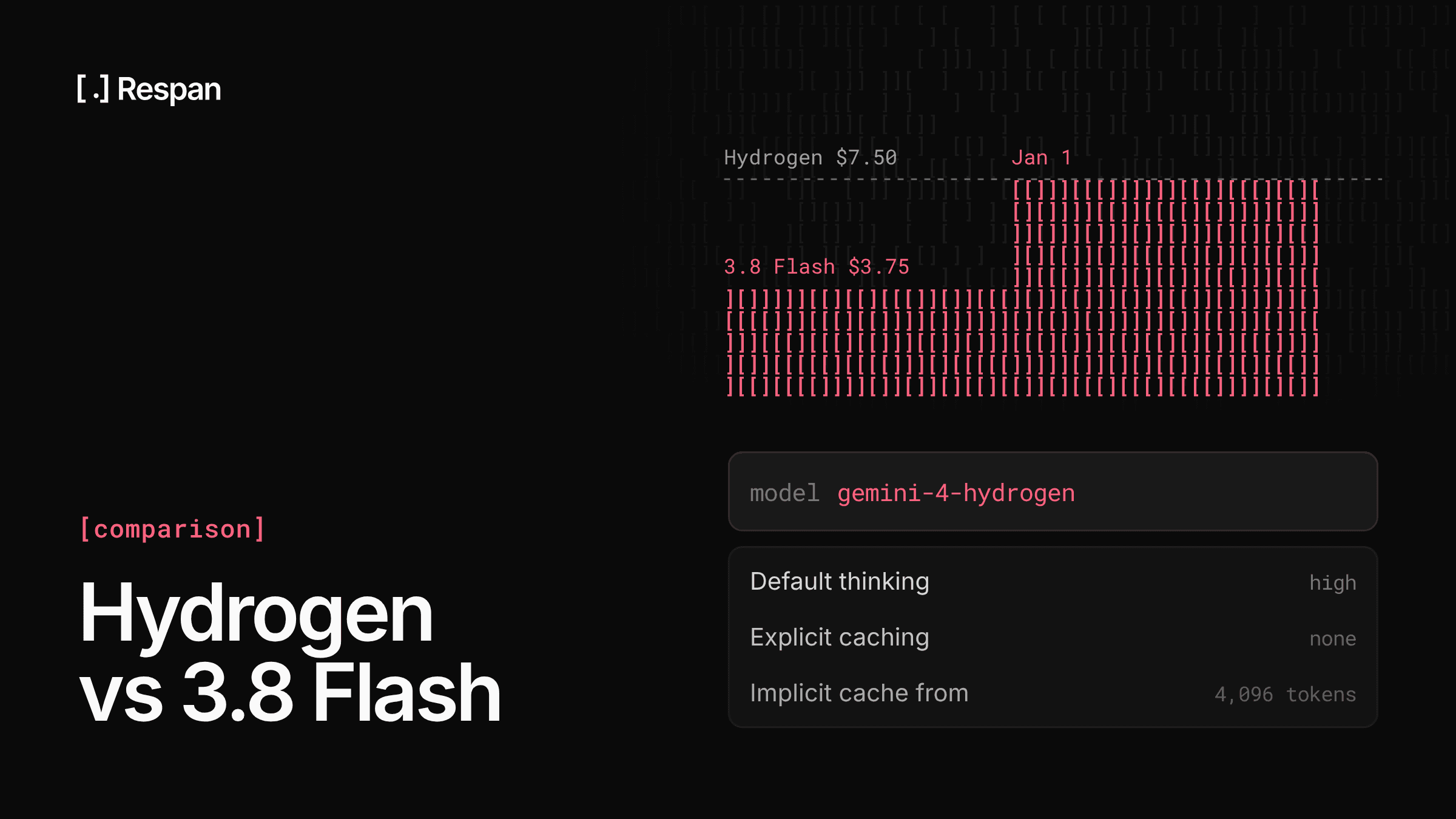
- Price - Hydrogen costs $1.50 per million input tokens and $7.50 per million output tokens. 3.8 Flash costs $0.75 and $3.75 through December 31, then the same as Hydrogen from January 1, 2027.
- Cost per task - Artificial Analysis measured $1.87 per completed index task for Hydrogen against $7.77 for 3.8 Flash, both on high, with 3.8 Flash reading about twice as many input tokens to finish.
- Switching - Hydrogen defaults to a higher thinking level, drops explicit caching, and only accepts
thinking_level, so test before you swap the model ID. - Verdict - Move agent and coding workloads to Hydrogen now. Keep high-volume, simple traffic on 3.8 Flash through December if the savings matter, and be ready to switch by January 1.
After January 1, the main reason left to stay on 3.8 Flash is a workload built around explicit caching.
If you're moving traffic from 3.8 Flash to Hydrogen, Respan's AI gateway puts both models behind one API, lets you split traffic between them by weight, and falls back to 3.8 Flash automatically when Hydrogen errors or rate-limits.
Is Hydrogen better than 3.8 Flash?
Yes, on almost every measure. Google adapted Hydrogen from Gemini 4 Carbon, and the gain over 3.8 Flash shows most clearly on multi-step coding and agent tasks.
Where Hydrogen leads
On the Respan Index, Hydrogen scores 70.8 against 54.6 for 3.8 Flash. Hydrogen leads in all five categories, with the largest gaps in coding (26.4 points) and reasoning (24.6 points), where 3.8 Flash scores 36.1 and 53.3.
Hydrogen also scores above Gemini 4 Argon, which sits at 69.3, and ranks third among Gemini models behind Gemini 4 Neon and Carbon, which is worth knowing if you're choosing the best Gemini model for a new project and assumed the cheaper tier meant a weaker one.
3.8 Flash holds up best on knowledge and language, where Hydrogen's lead is 0.1 points against 26.4 on coding. It also edges Hydrogen on LMArena's human-preference Elo, 1497 to 1490, and wins one of Roboflow's five vision tasks (identification, 97.9% vs 96.9%) while losing the other four. For general chat and knowledge lookups, the quality you'd give up by staying on 3.8 Flash is small.
Gemini 4 Hydrogen vs Gemini 3.8 Flash: comparison
The two models share a context window and a free tier, and differ on nearly everything else that affects a migration.
| Gemini 4 Hydrogen | Gemini 3.8 Flash | |
|---|---|---|
| Released | Nov 12, 2026 | Sep 2, 2026 |
| Respan Index | 70.8 | 54.6 |
| Terminal-Bench 4.0 (Vals AI) | 54% | 19.7% |
| Input / output per 1M | $1.50 / $7.50 | $0.75 / $3.75 to Dec 31 |
| From Jan 1, 2027 | $1.50 / $7.50 | $1.50 / $7.50 |
| Context window | 1M tokens | 1M tokens |
| Default thinking level | High | Medium |
| xhigh thinking | Yes | No |
| Explicit caching | No | Yes |
| Free tier | Yes | Yes |
Benchmarks
Gemini 4 Hydrogen more than doubles Gemini 3.8 Flash on independent agentic coding benchmarks. Vals AI's Terminal-Bench 4.0 run puts Hydrogen at 54% and 3.8 Flash at 19.7%, and Proximal Labs' FrontierSWE V2 shows a similar gap, 53.1% against 19.6%.
Google's own numbers point the same way. In its launch post, Google reports 57.0% for Hydrogen on Terminal-Bench 4.1 against 18.2% for 3.8 Flash, and says Hydrogen makes more than five times fewer fabricated claims. Google also says Hydrogen finishes tasks 2.5 times faster at its default high setting, which measures whole-task completion time rather than per-request latency. These are Google's measurements on a newer version of the benchmark, so they won't line up exactly with the Vals AI scores.
Artificial Analysis, which runs its own intelligence index, scores Hydrogen at 51 on high and 54 on xhigh, against 31 for 3.8 Flash on high.
Pricing and cost per task
Per token, Hydrogen costs twice what 3.8 Flash does today: $1.50 per million input tokens and $7.50 per million output tokens, against $0.75 and $3.75. Cached input is $0.075 per million on both, which on Hydrogen means implicit cache hits. Google's Gemini API pricing page lists 3.8 Flash's current rates as running through December 31, 2026. From January 1, 2027, 3.8 Flash costs $1.50 and $7.50, the same as Hydrogen, and its cached input rises to $0.15.
The per-token rate also leaves out how many tokens a model spends to finish the job. On Artificial Analysis's index at high thinking, 3.8 Flash read 10.2 billion input tokens to Hydrogen's 5.34 billion and wrote 126 million output tokens to Hydrogen's 110 million, which puts its cost per completed task at $7.77 against $1.87 for Hydrogen. The comparison shifts at default settings, though, since 3.8 Flash at medium wrote 83.9 million output tokens, fewer than Hydrogen at high. Results like these depend on your prompts and how many turns your tasks take, which is why AI token cost is worth measuring per request on your own traffic before you trust a price list.
Context window, output, and inputs
Both models take a 1,048,576-token context window and accept text, images, audio, and video, and both cap a single synchronous response at 65,536 tokens. On Hydrogen, input, thinking, and output share that one window, so a 900,000-token prompt leaves roughly 148,000 tokens for reasoning and the answer. Hydrogen can also write longer outputs in background mode, up to 1 million tokens, which 3.8 Flash can't.
Thinking levels and behavior changes
Hydrogen has four thinking levels (low, medium, high, and a new xhigh) and defaults to high, while 3.8 Flash defaults to medium. If you leave the default alone, Hydrogen spends more thinking tokens on every request than you were paying for on 3.8 Flash, which shows up in both latency and output-token billing. When a workload ran fine on 3.8 Flash at medium, set Hydrogen to medium explicitly when you test it. Even there, Artificial Analysis scores Hydrogen at 41 against 30 for 3.8 Flash at its medium default.
Swapping gemini-3.8-flash for gemini-4-hydrogen also changes request behavior in ways that can break code:
- Explicit caching - Hydrogen doesn't support explicit context caching, so calls that create or reference a cache won't work. Only implicit caching applies, on prompts of 4,096 tokens or more, and hits aren't guaranteed. If your cost model assumed cached hits from prompt caching, re-estimate it on Hydrogen.
- thinking_budget - Hydrogen only accepts
thinking_level(low, medium, high, or xhigh), so removethinking_budgetfrom your requests and set the level instead.
Temperature, top_p, and top_k aren't on that list because Google already ignores them on 3.8 Flash and on every Gemini model released since 3.6 Flash.
Which to use: Hydrogen or 3.8 Flash?
For new projects, start on Hydrogen. For traffic already on 3.8 Flash, the choice depends on how much the remaining weeks of introductory pricing are worth against the quality you give up in the meantime.
Switch to Hydrogen now
Coding agents, tool-calling workflows, and anything that runs many steps per task should move first. Those workloads show the largest gaps on Terminal-Bench and in the Respan Index coding category, so the quality gain is worth paying for even at today's rates. If you need deeper reasoning than Hydrogen offers, compare it with Argon and Carbon in Gemini 4 Hydrogen vs Argon vs Carbon, or with the newer Gemini 4 Neon, which now scores highest of the Gemini 4 models.
Stay on 3.8 Flash until January
High-volume, short requests such as classification, extraction, and simple chat are where 3.8 Flash's introductory price still pays off, since the quality gap there is smallest and each request uses few tokens. Workloads built around explicit caching also have a reason to wait, because moving them means reworking the caching layer and re-checking cost estimates first.
Nothing breaks on January 1, but from that date you pay Hydrogen's price for 3.8 Flash's quality. Finish testing the thinking-level and caching changes on real traffic in December, so the switch can happen on the first.
How to switch from 3.8 Flash to Hydrogen without breaking production
Changing the model ID takes a minute. Finding out whether Hydrogen's default thinking level raised your bill, whether losing explicit caching changed latency, or whether output quality moved on your real prompts takes data you may not be collecting yet.
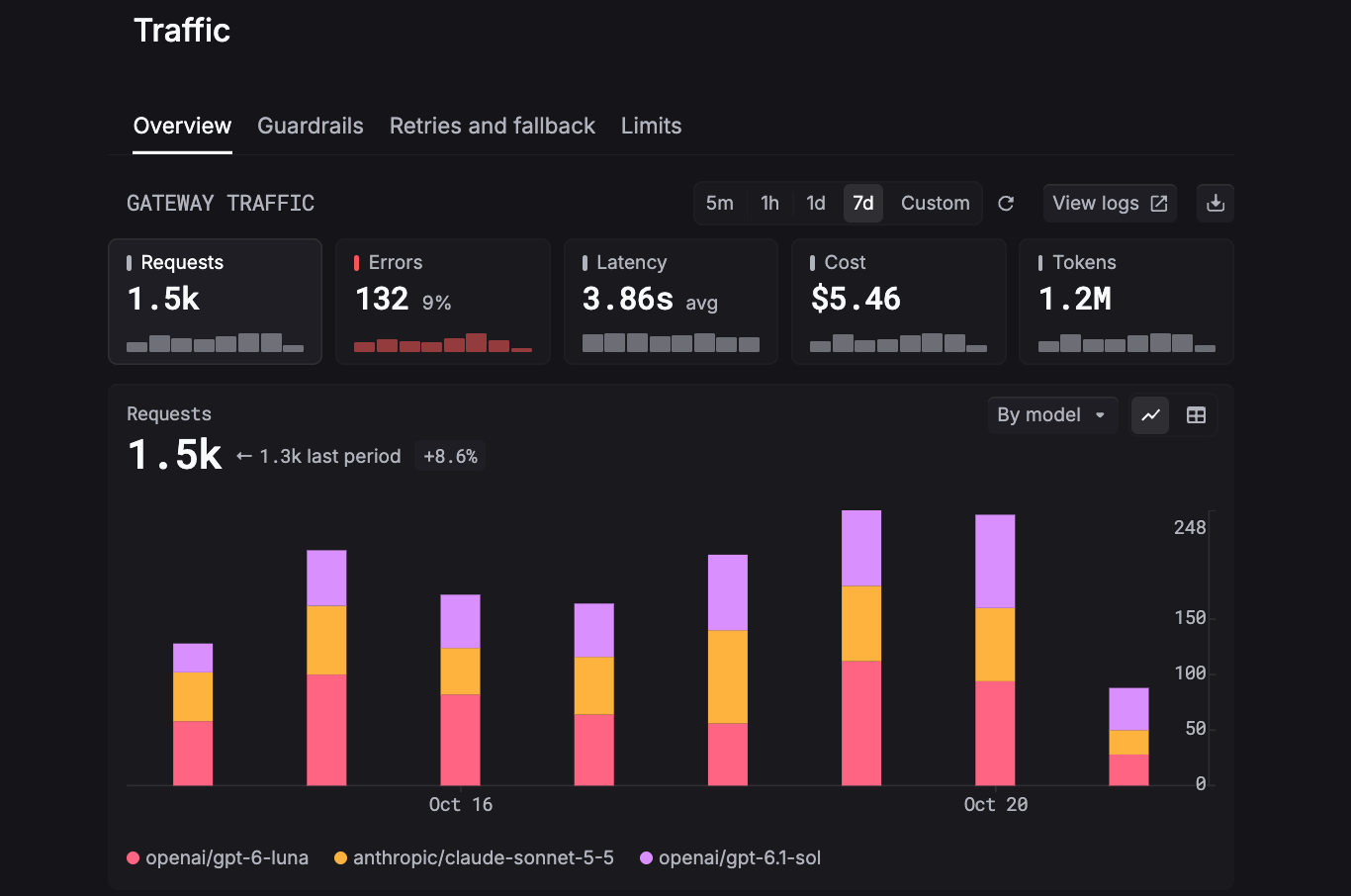
Respan routes every model call through one AI gateway, at up to 55% off per token with a 0% fee, then traces, prices, and scores each request, so you can move traffic from 3.8 Flash to Hydrogen and see what changed before it reaches every user.
- One endpoint for both models - Hydrogen and 3.8 Flash sit behind the same endpoint as 1,000+ other models, so the fallbacks, cost tracking, and evals below cover both from day one. If you call Gemini through Google's SDK, Respan's Gemini SDK proxy lets you keep your existing calls and change only the base URL and key.
- Gradual rollout - Use load balancing to send a weighted share of requests to Hydrogen while the rest stay on 3.8 Flash.
- Fallbacks you set once - List 3.8 Flash as the fallback for Hydrogen, and Respan moves the request to it automatically when Hydrogen errors or rate-limits. Keep fallback requests to settings both models accept, such as medium thinking.
- Cost per request and per customer - Every call is logged with its latency, tokens, and cost, broken down by model, request, and end customer, so a jump in thinking tokens shows up the day it starts.
- Tests on real traffic - Build a dataset from your production logs, run both models through the same evaluators in an experiment, and compare scores row by row before you cut over.
- Evals after the switch - Keep automated evals running on live production traffic after the switch, with monitors that alert Slack, email, or a webhook when cost, errors, or latency move.
Instead of reading logs after the fact, use Respan to run observability in production, know when production shifts, and act before it spreads.
FAQ
Is Gemini 4 Hydrogen replacing Gemini 3.8 Flash?
In Google's own products, yes. Hydrogen took over everyday requests in the Gemini app and Google Search at launch. On the Gemini API, 3.8 Flash is still available, and Google's deprecations page lists no shutdown date for it, so you can keep calling it while you test Hydrogen.
Is Gemini 4 Hydrogen more expensive than Gemini 3.8 Flash?
Per token, yes, until January 1, 2027. Hydrogen costs $1.50 per million input tokens and $7.50 per million output tokens, while 3.8 Flash costs $0.75 and $3.75 through December 31, 2026, then matches Hydrogen. Per completed task, Hydrogen can come out cheaper: Artificial Analysis measured $1.87 per index task for Hydrogen against $7.77 for 3.8 Flash, which read about twice as many input tokens to finish. Tracking cost per request in Respan shows which of those holds for your workload.
Does switching from 3.8 Flash to Hydrogen require code changes?
Usually only the model ID, unless you use explicit caching or thinking_budget. Hydrogen doesn't support explicit context caching and only accepts thinking_level, so both need to change. Hydrogen's higher default thinking level also changes cost and latency without throwing any error. Routing through Respan lets you shift traffic to Hydrogen gradually and keep 3.8 Flash as a fallback while you test.
What is the default thinking level in Gemini 4 Hydrogen?
High. Hydrogen supports low, medium, high, and xhigh, and defaults to high, while 3.8 Flash defaults to medium. Setting Hydrogen to medium or low cuts latency and thinking tokens on simple requests, though quality drops with it: Artificial Analysis scores Hydrogen at 41 on medium and 27 on low, against 51 on high.
Is Gemini 4 Hydrogen on the free tier?
Yes. Google released Hydrogen on the free and paid tiers of the Gemini API and Google AI Studio, and 3.8 Flash has a free tier too. Free-tier rate limits are lower, and Google uses free-tier data to improve its products, so production traffic belongs on a paid tier.