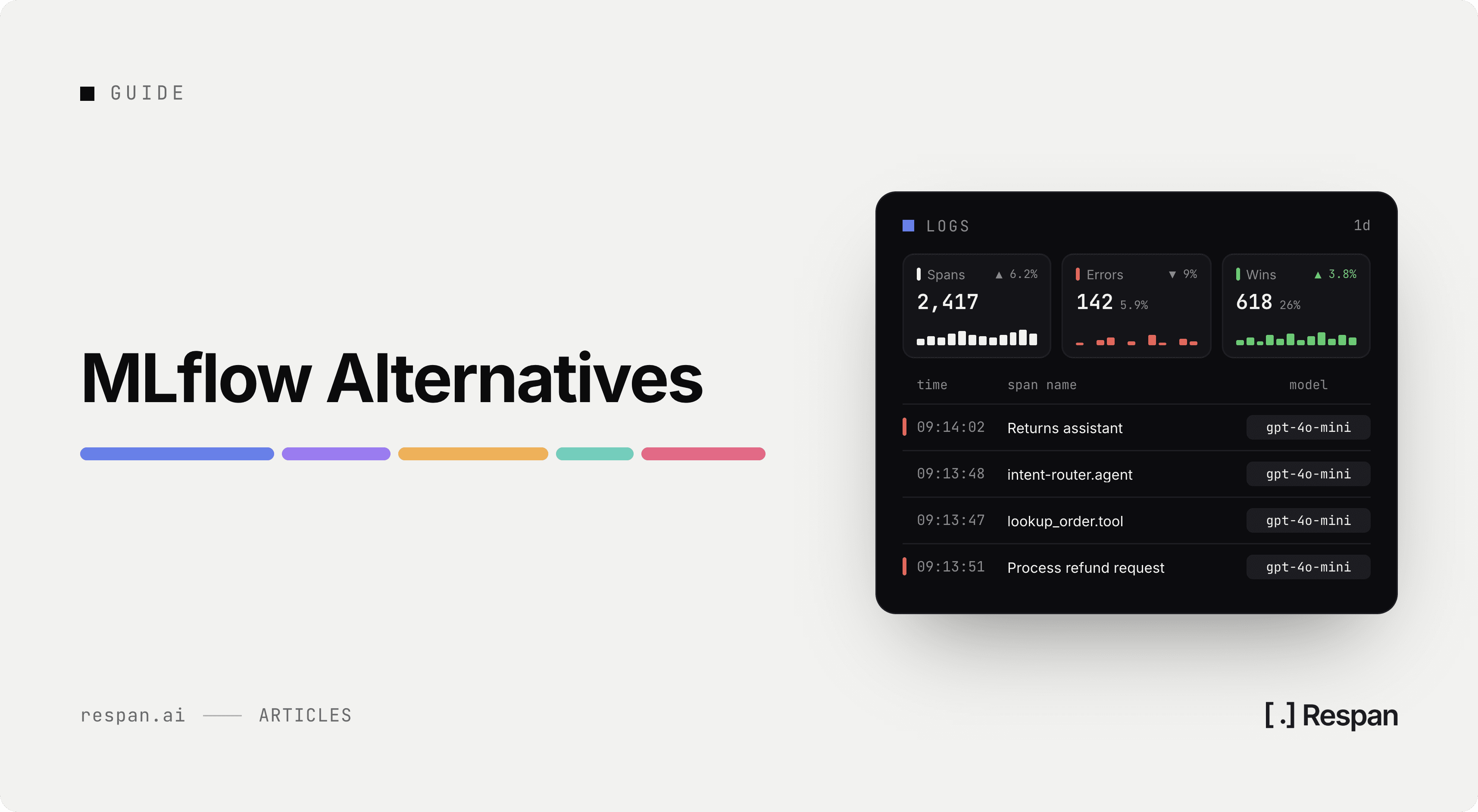
If your team already uses MLflow to track training runs, it's a natural place to start when an LLM app or agent heads into production. The questions change once real users arrive, though, from which hyperparameters won to which provider served a request, what it cost, and whether the answer held up.
That shift matters because LLM traffic fails in ways a training dashboard isn't organized to show, like a provider rate-limiting mid-launch or a prompt change quietly lowering answer quality.
A platform built around live LLM traffic, where every call is routed, traced, and scored in one place, catches those problems before a customer reports them.
If you're comparing MLflow alternatives for LLM apps and agents in 2026, here are the 10 best, judged on how they handle live LLM traffic.
TL;DR: MLflow alternatives at a glance
Gateway support and scoring on live traffic are where these options split for LLM apps.
| Tool | Best for | Gateway | Scores live traffic | Pricing model |
|---|---|---|---|---|
| Respan | Production LLM apps and agents | Yes, 1,000+ models | Yes | Free; Team $199/mo |
| Weights & Biases | Training plus LLM features | No | Yes (Weave) | Seats, storage, ingestion |
| Kubeflow | ML pipelines on Kubernetes | No | No | Free; you run it |
| ZenML | Portable ML pipelines | No | Via integrations | Per pipeline execution |
| Confident AI | DeepEval-based LLM evals | No | Yes (Starter and up) | Flat org fee + storage |
| Braintrust | Eval-driven development | Public preview | Yes | Data + scores, no seats |
| Laminar | Open-source agent tracing | No | Via Signals | Subscription + per GB |
| Comet ML | Tracking plus open-source LLM layer | Beta | Yes (Opik) | Per seat; Opik per span |
| Langfuse | Open-source LLM observability | No | Yes | Usage units |
| LangSmith | LangChain and LangGraph teams | Beta | Yes | Per seat + per trace |
What is MLflow?
MLflow is an open-source platform for managing the machine learning lifecycle, created by Databricks in 2018 and licensed under Apache 2.0. Its core jobs are experiment tracking, a model registry, and model deployment, which puts it alongside other MLOps tools built for training and shipping models.
MLflow also covers LLM tracing, evaluation, and an AI gateway, though those features sit on a platform organized around runs and models.
Self-hosted MLflow is free, and your team operates the tracking server, the backend database, and the artifact store. If you'd rather not run it, managed MLflow comes as part of a cloud ML platform such as Databricks, Amazon SageMaker AI, or Azure Machine Learning, and on Databricks the usage is billed through the platform's compute units.
How to evaluate and choose an MLflow alternative
Experiment tracking is organized around training runs, and a production LLM app or agent needs a different set of capabilities, so it's worth weighing each option against these:
- Routing and failover - One API across providers, with fallback when a model errors or rate-limits. Dedicated LLM gateways handle this, and some platforms build it in.
- Tracing for agents - Nested spans for every LLM call, tool run, and retrieval, so a bad output traces back to the step that caused it, which is the baseline any of the AI observability tools worth shortlisting should meet.
- Scoring live traffic - LLM evaluation tools that only score test sets can miss regressions that appear with real user inputs, so look for evaluators that also run on sampled production traffic.
- Spend control - Cost broken down by model and end customer, with caps that stop spend rather than only warn.
- Who operates it - Open-source tools cost nothing to license but put the deployment on your team, while managed platforms trade that for a usage bill.
An option that covers the first four in one place means one less integration between a failing request and the trace that explains it.
10 best MLflow alternatives in 2026
1. Respan
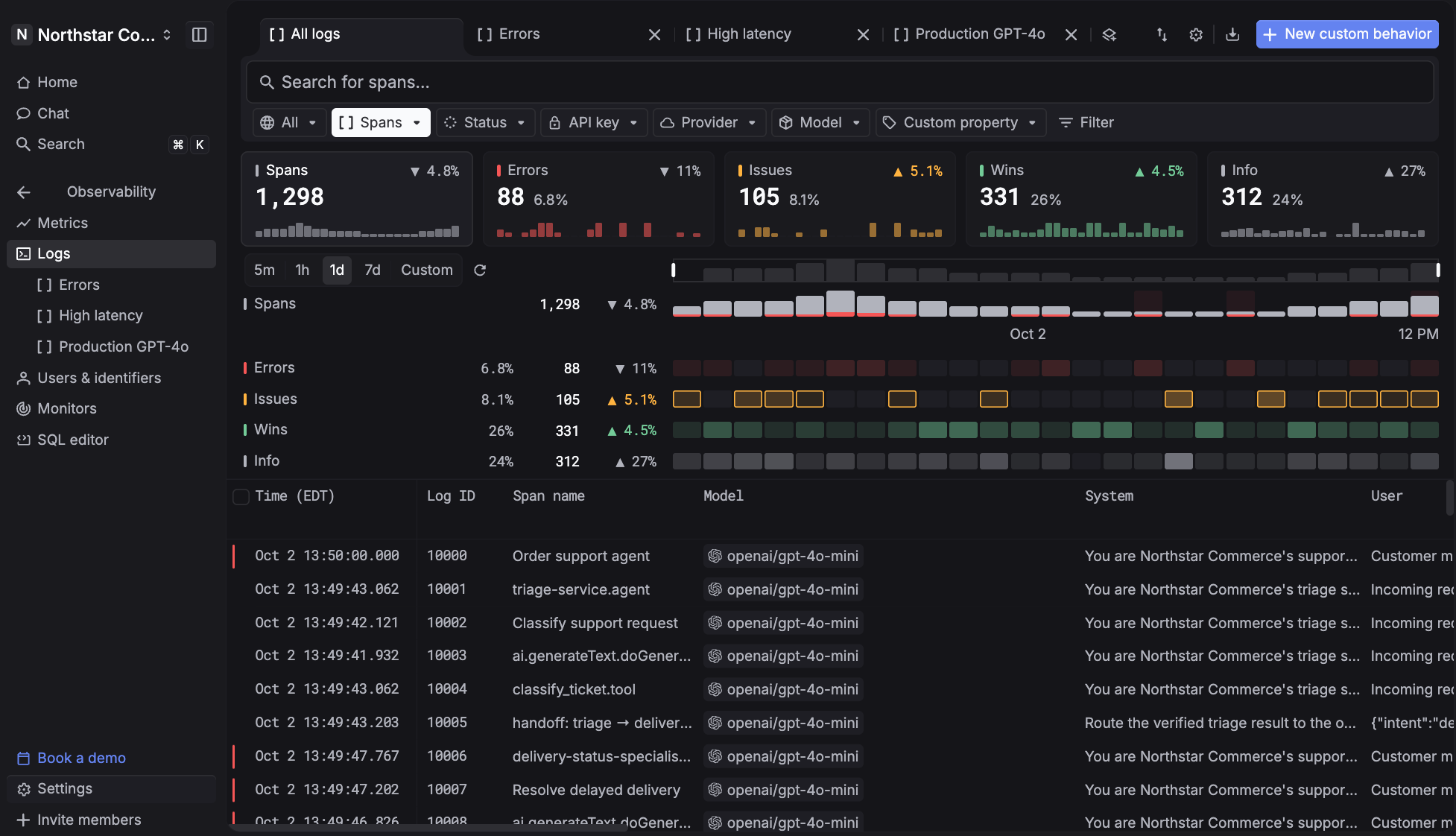
Respan is an AI router with built-in observability and automated evals. Every model call goes through one AI gateway to 1,000+ models, and every request it routes is traced, priced, and ready to score in the same place, so a metric always ties back to the run behind it.
That matters most once an LLM app or agent is in front of real users. Instead of reading logs after the fact, use Respan to run observability in production, know when production shifts, and act before it spreads.
- One API for every model - Reach 1,000+ models across every major provider and switch by changing a single word. Respan Router, in beta, can pick the model per task.
- Stay up when a provider fails - Set a fallback chain once, and traffic moves to the next model when a provider errors or rate-limits. Failed requests retry automatically.
- Trace every agent run - Every LLM call, tool run, retrieval, and agent turn becomes a span in one nested trace, with input, output, latency, and cost on each.
- Know where every dollar goes - See cost by model, request, and end customer, and set soft or hard caps per key, per customer, or org-wide. Exact repeat requests can be served from cache.
- Hear about problems first - Monitors watch cost, errors, latency, and tokens and alert Slack, email, or a webhook the moment one breaches.
- Catch regressions before users do - Score output with LLM judges, code checks, or human review on a test set before shipping and on sampled live traffic after. Click any score to land on the trace behind it.
- Close the loop - Build datasets from production logs, test a prompt or model change in an experiment, and ship new prompt versions without a code deploy.
- Enterprise-ready - SOC 2, HIPAA with a BAA, GDPR, and ISO 27001.
Best for: Teams shipping LLM apps and agents that want routing, tracing, and evals in one platform.
Live LLM traffic: Every call is routed, traced, priced, and scorable in one place, with fallback, spend caps, and monitors on top.
Pricing: Free with 100k logs, 1k scores, unlimited seats, and 7-day retention. Team is $199/month billed yearly with 5 members, 30-day retention, and usage-based overage on logs and scores.
2. Weights & Biases
Weights & Biases (often called wandb) covers both sides from one account for teams that train models and also ship LLM features. W&B Models handles experiment tracking, comparison, and hyperparameter sweeps, while Weave handles the LLM side with tracing, evaluations, and monitors that automatically score incoming production traces using the same scorers as offline evaluation.
The fit gets weaker when there's no training workload at all, since much of the product is built around runs, sweeps, and model versioning. Self-hosting is available for Models, while self-managed Weave goes through sales.
Best for: Organizations running model training and LLM apps side by side.
Live LLM traffic: Weave traces calls and scores production traces automatically.
Pricing: The free tier covers 5 model seats and 1 GB of Weave ingestion a month, and Pro starts at $60/month for companies under 50 employees. Weave overage bills by the megabyte of ingested data, so long agent traces with large contexts can push the bill up faster than request counts suggest.
3. Kubeflow
On Kubernetes, Kubeflow provides a set of open-source projects for running ML workloads, including Pipelines for workflow orchestration, Katib for hyperparameter tuning, Trainer for distributed training, Notebooks, and Hub for model registry. Where MLflow records what happened in a run, Kubeflow is closer to the system that schedules and executes the runs in the first place, which is why the two can sit in the same stack.
Its LLM scope is fine-tuning, with Trainer and Katib both supporting LLM fine-tuning jobs. It doesn't trace or score LLM calls in production, so for a team whose workload is an LLM app or agent rather than a training pipeline, Kubeflow solves a different problem.
Best for: Platform teams running ML training pipelines on Kubernetes.
Live LLM traffic: Not covered, since LLM support is limited to fine-tuning.
Pricing: Free and open source. What you take on is the Kubernetes cluster and the platform engineering to keep a multi-component install upgraded and running.
4. ZenML
ZenML orchestrates ML and LLM pipelines as an Apache 2.0 framework, with stack components that let the same pipeline run on different orchestrators and infrastructure. One of those components is the experiment tracker, and ZenML supports MLflow there, so in practice it can sit on top of MLflow rather than replace it.
For agents, ZenML's work lives in Kitaru, a separate open-source project built around replayable agent traces. ZenML itself points to integrations like Langfuse for LLM tracing, which means scoring live LLM traffic is another tool to add.
Best for: ML teams that need portable, reproducible pipelines across infrastructure.
Live LLM traffic: Through integrations rather than natively.
Pricing: The open-source version is free and self-hosted. The Scale plan is $999/month at 2,000 monthly pipeline executions and is sized by execution count, so cost tracks how often pipelines run rather than how much LLM traffic you serve. Kitaru is priced separately at a flat $39/month for 3 agents and 2 seats.
5. Confident AI
Confident AI is the hosted platform built around DeepEval, its Apache 2.0 evaluation framework, so teams already writing DeepEval tests can push results into a shared workspace. Beyond evals, the platform adds tracing, datasets built from production traces, prompt versioning, and online evaluations on live traffic from the Starter plan up. Red teaming is an Enterprise add-on module.
Evaluation is the center of the product, so if your main need is running production traffic reliably, more of that work may happen outside it. Self-hosting Confident AI is also limited to the Enterprise plan.
Best for: Teams standardizing on DeepEval for LLM evaluation.
Live LLM traffic: Online evals score live traffic on Starter and above.
Pricing: Plans charge a flat monthly fee per organization rather than per seat, plus trace storage billed per GB-month past the allowance. The step from Starter ($200/month) to Team ($2,000/month) is where SOC 2, SSO, and custom RBAC come in, and that's where compliance requirements can set the tier before usage does.
6. Braintrust
Evaluation workflows are what Braintrust is organized around, with datasets, experiments, playgrounds, and scorers, and production logging feeding the same views. Online scoring evaluates production traces automatically as they're logged, and the newer Braintrust Gateway, in public preview, adds multi-provider routing, caching, and fallback.
Because the gateway is still in preview, teams that need a production routing layer today may run one separately for now. Self-hosting is Enterprise only, with the data plane in your cloud and the control plane run by Braintrust, a tradeoff worth weighing against other Braintrust alternatives if data residency matters.
Best for: Teams running eval-driven development with experiments and datasets.
Live LLM traffic: Scores production traces as they're logged, with the gateway in preview.
Pricing: There's no per-seat charge. Starter is free and Pro is $249/month, with usage billed on GB of processed data and number of scores. Scoring a larger share of live traffic raises the bill along with volume.
7. Laminar
Agent tracing is the focus of Laminar, an Apache 2.0 platform with OpenTelemetry-native tracing and browser agent session recordings synced to spans for frameworks like Browser Use, Stagehand, and Playwright. Signals let you describe a failure in plain language and get alerted in Slack when traces match it, and evals run against datasets locally or in CI.
Self-hosting runs on Docker Compose, which keeps a trial install light, though a production deployment still means operating Laminar's services and storage yourself. The free cloud plan is single-seat with 7-day retention, so it suits a trial more than team use.
Best for: Agent teams, especially browser agents, that want open-source tracing.
Live LLM traffic: Traces production calls, and Signals flag the failures you define.
Pricing: Cloud plans pair a monthly subscription with per-GB overage, at $30/month for Starter and $150/month for Pro. Signals bill separately per million tokens on top of that.
8. Comet ML
Comet sells two products that cover different halves of this decision. Its experiment management product handles tracking, a model registry, and production model monitoring, and it's the part that overlaps with MLflow. Opik is the LLM side, an Apache 2.0 project for tracing, evaluation, prompt versioning, guardrails, and online evaluation rules that score sampled production traces with LLM judges.
The split matters if you need both, since they're priced and adopted separately. Opik also includes an LLM gateway, currently in beta.
Best for: Teams that want MLflow-style experiment tracking plus an open-source LLM layer.
Live LLM traffic: Opik traces calls and scores sampled production traces.
Pricing: Experiment management charges per seat ($19/user/month on Pro) plus training hours past the included 1,500, while Opik Cloud charges by spans ($19/month for 100k, then $5 per extra 100k). Running both means two bills that grow with different things.
9. Langfuse
Langfuse covers tracing, prompt management, evaluations, and datasets under an MIT license, with enterprise features like SCIM and audit logs kept in a separate directory. LLM-as-a-judge evaluators can run on production traces, so the scoring loop works on live traffic as well as test sets.
Langfuse sits beside your model calls rather than in front of them, so routing and failover stay with whatever client or gateway you already use. Self-hosting is free with the full core feature set, and the cost moves to running and scaling the deployment yourself, one of the main tradeoffs to weigh across Langfuse alternatives.
Best for: Teams that want open-source LLM tracing and prompt management.
Live LLM traffic: Traces calls and runs LLM judges on production traces.
Pricing: Cloud plans charge by units, where a unit is a trace, an observation, or a score, so a deep agent trace can use many units per request. Hobby is free with 50k units a month, Core ($29/month) and Pro ($199/month) each include 100k units and unlimited users, and Enterprise is $2,499/month. Overage is $8 per 100k units, and SSO and RBAC sit in a $300/month Teams add-on on top of Pro.
10. LangSmith
LangSmith is LangChain's platform for tracing, evaluating, and deploying agents, built to work closely with LangChain and LangGraph. Online evaluators score production traces, the Prompt & Context Hub versions prompts with commits and tags, and Studio gives LangGraph agents an IDE with graph visualization and time-travel debugging.
A newer LLM Gateway, in public beta, adds spend caps and redaction. With LangSmith, self-hosting is an Enterprise add-on, which is worth factoring in if you're comparing LangSmith alternatives and need data in your own infrastructure.
Best for: Teams building agents on LangChain or LangGraph.
Live LLM traffic: Online evaluators on production traces, with the gateway in beta.
Pricing: Plus is $39 per seat per month with 10k base traces included, then pay-as-you-go, and base traces keep 14 days of retention while extended retention costs more. Because seats and traces are billed separately, the bill can track team size as much as usage.
What is the best MLflow alternative?
For teams shipping LLM apps and agents, the best MLflow alternative is Respan, because every model call is routed, traced, and scored in one platform, with fallback, spend caps, and monitors built in. MLflow was built to track and compare training runs, while Respan is built around live LLM traffic, so when a score drops, the trace that explains it is one click away.
If your workload is still mostly model training, the choice looks different. W&B and Comet cover experiment tracking with an LLM layer alongside it, while Kubeflow and ZenML handle pipeline orchestration. If you need open-source LLM observability that you host yourself, Langfuse and Laminar both fit.
FAQ
MLflow vs Kubeflow: which should you use?
Use MLflow when you need to track experiments, version models in a registry, and deploy them, and use Kubeflow when you need to orchestrate ML pipelines, tuning, and distributed training on Kubernetes. The two can run together, with Kubeflow executing the pipelines and MLflow recording what each run produced. If you're building an LLM app or agent rather than training models, Respan is the more direct fit, with routing, tracing, and evals for live LLM traffic in one platform.
MLflow vs Weights & Biases: which should you use?
MLflow is free and open source, so you either run it yourself or get it through a cloud ML platform. Weights & Biases (wandb) is a managed product with experiment tracking, hyperparameter sweeps, and Weave for LLM tracing and production scoring, priced on seats, storage, and ingestion. If you'd rather not run infrastructure, W&B is the simpler choice, and if you want an open-source tracker under your control, MLflow is. For LLM apps and agents specifically, Respan puts routing to 1,000+ models, tracing, spend controls, and evals on live traffic in one managed platform.