Langfuse vs LangSmith: Open Source or Managed? (2026)
Updated November 17, 2026
Respan Gateway: up to 40% off tokens on Gemini, GPT, Claude and 1,000+ more models. One API key, 0% fee.
If you're choosing an LLM observability platform, Langfuse and LangSmith tend to end up on the same shortlist. Both trace LLM calls and agent runs, both score production traffic with evaluators, and both version prompts, so the feature lists alone won't settle it.
What separates them is how you run them. Langfuse is open source under MIT, and you can self-host it on your own infrastructure or use its managed cloud. LangSmith is a closed-source managed platform from LangChain, and self-hosting it is reserved for the Enterprise plan.
The pricing follows the same split, since Langfuse bills on usage and LangSmith bills per seat plus traces, and that gap widens as a team grows. Respan is also worth a look if you'd rather route, observe, and evaluate every LLM call from one API.
So the first question in Langfuse vs LangSmith is the one in the title: open source or managed.
Langfuse vs LangSmith at a glance
| Langfuse | LangSmith | |
|---|---|---|
| Best for | Self-hosting, any framework | LangChain and LangGraph teams |
| License | MIT open-source core | Closed source |
| Self-hosting | Free, any plan | Enterprise add-on |
| Deepest integration | Any OpenTelemetry stack | LangChain and LangGraph |
| Pricing model | Usage units | Seats plus traces |
| Free tier | 50k units, 2 users | 5k traces, 1 seat |
| Entry paid plan | $29/mo, unlimited users | $39 per seat/mo |
| Default retention | 30 days to 3 years | 14 days (base traces) |
| Online evals | LLM judge, code, human | LLM judge, code, human |
| Alerting | Yes, capped by plan | Yes, Slack, PagerDuty, webhooks |
| Prompt versioning | Versions and labels | Commits and tags |
| LLM gateway | Public beta | Beta |
| Compliance | SOC 2, ISO 27001, HIPAA region | SOC 2, ISO 27001, HIPAA |
Side by side, the two cover much of the same ground, and the split comes down to control: Langfuse hands you the code and the choice of where it runs, while LangSmith runs the platform for you and keeps self-hosting, custom SSO, and fine-grained access control on Enterprise. Respan takes a third route, with observability built into the router, so every model call is traced, priced, and scored as it passes through one API.
Open source vs managed: the core difference
The license decides more about day-to-day operations than any single feature. Langfuse publishes its core under MIT, and you can run it with Docker Compose or Kubernetes on your own servers, in your cloud, or on-premises. What you take on is the stack behind it: Postgres for transactional data, ClickHouse for traces and scores, Redis or Valkey for queues, and S3-compatible blob storage. A few add-on features, such as instance management and UI customization, also need an enterprise license key when you self-host.
ClickHouse acquired Langfuse in January 2026, and both companies said there are no planned licensing changes. Langfuse v4 shipped in August 2026, so the project is still moving at its usual pace.
LangSmith is closed source and runs as a managed service in US and EU regions. Self-hosting is an add-on to the Enterprise plan, delivered to your own Kubernetes cluster, which means most teams use the cloud version. LangSmith Cloud now stores traces in SmithDB, a proprietary datastore LangChain built for agent traces, while self-hosted installs still run on ClickHouse with SmithDB as an opt-in.
LangSmith doesn't require LangChain, and LangChain describes it as framework-agnostic. Its closest integration is still with LangChain and LangGraph apps, while Langfuse builds its SDKs on OpenTelemetry and treats every framework the same way.
Bottom line: Langfuse fits if you want to own the code and choose where it runs, and LangSmith fits if you'd rather have LangChain run the platform and don't need self-hosting outside Enterprise.
Tracing and observability
Both platforms record a trace for each request, with the LLM calls, tool runs, and retrieval steps inside it nested underneath, and both group multi-turn conversations into sessions or threads. That covers what most teams expect from AI observability tools, so the differences show up in monitoring and in what surrounds the trace, and it's worth comparing a wider set of AI observability tools if neither fits your stack.
Langfuse includes dashboards and alerts on every plan, with a cap that rises from 2 alerts on Hobby to 20 on Core and 50 on Pro. LangSmith alerts are set per tracing project and can route to Slack, PagerDuty, Dynatrace, or any webhook, and its paid plans add Insights and Engine, which look for patterns and failures across traces.
Both have also added an LLM gateway in beta that logs every call it handles as a trace. If routing is part of what you're shopping for, check what each gateway covers today, since both are early.
Bottom line: Tracing is close to even, so the choice comes down to monitoring: Langfuse includes alerts on every plan with caps by tier, while LangSmith routes alerts to Slack, PagerDuty, Dynatrace, or webhooks and adds Insights and Engine on paid plans.
Evaluation and human review
Both platforms score live production traffic as well as offline datasets. In Langfuse, you attach a rule to incoming observations, and the rule triggers LLM-as-a-judge or code evaluators written in Python or TypeScript. Annotation queues handle human review, with 1 queue on Hobby, 3 on Core, and unlimited queues on Pro.
LangSmith covers the same loop with online evaluators, datasets, experiments, and human labeling, and automation rules can act on runs that match a filter. The cost side differs, however. Every score in Langfuse counts as a billable unit, while in LangSmith an automation rule that matches a run upgrades the whole trace to extended retention, which costs more than a base trace.
Both models are reasonable, but your eval volume can move the bill on either platform, so it's worth estimating before you turn on rules for all production traffic. For a broader look at evaluation platforms, see these LLM evaluation tools.
Bottom line: Both score production traffic with LLM judges, code, and human review, so estimate how your eval volume will bill: as units in Langfuse, or as extended-retention traces in LangSmith.
Prompt management
Prompt management works much the same way in both, with different vocabulary. Langfuse saves every prompt edit as an immutable version and uses labels as pointers, so moving the production label is the deployment and moving it back is the rollback. Admins can protect a label so only certain roles can change it, and the SDKs cache prompts client-side, so fetching one at runtime doesn't add a network call.
LangSmith stores prompts as commits with commit tags, and you promote a commit through staging and production environments. Only prompt owners can change those tags, a webhook can fire on each commit, and LangChain's public prompt hub lets you pull community prompts. Both platforms include a playground for testing a version against a model before you promote it.
Bottom line: The two are close here, so pick the deployment model your team prefers: Langfuse's labels, or LangSmith's commits promoted through environments.
Pricing: units vs seats
The two pricing models meter different things, so the list prices don't compare directly. Langfuse charges for data ingested, and LangSmith charges for people plus traces.
Langfuse pricing
Langfuse counts a billable unit as one trace, one observation, or one score. An agent run with many spans can use several units on its own, and Langfuse's own example works out to about 7 units per trace. Plans on Langfuse's pricing page are:
- Hobby - Free, with 50k units a month, 2 users, and 30 days of data access.
- Core - $29 a month, with 100k units, unlimited users, and 90 days of data access.
- Pro - $199 a month, with 3 years of data access, SOC 2 and ISO 27001 reports, and a HIPAA region where you can sign a BAA.
- Enterprise - $2,499 a month, adding audit logs, SCIM, and support SLAs.
Paid plans charge $8 per extra 100k units, with lower rates at higher volume. SSO and fine-grained access control cost an extra $300 a month on Pro through the Teams add-on.
LangSmith pricing
LangSmith charges a seat fee on top of trace usage, and paid usage is billed in LangChain Standard Units, where 1 LSU equals $1. Plans on LangSmith's pricing page are:
- Developer - $0 for one seat, with 5k base traces a month.
- Plus - $39 per seat per month, with 10k base traces included for the organization and 0.005 LSU for each trace after that.
- Enterprise - Custom pricing, adding self-hosting, custom SSO, and role- and attribute-based access control.
Base traces are kept for 14 days. Extended traces are kept for 180 days for an additional fee that the pricing page doesn't list, and automation rules can upgrade traces to extended retention without anyone changing a setting.
What a five-person team pays
Take a team of five sending 100k traces a month, with about 7 Langfuse units per trace and LangSmith traces left at base retention:
| Plan | Monthly cost | Retention |
|---|---|---|
| Langfuse Core | $77 | 90 days |
| Langfuse Pro | $247 | 3 years |
| LangSmith Plus | $645 | 14 days |
The Langfuse figures are the plan fee plus 600k extra units at $8 per 100k, and the LangSmith figure is 5 seats at $39 plus 90k extra traces at $0.005. Your numbers will move with the number of spans and scores per trace on Langfuse, and with how many traces get upgraded to extended retention on LangSmith.
Switching between Langfuse and LangSmith
Moving in either direction is mostly a question of instrumentation and history. Langfuse builds its SDKs on OpenTelemetry, and LangSmith supports OpenTelemetry for LangChain and LangGraph apps, so teams already exporting OpenTelemetry spans can usually redirect them with less code change than teams using either vendor's own SDK.
Prompts and datasets have to be exported and re-created on the other side, since the two platforms version prompts differently. Trace history rarely comes along, so most teams run both platforms in parallel for a while and let the old one age out.
Langfuse or LangSmith: which should you choose?
Both platforms can trace, evaluate, and version prompts for a production LLM app, so the decision usually comes down to where your data lives, what framework you use, and how your bill should scale.
Choose Langfuse if
- You need to self-host - The core is MIT-licensed and runs on your own infrastructure on any plan.
- Your stack isn't built on LangChain - OpenTelemetry-based SDKs treat every framework the same way.
- Your team is growing faster than your traffic - Paid plans have unlimited users, so adding reviewers doesn't add seat fees.
- You want longer retention by default - Paid plans start at 90 days, and Pro keeps 3 years.
Choose LangSmith if
- You build on LangChain or LangGraph - The integration is closest there.
- You'd rather not run infrastructure - The managed cloud handles storage and scaling.
- You want LangChain's wider platform - Agent deployment, Engine, and the prompt hub sit in the same product.
- Your team is small and your traces are short-lived - One free seat and 14-day base retention can be enough for early projects.
If neither list describes your situation cleanly, that's usually a sign the decision is less about observability and more about how your LLM traffic is routed in the first place.
Best Langfuse & LangSmith Alternative: Respan
Langfuse and LangSmith both started as observability layers and have since added gateways in beta. Respan starts from the router instead: it's the AI router with built-in observability and automated evals, so your traffic goes through Respan's AI gateway first, and every request it routes is already traced, priced, and scored in the same place.
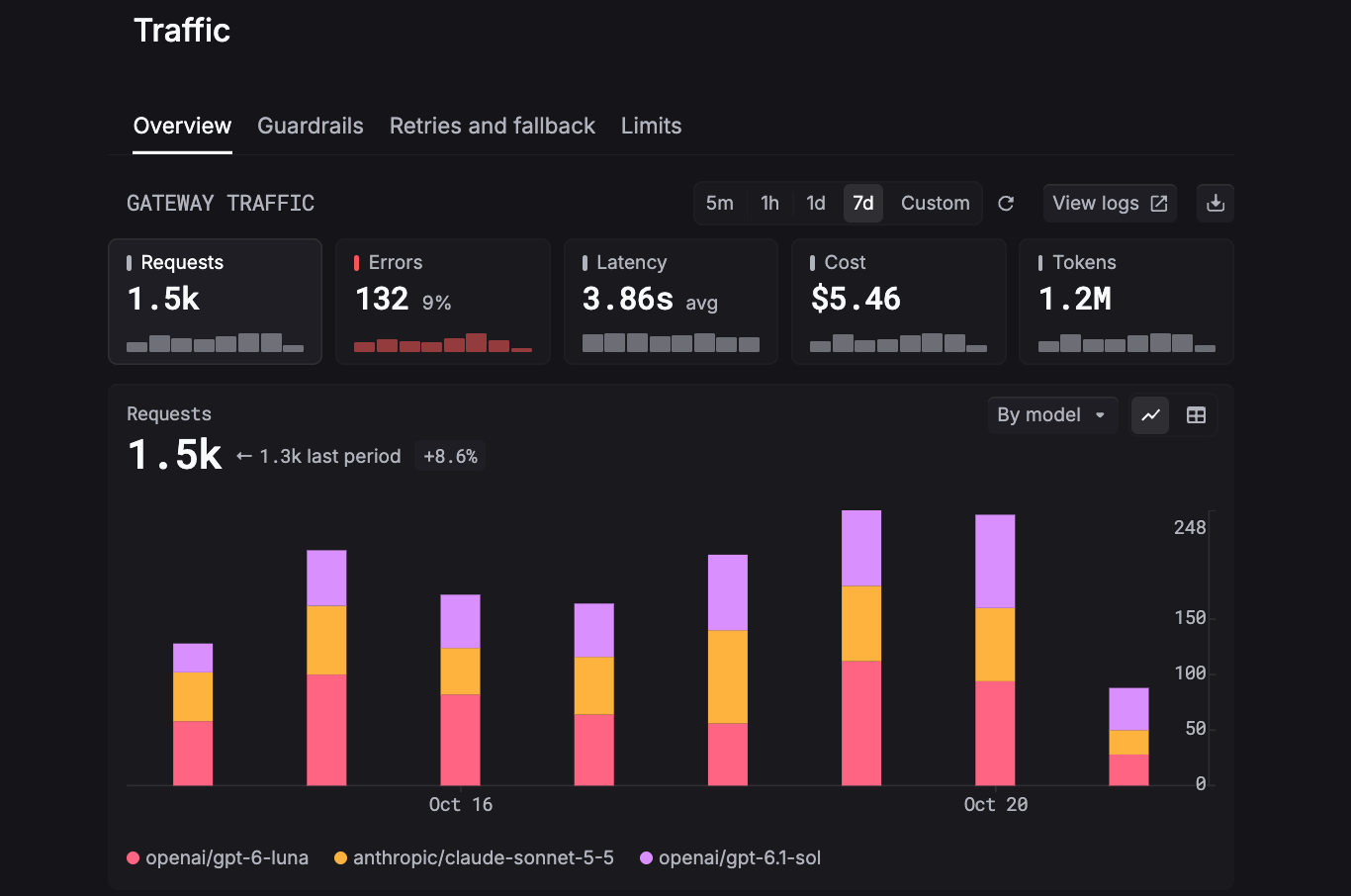
Instead of reading logs after the fact, you can use Respan to run observability in production, know when production shifts, and act before it spreads.
- One API for 1,000+ models - Route every model call through one OpenAI-compatible endpoint, with fallbacks when a provider fails.
- Traces without a second integration - Each LLM call, tool run, retrieval, and agent turn becomes a span in one trace, with its own input, output, latency, and cost.
- Routing that knows the task - Respan Router picks the model per task and weighs cache cost before switching, so a cheaper model doesn't end up costing more (beta).
- Evals that close the loop - A bad score in production becomes a dataset, an experiment, a prompt version, and a proven fix, with the trace attached at every step.
- Compliance built in - SOC 2, HIPAA with a BAA, GDPR, ISO 27001, PII masking, and the option to omit logs.
- Self-hosted routing - Start with the open-source gateway, which is still pre-alpha, on your own infrastructure. When you want every request traced, priced, and scored, turn on the Respan plugin to send them to the hosted platform.
Respan sits at the top of both the Langfuse alternatives and LangSmith alternatives rankings for that reason, and the Respan vs Langfuse and Respan vs LangSmith comparisons show how it differs from each one feature by feature.
Open source or managed? With Respan, you get both
Start with the open-source gateway on your own infrastructure. When you want every request traced, priced, and scored, turn on the Respan plugin to send them to the hosted platform.
Frequently asked questions
Neither is better across the board. Langfuse fits teams that want open source, self-hosting, and usage-based pricing without seat fees, while LangSmith fits teams on LangChain or LangGraph that want a managed platform. If you also need routing across many models, Respan combines a gateway for 1,000+ models with tracing and evals in one product.
LangSmith has a free Developer plan with one seat and 5,000 base traces a month, after which usage is pay as you go. The Plus plan costs $39 per seat per month. Respan can also be tried for free.
No. The LangSmith platform is closed source, and self-hosting it requires an Enterprise license. Langfuse, by contrast, publishes its core under the MIT license.
Yes, but only as an add-on to the Enterprise plan. LangChain delivers it to run on your own Kubernetes cluster in AWS, GCP, or Azure, so your data stays in your environment.
Yes. ClickHouse acquired Langfuse in January 2026, and both companies said there are no planned licensing changes. The core stays MIT-licensed and self-hostable, with a few add-on features requiring an enterprise license key.
No. LangSmith works with other frameworks and SDKs, and LangChain describes it as framework-agnostic. Its closest integration is still with LangChain and LangGraph.
It depends on how much control you need over model traffic. Both Langfuse and LangSmith now offer an LLM gateway in beta that logs calls as traces. Respan is built the other way around, as an AI router for 1,000+ models with observability and automated evals built in, so routing, fallbacks, tracing, and scoring run through one integration.