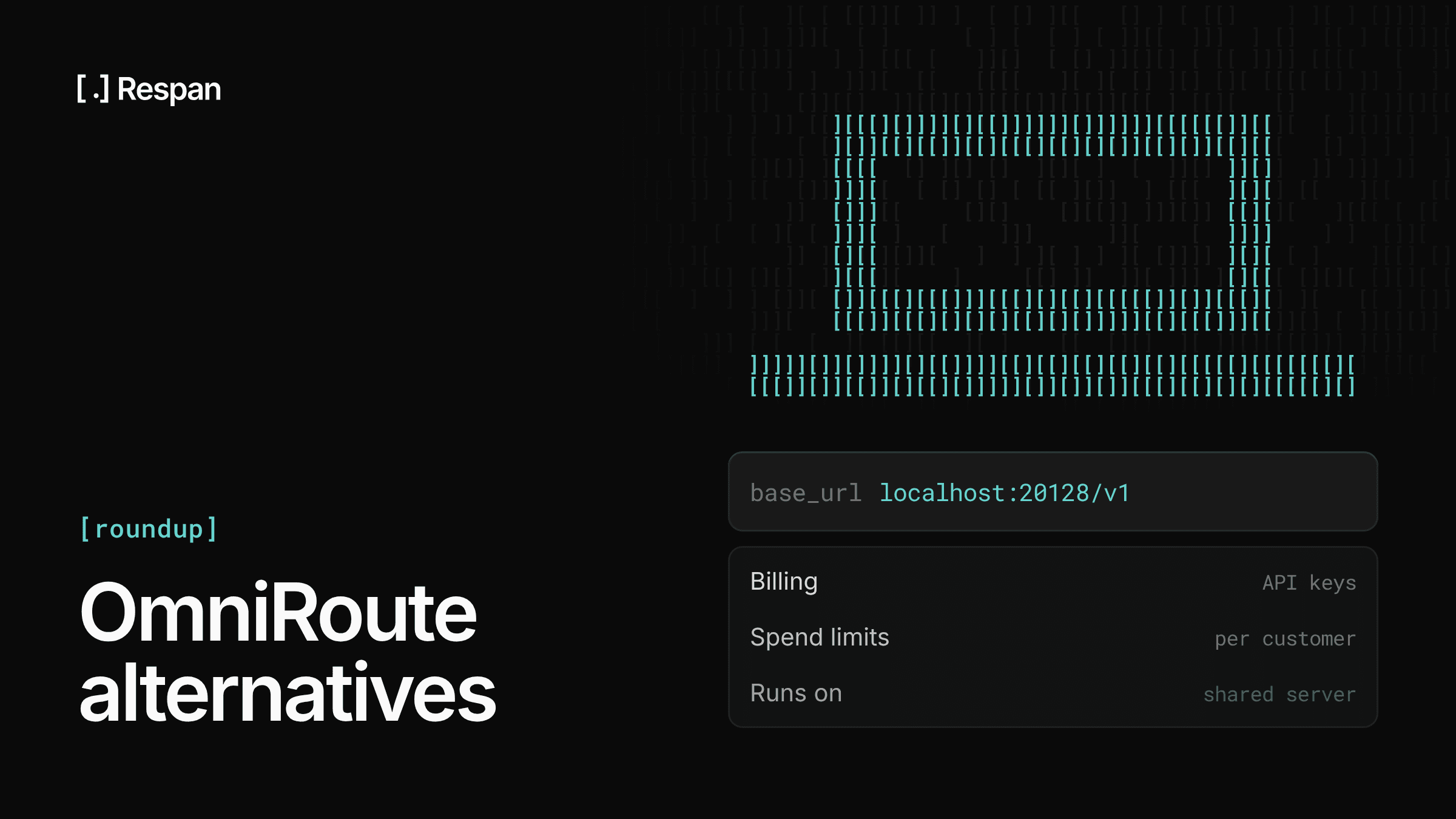
OmniRoute gives coding tools like Claude Code, Codex, and Cursor one local endpoint, then routes each request across the subscriptions, API keys, and free tiers you've connected. For one developer trying to keep an agent running without paying list price on every call, that setup works well.
An app that serves customers needs a different setup. That traffic has to run on API billing rather than personal subscriptions, behind keys and spend limits a team can share, through a gateway your whole team can reach that doesn't depend on one developer's machine.
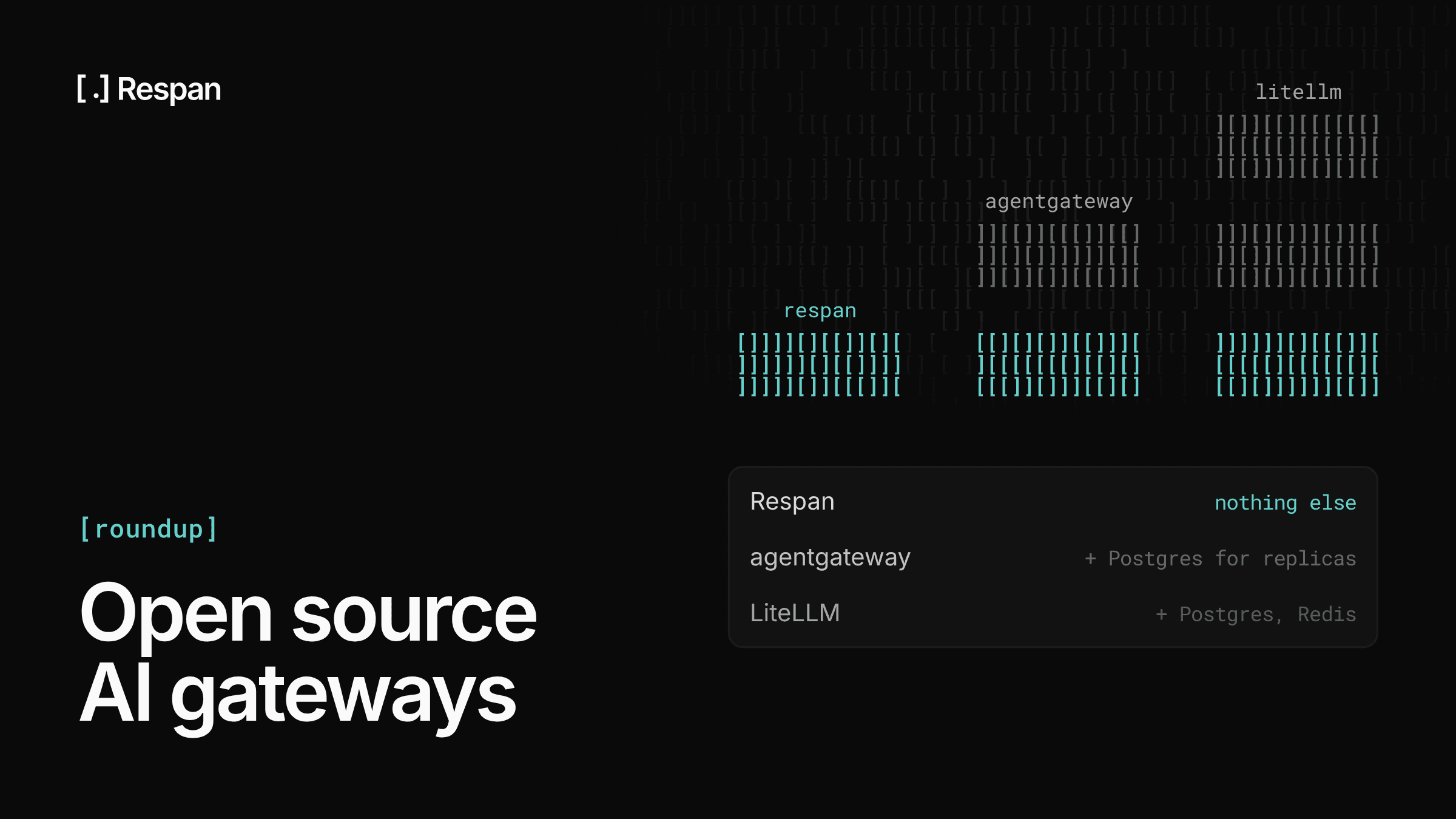
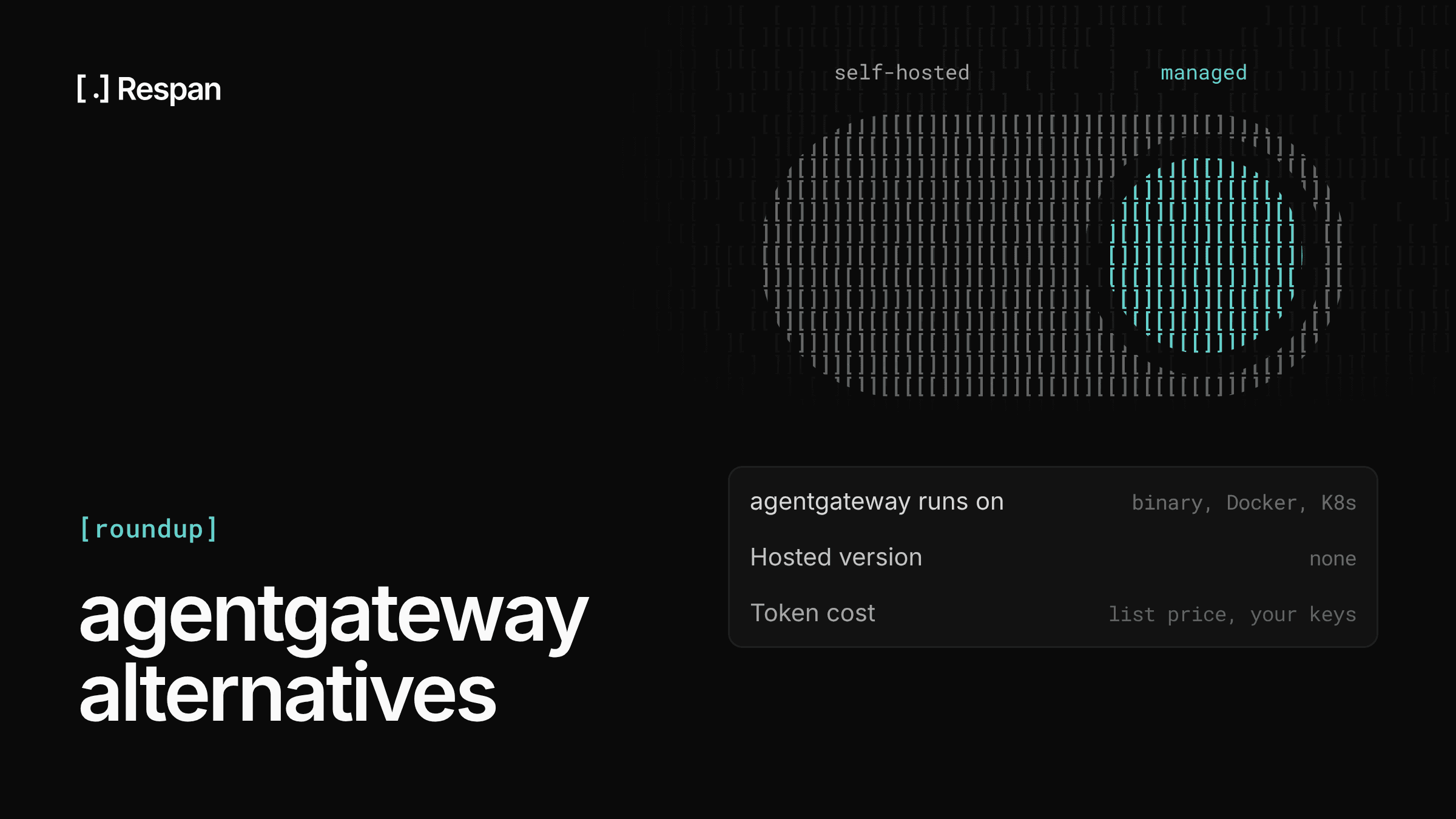
If you're serving customers and want one bill, look at managed gateways (Respan, OpenRouter, Portkey, Vercel AI Gateway). If traffic has to stay in your network, look at self-hosted ones (LiteLLM, Bifrost). If you're still one developer routing coding agents, look at other local proxies (9Router, RelayPlane).
Below are the top OmniRoute alternatives for production apps in 2026, compared on token price, fees, and where each one runs.
OmniRoute alternatives at a glance
Disclosure: Respan, which publishes this guide, makes one of the products below. We tried to place it only where it is a strong fit, and we list its limitations the same way we list everyone else's.
The order follows where each tool runs, from managed gateways to self-hosted ones to local proxies like OmniRoute itself, and within each group, what it does to your bill. Each entry says who it's best for.
| Tool | Best for | Token price | Fee or plan cost | Where it runs |
|---|---|---|---|---|
| Respan | Lower token costs, traced | Up to 55% off list | 0% fee; plans from $0 | Managed; gateway self-hostable |
| OpenRouter | One key, large catalog | Provider list price | 5.5% fee (8% Business) | Managed |
| Portkey | Governance and guardrails | Your provider rates | Free; Pro $49/mo | Managed; OSS gateway |
| Vercel AI Gateway | Hosted, no token markup | Provider list price | No markup; paid add-ons | Managed |
| LiteLLM | Self-hosted Python proxy | Your provider rates | Free OSS; Enterprise custom | Self-hosted |
| Bifrost | Self-hosted Go gateway | Your provider rates | Free OSS; Enterprise custom | Self-hosted |
| 9Router | Pooling coding subscriptions | Your accounts, free tiers | Free | Local |
| RelayPlane | Local spend caps for agents | Your provider rates | Free; hosted plans waitlisted | Local |
How we picked
The eight tools here come up most often in search results and AI answers for OmniRoute alternatives, are actively maintained, and route requests across more than one model provider. They're compared on these criteria, in this order:
- Token price - Provider list price, a discount, or whatever your own accounts and free tiers cost.
- Fees and plan cost - Percentage fees on credits, monthly plans, and paid add-ons.
- Where it runs - Managed, self-hosted on your own servers, or local on one machine.
- Who it's built for - Traffic from a production app, or one developer's coding tools.
Every price and plan limit was checked on the vendor's own pricing page, docs, or repository, linked in each entry. The one side-by-side speed run comes from the respan-gateway README:
| Gateway | Requests per second | Median added latency | Memory |
|---|---|---|---|
| Respan Gateway (open source) | 56,734 | 0.07 ms | 31 MB |
| Bifrost | 18,182 | 0.16 ms | 488 MB |
| Portkey | 4,187 | 0.17 ms | 350 MB |
| LiteLLM (1 worker) | 268 | 4.34 ms | 418 MB |
These are Respan-run benchmarks, and production LiteLLM deployments usually run more than one worker. OmniRoute, 9Router, RelayPlane, OpenRouter, and Vercel AI Gateway weren't part of the run, so test your shortlist on your own traffic before deciding on speed.
Pricing verified on November 25, 2026.
What is OmniRoute by Cheaper Inference?
OmniRoute is a free, MIT-licensed AI gateway that runs on your own machine and gives coding tools one OpenAI-compatible endpoint, by default http://localhost:20128/v1. You point Claude Code, Codex, Cursor, or Cline at it, and it sends each request to one of the providers you've connected, which its site puts at 352.
OmniRoute was created by Diego Souza and is now part of Cheaper Inference, which sells two things next to the open-source project. OmniRoute Cloud is a dedicated, managed OmniRoute instance with a monthly hosting fee that isn't published, and inference is billed separately. Cheaper Inference also runs its own hosted gateway, billed per token from a prepaid wallet at what the capacity costs it plus a margin it doesn't disclose, with each rate capped at the model maker's list price.
Like any LLM gateway, OmniRoute's core job is routing. You build "combos," chains of models that switch when quota runs out, a provider fails, or costs spike, and its fallback order runs from subscriptions to API keys to cheap models to free tiers. It also compresses eligible context, exposes MCP tools and A2A, and installs through npm, Docker, or a desktop app.
That fallback order is where OmniRoute stops fitting an app that serves customers, since Anthropic doesn't let third-party developers route requests through Claude Free, Pro, or Max credentials on behalf of their users. Anthropic's Claude Code docs reserve subscription sign-in for Claude Code and Anthropic's own apps, and OmniRoute itself excludes providers it marks tos: avoid from automatic routing by default.
Best OmniRoute alternatives
Respan
Best for: Teams that want to pay less per token on production traffic, with a fast gateway and every call traced.
The take: Respan (formerly Keywords AI) is an open-source AI gateway: one API for 1,000+ models, with every call traced in Respan. For teams moving off OmniRoute, the difference is how tokens are paid for, since Respan bills through prepaid credits with a 0% fee and passes bulk rates on, so tokens cost up to 55% less than list price. Rates differ by model and the larger discounts come with annual commitment, so check your model's current discount in Respan's model catalog before comparing.
Respan's open-source gateway adds 0.07 ms at p50 in Respan-run benchmarks, and the managed gateway adds 0.07 ms of median server-side overhead.
Moving an OmniRoute combo over means setting a fallback chain in Respan once, at the org level or per request, and Respan switches to the next model when one errors or rate-limits.
- Lower token prices - Up to 55% off list on Respan credits, varying by model, with a 0% fee on top.
- Stays up when a provider fails - Retries and load balancing across providers on top of your fallback chain, with a 99.99% uptime SLA on Team and Enterprise.
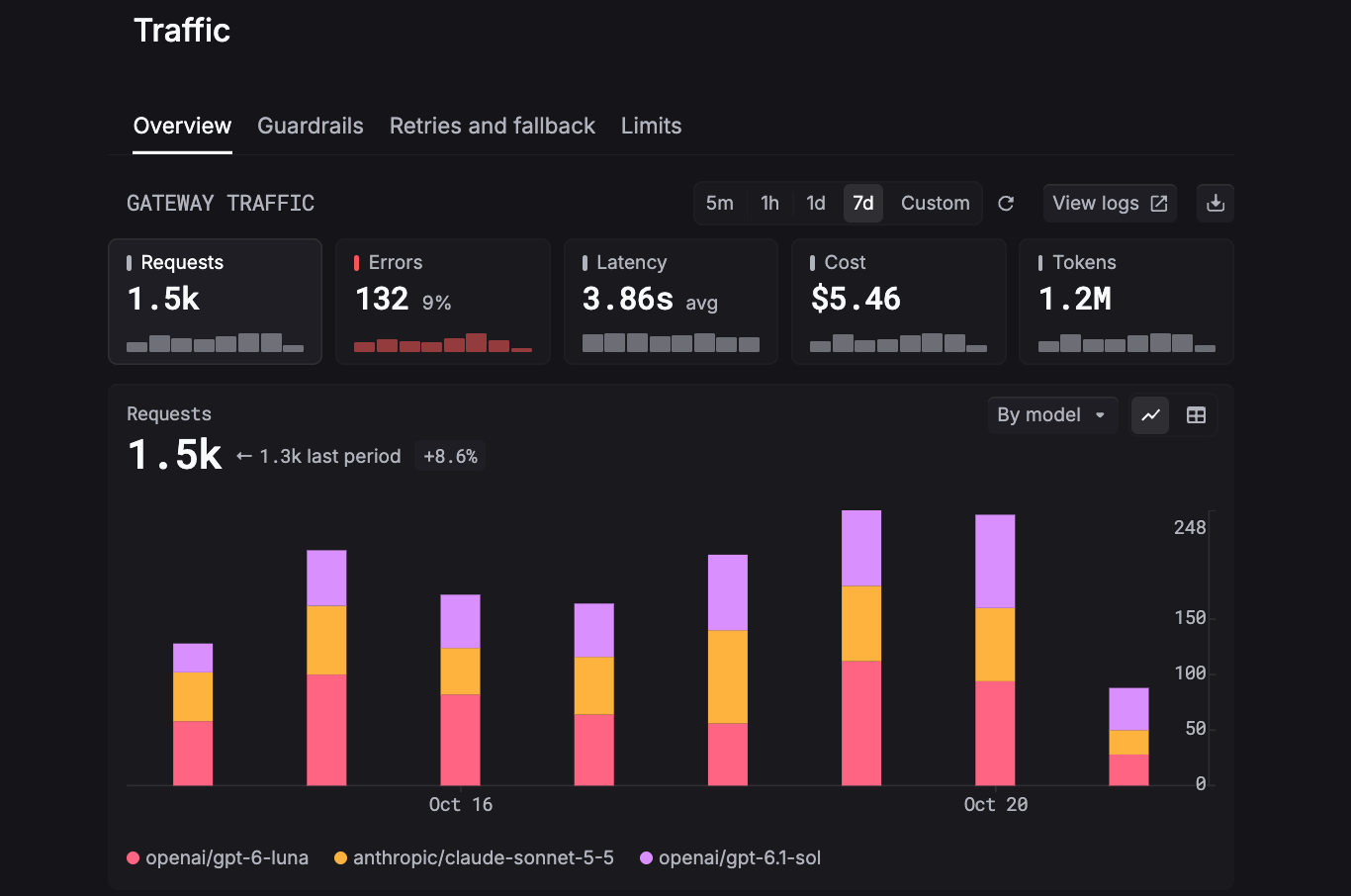
- Spend limits per customer - Soft and hard caps per key, per customer, or org-wide, with cost broken down by model, request, and end customer.
- Every call traced - Each request is recorded as a trace with its latency and cost, and scored on live traffic.
Self-host it: The gateway is a single open-source binary, dual-licensed MIT or Apache-2.0, that runs locally the way OmniRoute does, and its Respan plugin sends requests to the hosted platform when you want them traced.
- You want to keep running coding agents on Claude or ChatGPT subscriptions you already pay for. Respan bills tokens through Respan credits or, on Team and above, your own provider API keys.
- You want the whole Respan platform (dashboard, evals, prompts) on your own servers. That's Enterprise only, while the open-source gateway is free to self-host on any plan.
- You want the token discounts on your own provider keys. Respan's catalog discounts apply to Respan credits, not bring-your-own-key traffic.
Pricing: Free is $0 with 100k logs and 4,200 gateway requests a minute. Team is $199/month billed yearly ($249 monthly), adding bring-your-own-key support, 8,400 requests a minute, and the 99.99% SLA. Enterprise is custom and adds SAML SSO and the option to run the full platform on your own servers. Plan details are on Respan's pricing page, and gateway credits are bought separately, with each model's current discount listed in Respan's model catalog.
Pay-as-you-go discounts are smaller, and they grow with annual commitment, with spend across every provider counting toward one commitment.
OpenRouter
Best for: Teams that want one hosted key for a large model catalog without running anything.
The take: OpenRouter lists 600+ models from 80+ providers behind one OpenAI-compatible endpoint, with provider fallback built in, so moving off OmniRoute means trading a local process for a hosted one and pooled subscriptions for paid API access. Its cost sits in a platform fee on credits rather than in the token price, and since that fee grows with your bill, the OpenRouter alternatives comparison covers options without it.
- Your token bill is large and growing, since a 5.5% fee (8% on Business) scales with every dollar of spend.
- You need the gateway inside your own network.
Pricing: Standard carries a 5.5% platform fee and Business 8%, per OpenRouter's pricing. BYOK has no fee on the first $25,000 of list-price inference a month, then 5%, and Enterprise offers fee discounts rather than token discounts.
Portkey
Best for: Teams that want governance, guardrails, and load balancing in one managed gateway.
The take: Portkey is a governance-focused gateway with fallbacks, load balancing, guardrails, and an open-source version you can self-host. Palo Alto Networks acquired it in May 2026, and it's now sold as Prisma AIRS AI Gateway. Teams reassessing after that change can compare Portkey alternatives.
- You'll pass 3M requests a month on Pro, where overage stops.
- You need longer log retention on a lower tier, since Dev keeps 3 days and Pro 30.
Pricing: Dev is free with 10K requests a month. Pro is $49/month with 100K requests and $9 per additional 100K, per Portkey's plan comparison. Enterprise is custom, and its volume discounts lower the gateway bill rather than the token bill your provider sends.
Vercel AI Gateway
Best for: Teams that want a hosted gateway at provider list price with no token markup.
The take: If what you liked about OmniRoute was paying nothing on top of the model, Vercel AI Gateway charges no markup or platform fee on tokens, including on your own keys. Budgets and per-request zero data retention are included, and custom volume discounts are available on committed spend, so the costs to watch are the add-ons. Teams comparing hosted options can see Vercel AI Gateway alternatives.
- You need to self-host the gateway.
- You want team-wide data controls without per-request surcharges, since team-wide ZDR and provider allowlists each cost $0.10 per 1,000 requests.
Pricing: You pay provider list price through AI Gateway credits, per Vercel's pricing docs. Add-ons include regional hosting at 5% of inference cost and a per-request fee of $0.20 per 1,000 BYOK requests if you turn off fallback to Vercel's keys.
LiteLLM
Best for: Python teams that want a self-hosted proxy in front of 100+ providers.
The take: Built as a Python SDK and proxy, LiteLLM puts 100+ LLM providers behind one OpenAI-compatible API, by its own count, under an MIT-licensed core. Unlike OmniRoute, it's designed as shared infrastructure, so production deployments run PostgreSQL beside it and Redis once there's more than one instance.
The caveat is supply-chain risk, since compromised releases reached PyPI in March and October 2026, and the LiteLLM alternatives cover the replacements teams have moved to.
- You don't want to own a security-sensitive component, since running it safely means pinning versions, verifying signatures, and planning secret rotation.
- You need SSO, RBAC, or audit logs without an Enterprise license.
Pricing: The open-source proxy is free, so you pay provider rates plus the infrastructure it runs on. LiteLLM Enterprise is custom pricing, with a 30-day trial key.
Bifrost
Best for: Teams that want a fast self-hosted Go gateway with semantic caching.
The take: Maxim AI's Bifrost is an Apache 2.0 gateway written in Go that puts 23+ providers behind one OpenAI-compatible API, with failover and semantic caching. It placed second on throughput in the Respan-run benchmark above, and Maxim reports 11 µs of added overhead at 5,000 requests per second on its own t3.xlarge test setup, so if you're weighing it against similar self-hosted options, the Bifrost alternatives lay them out.
- You need high-availability clustering, guardrails, SSO, or MCP with federated auth without a sales contract, since Maxim sells those in Bifrost Enterprise.
- You don't want to run and scale the gateway yourself.
Pricing: Maxim lists the open-source build as free on Bifrost's pricing page, so your cost is provider rates plus infrastructure. Enterprise is custom pricing, with a 14-day trial.
9Router
Best for: Developers who want another local router for pooling coding subscriptions and free tiers.
The take: 9Router works much like OmniRoute: it's an MIT-licensed local router on the same default endpoint, localhost:20128/v1, that connects Claude Code, Codex, Cursor, and Cline to 40+ providers. It supports several accounts per provider with round-robin or priority routing, and falls back from subscriptions to cheap models to free tiers when an account runs out of quota. What it doesn't change is the setup itself, since it still runs on one machine against personal accounts.
- You're routing traffic from a production app, since subscription routing raises the same provider-terms questions it does with OmniRoute.
- You depend on free tiers staying put. Its README notes that iFlow, Qwen Code, and Gemini CLI tiers were discontinued or changed in 2026.
Pricing: Free, and its README says 9Router never charges. You pay the providers you connect, and the dashboard's cost figures are estimates rather than billing.
RelayPlane
Best for: Developers running agents locally who want spend caps and cost per run.
The take: Where OmniRoute focuses on keeping requests alive, RelayPlane focuses on what they cost. It's an MIT-licensed local proxy for Claude Code, Cursor, and OpenClaw that prices every call in a local SQLite ledger and maps requests to models by complexity tier. Daily, hourly, and per-request caps can block, downgrade, or alert, and circuit breakers fail over when a provider returns 429s, though the dollar figures are notional list prices that won't match your invoice.
- You want hosted team dashboards today, since its hosted plans are still waitlist only.
- You need a gateway in front of a production app rather than agent tools on developer machines.
Pricing: The proxy is free. Hosted Team at $49/month and Scale at $199/month are listed as early access on RelayPlane's pricing page, with a waitlist and no card required.
Recent changes
- Portkey joined Palo Alto Networks - The acquisition closed May 29, 2026, and Portkey now runs as Prisma AIRS AI Gateway.
- LiteLLM had compromised releases - Versions 1.82.7 and 1.82.8 in March 2026, and 1.107.0 in October.
- Respan open-sourced its gateway - respan-gateway launched in October 2026, dual-licensed MIT or Apache-2.0.
Gateways are being folded into larger companies, and self-hosted ones have become a supply-chain target.
How to choose an OmniRoute alternative
The decisions that are expensive to reverse come first:
- Subscriptions or API billing - If the traffic serves customers, put it on API keys or gateway credits, since consumer plans like Anthropic's assume ordinary, individual use.
- Managed or self-hosted - Self-host when data residency or a contract requires it, and the open source AI gateways comparison covers what each one takes to run.
- Price at next year's volume - A percentage fee on credits or a per-request add-on that looks small on a test bill grows with traffic.
- Spend limits per customer - Check that you can cap spend per key or per customer before a runaway agent loop finds the ceiling for you.
- Fallbacks across providers - Set them up on day one and test them, since one free tier or one personal account can't cover an outage.
Whichever you pick, keep your app on an OpenAI-compatible SDK so the next switch stays a base-URL change.
FAQ
Is OmniRoute free?
Yes, the software is free and MIT-licensed, but the models behind it aren't. You pay whatever the providers you connect charge, free tiers carry each provider's own limits and terms, and OmniRoute Cloud adds a monthly hosting fee that isn't published.
Is OmniRoute safe for a production app?
It can run one, but it was designed for one developer pooling subscriptions and free tiers on a local machine. Routing customer traffic through consumer subscriptions can run against provider terms such as Anthropic's, and free tiers can change without notice. For a production app, the main alternatives are a managed gateway like Respan, which gives one API key to 1,000+ models at up to 55% off tokens with a 0% fee, or a self-hosted team gateway like LiteLLM.
Is there a hosted version of OmniRoute?
Yes. OmniRoute Cloud is a dedicated, managed OmniRoute instance in a region you choose, with HTTPS, updates, and daily backups handled for you, and inference billed separately from its unpublished monthly hosting fee. If what you want from hosting is a gateway that's priced, traced, and spend-limited per customer, Respan runs managed, and OpenRouter and Vercel AI Gateway are hosted options too.
OmniRoute vs LiteLLM vs OpenRouter: which should you use?
OmniRoute suits one developer routing coding tools across their own accounts on a local machine. For a team, LiteLLM is the self-hosted proxy you run on your own infrastructure, while OpenRouter trades a 5.5% fee on credits for one hosted key to 600+ models. If the token bill is what you're optimizing, Respan is a hosted option with a 0% fee.