Coding assistants and agent frameworks have made it possible to get an AI agent working in a weekend. Getting that agent to hold up once real users depend on it takes far longer, and that gap is where a lot of build vs buy decisions go wrong.
Buying a finished agent skips most of that work, but it fits best when the agent does a job plenty of other companies also need done. When the agent is part of your product, a vendor's version won't know your tools, data, or edge cases, and you can end up building around it anyway.
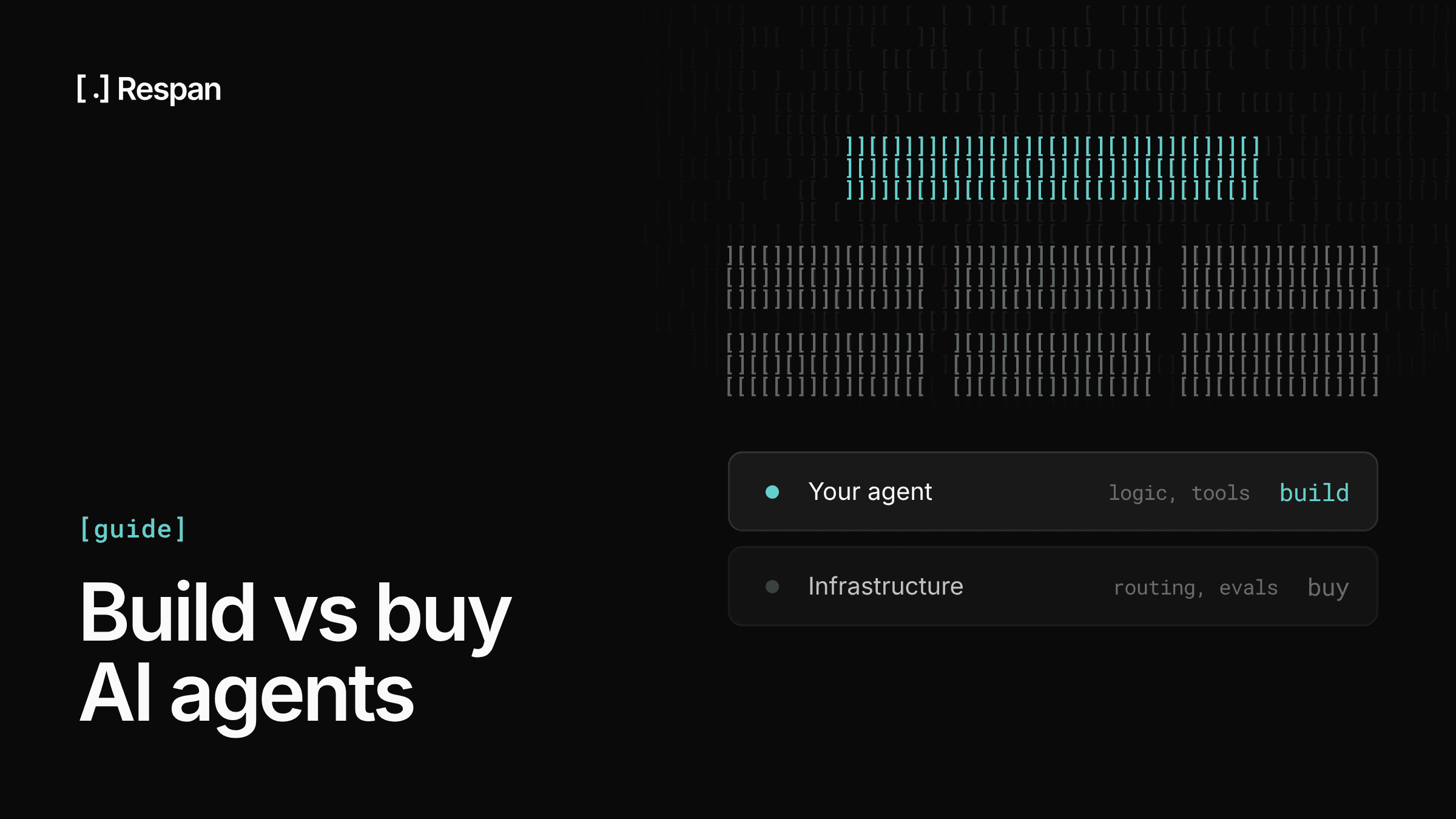
For most engineering teams, the more useful question is which parts to build. The agent's logic, tools, and prompts are worth your engineers' time. The routing, fallbacks, tracing, cost controls, and evals underneath it work much the same at every company, and they're where maintenance hours accumulate.
That makes build vs buy AI agents a decision engineering teams can make layer by layer, with the business case for each layer in view.
When to build AI agents
Building makes sense when the agent does something your company does differently from everyone else, since that's the part a vendor can't sell you. If you go this way, the hard part of learning how to build an AI agent is less the first working version and more what it takes to keep it running.
A few signs point toward building:
- The agent is the product - If customers pay for what the agent does, its behavior is your differentiator, and handing it to a vendor means competitors can buy the same thing.
- Your workflows don't exist anywhere else - Proprietary data, internal tools, and multi-step processes specific to your business are rarely covered by an off-the-shelf agent's integrations.
- The agent works across several systems - An agent that reads from your database, calls internal APIs, and writes back to a third system needs integration work a single-app vendor agent won't do for you.
- You need control over models and data - Building lets you choose a model per task, decide where prompts and outputs are stored, and answer your security team's questions directly instead of through a vendor's documentation.
What you take on in exchange is ownership. Once the agent ships, keeping it working is your team's job for as long as it's in production.
When to buy AI agents
Buying fits when the agent's job is one a lot of companies share, like answering common support questions, qualifying leads, or scheduling. Agent products such as Salesforce Agentforce already cover those jobs inside tools many teams run, and the vendor carries the maintenance.
Enterprises have been moving in that direction. Buyers purchased about 76% of AI use cases in 2025, up from 53% in 2024, according to Menlo Ventures' survey of 495 U.S. decision-makers. Separate research from MIT's NANDA initiative found that tools bought from specialized vendors succeeded about 67% of the time, while internal builds succeeded about a third as often, though that study covered generative AI broadly rather than agents specifically.
Buying is usually the better call when:
- The problem is already solved - If dozens of vendors sell an agent for the job, the core behavior is a commodity, and your engineers won't build a meaningfully better one.
- The agent lives inside one app - When the agent only acts inside a CRM or help desk you already pay for, the vendor's built-in agent has access a custom build would have to replicate.
- There's no spare AI engineering capacity - A custom agent needs engineers who can debug it after launch, on top of shipping it. If your team is already stretched, a vendor's agent gets the work done without pulling people off the roadmap.
- Speed matters more than differentiation - When the goal is value this quarter and the agent isn't a competitive advantage, a few weeks of configuration beats months of building.
What you give up is control. You work within the vendor's configuration options, model choices, and pricing, and moving off the product later can mean rebuilding from scratch.
What to ask yourself before you decide
Neither list settles the decision on its own, because many of the costs that decide it show up after launch. Before committing, answer these with the people who'll own the agent in production:
- Who maintains the agent after launch? - Prompts drift as models update, tools break as internal APIs change, and someone has to own the fixes. If nobody has that time budgeted, building turns into an unplanned commitment.
- What will it cost to run, not just to build? - Each agent run is a chain of model calls, so inference spend grows with traffic in a way upfront estimates tend to miss, and LLM cost optimization usually starts with sending simpler steps to cheaper models. Cost is also a common reason agent projects stall, since Gartner expects over 40% of agentic AI projects to be canceled by the end of 2027, with rising costs among the main reasons.
- What happens when a model provider goes down? - An agent that calls a single provider goes down with it. Fallbacks to a second model, retries, and rate-limit handling keep it up, and they're standard in LLM gateways, so they rarely need to be written from scratch.
- How will you know when output quality drops? - A prompt change or model update can make answers worse without moving latency or error rates. Catching that means scoring output on a test set before shipping and on live traffic after, which is the core of how teams evaluate AI agents in production.
- What does security and compliance need to sign off on? - Whoever owns the vendor decision will ask where prompts and outputs are stored, who can access them, and whether the setup meets SOC 2 or HIPAA requirements. A built agent needs an answer for each component, while a bought one needs the vendor's documentation and a contract.
- How hard is it to switch models or vendors later? - New models and price cuts arrive every few months. If model choices are hardcoded or tied to one vendor's platform, switching turns into a rewrite.
Several of these answers come back to the same layers: routing, fallbacks, tracing, cost tracking, and evals. That overlap is the reason to split the decision instead of making it once for the whole agent.
How to decide: build vs buy AI agents
Most agents end up partly built and partly bought, so the practical approach is to decide per layer.
Split the agent from the infrastructure under it
An agent has two kinds of parts. The first is what makes it yours: the logic that decides what to do next, the tools it calls, and the prompts that encode your domain. The second is the infrastructure any agent needs regardless of what it does, like sending calls to the right model, recovering from provider failures, and recording what happened on each run.
| Layer | Build or buy | Why |
|---|---|---|
| Agent logic and workflows | Build | It's your differentiator |
| Tools and integrations | Build | Tied to your systems |
| Prompts | Build | Encode your domain knowledge |
| Model routing | Buy or self-host | Same at every company |
| Fallbacks and retries | Buy or self-host | Tedious to maintain |
| Tracing | Buy | Hard to build well |
| Cost tracking and limits | Buy | Needs every request priced |
| Evals | Build criteria, buy tooling | Criteria are product-specific |
| Guardrails | Buy | Attack patterns are shared |
Prompts sit on the build side because the wording is yours, even if you manage versions in a separate tool. Evals split for a similar reason: what counts as a good answer is specific to your product, while running a scorer across thousands of outputs is not.
Build what's specific to your product
Spend engineering time where a user would notice the difference: how the agent plans, which tools it can call, what it does when a request falls outside policy, and when it hands off to a person. That code changes as your product changes, so keeping it in-house means those changes ship on your schedule.
Buy or self-host the layers every team needs
Routing, fallbacks, tracing, and cost tracking take real effort to build, and the effort continues after launch. Tracing alone means capturing each LLM call, tool run, and retrieval as a span, nesting them into one trace per run, and storing enough to debug a failure a week later, which is the scope a team takes on with an in-house agent tracing system. Buying gives you agent observability without carrying that maintenance yourself.
Self-hosting sits between the two. An open-source gateway on your own infrastructure keeps routing and provider keys inside your network, though your team is responsible for running and upgrading it.
Start hybrid and keep the decision reversible
A reversible setup is one where switching a model, a vendor, or an entire layer doesn't mean rewriting the agent. That applies on the buy side too, since Gartner predicts up to 70% of enterprises will abandon agentic AI built by vendor engineers by 2028, citing rising maintenance costs and teams that can't change systems they don't own.
Take a support agent for a B2B software product. A vendor's support agent could handle FAQ-style tickets, but this one issues account credits and changes settings through internal APIs, which puts it on the build side. The team writes the logic that decides whether to answer, look up the account, issue a credit, or escalate, along with the tools that call the billing API and ticketing system and the prompts that encode the refund policy.
Everything under that runs on bought or self-hosted infrastructure. Calls go through a gateway that sends classification steps to a smaller model and drafting to a frontier model, and falls back to a second provider when one rate-limits. Each run is traced with cost attached per customer, and evals score answers against past tickets before a prompt change ships, then sample live conversations after. If a better model comes out, switching is a config change, and if a tool in the infrastructure layer stops fitting, the agent logic stays the same.
How to run the agent infrastructure layer without building it
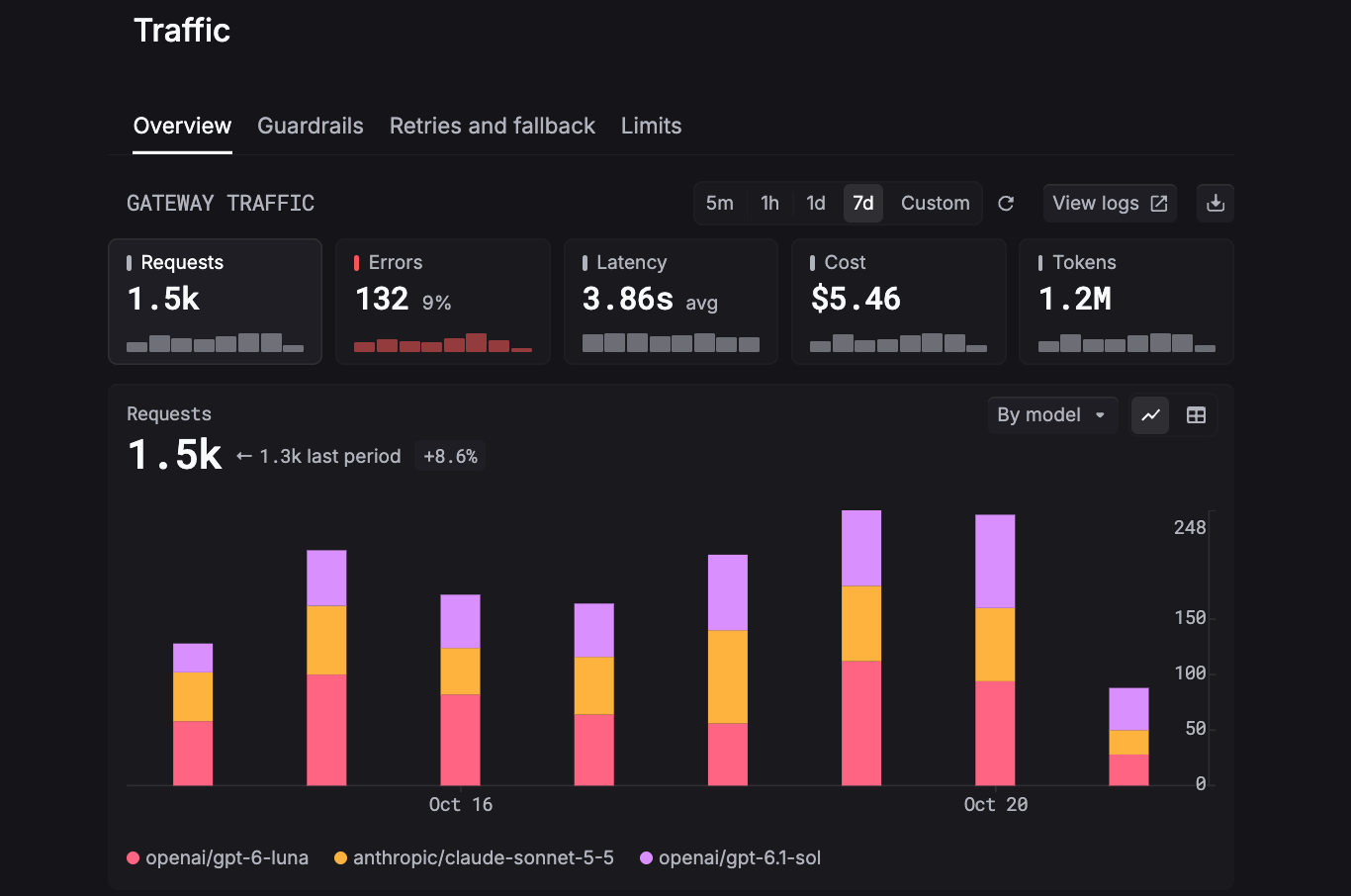
Respan is the AI gateway with built-in observability and evals, so the layers on the buy side of that table come from one platform instead of four separate tools. Route every model through one API, then trace, monitor, and evaluate every agent run, with each request priced and scored in the same place.
Because routing and tracing live in the same product, every request the gateway routes is already a trace, and a bad score in production links straight back to the run that produced it.
- One API for 1,000+ models - Switch models by changing a single word, without rewriting client code.
- Stay up when providers fail - List the models to fall back to once, and traffic moves to the next one when a provider errors or rate-limits.
- See what each agent run did - Every LLM call, tool run, and retrieval becomes a span in one trace, with its input, output, latency, and cost attached.
- Know where the money goes - Spend broken down by model, request, and end customer, with soft and hard limits per key, per customer, or org-wide.
- Catch regressions before users do - Evals score output on a test set before shipping and on sampled live traffic after, using LLM judges, code checks, or human review.
- Run the gateway yourself - Respan's open-source gateway, still early, is a single binary that lets any SDK call any model, with routing, fallbacks, and MCP turned on in one config file. When you want every request traced, priced, and scored, turn on the Respan plugin to send them to the hosted platform.
- Compliance - SOC 2 Type II, HIPAA with a BAA, and GDPR.
That leaves your engineers on the agent logic, tools, and prompts, the part of the stack your team is best placed to write.
FAQ
Is it cheaper to build or buy an AI agent?
It depends on where the cost lands. Building puts most of it in engineering time, and median pay for software developers was $135,980 in May 2025, before benefits, maintenance, or inference spend. Buying moves the cost to per-use pricing that grows with volume; Intercom, for example, prices its Fin agent from $0.99 per outcome. For many engineering teams the cheaper path is building the agent and buying the infrastructure, since the infrastructure is where ongoing engineering hours go. Respan covers that layer and has a free plan to start on.
How long does it take to build an AI agent?
A working prototype can come together in days with a modern framework, but production takes much longer. In a survey published in May 2024, Gartner found AI projects took about eight months on average to go from prototype to production, and fewer than half got there. Buying a finished agent for a narrow job shortens that, while building on bought infrastructure cuts the time spent on routing, logging, and evals. Respan sets those up behind an OpenAI-compatible endpoint, so they're in place from the first request.
Can you customize an AI agent you buy?
Within limits. Agent products typically let you configure knowledge sources, workflows, tone, and integrations, but the underlying logic and model choice usually stay under the vendor's control. If you find yourself needing to change those, that's a sign the agent belongs on the build side.
Is building on an agent framework building or buying?
It's building. A framework like LangGraph or the OpenAI Agents SDK supplies orchestration primitives such as state, tool calling, and handoffs, but your team still writes the agent's logic, tools, and prompts and owns them after launch. Picking among AI agent frameworks is a decision about which foundation to build on, and you still decide separately where the model calls are routed, traced, and evaluated.
What is a hybrid approach to building AI agents?
A hybrid approach buys finished agents for jobs many companies share, builds the agents that are part of your product, and runs the built ones on bought or self-hosted infrastructure. Many teams end up here because they have both kinds of agents.
Which parts of an AI agent stack should you buy?
The infrastructure layers: model routing, fallbacks and retries, tracing, cost tracking and limits, and eval tooling. They work the same way regardless of what the agent does, and they take ongoing engineering time to maintain. Respan covers them in one platform, with an open-source gateway for teams that want to run routing themselves.