

Span-01
Span-01
A reasoning classifier for agent traces. Span-01 applies behavior definitions it has never seen and returns probabilities in one forward pass.
Span-01 is Respan’s first-party classification model. It reads a trace and a set of behavior definitions written in plain language. For each definition, it returns the probability that the behavior is present, absent, or not observable in the trace.
You define the behaviors. Prompt injection, hallucination, secrets exposure, agent loops, tool misuse, and user frustration are all definitions you write, not categories built into the model.
Span-01 scores text. Each message’s content is a string.
The user expresses frustration or anger.
The customer describes a repeated problem with a late order.
In the example, the complaint and apology match their definitions. The span ends with the assistant’s reply, before the customer can say whether the problem is solved. Select Customer acceptance to see how Span-01 reports insufficient evidence.
How it differs from an LLM judge
Like an LLM, Span-01 understands natural language. Unlike an LLM judge, it doesn’t generate an answer. It returns probabilities directly.
For each behavior, the three probabilities sum to about 1. p_not_observable means the trace can’t answer the question. For example, if the trace ends at the assistant’s reply, it can’t show whether the customer accepted a fix. Treat that result as “unknown”, not as “absent”.
Architecture
Reason first, classify once
The hard part of classification isn’t returning a label. It’s applying a definition the model has never seen to context it has never encountered. Span-01 is trained for general classification reasoning with RLAIF, then specialized for behavior detection. As a result, it executes new definitions in new domains instead of matching a fixed taxonomy.
Hyper-parallel definition branches
Every definition in a request runs as its own branch over the same trace context. All behaviors are scored in one pass, so adding a behavior doesn’t add a generation step. There’s no per-request limit on the number of behaviors.
Hybrid attention
Production traces are long. Hybrid attention preserves the model’s reasoning across long, complex traces.
No generation
Span-01 doesn’t produce tokens, write explanations, or return free-form text. The only output is a set of probabilities per behavior, and output is free.
Where it fits
Span-01 is one step inside a larger system. For a support agent, your application can:
- Capture the turn to judge in
span.output, with the preceding messages inspan.input. - Score several behaviors in one request, such as escalation, user frustration, and prompt injection in tool output.
- Combine the probabilities with thresholds and rules in code: hand off to a human, block the reply, raise an alert, or log the result.
- Send uncertain cases, such as a high
p_not_observableor a borderlinep_present, to human review or a frontier model.
Choose thresholds using conversations you’ve labeled. In the Respan platform, Span-01 powers Behaviors on your traces.
Benchmarks
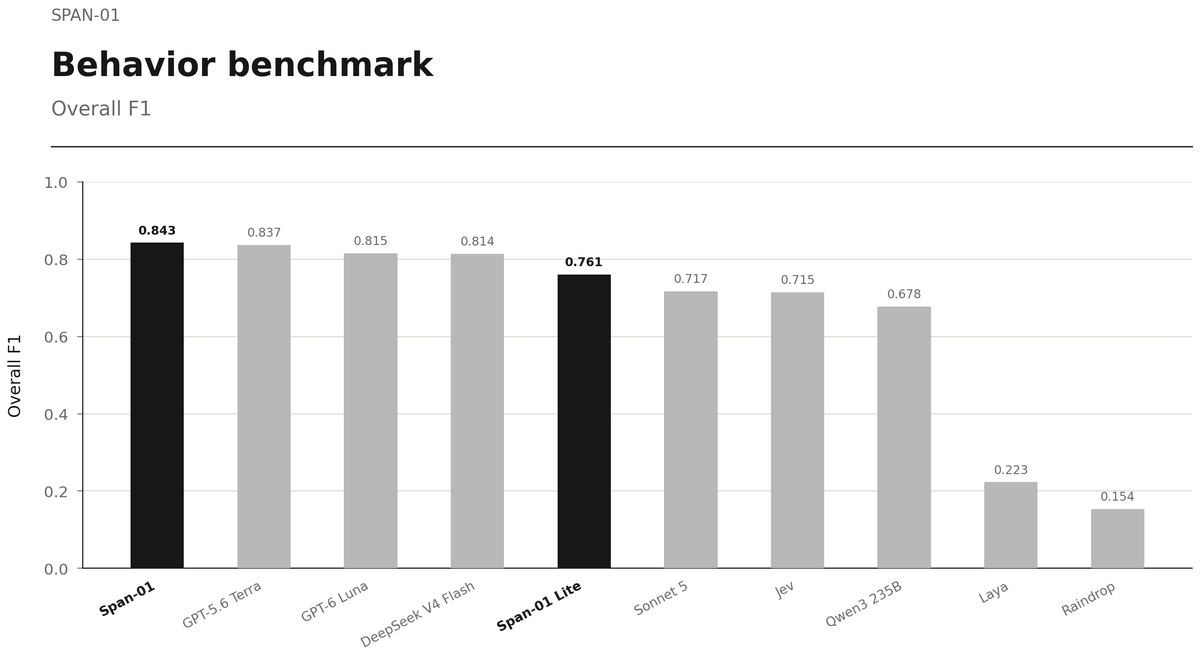
Behavior benchmark
Span-01 ranks first overall on English and multilingual behavior detection. Span-01 Lite outperforms Jev and Sonnet 5.
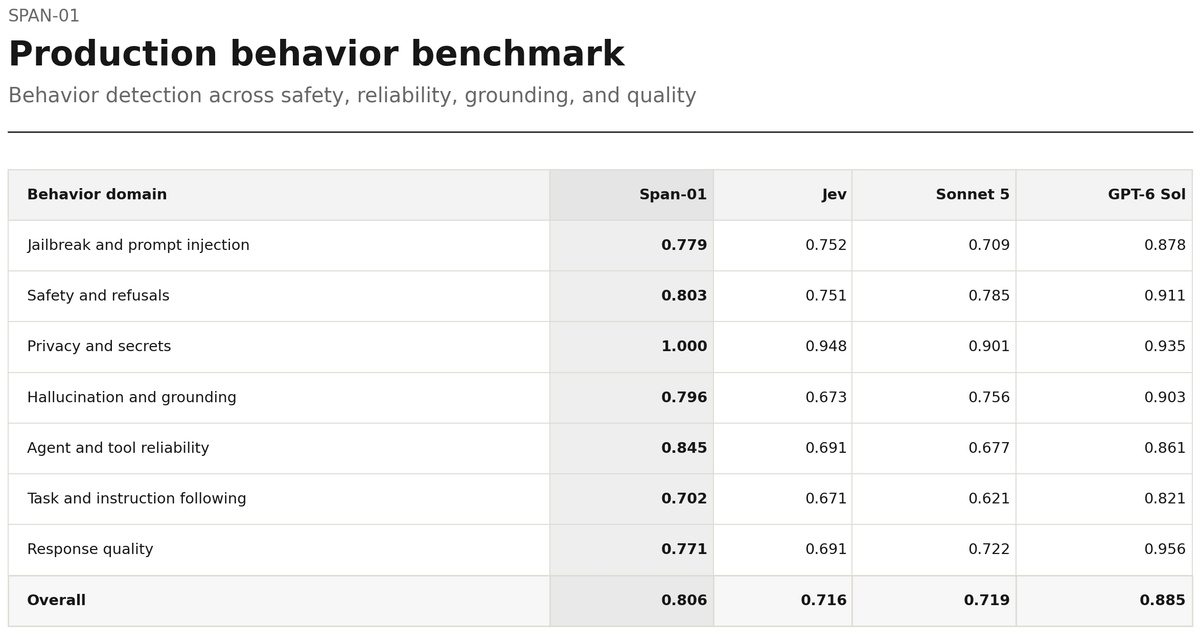
Production behavior benchmark
Aggregate scores can hide the behaviors that matter in production, so this benchmark reports each domain separately. Span-01 outperforms Jev and Sonnet 5 overall. A full frontier model (GPT-6 Sol) remains the ceiling.
Quality vs. cost
Span-01 and Span-01 Lite form the Pareto frontier. Span-01 Lite is free. Span-01 matches the quality of frontier models that cost up to 700× more per token.
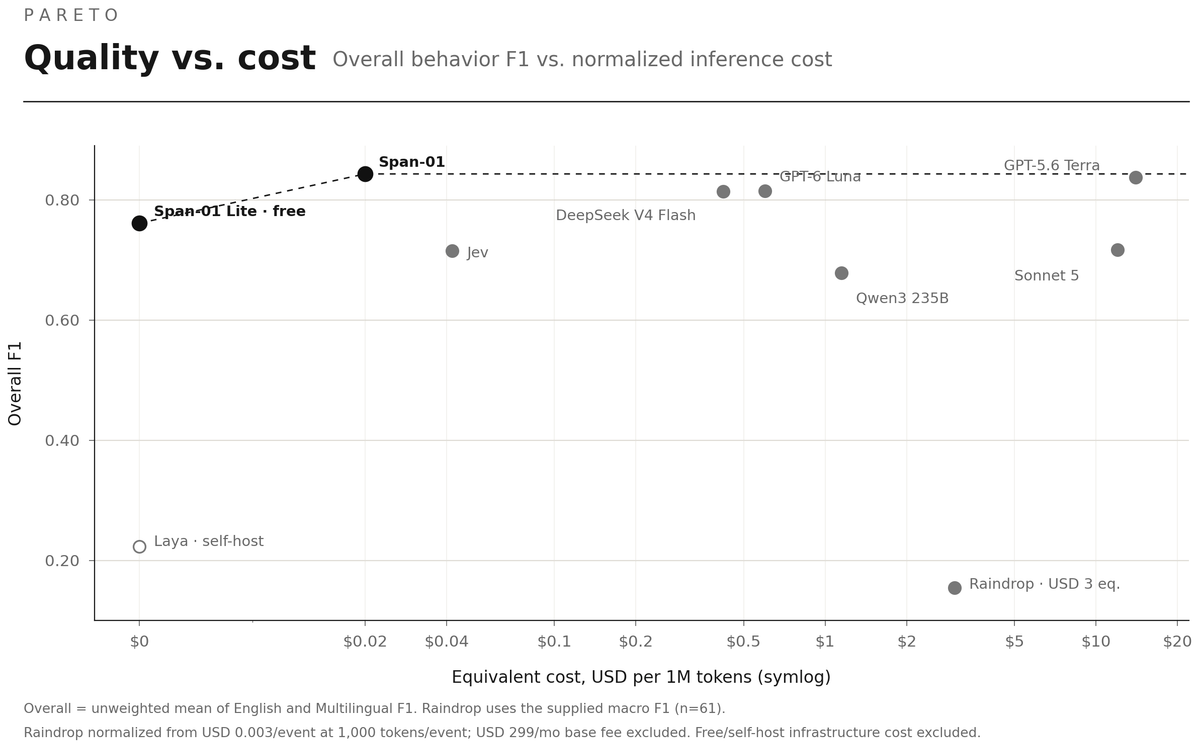
Raindrop uses the supplied macro F1 (n=61), normalized from 0.003/event at 1,000 tokens/event; the 299/month base fee is excluded. Free and self-hosted infrastructure costs are excluded.
The benchmark dataset is available on Hugging Face. See the launch post for the full methodology.
Models and pricing
- Input tokens: the trace plus all behavior definitions, reported as
usage.input_tokens. - Span-01 Lite: has a daily cap that resets at 00:00 UTC.
- Span-01: requires Respan credits.
Call Span-01
Send a trace and its behavior definitions to POST /api/v1/scores, and select a model with the model field.
Span-01 is in early access. Join the waitlist from the launch post. Until access is enabled for your organization, the API returns 403.